
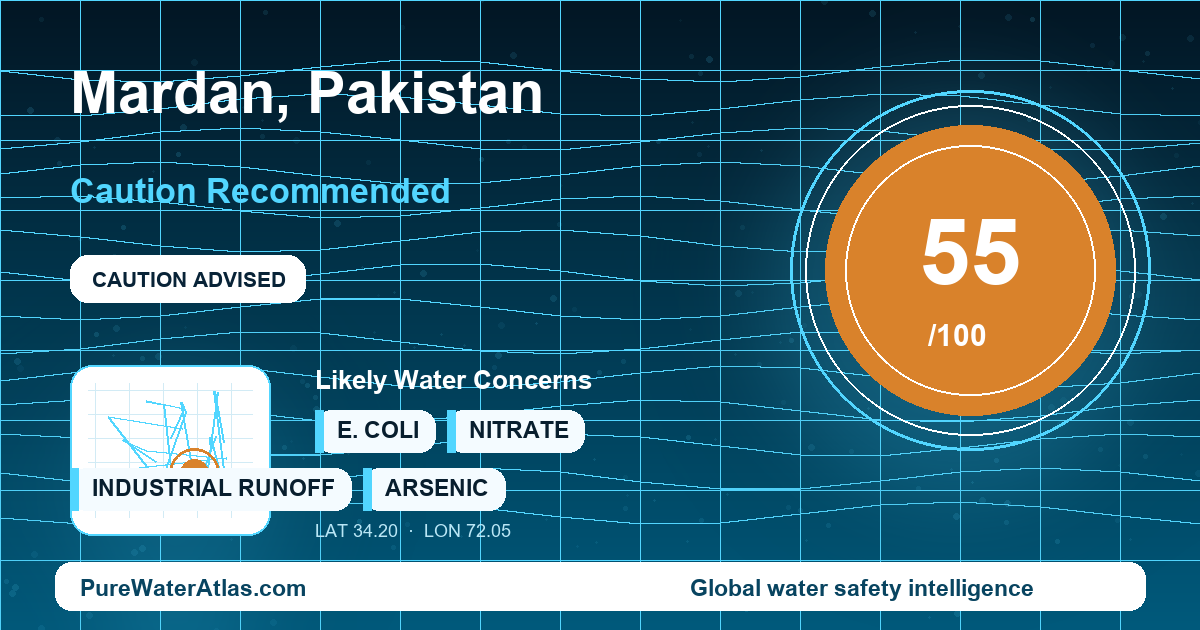
Mardan, Pakistan: groundwater-based municipal supply, intermittent-distribution risks, household storage concerns, and practical drinking-water precautions for visitors and residents.
Quick Answer
| Overall tap-water status | Caution recommended. Mardan’s water safety score is 55/100. Untreated tap water should not be assumed safe at every tap because public, recent, neighborhood-level compliance data are limited. |
|---|---|
| Traveler advice | Visitors should use sealed bottled water, freshly boiled water, or water treated by a reliable purifier. Tap water may be acceptable for washing hands and showering, but avoid swallowing it unless treated. |
| Resident advice | Residents should treat quality as locally variable. Disinfect or filter drinking water at the point of use, maintain rooftop and underground tanks, and test private boreholes or hand pumps. |
| Main water source | Predominantly groundwater from municipal tube wells and boreholes connected to pumping, storage, and piped distribution networks. |
| Local authority | Water and Sanitation Services Company Mardan, commonly known as WSSC Mardan or WSSCM. |
| Filter recommendation | A practical home barrier is sediment prefiltration plus disinfection by boiling, UV, or chlorination. RO may be useful for high TDS, nitrate, or arsenic only when testing supports it. |
Why Mardan Is Different
Mardan is a major city in Khyber Pakhtunkhwa’s Peshawar Valley, an irrigated agricultural region influenced by the Swat River canal system and local drainage channels such as the Kalpani stream. That setting makes groundwater an important urban water resource, but it also means shallow groundwater, local drains, and poorly protected wells can be exposed to pressure from agriculture, sewage, septic influences, and urban runoff.
The most important point for Mardan is that water quality can change between the source and the glass. Municipal groundwater drawn from tube wells may be relatively clear at abstraction, but the final water consumed in a home can be affected by intermittent pressure, aging or leaking pipes, nearby sewerage, storage reservoirs, rooftop tanks, underground tanks, and household plumbing. This is why a single citywide answer is not reliable for every neighborhood or household.
Mardan has also grown as an urban and district center. Expansion of housing colonies, roadside commercial areas, and peri-urban settlements can outpace upgrades to water, sewerage, and drainage systems. In that context, the practical safety question is not only “municipal water or bottled water?” It is whether the water actually consumed has passed through a clean tank, a maintained filter, a working UV unit, or proper boiling before use.
Where Does Mardan’s Tap Water Come From?
Mardan’s urban drinking water supply is understood to be predominantly groundwater-based. Municipal tube wells and boreholes draw from the Peshawar Valley groundwater system, after which water is moved through pumping stations, storage facilities where present, and the city’s distribution network. Surface canals and drainage channels are important local water features for irrigation and drainage, but they are not documented as the primary treated tap-water source for the city.
Key local infrastructure includes municipal tube wells and boreholes, pumping stations, distribution mains, overhead or ground-level storage reservoirs, and the last-mile plumbing and tanks inside homes and buildings. Household rooftop and underground tanks are especially important in Mardan because stored water can become contaminated even when source groundwater is visually clear.
Historically, many households in and around Mardan have also used private boreholes, hand pumps, shallow wells, and stored water, particularly where piped coverage or pressure is inconsistent. This mixed water-use environment means two nearby households may have different risk profiles: one may receive WSSC Mardan supply through a storage tank, while another may rely on a private borehole or hand pump with different nitrate, microbial, TDS, hardness, iron, or arsenic results.
Who Manages Drinking Water in Mardan?
The main urban water supply and sanitation service provider for Mardan city is Water and Sanitation Services Company Mardan, commonly called WSSC Mardan or WSSCM. Broader local government oversight sits within Khyber Pakhtunkhwa’s local government framework, including the Local Government, Elections and Rural Development Department, Khyber Pakhtunkhwa.
Pakistan’s National Standards for Drinking Water Quality provide the main national benchmark for drinking water parameters. Pakistan EPA, provincial environmental authorities, health departments, and local governments share relevant oversight roles. International interpretation can also be informed by the WHO Guidelines for Drinking-water Quality.
A key limitation for consumers is transparency at the tap level. Public information is sufficient to identify Mardan’s utility context and groundwater-based supply model, but recent, routine, neighborhood-level results for residual chlorine, E. coli, nitrate, arsenic, TDS, or turbidity are not available in a transparent public dashboard. This page therefore avoids claiming that all taps are safe or unsafe and instead focuses on verified system context and practical risk-reduction steps.
Main Local Water Concerns
- Microbial contamination: The most practical concern is contamination from intermittent supply, pressure drops, leaking distribution lines, nearby sewerage, and household storage tanks. These pathways are closely related to E. coli and total coliform risk.
- Turbidity and sediment: Cloudy or muddy water can occur after pipe repairs, pump changes, tank cleaning, monsoon runoff, or other distribution disturbance. Learn more about turbidity and why cloudy water can interfere with disinfection.
- Nitrate in private groundwater: Shallow private wells or poorly protected boreholes may be vulnerable in an agricultural and densely settled valley where fertilizer, wastewater, and septic influences exist. See nitrate for health and testing context.
- Hardness and TDS: Groundwater can vary in taste, hardness, and total dissolved solids. These issues may cause scaling or poor taste even when they are not always an acute health risk.
- Iron or manganese staining: Some groundwater systems can produce staining, metallic taste, or sediment. Public data are not sufficient to map this reliably across Mardan, but iron is a useful reference for affected homes.
- Arsenic screening: There is not enough public evidence to claim a uniform citywide arsenic problem in Mardan. However, arsenic should not be ignored for private groundwater users in Pakistan.
Season matters. Monsoon rainfall can move sewage, drain water, and surface runoff toward shallow wells, damaged pipes, or poorly sealed boreholes. Flooding or standing water around pumps, hand pumps, and underground tanks should trigger disinfection and testing. Hot weather can also increase household storage time and biofilm growth in tanks, pipes, and dispensers.
For Travelers
Travelers should not rely on untreated tap water as their default drinking water in Mardan. The recommended options are sealed bottled water from a reputable source, freshly boiled water, or water treated by a reliable purifier. This advice reflects limited public compliance data and common microbial risks in intermittent piped and stored-water systems, not proof that every tap in Mardan is unsafe.
Use bottled, boiled, or filtered water for brushing teeth, especially for short-term visitors, children, pregnant travelers, and anyone with a sensitive stomach. If only tap water is available, avoid swallowing it. Tap water is generally less concerning for showering and handwashing, but drinking it untreated carries more risk.
Avoid ice unless you know it was made from treated water. Ice from street vendors or small shops can carry the same microbial risk as untreated stored water. In hotels and restaurants, prefer sealed bottled water or ask whether water used for juices, chutneys, salads, and ice is treated by a maintained filtration, UV, or RO system. Hot tea and freshly boiled drinks are generally lower risk than cold mixed drinks.
Carry sealed water during local travel, check bottle caps for tampering, and use oral rehydration salts if diarrhea occurs. Boiling is the simplest emergency method for microbial safety: bring water to a rolling boil and store it in a clean, covered container. Boiling does not remove dissolved chemicals such as nitrate, arsenic, or salts. For details, see Boiling Water Purification: Complete Guide.
For Residents
Mardan residents should treat tap-water safety as a household-specific issue. If connected to WSSC Mardan supply, test and treat water at the point of use, not only at the incoming line, because household tanks and internal plumbing can change water quality. A practical drinking and cooking setup is sediment prefiltration followed by disinfection through boiling, UV, or chlorination. For UV, prefiltration matters because cloudy water can reduce effectiveness; see UV Water Purification: Complete Guide.
Reverse osmosis can help with high TDS, nitrate, and arsenic, but it should be selected based on laboratory results and maintained carefully. RO is not automatically the right solution for every Mardan home; a neglected RO unit or dirty storage tank can create new problems. Households using private boreholes or hand pumps should test for E. coli or total coliform, nitrate, TDS, electrical conductivity, hardness, pH, iron, manganese, and arsenic before using the source as the main drinking water.
Retest after flooding, nearby sewer overflow, borehole repair, pump replacement, unexplained taste or odor changes, or repeated stomach illness in the household. If infants, pregnant people, elderly residents, or immunocompromised people use the water, prioritize microbial testing and nitrate testing. Older buildings may contribute rust, sediment, and possibly metals from fittings, solder, or pipes; see lead and Lead in Drinking Water: Testing and Detection Methods for plumbing-related concerns.
Rooftop and underground tanks are a major control point in Mardan. Tanks should be covered, screened against insects and rodents, cleaned and disinfected on a schedule, and protected from sewage seepage or roof runoff. If a tank has sludge, odor, insects, algal growth, or flood contact, treat the water as unsafe until the tank has been cleaned and disinfected.
Relevant Contaminants and Water-Quality Issues
The most relevant Mardan contaminant categories are microbial indicators, sediment, groundwater chemistry, and plumbing-related metals. Start with E. coli for sewage intrusion and storage-tank risk, then review turbidity if water becomes cloudy after repairs, monsoon runoff, or tank disturbance. For private groundwater, nitrate is important because agricultural and densely settled valley conditions can affect shallow wells and poorly protected boreholes.
Private borehole users should also understand arsenic, even though public evidence does not support claiming a uniform Mardan citywide arsenic problem. Iron is relevant for staining, metallic taste, and sediment. Lead is most relevant to older internal plumbing and fittings rather than a confirmed citywide source-water issue.
How to Verify Your Water Quality
The safest way to answer “Is my Mardan tap water safe?” is to test the water actually used for drinking. Collect a sample from the kitchen tap after the household tank and plumbing, not only from the utility connection. For private boreholes and hand pumps, test before relying on the source and repeat testing after floods, repairs, or major taste and odor changes.
Use an accredited or government-recognized laboratory where possible, and compare results with Pakistan’s National Standards for Drinking Water Quality or WHO guideline values where national values are not available. For step-by-step help, use PureWaterAtlas resources on Water Testing, Drinking Water Safety, Water Microbiology, Water Treatment Systems, and Water Contamination.
To interpret specific lab parameters, use the Contaminants Search Engine. To compare Mardan with other destinations, use the Global Water Quality Checker. For deeper groundwater screening topics, see Nitrate Contamination in Drinking Water: Testing and Detection Methods and Arsenic in Drinking Water: Testing and Detection Methods.
Official and Technical Sources
- Water and Sanitation Services Company Mardan official website — used to identify the local urban water and sanitation service provider.
- Khyber Pakhtunkhwa Cities Improvement Project, Asian Development Bank — urban water, sanitation, and municipal infrastructure context for Khyber Pakhtunkhwa cities including Mardan.
- National Standards for Drinking Water Quality, Pakistan Environmental Protection Agency and Government of Pakistan — national drinking-water benchmark context.
- Pakistan Council of Research in Water Resources — national water-quality research context.
- PCRWR water quality reports page — reference point for national and regional reporting; routine Mardan tap-level results remain limited in public access.
- WHO Guidelines for Drinking-water Quality — international health-based guidance for microbial and chemical interpretation.
- WHO/UNICEF Joint Monitoring Programme data for Pakistan — national context on water service levels and the difference between improved access and safely managed water.
- Local Government, Elections and Rural Development Department, Khyber Pakhtunkhwa — provincial local government context for service delivery and municipal institutions.
Bottom Line
Mardan’s tap water should be approached with caution, not panic. The city’s urban supply is mainly groundwater from municipal tube wells and boreholes managed through WSSC Mardan, but public neighborhood-level water-quality results are limited. The main practical risks are microbial contamination from intermittent pressure, leaking lines, nearby sewerage, and household storage tanks, plus variable groundwater chemistry in private wells and boreholes. Visitors should use sealed bottled, boiled, or reliably filtered water for drinking and brushing teeth. Residents should maintain tanks, disinfect or filter drinking water at the point of use, and test private groundwater for bacteria, nitrate, TDS, hardness, iron, manganese, and arsenic before relying on it.
Read the full guide: Global Water Quality Guide
Explore more in this category: Global Water Quality Articles