
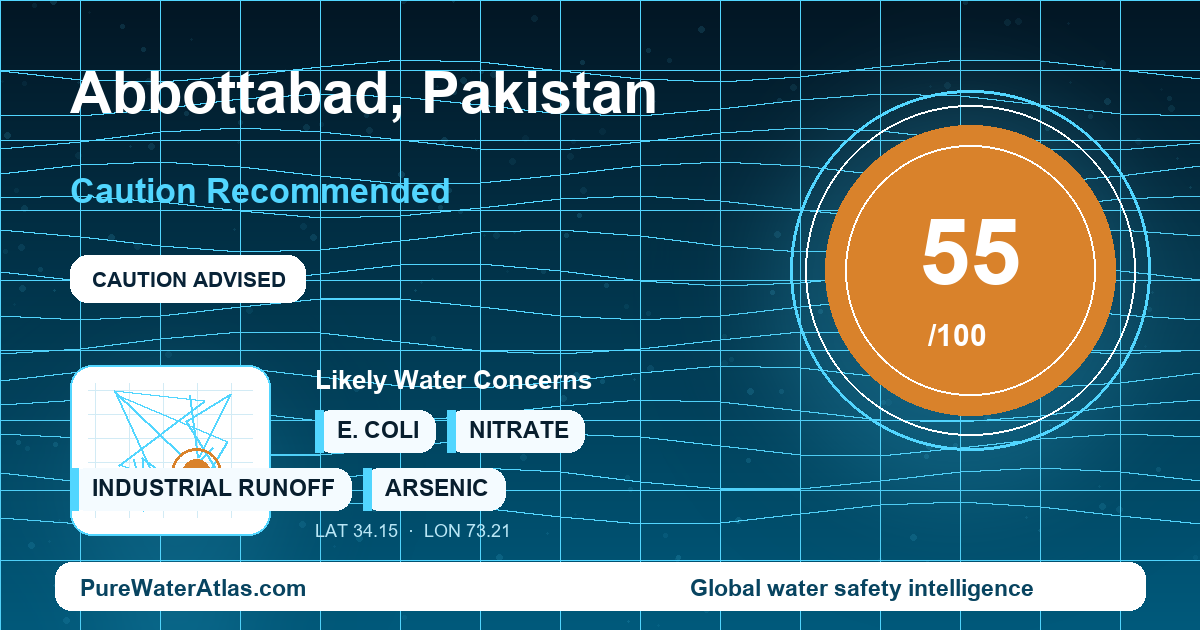
Abbottabad, Pakistan: a hill-city water system with organized services, mixed groundwater and spring-source influences, and tap-level safety that depends heavily on distribution pressure, storage tanks, season, and local testing.
Quick Answer
| Overall tap-water status | Caution recommended. Abbottabad has formal urban water services, but tap water should not be treated as reliably potable without local confirmation or household treatment. |
|---|---|
| Water safety score | 55 / 100 — risk level: Caution Recommended. |
| For travelers | Drink sealed bottled water or properly treated water. Avoid drinking untreated tap water, especially after monsoon rain, outages, pipe repairs, or visible turbidity. |
| For residents | Safety is address-specific. Use sediment filtration plus verified disinfection such as UV or boiling when needed, and test water periodically at the actual drinking tap. |
| Main water-source identity | A mixed hill-city system: groundwater from tube wells and boreholes, with spring or gravity-fed components and local storage reservoirs in parts of the wider system. |
| Main authority | Water and Sanitation Services Company Abbottabad, commonly WSSCA, for urban service areas; Abbottabad Cantonment Board may be relevant inside cantonment-administered areas. |
| Filter recommendation | A washable sediment pre-filter followed by microbiological disinfection is a practical baseline unless recent tap-level laboratory results show water is consistently safe. |
PureWaterAtlas classifies Abbottabad tap water as caution recommended, not because every connection is known to be unsafe, but because public neighborhood-level compliance reporting is limited and several local risk factors can affect water between source and tap.
Why Abbottabad Is Different
Abbottabad is a highland city in the Hazara region of Khyber Pakhtunkhwa, located in a valley surrounded by hills. That geography helps explain why the city’s water identity differs from many lowland Pakistani cities. The practical concerns are not dominated by salinity in the way they can be in some lower-lying areas. In Abbottabad, the first-line issues are more often microbial safety, turbidity after rain, sediment, variable chlorination, and contamination introduced through distribution leaks or building storage tanks.
The city is also not a simple single-source system. Abbottabad developed as a hill station and cantonment town, and older parts of the city historically relied on local springs, gravity-fed lines, municipal wells, and stored water. As the population grew, and as schools, hospitals, markets, tourism, and military or cantonment functions expanded demand, the system became more dependent on mechanized groundwater abstraction, reservoirs, pumping, and network extensions.
This matters for drinking-water safety because Abbottabad’s tap water can vary by service area, institution, cantonment boundary, building plumbing, private borehole use, and storage-tank condition. A household receiving reasonably treated water at one point in the network can still experience unsafe water if pressure is intermittent, pipes are leaking, or a rooftop or underground tank is poorly maintained.
Where Does Abbottabad’s Tap Water Come From?
Abbottabad’s urban drinking-water supply is best understood as a mixed hill-city system. The dataset identifies groundwater from tube wells and boreholes as a major component, supplemented in parts of the wider system by mountain spring or surface-water gravity sources and local storage reservoirs. The actual source mix can vary by neighborhood, service area, institution, cantonment-administered zone, and private connection.
Key infrastructure includes municipal and WSSC-managed tube wells and pumping stations, hill spring or gravity-fed components where available, service reservoirs, overhead tanks, and local distribution mains. At the household level, underground and rooftop storage tanks are common and are one of the most important end-point risk points. Some households, institutions, and peri-urban locations may also use private boreholes, water tankers, or small local arrangements.
The city’s hill setting creates operational challenges. Slope, pressure variation, pipe damage, repairs, and intermittent supply can all influence whether water remains protected after it leaves the source. During low-pressure events, damaged pipes or cross-connections near drains can increase the risk of ingress. During heavy rain, source disturbance, runoff, pipe repairs, or landslides can increase turbidity and sediment. These are not abstract concerns; they are the practical reasons Abbottabad tap water should be verified at the point of use rather than assumed safe citywide.
Who Manages Drinking Water in Abbottabad?
The main urban water and sanitation service company for Abbottabad city service areas is Water and Sanitation Services Company Abbottabad, commonly WSSCA. In some areas, especially those under cantonment administration, the Abbottabad Cantonment Board may be relevant. Provincial and local government agencies are also relevant for schemes outside the WSSCA urban service boundary, with broader institutional context provided by the Khyber Pakhtunkhwa Local Government, Elections and Rural Development Department.
Pakistan’s drinking-water quality context is generally benchmarked against national standards and public-health guidance from Pakistan EPA, provincial authorities, the Pakistan Council of Research in Water Resources, and WHO guideline concepts. The Pakistan Environmental Protection Agency provides national environmental and drinking-water standards context, while the Pakistan Council of Research in Water Resources is a high-authority Pakistani source for water-quality monitoring and research.
A key limitation for Abbottabad is transparency at the tap level. Publicly accessible city-level institutional information exists, but PureWaterAtlas did not identify a consistently updated public dashboard showing neighborhood-level E. coli results, turbidity, residual chlorine, nitrate, metals, pipe-age risk, or compliance trends for every service zone. Therefore, this profile does not claim that all Abbottabad tap water meets or fails standards. It gives a cautious, risk-based assessment using verified institutional context and locally relevant risk factors.
Main Local Water Concerns
The leading Abbottabad concerns are practical and location-specific. Microbial contamination risk is the most important drinking-water issue for many users because intermittent supply, low pressure, leaking pipes, poor tank hygiene, and possible sewage ingress can undermine safety between the source and the tap. If water is stored for many hours or days in an unclean tank, a safe supply can become unsafe before it is consumed.
Turbidity and sediment are also relevant, especially after heavy rain, pipe repairs, source disturbance, landslide-related damage, or long supply interruptions. Turbid water is not only unpleasant; it can reduce the effectiveness of disinfection and may indicate that the system has been disturbed. Abbottabad’s monsoon period can increase runoff, drain overflow, source turbidity, and microbial risk.
Residual chlorine can be inconsistent at the household tap, particularly after long storage or in distant parts of a distribution system. Chlorine is a key protection against microbial contamination in piped and stored water, but it must remain present at the point of use to be fully protective.
For private wells and boreholes, nitrate becomes a concern where septic systems, livestock, agriculture, or poorly protected wellheads influence groundwater. Source-specific issues such as hardness, iron, manganese, scaling, taste, and sediment can also occur in groundwater-dependent supplies. Lead is not documented in the dataset as a city-wide Abbottabad problem, but older buildings with corroded galvanized pipes, old fittings, solder, brass components, or legacy plumbing can create premise-plumbing risk.
For Travelers
Visitors should generally avoid drinking untreated tap water in Abbottabad. Use sealed bottled water from reputable shops, or treated water provided by a trusted hotel. Tap water may be acceptable for bathing and handwashing, but it is not recommended for direct drinking by short-stay travelers, especially during monsoon periods, after water outages, after pipe repairs, or when the water looks cloudy or contains visible particles.
For brushing teeth, use bottled or treated water if you have a sensitive stomach, are traveling with children, are immunocompromised, or are staying only briefly. Many local residents may use tap water, but traveler risk tolerance should be lower because visitors are more vulnerable to gastrointestinal disruption from unfamiliar microbial exposures.
Avoid ice unless the hotel or restaurant can confirm it was made from treated water. Ice made from untreated tap water or storage-tank water can carry the same microbial risks as the original source. Better hotels and restaurants may use filtered or bottled water, but this should not be assumed. Ask whether drinking water and ice are filtered, boiled, or bottled. For tea and hot drinks, make sure the water has been brought to a full boil.
If you are traveling onward to Galiyat or nearby mountain areas, carry sealed bottled water, especially on road trips. After heavy rain, visible turbidity, landslide disruption, pipe repairs, or water-supply interruptions, switch to bottled or boiled water even if your accommodation normally uses tap water.
For Residents
Residents should treat Abbottabad tap-water safety as address-specific. A practical household setup for many homes is a washable sediment pre-filter followed by verified microbiological treatment, such as UV disinfection, or boiling during high-risk periods. UV systems work best when the water is already clear, so sediment removal before UV is important. Reverse osmosis may be useful where testing shows nitrate, high dissolved solids, specific metals, or taste problems, but it should not be installed blindly without understanding source-water chemistry and maintenance needs.
Testing is strongly advisable if you use a private borehole, an older building, a rooftop tank, an underground tank, or water that changes after rain or outages. At least once per year, test the actual drinking-water tap for E. coli or thermotolerant coliforms, total coliforms, turbidity, pH, electrical conductivity or TDS, nitrate, hardness, iron, and manganese. Test immediately after major plumbing changes, pipe breaks, tank cleaning, flooding, landslides, or long supply interruptions.
Private boreholes and wells should include nitrate and basic metals, and arsenic screening can be considered even though Abbottabad is not identified here as one of Pakistan’s best-known arsenic hot spots. If infants, pregnant people, elderly residents, or immunocompromised residents live in the home, prioritize microbiological testing and verified disinfection.
Storage tanks deserve special attention. Rooftop and underground tanks should be covered, screened against insects and debris, cleaned and disinfected routinely, and inspected after monsoon rain or nearby sewer or drain overflow. In Abbottabad, the condition of the household tank can be just as important as the quality of the water entering the property.
Relevant Contaminants and Water-Quality Issues
The most relevant microbial indicator for Abbottabad’s intermittent supply, storage-tank, and traveler-risk context is E. coli in drinking water. If E. coli is detected at the drinking tap, the water should not be consumed without effective treatment.
Turbidity and sediment are important in Abbottabad because monsoon rain, hill-source disturbance, pipe repairs, and storage-tank deposits can make water cloudy or particle-laden. Turbidity can interfere with disinfection, so visibly cloudy water should be settled and filtered before disinfection where possible.
Chlorine matters because residual chlorine is a key barrier against microbial regrowth in piped and stored water. If chlorine is absent after long storage, microbial risk can rise. For private wells or boreholes influenced by sanitation, agriculture, livestock, or poor wellhead protection, nitrate testing is important. In older buildings, lead should be viewed as a premise-plumbing concern rather than a confirmed city-wide Abbottabad issue.
How to Verify Your Water Quality
The only reliable way to know whether your Abbottabad tap water is safe is to test the water you actually drink. Samples should be collected from the drinking-water tap, not only from the source, borehole, or storage tank. Use an accredited or recognized laboratory where possible, and repeat testing after plumbing repairs, flooding, landslides, prolonged outages, tank cleaning, or major seasonal changes.
For step-by-step testing guidance, see the PureWaterAtlas complete guide to water testing and analysis. For broader safety principles, see Drinking Water Safety, Water Microbiology, and Water Treatment Systems.
During outages, heavy rain, or suspected microbial contamination, residents and travelers can use boiling guidance. Homes considering disinfection can review UV water purification. Older homes can consult lead testing methods, and private well users can review nitrate testing methods. To compare destinations, use the Global Water Quality Checker, and to research a detected contaminant, use the Contaminants Search Engine.
Official and Technical Sources
- Water and Sanitation Services Company Abbottabad — local utility context for Abbottabad urban water and sanitation services.
- Khyber Pakhtunkhwa Local Government, Elections and Rural Development Department — provincial local-government and urban-service context.
- Abbottabad Cantonment Board — relevant for cantonment-administered parts of Abbottabad.
- Pakistan Council of Research in Water Resources — national water-quality research and monitoring authority.
- Pakistan Environmental Protection Agency — national environmental and drinking-water standards context.
- Asian Development Bank: Khyber Pakhtunkhwa Cities Improvement Project — technical context on urban infrastructure improvement needs in Khyber Pakhtunkhwa cities.
- WHO Guidelines for Drinking-water Quality — international public-health framework for microbial safety, disinfection, turbidity, and risk-based water management.
- WHO/UNICEF Joint Monitoring Programme — country-level WASH context; not a substitute for Abbottabad tap-level testing.
Bottom Line
Abbottabad has organized urban water services and a hill-city supply identity that includes groundwater, tube wells, boreholes, spring or gravity-fed components, reservoirs, and household storage. However, current public tap-level reporting is limited, and safety can change by service area, building, season, and storage conditions. The main concerns are microbial contamination, turbidity after rain, sediment, inconsistent residual chlorine, private-borehole nitrate risk, and old-building plumbing issues. Travelers should choose sealed bottled or properly treated water and avoid untreated tap water and uncertain ice. Residents should use sediment filtration plus disinfection where needed, keep tanks clean and covered, and test the actual drinking tap periodically.
Read the full guide: Global Water Quality Guide
Explore more in this category: Global Water Quality Articles