
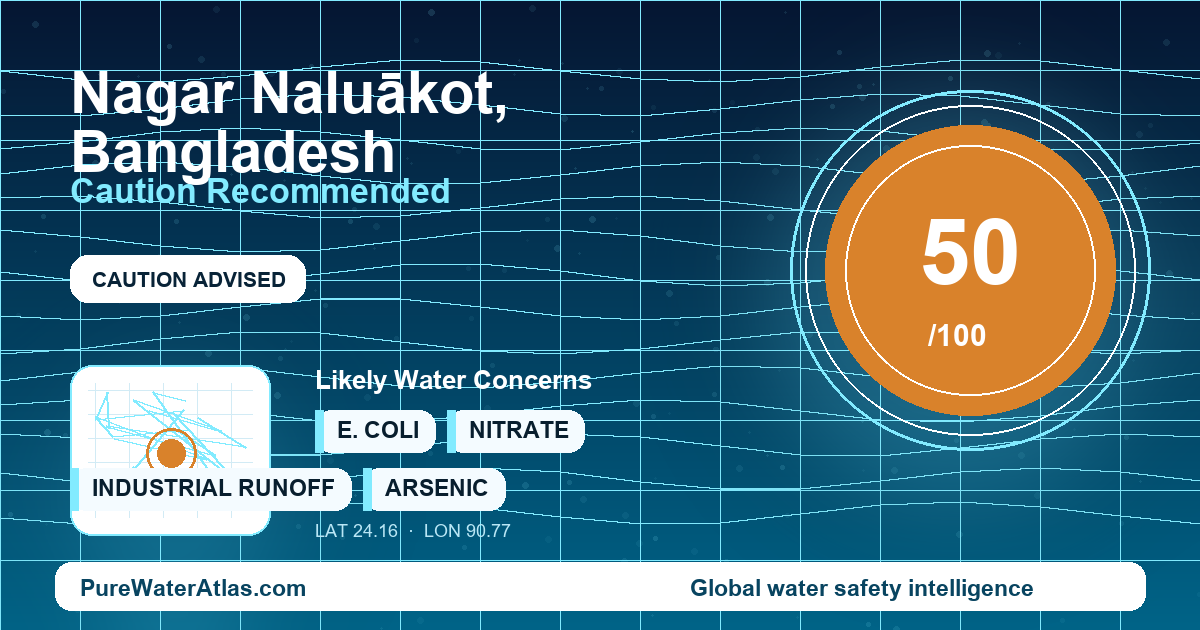
Nagar Naluākot, Bangladesh: caution is recommended because publicly available city-specific tap-water compliance data is limited, and local drinking water is likely groundwater-based with well-by-well risks such as arsenic, microbial contamination, iron, manganese, nitrate, and storage-tank hygiene.
Quick Answer
| Water safety score | 50 / 100 |
|---|---|
| Risk level | Caution Recommended |
| Can visitors drink the tap water? | Not recommended untreated. Short-stay visitors should use sealed bottled water, fully boiled water, or water treated by a reliable purifier. Avoid ice unless it is confirmed to be made from purified water. |
| Resident advice | Do not assume a private tubewell, household pump, or small piped connection is safe without testing. Test for arsenic and fecal contamination first, then consider iron, manganese, nitrate, turbidity, and conductivity or salinity where relevant. |
| Main likely water source | Groundwater-dominated: household and community tubewells, production wells for any limited piped supply, and household or community hand-pump tubewells. |
| Likely local authority | Nangalkot Pourashava or the relevant local government body, with technical support and sector responsibility from Bangladesh’s Department of Public Health Engineering. |
| Filter recommendation | Use treatment based on test results. Boiling, UV, or disinfection can address microbes when used correctly, but they do not remove arsenic, nitrate, iron, manganese, or salinity. Arsenic and nitrate require specific treatment technologies. |
Why Nagar Naluākot Is Different
Nagar Naluākot appears to correspond most closely to Nangalkot in Cumilla District, Bangladesh. That identification matters because the most useful water records and local administrative references are more likely to use the spelling Nangalkot, Nangalkot Pourashava, Cumilla District, or the local Department of Public Health Engineering office rather than the romanized spelling Nagar Naluākot.
This is not a large metropolitan water system with a routinely published consumer confidence report. Publicly available, city-specific drinking-water compliance data for Nagar Naluākot is very limited. The safety picture therefore depends on Bangladesh’s small-town and rural-urban groundwater context: individual tubewells, small piped systems, local pumps, storage tanks, and household handling can all determine whether a particular tap is safe.
Bangladesh expanded tubewell use historically to reduce reliance on ponds, open surface sources, and other microbiologically contaminated water. That change reduced many surface-water disease risks but later revealed naturally occurring groundwater arsenic in many areas of the country, including areas historically discussed within the former Comilla region. For Nagar Naluākot, the practical lesson is simple: clear-looking groundwater is not automatically safe, and safety cannot be confirmed by taste, smell, or the depth of a neighboring well.
Where Does Nagar Naluākot’s Tap Water Come From?
Drinking water in Nagar Naluākot is expected to be groundwater-dominated. In small towns and rural-urban areas of Bangladesh such as Nangalkot, water commonly comes from deep or shallow tubewells, production wells for limited piped supply, household pumps, and community hand-pump tubewells. Surface water from ponds, canals, or seasonal water bodies should not be considered a reliable drinking source unless it receives full treatment.
The likely local infrastructure is mixed. Some households may use a private tubewell or pump directly. Others may receive water from a small municipal or community groundwater-based piped system. Household rooftop tanks, ground reservoirs, suction pumps, and internal plumbing can change water quality after the water leaves the source. A well that tests acceptably at the source can still deliver unsafe water at the cup if water is stored in a dirty tank, drawn through leaking pipes, or handled with contaminated containers.
Seasonal conditions also matter. During the monsoon, flooding, waterlogging, and drain overflow can increase microbial risks in shallow wells, poorly sealed wells, leaking pipes, and storage tanks. During dry periods, falling water levels and heavier pumping may change taste, turbidity, iron, or manganese in some wells. Power cuts and intermittent pumping can reduce pressure in piped lines, increasing the possibility of intrusion through leaks.
Who Manages Drinking Water in Nagar Naluākot?
The local civic authority is expected to be Nangalkot Pourashava or the relevant local government body. Technical support and sector responsibility come from the Department of Public Health Engineering under Bangladesh’s Ministry of Local Government, Rural Development and Cooperatives. Outside any municipal piped coverage, many households may rely on privately owned or community tubewells, meaning the owner or users are often responsible for testing, maintenance, and treatment decisions.
Bangladesh’s drinking-water oversight is handled through national government institutions, while national access indicators are reported by organizations such as the WHO/UNICEF Joint Monitoring Programme. However, national access data does not prove that a specific tap, storage tank, or well in Nagar Naluākot meets chemical and microbiological safety criteria. No recent, publicly accessible Nagar Naluākot-specific water-quality report, distribution-system monitoring dataset, or consumer confidence report was identified for this profile.
Because of that data limitation, this assessment uses the likely local administrative identity of Nangalkot in Cumilla District, Bangladesh’s national groundwater context, DPHE responsibility, and high-authority groundwater evidence. The confidence level is low-to-moderate: the general risk factors are well established, but conditions can vary well by well and building by building.
Main Local Water Concerns
- Arsenic in groundwater: Arsenic is the priority chemical concern for untested groundwater wells in many parts of Bangladesh, including districts with historical detections. Not every well in Nagar Naluākot is necessarily contaminated, but every long-term drinking well should be tested.
- Fecal contamination: E. coli or thermotolerant coliforms can enter shallow wells, poorly sealed tubewells, household storage containers, rooftop tanks, or low-pressure distribution lines. The risk can increase after flooding, repairs, tank cleaning failures, or illness clusters.
- Iron and manganese: These are common Bangladesh groundwater issues. They may cause reddish or blackish staining, metallic taste, sediment, turbidity, or treatment performance problems. They are not always the main acute health risk, but they can make water unacceptable and interfere with disinfection or filtration.
- Nitrate: Nitrate can be relevant where wells are shallow or near latrines, septic pits, livestock areas, ponds, fertilizer storage, cultivated fields, or agricultural runoff.
- Turbidity and sediment: Cloudy water can increase after monsoon runoff, pump disturbance, pipe repair, tank cleaning problems, or flooding. Turbidity is especially important before UV disinfection because cloudy water can reduce UV effectiveness.
- Salinity or conductivity changes: Nagar Naluākot is inland, so coastal salinity intrusion is not the dominant concern in the way it is for parts of southern and southwestern coastal Bangladesh. Still, conductivity or total dissolved solids should be checked if the water tastes salty, brackish, or seasonally different.
For Travelers
Visitors should not treat ordinary tap water in Nagar Naluākot as reliably safe to drink untreated. Use sealed bottled water, water that has been fully boiled, or water treated by a reliable purifier. Check bottle seals, carry drinking water when moving around, and choose hot tea or coffee made with water that has been brought to a full boil.
For brushing teeth, short-stay visitors should use bottled, boiled, or properly filtered water, especially if they are immunocompromised, pregnant, traveling with small children, or prone to stomach illness. Avoid ice from street vendors or small eateries unless the source is clearly purified; freezing does not reliably make contaminated water safe.
Hotels and restaurants may provide bottled or filtered water, but do not assume all kitchen water is purified. Ask specifically whether drinking water, ice, diluted drinks, and washed salad ingredients are made or washed with boiled, filtered, or commercially bottled water. If you have a sensitive stomach, avoid raw foods washed in untreated water.
For Residents
Residents should not rely on appearance, taste, or tradition to judge water safety. A private tubewell, household pump, or small piped connection should be tested before being used as a long-term drinking-water source. At minimum, test for arsenic and fecal contamination. Add iron, manganese, nitrate, turbidity, and conductivity or salinity testing when taste, staining, agricultural surroundings, shallow wells, or seasonal changes make them relevant.
A home treatment system is advisable when the source is untested or when the household relies on a private tubewell, rooftop tank, or intermittent supply. The correct system depends on laboratory results. Boiling helps control pathogens but does not remove arsenic, nitrate, iron, manganese, or salinity. UV can help with microbial control when water is clear and the system is maintained, but it is not an arsenic or nitrate solution. Arsenic requires a certified arsenic-removal technology or reverse osmosis, and nitrate requires specific treatment such as reverse osmosis or ion exchange.
Older plumbing is not the best-documented risk for this area, but brass fittings, solder, galvanized pipes, older taps, and poorly maintained plumbing can contribute metals or sediment. If water has been standing overnight, flush the tap before using it for drinking. Households with infants, pregnant people, or children may consider testing both first-draw and flushed samples.
Storage tanks deserve special attention in Nagar Naluākot-style small-system settings. Rooftop and ground tanks should be covered, screened against insects and animals, cleaned periodically, disinfected after cleaning or flooding, and protected from backflow. A tested source can become unsafe if water is stored in an unclean tank or handled with unclean vessels.
Relevant Contaminants and Water-Quality Issues
The most important contaminant profile for Nagar Naluākot groundwater users is arsenic. Bangladesh’s groundwater history makes arsenic testing essential for any well used as a long-term drinking source. For more detail, see Arsenic in Drinking Water: Testing and Detection Methods and Arsenic in Drinking Water: Best Filters, Systems and Solutions.
For microbial safety, review E. coli and the PureWaterAtlas guide to Water Microbiology. E. coli is especially relevant for shallow wells, storage tanks, and intermittent small piped systems. Turbidity also matters because cloudy water can make UV and other disinfection methods less reliable.
Other locally relevant issues include nitrate near latrines, livestock, fertilizer use, or agricultural runoff; iron where water is reddish, metallic, or staining; and manganese where water causes black staining, sediment, or dark particles.
How to Verify Your Water Quality
The most reliable way to answer “is my water safe?” in Nagar Naluākot is to test the actual source and the water as used in the home. Test any new well, private tubewell, or household pump before long-term use. Retest after flooding, pump-depth changes, plumbing repairs, tank cleaning, switching between municipal and private supply, or unexplained illness in the household.
Start with arsenic and E. coli or thermotolerant coliforms. Add nitrate if the well is shallow or close to sanitation, livestock, fertilizer, or agriculture. Add iron and manganese if there is staining, metallic taste, black particles, sediment, or discoloration. Check turbidity before relying on UV. If the water tastes salty or brackish, test conductivity or total dissolved solids.
For broader guidance, use the PureWaterAtlas Water Testing guide, the Global Water Quality Checker, and the Contaminants Search Engine. For treatment planning, see Water Treatment Systems, Boiling Water Purification, UV Water Purification, and Nitrate Contamination in Drinking Water: Testing and Detection Methods.
Official and Technical Sources
- Department of Public Health Engineering, Government of Bangladesh — national agency relevant to rural and small-town water supply, tubewells, arsenic mitigation, and water-quality responsibilities.
- Nangalkot Upazila official government portal — local administrative reference connecting Nagar Naluākot with the Nangalkot area of Cumilla District; not a water-quality compliance report.
- British Geological Survey and Department of Public Health Engineering: Arsenic contamination of groundwater in Bangladesh — high-authority evidence explaining why well-by-well arsenic testing is essential.
- WHO/UNICEF Joint Monitoring Programme household WASH data for Bangladesh — national access and service-level data, useful for context but not proof of safety at a Nagar Naluākot tap or well.
- UNICEF Bangladesh: Water, sanitation and hygiene in Bangladesh — national WASH context, contamination concerns, and safe-water challenges.
- World Health Organization: Guidelines for Drinking-water Quality — international reference for microbial and chemical drinking-water risk management.
Bottom Line
Nagar Naluākot should be treated as a caution-recommended drinking-water location. The area appears to align with Nangalkot in Cumilla District, where drinking water is likely groundwater-based and may come from tubewells, small piped systems, household pumps, and storage tanks. No recent city-specific public compliance report was found, so safety cannot be assumed. Visitors should use sealed bottled, boiled, or reliably purified water and avoid uncertain ice. Residents should test their actual source for arsenic and fecal contamination, then add iron, manganese, nitrate, turbidity, and conductivity testing where conditions suggest. Boiling helps with pathogens but not arsenic, nitrate, metals, or salinity; treatment must match test results.
Read the full guide: Global Water Quality Guide
Explore more in this category: Global Water Quality Articles