
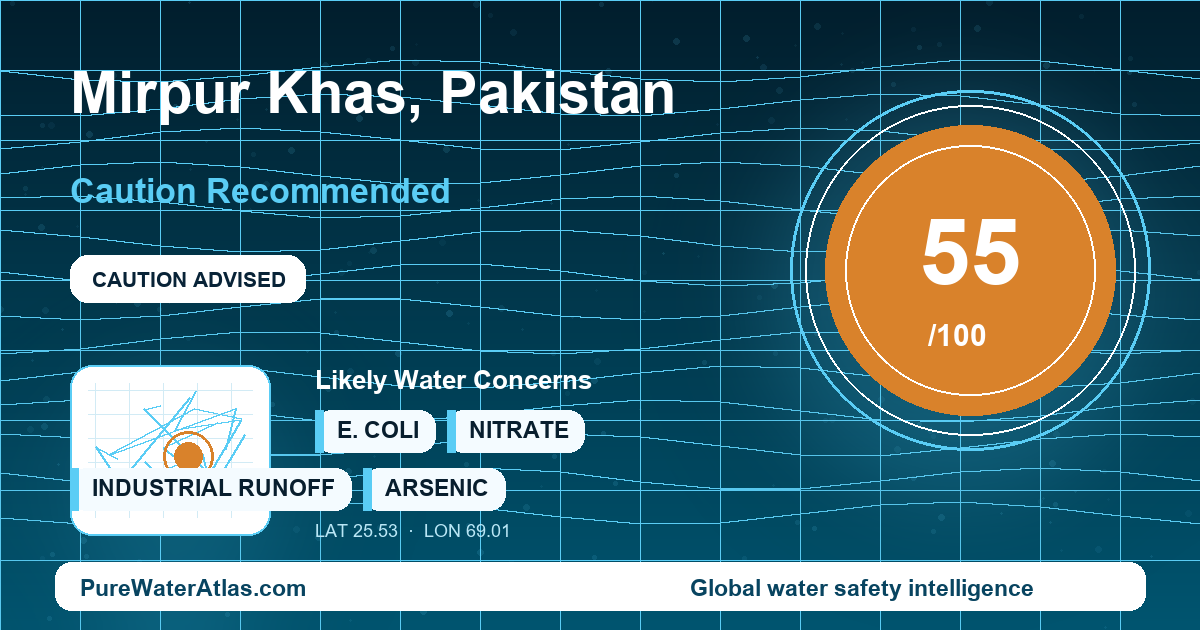
Mirpur Khas, Pakistan: canal-fed municipal water in lower Sindh, with variable safety because of intermittent supply, storage tanks, seasonal turbidity, and regional groundwater salinity risks.
Quick Answer
| Water safety score | 55 / 100 |
|---|---|
| Risk level | Caution Recommended |
| Can tourists drink untreated tap water? | No. Visitors should use sealed bottled water, boiled water, or water treated by a reliable purifier. |
| Resident guidance | Treat municipal, tanker, or private pump water as variable-quality unless the specific kitchen tap has been tested recently. |
| Main water source | Primarily canal-fed supply associated with the regional Nara/Jamrao irrigation system; some households also use private boreholes, suction pumps, tankers, and stored water. |
| Responsible institutions | Municipal local-government arrangements in Mirpur Khas, with involvement from the Government of Sindh Public Health Engineering Department and provincial local-government oversight. |
| Filter recommendation | At minimum: sediment pre-filtration plus disinfection. If testing shows high TDS, salinity, arsenic, nitrate, or other dissolved contaminants, use a properly maintained reverse-osmosis system. |
Overall verdict: Caution recommended. Mirpur Khas is not a city where untreated tap water should be assumed consistently safe to drink. The main concern is not one single contaminant; it is the full water chain from canal source to storage, treatment, intermittent distribution, household tanks, and possible use of saline or contaminated groundwater. Publicly accessible, recent tap-by-tap compliance data for Mirpur Khas are limited, so point-of-use testing matters.
Why Mirpur Khas Is Different
Mirpur Khas sits in southeastern Sindh, east of Hyderabad, in an arid to semi-arid agricultural belt. Unlike a city supplied by a large local freshwater river, Mirpur Khas depends heavily on the irrigated left-bank Indus canal system. That makes canal management, turbidity, irrigation drainage, seasonal water movement, and storage practices central to drinking-water safety.
The surrounding district developed around canal irrigation and intensive agriculture, including mango-growing areas and irrigated farmland. This local setting matters because raw water can be affected by canal sediment, rainfall, drainage events, and sanitation conditions. In practical terms, even if the water entering the municipal system is lower in salinity than local groundwater, it can still carry microbial and turbidity risks if treatment, chlorination, or distribution integrity is weak.
Mirpur Khas also has a lower-Sindh groundwater problem: private boreholes and pumps may produce water that looks clear but is brackish, saline, or high in total dissolved solids. Some groundwater may also need testing for geogenic or land-use-related contaminants such as arsenic or nitrate. A clear appearance is not a safety certificate.
Where Does Mirpur Khas’s Tap Water Come From?
Mirpur Khas’s urban supply is generally understood to be canal-water dependent, with water drawn from the regional canal network associated with the Nara/Jamrao irrigation system and then stored, treated where systems are functioning, and distributed through municipal waterworks. The city is part of the irrigated lower-Sindh landscape rather than a place built around a perennial local freshwater river.
Key water infrastructure for Mirpur Khas includes canal-fed raw-water intake or supply arrangements, municipal waterworks, storage reservoirs, ground tanks, overhead tanks, and distribution mains. After water enters the city network, it may pass through long lines and local storage before reaching individual buildings. In an intermittent system, low pressure can allow contaminated water to enter through leaks, damaged pipes, illegal connections, or cross-connections near drains.
At the household level, the water system continues inside the property. Roof tanks, underground tanks, suction pumps, small storage containers, and private plumbing can all introduce contamination after water has left the utility network. This is especially important in hot weather, after long supply interruptions, and when tanks are uncovered, dusty, or rarely cleaned.
Some households and peri-urban users rely on private boreholes, hand pumps, tankers, or stored water when piped service is intermittent or inadequate. These alternatives can solve a supply problem while creating a quality problem. Borehole water in much of lower Sindh cannot be assumed potable without testing because salinity, high TDS, nitrate, arsenic, fluoride, chloride, sulfate, sodium, iron, manganese, and other parameters can vary sharply by location and depth.
Who Manages Drinking Water in Mirpur Khas?
Primary local responsibility for water service in Mirpur Khas sits with the Municipal Corporation or municipal local-government setup. The Government of Sindh Public Health Engineering Department is also involved in water-supply and sanitation schemes, especially for district-level and smaller-city infrastructure. Provincial oversight and planning involve the Sindh Local Government Department and the Sindh Public Health Engineering Department.
Pakistan uses National Standards for Drinking Water Quality, with national and provincial institutions providing standards, monitoring, environmental regulation, and sector oversight. Relevant authorities include the Pakistan Council of Research in Water Resources, the Pakistan Standards and Quality Control Authority, the Sindh Environmental Protection Agency, and Government of Sindh departments responsible for water supply and sanitation.
A key limitation for consumers is data access. Recent public datasets showing Mirpur Khas tap-water compliance by neighborhood, season, contaminant, and point of use are not consistently available in an easily accessible official format. For that reason, this profile does not claim exact citywide contaminant concentrations or universal compliance. The safer interpretation is that Mirpur Khas tap-water quality is variable and should be verified at the tap where it is consumed.
Main Local Water Concerns
- Microbial contamination: The most immediate household and traveler risk is contamination from intermittent distribution, leaking pipes, open drains, cross-connections, and poorly maintained storage tanks. Fecal contamination can cause acute illness even when water looks normal.
- Turbidity and sediment: Canal-fed water can carry sediment, especially after rainfall, canal disturbance, maintenance, or high-flow conditions. Turbid water also makes disinfection less reliable because particles can shield microbes.
- Variable chlorine residual: Chlorination may not remain effective through long distribution lines, warm storage, intermittent pressure, and household tanks. No chlorine smell does not prove the water is unsafe, and a chlorine smell does not prove all risks are controlled.
- Salinity and high TDS: Private groundwater and some tanker sources in lower Sindh may be salty or high in total dissolved solids. This can affect taste, household usability, and treatment choices.
- Arsenic and other groundwater chemistry risks: Sindh has recognized groundwater concerns, but the risk depends on the specific borehole. It should not be assigned uniformly across Mirpur Khas without testing.
- Nitrate: Shallow groundwater influenced by sewage, septic leakage, animal waste, or agricultural inputs can contain elevated nitrate.
- Post-treatment contamination: Roof tanks, underground tanks, open containers, and informal plumbing can recontaminate water even if the municipal source was treated.
Seasonal conditions can increase these risks. Monsoon rains may raise turbidity, overflow drains, and increase microbial intrusion. Flooding in Sindh should trigger immediate use of boiled, chlorinated, or sealed bottled water. Canal closures and irrigation maintenance periods can increase reliance on stored water, tankers, or groundwater. Hot weather increases storage demand and can reduce disinfectant residual in tanks and pipes.
For Travelers
Tourists and short-stay visitors should not drink untreated tap water in Mirpur Khas. The lowest-effort option is sealed bottled water from a reputable brand, with the seal checked before drinking. Boiled water is also suitable when brought to a proper boil and stored in a clean, covered container. A reliable purifier can be used if it is appropriate for the actual water quality and is maintained correctly.
Use bottled, boiled, or treated water for brushing teeth, especially if you are immunocompromised, pregnant, traveling with children, or staying in accommodation where the plumbing and tank hygiene are unknown. Avoid refilling from unknown taps, even if local residents sometimes do so.
Ice is a common exposure route. Avoid ice unless you know it was made from treated water. Ice from small street vendors or unverified shops is riskier than hot tea or thoroughly boiled beverages. In hotels and restaurants, ask whether water is bottled, filtered, or boiled. Prefer sealed bottles opened in front of you. Be especially cautious during monsoon rain, local flooding, supply interruptions, unusual taste, visible sediment, or reports of waterborne illness.
During hot months, carry a personal bottle of safe water and oral rehydration salts. Heat and dehydration can make a minor stomach illness more serious, so it is better to avoid uncertain water than to rely on treatment after illness begins.
For Residents
For most Mirpur Khas households, some form of home treatment is recommended unless recent point-of-use testing confirms safety. A practical setup starts with sediment pre-filtration to reduce particles, followed by an effective disinfection step such as boiling, UV treatment with adequate pre-filtration, or correctly dosed chlorination. Sediment and carbon filters alone should not be treated as complete protection against bacteria, viruses, high salinity, arsenic, or nitrate.
If household testing shows high TDS, salinity, arsenic, nitrate, or other dissolved contaminants, a certified and properly maintained reverse-osmosis system is more appropriate than a simple cartridge filter. RO systems also require maintenance: membranes can fail silently, units can be poorly installed, and storage tanks can become contaminated if not cleaned and sanitized.
Testing should be done at the point of use, not only at the source. The kitchen tap result is the drinking exposure that matters. Useful routine tests include E. coli or thermotolerant coliforms, total coliforms, turbidity, pH, electrical conductivity, total dissolved solids, residual chlorine, hardness, and nitrate. For private boreholes, add arsenic, fluoride, iron, manganese, chloride, sulfate, sodium, and salinity indicators.
Older buildings and informal plumbing can add risk through corroded pipes, unprotected suction pumps, cross-connections with drains, and stagnant roof tanks. Lead is less documented as a citywide Mirpur Khas problem than microbial contamination, but old fittings, brass fixtures, solder, and uncertain storage components can justify testing in older premises.
Storage tanks are a major control point. Keep roof and underground tanks covered, screened from insects and dust, cleaned on a schedule, and protected from sewage seepage. Do not assume municipal chlorination remains effective after water sits in a warm, dirty tank.
Relevant Contaminants and Water-Quality Issues
The most important immediate concern in Mirpur Khas is microbial safety. Learn more about E. coli in drinking water, because intermittent supply, sewage intrusion, and household tank contamination can all create fecal contamination risk.
Because the city relies heavily on canal-fed water, turbidity and sediment are also important. Cloudy or particle-laden water can reduce the effectiveness of UV or chlorine disinfection and may indicate canal disturbance, tank contamination, or pipe problems.
Chlorine residual is useful for understanding whether treated water remains protected through the network and household storage. For private groundwater users, arsenic and nitrate deserve attention, but only testing can show whether a specific borehole is affected.
How to Verify Your Water Quality
The best way to know whether a Mirpur Khas tap is safe is to test that specific tap, especially after floods, sewage backups, pipe repairs, tank cleaning, long interruptions, unusual taste, or visible sediment. Use the PureWaterAtlas complete guide to water testing to plan microbiological and chemical tests, and the broader drinking water safety guide to interpret risk.
If you are choosing treatment equipment, compare methods in the water purification methods guide and the water treatment systems guide. For short-term or emergency protection, see boiling water purification. For UV users, see the UV purification guide, remembering that UV needs low turbidity and proper maintenance.
For groundwater concerns, use the guides on arsenic testing and detection and nitrate testing. Older buildings may also benefit from the lead testing guide. You can also search individual contaminants in the PureWaterAtlas Contaminants Search Engine or compare broader city guidance with the Global Water Quality Checker.
Related PureWaterAtlas categories include Drinking Water Safety, Water Testing, Water Microbiology, Water Purification, and Global Water Quality.
Official and Technical Sources
- Pakistan Council of Research in Water Resources — national water research authority and key source for drinking-water quality context in Pakistan.
- PCRWR National Water Quality Monitoring Programme reports — national and regional evidence on microbial, arsenic, salinity, nitrate, and chemical water-quality issues.
- Pakistan Standards and Quality Control Authority — national standards body relevant to drinking-water and bottled-water standards.
- Government of Sindh Public Health Engineering Department — provincial water-supply and sanitation department involved in public schemes.
- Government of Sindh Local Government Department — provincial local-government authority relevant to municipal service delivery.
- Sindh Environmental Protection Agency — provincial environmental regulator for pollution issues affecting source-water and drainage conditions.
- World Bank Pakistan — high-level sector context on water-service challenges, infrastructure, intermittency, and public-health risks.
- WHO/UNICEF Joint Monitoring Programme Pakistan data — national drinking-water service-level context, not a substitute for Mirpur Khas tap testing.
- UNICEF Pakistan WASH — public-health context on water, sanitation, hygiene, and waterborne disease exposure.
- Pakistan Meteorological Department — monsoon, heat, and flood-season information relevant to canal turbidity and water-supply risk in Sindh.
Bottom Line
Mirpur Khas tap water deserves caution. The city is mainly supplied through canal-fed municipal systems in lower Sindh, where source-water turbidity, intermittent pressure, aging distribution, household storage tanks, and seasonal monsoon or flood conditions can affect safety. Private groundwater and tanker sources add different risks, especially salinity, high TDS, and possible borehole-specific arsenic or nitrate concerns. Tourists should avoid untreated tap water and use sealed bottled, boiled, or reliably purified water. Residents should test water at the kitchen tap, keep storage tanks clean and covered, and use treatment matched to test results. Because recent public neighborhood-level compliance data are limited, Mirpur Khas water should be treated as variable until verified at the point of use.
Read the full guide: Global Water Quality Guide
Explore more in this category: Global Water Quality Articles