
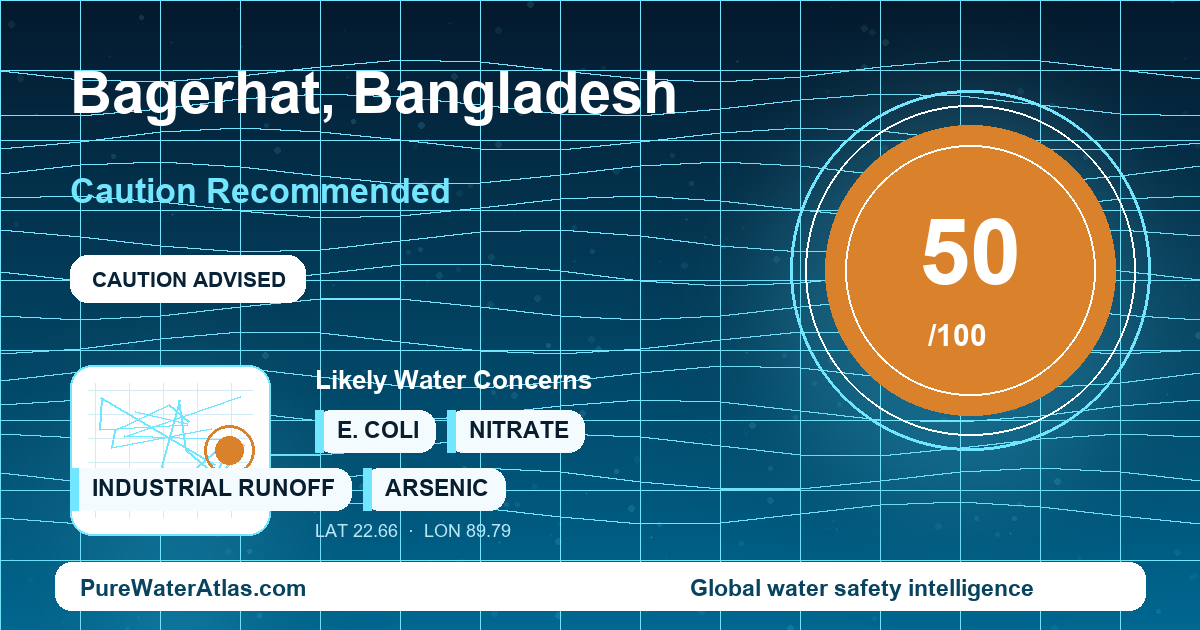
Bagerhat, Bangladesh: caution recommended for tap water because this coastal delta town relies on mixed sources, faces salinity and flooding pressures, and lacks readily available public tap-by-tap compliance reporting.
Quick Answer
| Water safety score | 50 / 100 |
|---|---|
| Risk level | Caution Recommended |
| Is tap water safe to drink? | Not recommended without treatment for visitors. Some households may have acceptable water, but safety depends on the specific source, storage, plumbing, season, and recent testing. |
| Traveler advice | Use sealed bottled water, reputable filtered water, or water that has been boiled or otherwise disinfected. Be especially careful during monsoon flooding, cyclones, or after changes in taste, color, odor, or turbidity. |
| Resident advice | Make drinking-water decisions at the household level. Test the actual source and point-of-use water for E. coli, arsenic, salinity indicators, iron, manganese, turbidity, and nitrate where relevant. |
| Main water sources | Bagerhat Paurashava piped supply where connected, plus tube wells, rainwater harvesting, pond or pond-sand-filter systems, and purchased bottled or jar water. |
| Local authority | Bagerhat Paurashava for municipal service inside the municipality, with technical and public-health engineering support from Bangladesh’s Department of Public Health Engineering. |
| Filter recommendation | Usually needed for drinking water unless recent reliable tests confirm safety. Choose treatment from test results: boiling or UV for many microbial risks; reverse osmosis for salinity and several dissolved contaminants; arsenic-specific treatment if arsenic is confirmed. |
The overall verdict for Bagerhat is caution recommended. The concern is not a proven single contaminant exceedance at every tap. It is the combination of coastal salinity pressure, mixed water sources, intermittent or localized infrastructure, household storage, microbial contamination risk, and Bangladesh-wide groundwater concerns such as arsenic, iron, and manganese. Publicly accessible city-level water-quality reporting is limited, so this guide should be read as a risk-based profile rather than a claim that every Bagerhat tap is unsafe or safe.
Why Bagerhat Is Different
Bagerhat is not best understood as a city with one uniform drinking-water source. It is a southwest Bangladesh coastal delta town where households may describe their drinking water as municipal tap water, tube-well water, pond-filter water, rainwater, jar water, or bottled water. Each of those has a different risk profile. The most useful first question in Bagerhat is not only “Is it tap water?” but “What is the actual source, how is it stored, and has it been recently tested?”
The city sits in Bagerhat District, in the Ganges-Brahmaputra-Meghna delta region and near the Sundarbans coastal system. Rivers, tidal influence, low elevation, cyclones, storm surge, dry-season salinity intrusion, and monsoon runoff are important water-security pressures. Southwest Bangladesh, including Bagerhat District, is repeatedly identified in water-sector literature as a salinity-affected coastal zone. That is why rainwater harvesting, pond sand filters, and alternative safe-water schemes are more relevant here than in many inland Bangladeshi towns.
Historically, coastal Bagerhat and neighboring areas have relied heavily on hand-pumped tube wells, ponds or dighis, rainwater collection, and later pond sand filters. This pattern reflects the difficulty of finding consistently fresh groundwater in saline-prone coastal areas and the wider Bangladesh history of arsenic and metal contamination in groundwater.
Where Does Bagerhat’s Tap Water Come From?
Within the municipality, connected households may receive Bagerhat Paurashava piped water supply. Outside or alongside those connections, many households and institutions use public or private tube wells, rainwater-harvesting systems, protected pond sources, pond sand filters, and purchased jar or bottled water. This mixed-source identity matters because risk varies sharply between piped supply, shallow groundwater, pond-derived water, stored rainwater, and commercial water.
The local raw-water setting is the southwest coastal delta. Shallow groundwater and surface ponds can be affected by salinity, monsoon runoff, storm surge, and sanitation-related microbial contamination. In dry periods, salinity and high total dissolved solids may become more important as freshwater river flow decreases and saline water moves farther inland. In the monsoon, rainfall can dilute salinity but increase turbidity, runoff, latrine overflow, and microbial contamination risk.
Key water infrastructure relevant to Bagerhat includes municipal piped supply where network connections exist, Department of Public Health Engineering support for water-supply infrastructure and testing in Bagerhat District, tube wells used by households and institutions, rainwater-harvesting systems, ponds and pond sand filters in coastal or peri-urban areas, and household or building-level storage tanks. Storage is especially important: even if incoming water is acceptable, dirty rooftop tanks, buckets, jerry cans, or building reservoirs can reintroduce E. coli and other pathogens.
Who Manages Drinking Water in Bagerhat?
Bagerhat Paurashava is the local municipal body responsible for urban water-supply service inside the municipality where service is available. Bangladesh’s Department of Public Health Engineering, under the Local Government Division, is the principal national technical agency for public water supply and sanitation outside the large WASA cities and supports testing, planning, and infrastructure in district towns and rural areas.
Bagerhat does not have the same large, highly centralized water utility structure as Dhaka WASA or Chattogram WASA. Urban supply is municipal and local, and household-level source switching is common. That means tap safety can vary by connection, neighborhood infrastructure, building plumbing, storage practice, and season.
Drinking water quality in Bangladesh is guided by national standards and government institutions including the Department of Public Health Engineering, the Local Government Division, the Department of Environment, and Bangladesh standards for drinking water and bottled water. For health interpretation, the WHO Guidelines for Drinking-water Quality are also commonly used. However, publicly available information does not establish a current, continuously published Bagerhat tap-water compliance record comparable to annual consumer confidence reports in some countries.
Main Local Water Concerns
- Salinity and high dissolved solids: Coastal Bagerhat District is exposed to dry-season salinity pressure and storm-surge impacts. Electrical conductivity, total dissolved solids, and chloride are useful indicators for understanding whether water is becoming too saline for drinking.
- Microbial contamination: Stored water, surface-water or pond-derived sources, shallow groundwater, and piped systems with intermittent pressure or damaged pipes can carry microbial risk. This is especially important after flooding, pipe repairs, or tank contamination.
- Arsenic: Arsenic remains a Bangladesh-wide groundwater issue. A Bagerhat tube well or groundwater-fed supply should not be assumed arsenic-free unless the source has been tested.
- Iron and manganese: These can occur in Bangladeshi groundwater and may cause metallic taste, staining, reddish or blackish discoloration, sediment, and treatment complications. Manganese can also raise health or acceptability concerns depending on concentration.
- Turbidity and sediment: Turbidity can rise during monsoon rainfall, pipe disturbance, flooding, pond-water use, or dirty storage-tank conditions. Cloudy water can make disinfection less reliable.
- Residual chlorine gaps: Residual chlorine may be absent or inconsistent at household taps if water is stored too long, supply is intermittent, pipes are compromised, or tanks are contaminated.
- Nitrate: Nitrate is most relevant for shallow wells near latrines, septic tanks, livestock areas, drains, fertilized land, or agricultural runoff.
Season matters. Cyclones and storm surges can contaminate ponds, shallow wells, and rainwater systems with saline water, debris, sewage, and pathogens. After floods, visible discoloration, or supply interruption, boiling or another proven disinfection method is prudent until the source is confirmed safe.
For Travelers
Visitors should not assume untreated tap water in Bagerhat is safe to drink. Use sealed bottled water, reputable filtered water, or water that has been boiled or otherwise disinfected. Do not rely on taste alone. Microbial contamination and arsenic are not reliably detected by taste or smell, while salty or cloudy water is a warning sign but not the only possible risk.
For brushing teeth, visitors should use bottled, boiled, or reliably filtered water, especially if immunocompromised, pregnant, traveling with young children, or visiting during monsoon or post-flood conditions. Avoid swallowing water in the shower if the supply is uncertain.
Avoid ice unless a hotel or restaurant can confirm that it was made from bottled or properly treated water. Ice made from untreated tap, pond, or tube-well water can carry microbial risk. In hotels and restaurants, higher-end or established venues may use filtered or bottled water, but confirm before drinking table water or accepting ice. Prefer sealed bottled water opened in front of you. Hot tea and coffee are generally lower risk if the water was brought to a rolling boil.
Practical travel precautions in Bagerhat include carrying oral rehydration salts, using sealed bottled water for drinking, avoiding raw foods washed in untreated water, and switching immediately to bottled or boiled water if tap water becomes salty, cloudy, colored, or unusually odorous. For emergency treatment guidance, see the PureWaterAtlas Boiling Water Purification Guide.
For Residents
For Bagerhat residents, the safest approach is household-level verification. A home filter is usually advisable for drinking water unless the household has recent reliable test results from the actual source and point of use. The correct system depends on the result. Boiling or UV can address many microbial risks but will not remove salinity, arsenic, nitrate, iron, or manganese. Reverse osmosis can reduce salinity and several dissolved contaminants, but it needs prefiltration, maintenance, and safe storage. Chlorination helps control microbes but is less effective when water is highly turbid.
Testing should be practical and source-specific. Test for E. coli and total coliform at the point of use, especially after monsoon flooding, pipe repairs, tank-cleaning failures, or illness clusters. Test tube wells and groundwater-fed supplies for arsenic through a reliable laboratory or government-recognized testing program; do not rely on the color, taste, or age of a well. Measure electrical conductivity, total dissolved solids, chloride, and taste acceptability to understand salinity risk, especially in the dry season.
Iron and manganese testing is useful if water is reddish, blackish, metallic tasting, stains fixtures, or leaves sediment. Check turbidity before disinfection; cloudy water should be settled and filtered before chlorination or UV. Test nitrate if using a shallow well near latrines, septic tanks, drains, livestock areas, or fertilized land. For municipal piped water, periodically check residual chlorine at the tap and retest after any long outage or supply interruption.
Older buildings and mixed-material plumbing can add point-of-use risk. Where plumbing materials are uncertain, especially in homes with infants, pregnant residents, or persistent metallic taste, consider first-draw and flushed sample testing for metals including lead. Storage tanks also deserve attention: keep tanks covered, screened, routinely cleaned, protected from floodwater and animals, and disinfected after cleaning.
Relevant Contaminants and Water-Quality Issues
The most immediate health issue for uncertain Bagerhat water is often microbial contamination, especially after flooding, supply interruption, or storage-tank contamination. Learn more about E. coli in drinking water and broader microbial risks in the PureWaterAtlas Water Microbiology guide.
Groundwater-fed supplies should be evaluated for arsenic, because Bangladesh has a long-standing groundwater arsenic problem and individual wells require testing. If arsenic is a concern, use the guides on arsenic testing and detection and arsenic filters and treatment systems.
During monsoon, pipe disturbance, pond-water use, or post-flood conditions, turbidity is important because cloudy water can interfere with disinfection. Bagerhat households using wells should also consider iron and manganese when water has metallic taste, staining, discoloration, or sediment. Shallow wells near sanitation systems, drains, livestock, or agriculture should be assessed for nitrate. Municipal users should understand chlorine residual because residual protection can decline in intermittent or stored water.
How to Verify Your Water Quality
Because public Bagerhat tap-by-tap monitoring data are limited, verification should start with the actual water you drink. Identify whether your household uses municipal piped water, a tube well, pond or pond-sand-filter water, rainwater, jar water, bottled water, or a combination. Then test at the point of use, not only at the source, because tanks and containers can change water quality.
For a testing framework, use the PureWaterAtlas Complete Guide to Water Testing and Analysis. For choosing treatment, see Water Purification Methods, the UV Water Purification Guide, and the Boiling Water Purification Guide. UV and boiling can be useful against many microbes, but they do not remove salinity, arsenic, nitrate, iron, or manganese.
You can also compare broader water-safety context with the Global Water Quality Checker and look up specific substances in the Contaminants Search Engine. For general safety decision-making, see Drinking Water Safety. Related PureWaterAtlas categories include Global Water Quality, Drinking Water Safety, Water Testing, and Water Contamination.
Official and Technical Sources
- Department of Public Health Engineering, Government of Bangladesh — principal public-health engineering agency for water supply and sanitation in Bangladesh outside large WASA service areas.
- Bagerhat District Portal, Government of Bangladesh — official district context and administrative information.
- Bagerhat Paurashava — local municipal authority associated with urban services in Bagerhat.
- UNICEF Bangladesh WASH — background on Bangladesh water, sanitation, hygiene, microbial safety, and climate-resilient water challenges.
- WHO Guidelines for Drinking-water Quality — health-based reference for microbial and chemical risks.
- World Bank, Bangladesh WASH Poverty Diagnostic — evidence on safely managed water, contamination, poverty, and service disparities.
- Asian Development Bank, Coastal Towns Environmental Infrastructure Project — context for coastal Bangladesh towns facing drainage, sanitation, water supply, cyclone, and climate-resilience pressures.
- British Geological Survey and Department of Public Health Engineering: Arsenic contamination of groundwater in Bangladesh — foundational evidence on groundwater arsenic risk and well-specific testing.
- Bangladesh Bureau of Statistics and UNICEF, Multiple Indicator Cluster Survey 2019 — household water, sanitation, and hygiene data relevant to point-of-use risks.
- Bangladesh Delta Plan 2100 — official planning context for delta, coastal-zone, salinity, flooding, and climate risks.
Bottom Line
Bagerhat tap water should be approached with caution. The city has real municipal water-service identity through Bagerhat Paurashava, but drinking water in practice is mixed-source: piped supply, tube wells, rainwater, pond or pond-sand-filter systems, jar water, and bottled water may all be used. Coastal salinity, monsoon runoff, cyclones, storm surge, microbial contamination, storage tanks, and Bangladesh-wide groundwater concerns such as arsenic, iron, and manganese make household-level verification essential. Visitors should use sealed bottled, boiled, disinfected, or reliably filtered water and avoid uncertain ice. Residents should test the actual source and point-of-use water, then choose treatment based on results rather than taste alone.
Read the full guide: Global Water Quality Guide
Explore more in this category: Global Water Quality Articles