Colonia del Valle, a central neighborhood in Benito Juárez, Mexico City, receives treated water through the wider Mexico City network, but safety at the tap can depend heavily on pressure conditions, older pipes, cisterns, rooftop tinacos, and building maintenance.
Quick Answer
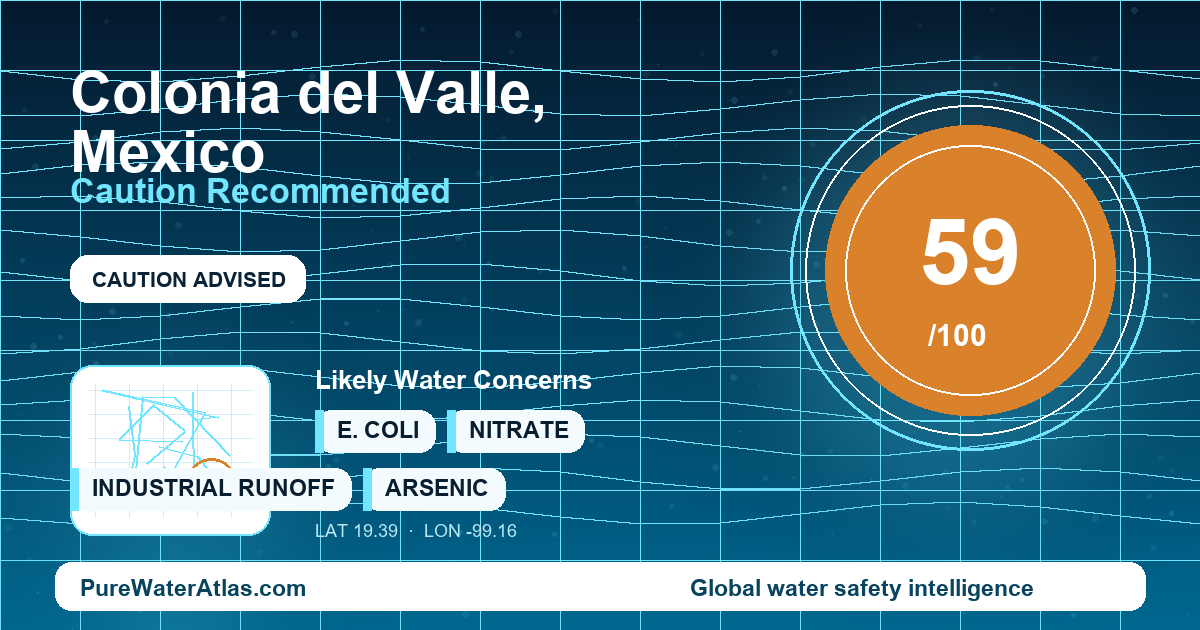
| Water safety score | 59 / 100 |
|---|---|
| Risk level | Caution Recommended |
| Can visitors drink the tap water? | Not recommended as a default. Short-term visitors in Colonia del Valle should use sealed bottled water, commercially purified garrafón water, or water from a verified purifier for drinking. |
| Resident guidance | Residents who plan to drink tap water regularly should use a maintained point-of-use treatment system and should test both the kitchen tap and building storage water when possible. |
| Main water supply identity | Colonia del Valle is supplied by the Mexico City metropolitan distribution system, using a variable blend that can include local Valley of Mexico groundwater, imported Cutzamala System surface water, and Lerma-associated imported groundwater. |
| Water authority | Public water service is managed by Mexico City water authorities, historically SACMEX, with water policy and management functions now associated with SEGIAGUA. Benito Juárez is the borough, not an independent water utility. |
| Filter recommendation | Sediment prefiltration plus activated carbon is a practical baseline. Reverse osmosis can add broader dissolved-contaminant reduction; UV may help microbial control only after sediment filtration. |
Editorial verdict: Caution is recommended. Municipal water is typically treated and chlorinated, but the point-of-use risk in Colonia del Valle is strongly affected by the last mile: distribution pressure, aging mains, repairs, cisterns, rooftop tanks, pumps, and internal plumbing. Public routine test results are not usually available at the block, building, cistern, or tap level, so this page should not be read as a guarantee for any specific apartment, hotel, restaurant, or office faucet.
Why Colonia del Valle Is Different
Colonia del Valle is not a separate municipality with its own drinking-water source. It is a dense residential and commercial district within the Benito Juárez borough of Mexico City, roughly in the central-south area of the capital. That matters because the neighborhood’s water quality is shaped by the larger Mexico City system rather than by a standalone local utility serving only Colonia del Valle.
The important local distinction is that building-level infrastructure can dominate the actual water quality that reaches a kitchen glass. Many properties in Colonia del Valle, especially apartment buildings and older structures, store municipal water in cisterns, pump it through building systems, and may hold it again in rooftop tinacos before it reaches taps. This storage can reduce chlorine residual, allow sediment to accumulate, and create microbial risk if tanks are uncovered, dusty, insect-accessible, or poorly cleaned.
Benito Juárez, including areas near or associated with Del Valle, also received public attention in 2024 after residents reported unusual odor and quality problems in tap water. Mexico City authorities announced sampling, field inspections, flushing, well and network investigations, and emergency support measures. That episode is best understood as a documented warning about localized network vulnerability in the borough, not as proof that every Colonia del Valle tap is currently contaminated.
Where Does Colonia del Valle’s Tap Water Come From?
Colonia del Valle is supplied through the Mexico City metropolitan distribution system. The raw-water portfolio for Mexico City includes local groundwater from the Valley of Mexico aquifer system, imported surface water from the Cutzamala System, and imported groundwater historically associated with the Lerma System. The exact blend reaching a specific building in Colonia del Valle can vary by network operation, pressure zone, maintenance activity, and drought-related supply adjustments.
The Cutzamala System includes reservoirs, conveyance works, pumping plants, and the Los Berros treatment plant serving part of the Valley of Mexico. The Lerma System and well fields have historically supplemented Mexico City supply. Local groundwater wells also connect to the urban distribution network. Once treated water enters the city network, it moves through SACMEX and Mexico City distribution mains, valves, pressure zones, storage tanks, and pumping infrastructure before it reaches neighborhood buildings.
For Colonia del Valle residents and visitors, the public supply is only part of the story. Building cisterns, rooftop tinacos, internal pumps, filters, and plumbing can substantially change water quality between the street main and the faucet. Intermittent supply, low pressure, or pipe work can disturb sediment or increase intrusion risk during depressurization. A modern café or office may serve purified water even while the building still receives standard municipal water for sinks and bathrooms.
Who Manages Drinking Water in Colonia del Valle?
The public water service for Colonia del Valle is managed by Mexico City water authorities. The agency historically associated with the city water system is the Sistema de Aguas de la Ciudad de México, or SACMEX. Water policy and management functions are now also associated with the Secretaría de Gestión Integral del Agua, SEGIAGUA, within the Mexico City government structure. Benito Juárez is the local borough, but it is not an independent drinking-water utility.
Drinking water in Mexico is governed by national sanitary standards, principally NOM-127-SSA1-2021 for water for human use and consumption. Federal and local health authorities are involved in sanitary oversight, while CONAGUA has national water-resource authority and publishes information on major systems such as Cutzamala. This profile does not claim Colonia del Valle-specific compliance because public routine results are not generally published at the neighborhood block, building, cistern, or tap level.
Main Local Water Concerns
The main concerns in Colonia del Valle are practical, localized, and infrastructure-related rather than limited to a single treatment plant. The most important variable is often the last mile: old or repaired distribution pipes, pressure fluctuations, building storage, rooftop tanks, and internal plumbing materials.
- Intermittent supply and low pressure: During dry-season stress, drought restrictions, or Cutzamala reductions, lower pressure or scheduled cuts can increase the chance of sediment disturbance and intrusion risk during pipe depressurization.
- Sediment and turbidity: Aging urban pipes, street work, repairs, and tank disturbance can produce cloudiness, rust-colored water, or particles at the tap.
- Cisterns and rooftop tinacos: These can become microbial or sediment sources if not sealed, cleaned, and disinfected regularly.
- Old internal plumbing: Older buildings may contain galvanized lines, solder, brass fixtures, or undocumented renovations that can affect metals at the tap.
- Chlorine variability: Chlorine taste or odor is common in treated water. However, the absence of chlorine smell does not prove safety, especially after water has sat in a cistern or tinaco.
- Chemical odors: Hydrocarbon-like, solvent-like, oily, or fuel-like odors should be treated as warning signs. Do not boil such water for drinking; use an alternate source and report it.
- Mineral taste and hardness: Hardness, total dissolved solids, and mineral character can vary because Mexico City uses blended groundwater and imported sources.
Season also matters. Dry periods can reduce imported supply and pressure. Rainy-season storms, flooding, repairs, earthquakes, and major street work can temporarily increase sediment and discoloration. Warmer periods can accelerate biological growth in poorly maintained storage tanks.
For Travelers
Short-term visitors should not rely on untreated tap water as their main drinking water in Colonia del Valle. Use sealed bottled water, commercially purified garrafón water, or water from a verified filtration system. This is especially important for pregnant travelers, immunocompromised people, children, and visitors who are not acclimated to Mexico City water.
For brushing teeth, most healthy adults can usually use clear, normal-smelling tap water in reputable hotels or well-maintained apartments, but cautious travelers should use bottled or purified water. Children, people with sensitive stomachs, and immunocompromised travelers should use purified water for brushing as well as drinking.
Ice in established restaurants, hotels, and cafés is commonly made from purified water or commercial ice, but ask if unsure. Avoid ice from informal vendors or places that cannot confirm it is made with purified water. In Colonia del Valle, many cafés, offices, and apartments may serve purified drinking water even though the building’s sinks and bathrooms use standard municipal supply. Ask whether drinking water and ice come from a garrafón, a commercial purifier, or directly from the tap.
Before using tap water in a rental apartment, check for unusual smell, color, turbidity, particles, or oily sheen. If water smells like fuel, solvent, sewage, or strong chemicals, do not drink it, do not cook with it, and do not boil it for consumption. For short stays, bottled water is the simplest risk-control measure.
For Residents
Residents who plan to drink tap water regularly in Colonia del Valle should treat building-level conditions as part of the water system. A maintained home treatment setup is strongly advisable. A practical baseline is sediment prefiltration followed by activated carbon for chlorine, taste, odor, and many organic compounds. Reverse osmosis can be considered when broader reduction of dissolved salts, some metals, nitrate, arsenic, and other dissolved contaminants is desired. UV can be useful for microbiological control only after sediment filtration, but it does not remove chemicals or metals.
Testing is more reliable than assumptions. If possible, test both the kitchen tap and the building cistern or rooftop tank because results can differ substantially. Include total coliform and E. coli to evaluate microbial risk from storage tanks and internal plumbing. Measure free chlorine residual, turbidity, pH, conductivity or TDS, and hardness to understand operational and aesthetic conditions. In old buildings, recently renovated apartments, or properties with unknown plumbing materials, test first-draw and flushed samples for lead and copper.
A broader laboratory package may include arsenic, nitrate, iron, manganese, and other metals, especially where groundwater contribution is possible. If the water has a fuel-like, oily, solvent-like, or unusual chemical odor, request laboratory testing for volatile organic compounds and petroleum-related indicators rather than relying on boiling or basic filters.
Older buildings in Colonia del Valle may contain legacy internal plumbing, galvanized pipes, solder, older fixtures, or poorly documented renovations. These can change water quality at the tap independently of the municipal supply. Cisterns and rooftop tinacos should be sealed, protected from insects and dust, cleaned and disinfected on a regular schedule, and inspected after water outages or contamination complaints.
Relevant Contaminants and Water-Quality Issues
Several PureWaterAtlas contaminant and water-quality profiles are especially relevant for Colonia del Valle because the neighborhood’s tap-water risk is closely tied to treatment residual, distribution conditions, storage tanks, and plumbing.
- Chlorine in Drinking Water explains the disinfectant taste and odor that can occur in treated Mexico City water, as well as why residual disinfectant matters after storage.
- Turbidity in Drinking Water is relevant after pipe repairs, pressure loss, tank disturbance, or visible cloudiness at the tap.
- Sediment in Drinking Water applies to aging pipes, cisterns, rooftop tinacos, and intermittent service conditions.
- Lead in Drinking Water is important for older internal plumbing and proper first-draw tap sampling.
- E. coli in Drinking Water is relevant for microbial risk from storage tanks, low chlorine residual, or possible intrusion during pressure loss.
Boiling can be useful for some microbial risks, but it is not a solution for chemical odors, metals, petroleum-like contamination, or many dissolved contaminants. For more context, see Boiling Water Purification: Complete Guide and UV Water Purification: Complete Guide.
How to Verify Your Water Quality
The most important limitation for Colonia del Valle is that official system-level information does not automatically describe the water in a specific apartment, hotel, restaurant, office, cistern, or rooftop tinaco. Public routine results are not generally presented at the street, block, building, storage-tank, or tap level. Because building storage and plumbing can dominate household risk, verification should be local.
Residents should start with a basic laboratory panel that includes microbial indicators, free chlorine residual, turbidity, pH, conductivity or TDS, hardness, and metals selected for the age and plumbing history of the building. If water appearance or odor changes after pipe work, outages, tank cleaning, or recurring discoloration, retest. If chemical odors are present, do not depend on boiling; request targeted testing for volatile organic compounds and petroleum-related indicators.
PureWaterAtlas resources that can help include the Water Testing guide, the Global Water Quality Checker, and the Contaminants Search Engine. For broader background, see Drinking Water Safety, Water Treatment Systems, and Water Microbiology.
Official and Technical Sources
- Sistema de Aguas de la Ciudad de México, SACMEX — local water-system agency source for service, infrastructure, and user information relevant to Colonia del Valle.
- SACMEX water quality information — official local source for Mexico City public water quality topics and user guidance.
- Secretaría de Gestión Integral del Agua, SEGIAGUA — Mexico City government water-management authority context.
- CONAGUA, Sistema Cutzamala — official description of the Cutzamala System, a major imported water source for the Valley of Mexico and Mexico City.
- NOM-127-SSA1-2021 — official Mexican sanitary standard for water for human use and consumption.
- Government of Mexico City communications on Benito Juárez water-quality reports — official communication on the 2024 Benito Juárez water-quality complaints and response actions.
- CONAGUA national portal — national context on water resources, drought, aquifers, and infrastructure affecting Mexico City supply reliability.
Bottom Line
Tap water in Colonia del Valle deserves a caution rating, not because the neighborhood has a separate untreated source, but because the final water quality can change significantly between the Mexico City network and the faucet. The supply is typically treated and chlorinated and comes through the broader Mexico City system, with possible contributions from local groundwater, Cutzamala, and Lerma-associated sources. However, pressure changes, aging pipes, cisterns, rooftop tinacos, and old internal plumbing can affect safety in individual buildings. Visitors should use bottled or verified purified water for drinking. Residents should maintain storage tanks, use appropriate point-of-use treatment, and test both tap and stored water when possible.
Read the full guide: Global Water Quality Guide
Explore more in this category: Global Water Quality Articles