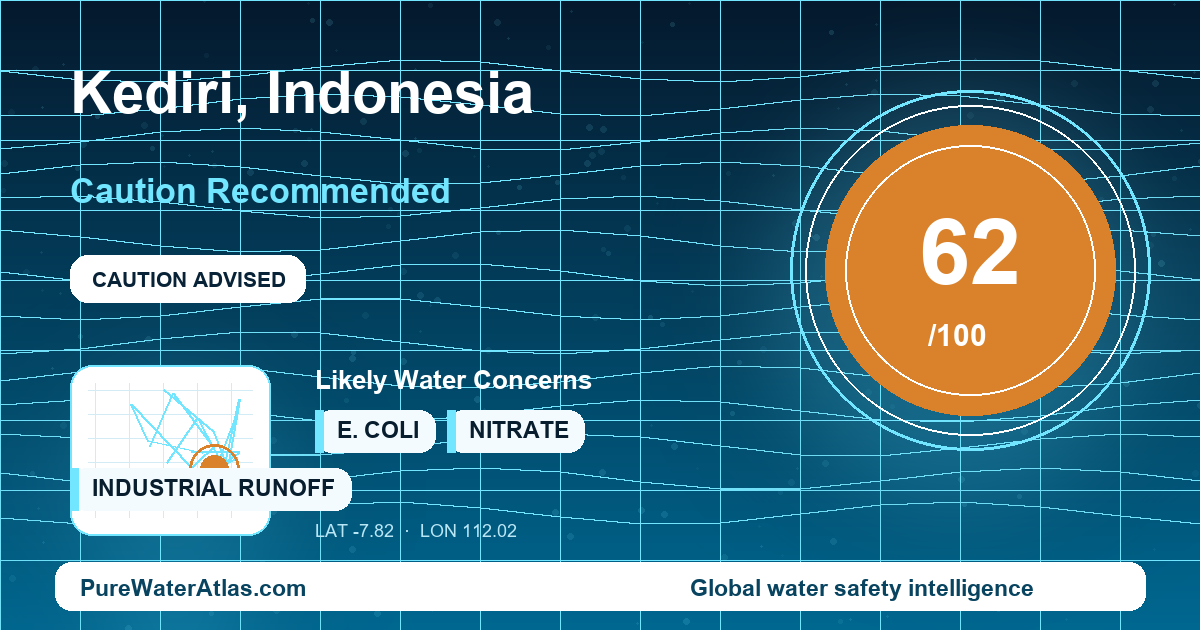
Kediri, East Java: a Brantas River basin city where managed municipal water exists, but direct tap drinking is not recommended without boiling, filtration, or verified treatment.
Quick Answer
| Water safety score | 62 / 100 |
|---|---|
| Risk level | Caution Recommended |
| Can visitors drink the tap water? | No. Visitors should not drink untreated tap water in Kediri. Use sealed bottled water, reputable refill water, or water that has been boiled or properly filtered and disinfected. |
| Resident guidance | Residents connected to Perumda Air Minum Tirta Dhaha can generally use the managed supply for washing, bathing, and cooking after boiling, but direct drinking should rely on boiling, maintained filtration plus disinfection, or verified depot/refill water. |
| Main local water context | Kediri sits in the Brantas River basin. The local municipal supply is operated by Perumda Air Minum Tirta Dhaha Kota Kediri and is understood from local utility context to rely on local groundwater and spring-fed sources, while the Brantas River is the dominant regional water system. |
| Local authority | Perumda Air Minum Tirta Dhaha Kota Kediri, with public-health oversight linked to Dinas Kesehatan Kota Kediri and national standards from Indonesia’s Ministry of Health. |
| Home filter recommendation | For direct drinking, yes. A practical Kediri setup is sediment prefiltration, activated carbon, and either UV disinfection or boiling. Reverse osmosis should be considered mainly where testing shows dissolved contaminant concerns. |
Editorial verdict: Caution recommended. Kediri has an established municipal water utility and local raw-water resources, but recent city-level drinking-water quality reports by treatment unit, distribution zone, and household tap were not found in easily accessible public sources. That means this profile does not claim that Kediri tap water meets or fails specific limits for E. coli, nitrate, arsenic, lead, turbidity, iron, manganese, PFAS, or chlorine. The guidance is a cautious synthesis of the local utility setting, Brantas basin context, Indonesian travel-water norms, and household storage risks.
Why Kediri Is Different
Kediri’s drinking-water risk profile is shaped by its inland East Java geography. The city is physically divided by the Brantas River, one of Java’s most important river systems. Unlike coastal Indonesian cities, Kediri’s main concern is not seawater salinity intrusion. The more relevant pressures are river-basin pollution, urban wastewater, agricultural runoff, seasonal turbidity, groundwater protection, household tanks, and building-level plumbing.
This matters because water safety in Kediri is not only a question of whether a municipal utility exists. It also depends on what happens after water leaves a production unit: pressure changes in pipes, intermittent supply events, storage in roof or ground tanks, private pumps, faucet aerators, and older internal plumbing can all affect the water that actually reaches a glass. For travelers, the practical conclusion is simple: clear tap water should not be assumed to be microbiologically safe. For residents, the decisive point is often the “last 10 meters” inside the property.
Kediri also sits in a volcanic and agricultural landscape where groundwater recharge, spring flows, sediment movement, and runoff patterns can vary seasonally. This does not prove a citywide contaminant exceedance, but it does explain why turbidity, sediment, iron, manganese, microbial indicators, and private-well testing are more relevant concerns than desalination or seawater intrusion.
Where Does Kediri’s Tap Water Come From?
Kediri is located in the Brantas River basin, and the Brantas River is the dominant regional surface-water system running through the city. The basin is important for water resources, drainage, irrigation, and regional source-water pressure. Municipal drinking-water service in the city is operated by Perumda Air Minum Tirta Dhaha Kota Kediri.
Based on the local utility context available for Kediri, the municipal supply is understood to rely on local groundwater and spring-fed raw-water sources rather than a single large, publicly documented surface-water treatment plant. This distinction matters. Groundwater and spring-fed systems can have different concerns from river-intake systems, including mineral-related taste, staining, iron or manganese deposits, and household filter clogging. At the same time, the wider Brantas basin still matters because it shapes regional water-resource management, drainage, runoff, and pollution pressure.
Kediri’s practical drinking-water infrastructure includes the Perumda Air Minum Tirta Dhaha distribution network, local production units using spring or groundwater sources where documented by utility context, Brantas basin water resources managed regionally by national water institutions, household storage tanks and pumps, and commercial bottled or refill water supply chains. In day-to-day use, many households and businesses rely on a mix of PDAM water, private wells, storage tanks, boiling, filters, and depot or bottled drinking water rather than universal direct-from-tap drinking.
Who Manages Drinking Water in Kediri?
The local municipal drinking-water utility is Perumda Air Minum Tirta Dhaha Kota Kediri. Local public-health oversight is associated with Dinas Kesehatan Kota Kediri, while national drinking-water health requirements are set by Indonesia’s Ministry of Health. The relevant national framework includes Permenkes No. 2 Tahun 2023, which covers environmental health quality standards and health requirements for water.
The wider water-resource setting is connected to the Brantas basin, overseen through national and provincial institutions, including the Ministry of Public Works and Housing river-basin organization for Brantas. The Balai Besar Wilayah Sungai Brantas is relevant because Kediri sits on this major river system. City administrative context is available from the Kediri City Government, and city-level statistical context is available from BPS Kota Kediri.
However, institutional clarity is not the same as full public tap-water transparency. Recent public datasets showing Kediri parameter-by-parameter tap-water results by distribution zone, treatment unit, household faucet, or private well were not found in accessible official sources. That limitation is important when deciding whether untreated tap water is safe to drink.
Main Local Water Concerns
- Microbial contamination at the point of use: This is the central practical concern for Kediri travelers and many households. Even if municipal water is treated, contamination can occur through low pressure, leaks, household tanks, poor storage, or internal plumbing. This is why untreated tap water is not recommended for visitors.
- Turbidity and sediment during rainy periods: The rainy season in East Java commonly runs around November to April. Heavy rain in the Brantas basin can increase runoff, suspended solids, sediment, and microbial loading in source waters. Turbidity can also reduce disinfection effectiveness and leave visible deposits in taps or tanks.
- Groundwater minerals such as iron and manganese: Where spring and groundwater sources are used, aesthetic or operational issues can include metallic taste, orange or black deposits, staining, and filter clogging. This is a plausible groundwater-fed system concern, not a claim of a confirmed citywide exceedance.
- Agricultural and urban runoff: The Brantas basin receives pressure from settlement, agriculture, and industry across East Java. For drinking water, this increases the importance of source protection, adequate treatment, and household caution.
- Old plumbing and storage tanks: Older galvanized pipes, corroded fittings, stagnant plumbing, uncovered tanks, insects, sunlight, sediment, and biofilm can change water quality after it leaves the utility network.
Dry season, commonly around May to October, can bring different issues: lower river flows may concentrate pollutants, and some properties may depend more heavily on stored water, private wells, or pumped supply. After floods, pipe repairs, or long service interruptions, discolored water and microbial intrusion risk can increase. In those situations, flushing taps and boiling or disinfecting water until clarity and safety are restored is prudent.
For Travelers
Do not drink untreated tap water in Kediri. Short-stay visitors should use sealed bottled water, reputable refill water, or water that has been boiled or properly filtered and disinfected. This is especially important for children, pregnant travelers, older adults, people with sensitive stomachs, and anyone with a weakened immune system.
For brushing teeth, healthy adults can reduce risk by using bottled or boiled water, especially on short visits. Immunocompromised travelers, young children, and people prone to gastrointestinal illness should avoid tap water for brushing. Do not rinse baby bottles, cut fruit, or ready-to-eat foods with untreated tap water.
Ice is a common weak point. Avoid ice from street vendors or unclear sources. In higher-end hotels or restaurants, ice may be made from purified water, but if uncertain, ask whether it is made from air matang or filtered water. For hot drinks, tea and coffee made with boiled water are usually a safer option than cold drinks of uncertain water origin.
Hotels and guesthouses in Kediri may provide bottled water, refill dispensers, or a kettle. A kettle is useful for microbial safety, but boiling does not remove metals, nitrate, or dissolved chemicals if those are present. Carry sealed water when moving around Kediri in hot weather, and ask rentals or small guesthouses whether drinking water is bottled, filtered, or boiled.
For Residents
For Kediri residents, direct drinking should rely on a treatment barrier unless recent test results from the household tap show the water is safe. A practical setup for many PDAM-connected homes is sediment prefiltration for particles, activated carbon for taste and chlorine, and either UV disinfection or boiling for microbial control. Learn more about options in the PureWaterAtlas guide to water purification methods, plus the specific guides to boiling water purification and UV water purification.
Reverse osmosis may be appropriate for some private wells or homes with confirmed nitrate, salinity, or dissolved contaminant concerns, but it should not be chosen blindly. RO systems require maintenance, reject water, and post-treatment hygiene. Testing first is the better approach.
Private wells should be tested at least annually for total coliform and E. coli, and again after flooding, plumbing work, or a change in taste, odor, or color. PDAM-connected homes should test at the tap if there is persistent odor, discoloration, sediment, gastrointestinal illness concern, or storage in a roof or ground tank. Useful parameters include turbidity, pH, electrical conductivity or TDS, free chlorine residual where relevant, color, odor, temperature, total coliform, and E. coli. For groundwater and wells, consider nitrate, iron, manganese, hardness, and where local geology or industrial influence is suspected, arsenic and other metals.
Older buildings need extra caution. Utility water quality is not always the same as faucet quality. Old pipes, brass fixtures, solder, sediment buildup, and long stagnation periods can alter water inside the property. If plumbing materials are unknown, flush stagnant water before use and consider first-draw and flushed testing for lead. Storage tanks should be covered, screened against insects and animals, cleaned periodically, protected from sunlight and roof runoff, and retested after cleaning if biofilm, algae, sediment, or odor has been present.
Relevant Contaminants and Water-Quality Issues
The most relevant Kediri issue for drinking decisions is microbial safety. Read the PureWaterAtlas profile on E. coli in drinking water for why fecal indicator bacteria drive boil-water decisions. The broader water microbiology guide explains bacteria, viruses, and household risk control.
Because Kediri sits in the Brantas basin and experiences rainy-season runoff pressures, turbidity and sediment are important practical topics. Turbid or visibly dirty water should not be treated as safe simply because it has no strong odor.
For groundwater-fed supplies and household wells, iron, manganese-related staining, hardness, and taste issues may be relevant, while nitrate matters for wells exposed to agricultural or wastewater influence. Use the nitrate testing guide on nitrate contamination detection if a well or agricultural setting is involved. In older buildings, review lead in drinking water and the lead testing guide, not because Kediri has a proven citywide lead problem, but because internal plumbing can be a site-specific risk.
Chlorine is also relevant in piped systems because residual disinfectant helps control microbial regrowth. The PureWaterAtlas page on chlorine in drinking water explains its role in taste, odor, and microbial protection.
How to Verify Your Water Quality
The best way to move beyond general caution is to test the water at the point where you actually drink it. For Kediri residents, that usually means the kitchen tap after any household tank, pump, filter, or building plumbing. The PureWaterAtlas complete water testing guide explains how to choose parameters and interpret results.
If you are comparing Kediri with other destinations, use the Global Water Quality Checker. If a laboratory report lists an unfamiliar parameter, search it in the Contaminants Search Engine. For broader decision-making, the PureWaterAtlas guide to drinking water safety gives a framework for deciding whether tap water is safe at the faucet.
For private wells, include microbiology first: total coliform and E. coli. Add nitrate, iron, manganese, hardness, conductivity or TDS, pH, turbidity, and locally relevant metals where needed. For PDAM-connected homes, test after storage tanks and filters, because that is the water you actually consume. Retest after floods, plumbing repairs, long interruptions, tank cleaning, or sudden changes in taste, odor, or color.
Official and Technical Sources
- Perumda Air Minum Tirta Dhaha Kota Kediri — official local municipal water utility identity for Kediri.
- Kediri City Government — official city-government source for local administrative context and public services.
- BPS Kota Kediri — official statistical source for Kediri City context.
- Balai Besar Wilayah Sungai Brantas — official Brantas river-basin authority under Indonesia’s Ministry of Public Works and Housing.
- Permenkes No. 2 Tahun 2023 — Indonesian national health regulation covering environmental health quality standards and water requirements.
- WHO Guidelines for Drinking-water Quality — international reference for microbial risk, chemical contaminants, and household water safety principles.
- CDC Travelers’ Health: Indonesia — travel-health guidance supporting conservative food and water precautions for visitors.
Bottom Line
Kediri’s tap water should be treated with caution. The city has a recognized municipal utility, Perumda Air Minum Tirta Dhaha Kota Kediri, and sits within the important Brantas River basin, but easily accessible recent tap-level compliance data are limited. Visitors should not drink untreated tap water and should use sealed bottled water, reputable refill water, or boiled and properly treated water. Residents can generally use managed piped water for bathing, washing, and cooking after boiling, but direct drinking should depend on boiling, UV, maintained filtration, or verified refill water. Private wells, roof tanks, older plumbing, sediment, odor, or discoloration all justify testing at the actual household tap.
Read the full guide: Global Water Quality Guide
Explore more in this category: Global Water Quality Articles