
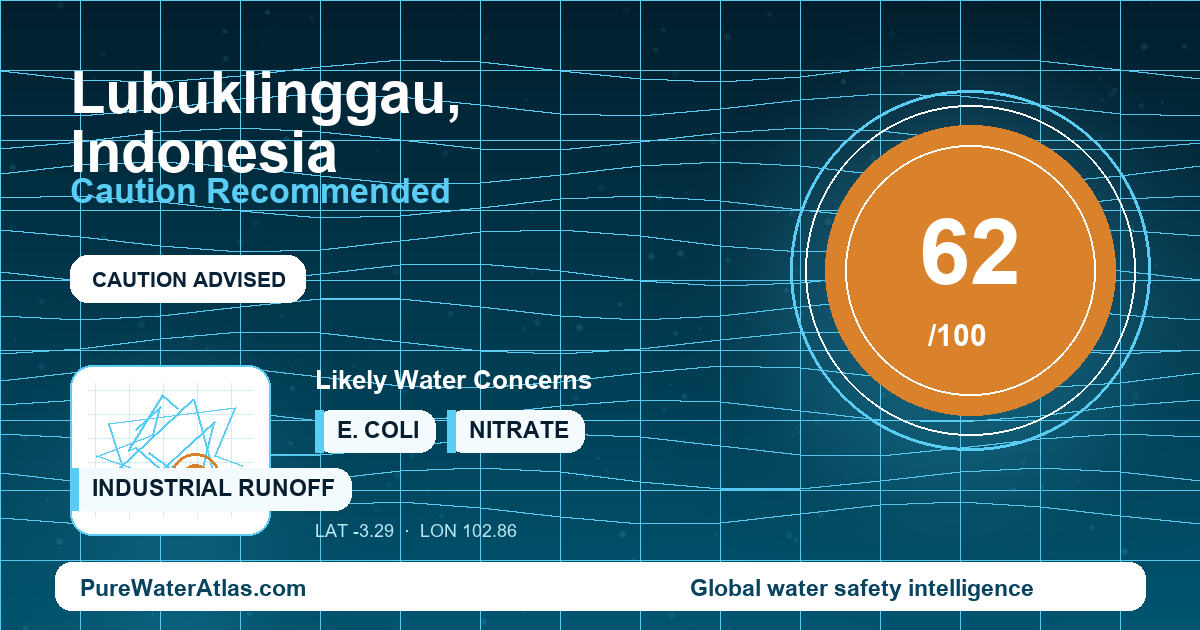
Lubuklinggau, South Sumatra: inland river-fed municipal water with caution recommended for direct drinking, especially where building tanks, pressure interruptions, or recent rain affect final tap quality.
Quick Answer
| Overall safety status | Caution recommended. PureWaterAtlas score: 62/100. Lubuklinggau has a formal municipal supplier and treated surface-water infrastructure, but recent public tap-level laboratory results are limited. |
|---|---|
| Can tourists drink the tap water? | Not recommended straight from the tap for most visitors. Use sealed bottled water, properly boiled water, or a verified purifier unless your hotel specifically confirms its drinking-water system is maintained for potable use. |
| Resident guidance | Municipal water can generally be used for bathing, washing, and cooking after boiling, but daily drinking should depend on household plumbing, storage tanks, pressure reliability, and periodic testing. |
| Main water setting | Inland surface-water context in the upper Musi basin, closely associated with the Kelingi River system and local river infrastructure such as Watervang. |
| Water authority | Perumda Air Minum Tirta Bukit Sulap, also referred to locally as PDAM Tirta Bukit Sulap, with local government oversight by Pemerintah Kota Lubuklinggau and national standards set by Indonesia’s Ministry of Health. |
| Filter recommendation | For drinking, use sediment prefiltration plus activated carbon and a microbiological barrier such as boiling or UV where suitable. Reverse osmosis is mainly for cases where testing shows nitrate, metals, high dissolved solids, or well-water concerns. |
Confidence level: medium-low. The city’s utility identity and river-basin context are clear, but recent, public, consumer-tap-level laboratory data for Lubuklinggau is not readily available.
Why Lubuklinggau Is Different
Lubuklinggau’s drinking-water profile is shaped by its inland location in South Sumatra, not by coastal or desalination issues. The city sits near the Bukit Barisan foothill environment and is associated with the Kelingi River system in the upper Musi basin. That means the most relevant practical concerns are river-source variability, wet-season turbidity, microbial protection, distribution pressure, and household storage conditions.
This is important because clear-looking tap water in Lubuklinggau does not automatically mean low risk. In river-fed systems, raw water can change quickly after heavy rain. If treatment, disinfection, pressure, or tank hygiene is inconsistent, water that left the plant in better condition can become vulnerable before it reaches a kitchen or bathroom tap. For that reason, this page treats the final tap as a local, building-specific risk point, not only a municipal source-water question.
The Watervang area is a well-known water-control landmark on the Kelingi River and reflects Lubuklinggau’s historical dependence on engineered river water. It should be understood as useful local context, not proof that every present-day tap in the city is supplied from one specific structure.
Where Does Lubuklinggau’s Tap Water Come From?
Lubuklinggau is best understood as a treated surface-water city. The local municipal supply is associated with river catchments, especially the Kelingi River system and nearby tributaries, within the upper Musi watershed. It is not a coastal groundwater or desalinated water system, so seawater intrusion is not the dominant drinking-water issue for the city.
The main infrastructure relevant to tap-water safety includes surface-water intakes, water treatment plants known locally as IPA or instalasi pengolahan air, distribution mains, service pipes, and the building-level systems that complete the last mile. Household pumps, roof tanks, ground tanks, hoses, and internal plumbing can materially affect the water that residents or visitors actually consume.
During wet-season storms, river water can become more turbid, more colored, and more sediment-laden. These conditions increase treatment load and can also make household filters clog more quickly. During dry or low-flow periods, lower river flow can concentrate taste, odor, or pollution pressures where upstream wastewater, market activity, agriculture, urban drainage, or tributary conditions influence the watershed. After flooding, pipe repairs, main breaks, or pressure loss, water should be treated as a boil-water situation until it runs clear and normal service is confirmed.
Who Manages Drinking Water in Lubuklinggau?
Lubuklinggau’s municipal drinking-water utility is Perumda Air Minum Tirta Bukit Sulap, also referred to locally as PDAM Tirta Bukit Sulap. Local oversight sits with Pemerintah Kota Lubuklinggau, while health-based drinking-water requirements are set nationally by Indonesia’s Ministry of Health.
Indonesia’s current national regulatory context includes Permenkes No. 2 Tahun 2023, which sets environmental health and water quality standards. Water-resource and bulk infrastructure responsibilities also involve public works and water-resources agencies, including the relevant river-basin authority for the Musi and Sumatra VIII area. Utility performance information may appear through Ministry of Public Works and Housing or BPPSPAM-related systems, but consumer-facing tap test reports for Lubuklinggau are not consistently easy to obtain.
Because of that data limitation, this profile does not claim that all neighborhoods meet or fail specific parameters. The practical recommendation is based on the identifiable municipal supplier, local river-source context, Indonesian regulatory framework, and common distribution or storage vulnerabilities in systems where pressure and household tanks can influence final tap safety.
Main Local Water Concerns
- Turbidity and sediment pulses: Lubuklinggau’s surface-water setting means rain can make source water muddy. High turbidity can interfere with disinfection and increase filter load. Learn more about turbidity and sediment.
- Microbial contamination risk: River-source water requires reliable treatment and disinfection. Risk rises after treatment interruptions, leaks, pressure drops, flooding, repairs, or contaminated tanks. E. coli is a key indicator for fecal contamination risk.
- Chlorine residual variability: A residual disinfectant helps protect water in the distribution network, but residual, taste, and odor can vary by distance from treatment works and by storage practices. See PureWaterAtlas on chlorine.
- Iron, manganese, and discoloration: City-specific measured levels should be confirmed by testing, but discoloration or staining may come from pipe deposits, source conditions, household tanks, or well-water influence. Relevant profiles include iron and manganese.
- Private wells and shallow groundwater: Homes not continuously served by piped water may use wells. Shallow wells near septic systems, drains, runoff pathways, workshops, or agricultural influence can be vulnerable to E. coli, nitrate, turbidity, taste, and color problems.
- Old premises and internal plumbing: No public evidence confirms a citywide lead problem in Lubuklinggau, but older fixtures, brass components, solder, or poorly maintained internal plumbing can affect the final tap. See lead for testing context.
For Travelers
Most short-term visitors should avoid drinking Lubuklinggau tap water straight from the tap. The safest practical choice is sealed bottled water, properly boiled water, or water from a verified purifier or maintained dispenser. This recommendation is not based on a known seawater or desalination problem; it is based on limited public tap-testing transparency and the practical risks of river-fed supply, building storage, and possible pressure variability.
For brushing teeth, use bottled or boiled water if you have a sensitive stomach, are immunocompromised, are traveling with young children, or are staying in budget accommodation where tank maintenance is uncertain. Some experienced travelers may brush with tap water, but it is not the lowest-risk option.
Be cautious with ice. Use ice only where a reputable hotel, cafe, or restaurant can confirm it is commercially produced or made from treated water. Street-vendor ice is harder to verify. In hotels and restaurants, ask whether drinking water comes from sealed gallons, a maintained dispenser, boiled water, or a filtration system. In better-maintained properties, dispenser water may be safer than bathroom tap water because it may bypass building plumbing and roof tanks.
If you must use tap water, bring it to a rolling boil and let it cool in a clean, covered container. PureWaterAtlas has a detailed guide to boiling water purification, and the CDC traveler guidance linked below provides additional practical disinfection advice.
For Residents
Residents connected to Perumda or PDAM water can generally use municipal water for bathing, washing, and cooking after boiling, but drinking-water decisions should be made at the household level. The important questions are: Does your supply become cloudy after rain? Is service intermittent? Is water stored in a roof tank or ground tank? Has the property had recent pressure loss, flooding, repairs, or pump issues? Is the building old or are plumbing materials unknown?
For daily drinking, a home treatment step is advisable where water is stored, cloudy, intermittently supplied, or used by infants, pregnant people, older adults, or immunocompromised residents. A practical setup is sediment prefiltration followed by activated carbon and then boiling, UV, or another microbiological barrier. See PureWaterAtlas guides to UV water purification and broader water purification methods.
Reverse osmosis can be useful for some private wells or where testing shows nitrate, metals, or high dissolved solids, but it should not be installed blindly. It requires maintenance, cartridge replacement, and a clear reason based on testing.
Storage tanks deserve special attention in Lubuklinggau because building systems can undo the benefit of treated municipal water. Clean and disinfect roof tanks or ground tanks regularly, especially before and after the wet season. Keep lids sealed against insects, dust, birds, rodents, and floodwater. Treat tank water as higher risk when chlorine odor is absent, sediment accumulates, algae grows, insects are visible, or pressure has recently failed.
In older buildings, avoid drinking first-draw water that has sat overnight. Flush the tap, use cold water for cooking, and consider laboratory testing for lead or other metals if plumbing age is uncertain. PureWaterAtlas has a practical guide to lead testing and detection methods.
Relevant Contaminants and Water-Quality Issues
The most relevant Lubuklinggau issues are not exotic contaminants; they are basic river-water and distribution-system risks. Start with turbidity, because muddy water after rain can reduce treatment effectiveness and clog home filters. Pair that with sediment if you see cloudiness, grit, or deposits after storms or pipe work.
For health protection, the key microbiological indicator is E. coli, especially for private wells, tank-stored water, and tap water after outages, flooding, or repairs. Chlorine matters because residual disinfectant helps protect treated water in distribution, although taste and residual levels may vary.
If your water causes staining, black particles, metallic taste, or discoloration, review iron and manganese. If you use a shallow well near septic systems, drains, runoff routes, or agriculture, include nitrate in testing. If your building is older or plumbing materials are unknown, include lead even though no citywide lead source-water problem is documented here.
How to Verify Your Water Quality
Because recent public consumer-tap laboratory data for Lubuklinggau is limited, verification should happen at the point of use: your tap, tank, well, or dispenser. For piped water, test turbidity, color, pH, conductivity or TDS, and free chlorine residual to understand basic operating conditions. After outages, flooding, repairs, or pressure loss, add E. coli or total coliform testing.
For private wells or mixed supply, add nitrate, iron, manganese, and locally relevant parameters such as hardness or ammonia. If the property is older, collect both first-draw and flushed samples for lead and other metals rather than assuming the municipal source is the only risk.
PureWaterAtlas resources that can help include the complete guide to water testing, the Contaminants Search Engine, the Global Water Quality Checker, the drinking water safety guide, and the water microbiology guide. For watershed runoff context, see agricultural runoff in drinking water and the PureWaterAtlas article on nitrate testing and detection.
Official and Technical Sources
- Badan Pusat Statistik Kota Lubuklinggau — official city statistics source for Lubuklinggau geography, population, and infrastructure context.
- Pemerintah Kota Lubuklinggau — official municipal government source for local institutions and city administration context.
- Balai Besar Wilayah Sungai Sumatera VIII, Ministry of Public Works and Housing — river-basin authority relevant to South Sumatra water resources and the Musi basin.
- Ministry of Public Works and Housing drinking-water performance information system, BPPSPAM or Cipta Karya — official source for Indonesian municipal drinking-water utility performance references where available.
- Permenkes No. 2 Tahun 2023 — national legal reference for Indonesian environmental health and drinking-water quality standards.
- World Health Organization drinking-water fact sheet — public-health background on safe drinking water and microbial risk.
- CDC Travelers Health: Water Disinfection for Travelers — practical traveler guidance for boiling and disinfection.
Bottom Line
Lubuklinggau’s tap water deserves a cautious rating, not because the city is coastal or lacks a municipal supplier, but because it is an inland, river-influenced system where final tap quality can depend on treatment consistency, wet-season turbidity, distribution pressure, household tanks, and premise plumbing. Perumda or PDAM Air Minum Tirta Bukit Sulap is the local municipal operator, and national standards apply, but recent public tap-level test results are not readily accessible. Visitors should use sealed bottled, boiled, or verified filtered water for drinking. Residents can usually use municipal water for washing and cooking after boiling, but daily drinking is safer with maintained filtration, boiling or UV, tank hygiene, and targeted testing after outages, flooding, repairs, or visible water changes.
Read the full guide: Global Water Quality Guide
Explore more in this category: Global Water Quality Articles