
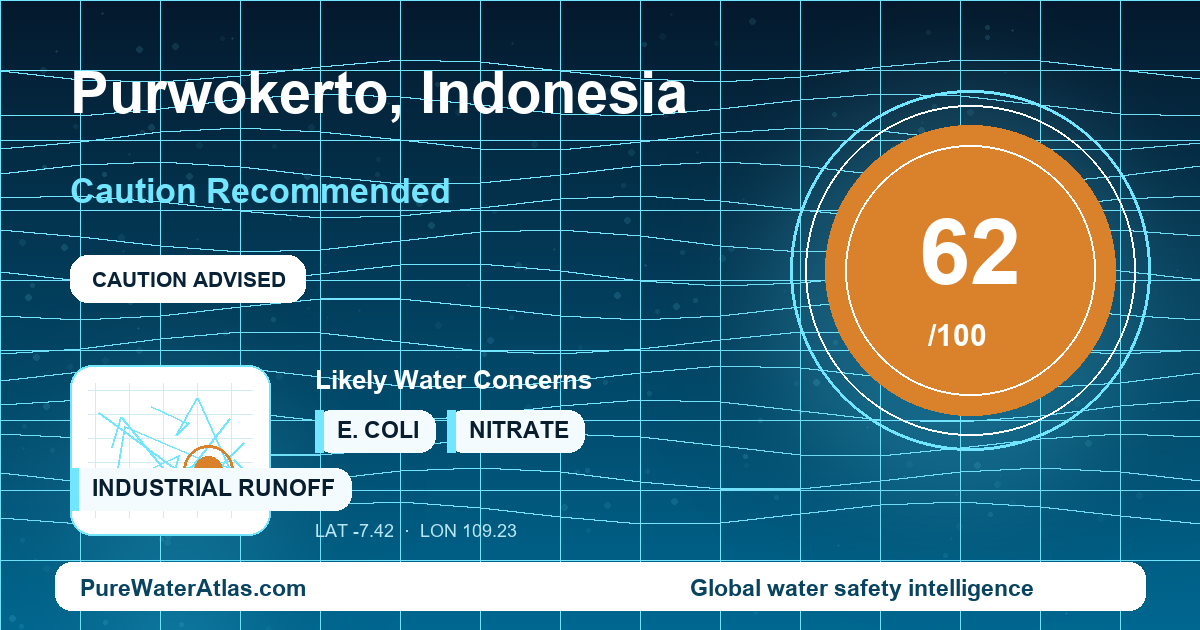
Purwokerto has organized piped-water service through the Banyumas public water company and benefits from an inland Mount Slamet–Serayu basin setting, but untreated tap water should still be approached with caution because public tap-sampling data are limited and household-level risks can be significant.
Quick Answer
| Overall safety status | Caution recommended. Purwokerto’s water safety score is 62/100. The city has a public utility and relevant mountain catchment resources, but untreated tap water should not be assumed safe for all users. |
|---|---|
| Can travelers drink the tap water? | No for most short-term visitors. Use sealed bottled water, properly boiled water, or water from a reputable filtered refill source. Be careful with ice and cold drinks made with unknown water. |
| Resident advice | Perumdam Tirta Satria customers may receive treated piped water, but point-of-use treatment is prudent for drinking, especially where water is stored in roof tanks, pressure is intermittent, or building plumbing is old. |
| Main local water setting | Purwokerto is inland in Banyumas Regency, near the southern foothills of Mount Slamet and within the Serayu River basin context. Upland springs, surface-water intakes, shallow groundwater, private wells, and commercial refill water are all relevant. |
| Water authority | Public piped water is associated with Perumdam Tirta Satria Banyumas, with public-health oversight linked to Banyumas Regency and Indonesia’s national drinking-water requirements. |
| Filter recommendation | For piped water, use sediment filtration plus activated carbon for particles, taste, and odor; add boiling, UV, or another verified disinfection step when microbiological safety is uncertain. Private wells should be tested before treatment is selected. |
Why Purwokerto Is Different
Purwokerto is not a coastal city and its main water questions are not primarily about seawater intrusion or desalination. It is the urban center and regency capital of Banyumas in Central Java, located inland near the southern foothills of Mount Slamet and within the broader Serayu River basin setting. That geography matters: mountain runoff, upland springs, volcanic soils, river catchments, storm runoff, and seasonal rainfall are more relevant to local drinking-water risk than coastal salinity.
The city also has an administrative feature that affects water information: Purwokerto is not a separate municipality with its own stand-alone water regulator. Water governance, infrastructure statistics, and public-service information are often reported at the Banyumas Regency level rather than as Purwokerto-only drinking-water datasets. This makes it possible to identify the responsible water company and regional water context, but harder to verify neighborhood-by-neighborhood tap quality from public records.
The practical question for residents and visitors is therefore not simply whether water is treated at a plant. Water may pass through distribution pipes, low-pressure sections, household storage tanks, roof tanks, hotel tanks, boarding-house plumbing, refill containers, or private well systems before it is consumed. In Purwokerto, the final safety of water at the glass can differ from the quality of water leaving a treatment facility.
Where Does Purwokerto’s Tap Water Come From?
Purwokerto is served where network connections exist by Perumdam Tirta Satria Banyumas, the public drinking-water company for Banyumas Regency. The relevant raw-water setting is the Mount Slamet and Serayu River basin system. Upland springs and surface-water intakes from the Serayu catchment and its tributaries are the most relevant public-water sources for the Banyumas–Purwokerto urban system.
The broader Banyumas water-supply context has historically depended on upland springs, small rivers, and shallow groundwater rather than large coastal reservoirs or seawater desalination. This inland volcanic setting can provide important water resources, but it also means that rainfall, catchment disturbance, sediment movement, and microbial contamination pathways matter. During heavy storms, surface-water sources and spring catchments can receive more sediment and microbial loading. After landslides or sediment pulses in upland catchments, treatment plants and distribution systems may be stressed, and some users may notice visible cloudiness or sediment.
Key infrastructure relevant to Purwokerto includes the Perumdam Tirta Satria Banyumas piped distribution network, raw-water intakes and spring-capture systems in the Banyumas and Mount Slamet catchment area, water treatment installations known locally as IPA or instalasi pengolahan air for surface-water sources, transmission mains, reservoirs, neighborhood pipes, household storage tanks, and private wells. Commercial refill-water depots are also common drinking-water sources in Indonesia, but their safety depends on depot hygiene, filtration, disinfection, and container handling.
Who Manages Drinking Water in Purwokerto?
The local public drinking-water utility for Banyumas Regency, including Purwokerto where piped service is available, is Perumdam Tirta Satria Banyumas. Local government context is provided by the Banyumas Regency Government, and official statistical context is available through BPS Kabupaten Banyumas. The Serayu basin context is supported by the Balai Besar Wilayah Sungai Serayu Opak, under Indonesia’s Ministry of Public Works.
Indonesia’s national drinking-water and environmental health requirements are set through national regulation. A key reference is Ministry of Health Regulation No. 2 of 2023. National water-supply infrastructure context is also associated with the Direktorat Jenderal Cipta Karya, Kementerian PUPR.
PureWaterAtlas did not find a recent, comprehensive, Purwokerto-specific public tap-water compliance report comparable to a U.S. Consumer Confidence Report. The available information supports a risk-based assessment rather than a claim that every household tap is verified safe or unsafe. This is why the city rating is “Caution Recommended,” not a blanket pass or fail.
Main Local Water Concerns
The most important Purwokerto-specific concern is the gap between source or treated-water quality and water as actually consumed. Treated utility water may still pass through old or low-pressure distribution sections, building plumbing, roof tanks, ground tanks, and household containers before reaching the user. These final steps can introduce or amplify risk, especially when water is stored for long periods or tanks are not sealed and cleaned.
- Rainy-season turbidity: Heavy rainfall in the Mount Slamet and Serayu catchments can increase sediment and cloudiness in surface-water sources, particularly after storms.
- Microbial risk: Private wells, shallow groundwater, septic influence, poorly maintained tanks, and unhygienic storage containers can create risk from fecal contamination, including E. coli.
- Intermittent pressure: Service interruptions or low-pressure conditions can increase intrusion risk where pipes are damaged or depressurized.
- Iron, manganese, discoloration, or sediment: These are plausible in well water and some distribution or storage situations, but they require property-level testing rather than assumptions.
- Nitrate in shallow wells: Nitrate risk is most relevant for shallow wells in dense settlements or agricultural and peri-urban areas. It is especially important for infants and pregnant residents.
- Building-level metals: Lead is not documented as a Purwokerto-wide problem, but old plumbing, brass fixtures, solder, galvanized components, and stagnant water can affect individual buildings.
- Coastal salinity: This is not a primary Purwokerto concern because the city is inland.
For Travelers
Most travelers should not drink untreated tap water in Purwokerto. The safest practical choices are sealed bottled water, properly boiled water, hotel-provided dispenser water that is clearly maintained, or water from a reputable filtered refill source. This is consistent with conservative food-and-water precautions for Indonesia from CDC Travelers’ Health.
For brushing teeth, short-term visitors, immunocompromised travelers, pregnant travelers, young children, and people prone to stomach illness should use bottled, boiled, or reliably filtered water. Tap water may be fine for washing hands or showering, but ingestion is the key concern.
Be cautious with ice. Avoid ice from street vendors or informal locations unless you can confirm it was made from treated commercial water. Ice in higher-standard hotels and established restaurants is lower risk, but it still depends on the supplier, storage, and handling. Cold drinks, blended drinks, and cut fruit washed with unknown water deserve extra caution.
In hotels and restaurants, ask whether drinking water comes from sealed bottles, a maintained dispenser, or an in-house filtration system. Hot tea and coffee are generally safer when made with water that has reached a proper boil. If boiling water yourself, bring it to a rolling boil and let it cool in a clean, covered container. Do not drink water that is cloudy, has sediment, smells unusual, or comes from an unclean dispenser or storage jug.
For Residents
Residents connected to Perumdam Tirta Satria may receive treated piped water, but point-of-use treatment is still prudent for drinking in many homes. A sediment prefilter can reduce particles, while activated carbon can improve taste, odor, and chlorine-related complaints. However, sediment and carbon filters alone should not be treated as microbiological disinfection. If water is stored in roof tanks, if pressure interruptions occur, or if there is uncertainty about tank hygiene, add a verified disinfection step such as boiling or UV after appropriate sediment control.
Private well users should not assume the water is safe because it looks clear. Test at least annually for E. coli or thermotolerant coliforms, nitrate, turbidity, pH, conductivity or TDS, iron, and manganese. Test again after flooding, well repair, pump replacement, nearby construction, septic failure, or any sudden change in taste, odor, or color. For infants, pregnant residents, and immunocompromised people, microbial and nitrate testing should be prioritized before the water is used for drinking or formula.
Older buildings deserve additional caution. There is no public evidence of a Purwokerto-wide lead service-line issue, but old internal plumbing, brass fixtures, solder, galvanized materials, and stagnant water can contribute metals in individual buildings. Flush taps after long stagnation and test first-draw and flushed samples if children or pregnant people will drink the water regularly.
Storage tanks are often the weak point. Roof tanks, ground tanks, hotel tanks, and boarding-house tanks should be covered, screened against insects and animals, cleaned periodically, and disinfected after maintenance or contamination events. Refill-water users should choose depots that can show recent hygiene inspection or testing records and should use clean, sealed containers.
Relevant Contaminants and Water-Quality Issues
Turbidity in drinking water is one of the most relevant Purwokerto issues because rainy-season runoff in the Mount Slamet and Serayu catchment context can increase cloudiness and sediment in source waters. Turbidity can also reduce disinfection effectiveness, which is why visibly cloudy water should be treated cautiously.
E. coli in drinking water is the key indicator for fecal contamination in private wells, storage tanks, and poorly handled refill water. It is especially relevant for traveler stomach illness risk and for residents relying on shallow groundwater.
Chlorine in drinking water is relevant because treated piped systems often rely on residual disinfection. Some households filter water because of chlorine taste or odor, but removing chlorine without maintaining hygienic storage can increase microbial risk.
Nitrate in drinking water matters most for shallow wells in dense settlements or agricultural and peri-urban areas. Residents using wells for infants or during pregnancy should treat nitrate testing as a priority. Lead in drinking water is not identified as a citywide Purwokerto issue, but building-level plumbing can still matter in older properties.
How to Verify Your Water Quality
Because recent Purwokerto-specific consumer tap-water datasets were not found in readily accessible public sources, verification should be practical and household-specific. Start by identifying your water source: Perumdam piped water, a private well, a bore well, a refill depot, bottled water, or a building storage system. Then match testing and treatment to that source.
Private well households should use a laboratory or credible local testing pathway for microbial indicators, nitrate, turbidity, pH, conductivity or TDS, iron, and manganese. Old buildings should consider metals testing, including first-draw and flushed samples. Users of refill water should verify depot hygiene, filtration, disinfection, and container handling rather than judging only by taste or appearance.
PureWaterAtlas resources that can help include the complete water testing guide, the drinking water safety guide, the water microbiology guide, and the water purification methods guide. For treatment choices, see the guides to boiling water purification and UV water purification. For specific testing topics, see nitrate testing and detection and lead testing and detection.
You can also compare Purwokerto with other destinations using the Global Water Quality Checker, or look up individual substances in the Contaminants Search Engine.
Official and Technical Sources
- Perumdam Tirta Satria Banyumas — local public drinking-water company serving Banyumas Regency, including Purwokerto where piped service is available.
- Banyumas Regency Government — administrative and public-service context for Purwokerto within Banyumas Regency.
- BPS Kabupaten Banyumas — official Banyumas-level statistical context.
- Balai Besar Wilayah Sungai Serayu Opak — river basin authority context relevant to the Serayu basin.
- Direktorat Jenderal Cipta Karya, Kementerian PUPR — national SPAM and water infrastructure context.
- Ministry of Health Regulation No. 2 of 2023 — Indonesia’s national regulatory reference for drinking-water and environmental health quality requirements.
- CDC Travelers’ Health: Indonesia — conservative travel health advice on food and water exposure.
- World Health Organization: Drinking-water fact sheet — public health context for safe drinking water and microbial contamination risks.
Bottom Line
Purwokerto’s tap water deserves a cautious, source-specific approach. The city is served where connections exist by Perumdam Tirta Satria Banyumas and sits in an inland Mount Slamet–Serayu basin setting where springs, upland runoff, surface-water intakes, shallow groundwater, and seasonal rainfall all matter. However, PureWaterAtlas did not find recent public Purwokerto tap-sampling data showing routine neighborhood-level results for residual chlorine, E. coli, turbidity, metals, or treatment performance. Travelers should avoid untreated tap water and use bottled, boiled, or reliably filtered water. Residents should manage storage tanks carefully, test private wells, and use point-of-use disinfection when microbial safety is uncertain.
Read the full guide: Global Water Quality Guide
Explore more in this category: Global Water Quality Articles