
Introduction
Safe drinking water is one of the most important foundations of a healthy home. People rely on water every day for drinking, cooking, preparing infant formula, washing produce, brushing teeth, and many other daily activities. When that water becomes contaminated, even at levels that are not immediately noticeable, it can create short-term illness, long-term health concerns, and household safety problems. Understanding drinking water safety for households causes and sources helps families make better decisions about testing, treatment, storage, and everyday water use.
Water contamination does not always come from a single obvious event. It may begin at the source, such as a river, lake, or groundwater well. It can also occur during treatment, in storage tanks, in aging municipal distribution lines, or within household plumbing. For some homes, the risk is linked to environmental conditions such as flooding, nearby agriculture, industrial activity, or naturally occurring minerals in the ground. In others, the main concern may be old pipes, private wells, or poor maintenance of filters and treatment devices.
Because of these many pathways, households benefit from learning the common contamination routes, health effects, warning signs, and practical prevention steps. A broad overview is available in this complete guide to household drinking water safety, while readers seeking more topic-specific information can also explore the wider drinking water safety category.
This article explains what household drinking water safety means, identifies major contamination sources, outlines drinking water safety for households risk factors, and reviews drinking water safety for households detection and drinking water safety for households prevention. It also addresses common myths and summarizes the standards that shape water quality management.
What It Is
Drinking water safety for households refers to the condition in which water used in the home is free, or sufficiently protected, from harmful biological, chemical, physical, and radiological contaminants. Safe water should be suitable for human consumption and routine food-related use. It should also be monitored and managed in a way that reduces exposure to contaminants over time.
Water safety is not defined only by whether the water looks clean. Clear water may still contain bacteria, nitrates, lead, arsenic, pesticides, solvents, or other contaminants that cannot be seen, smelled, or tasted. In contrast, water with an unusual taste or odor does not always pose a serious health hazard, though it may indicate a problem that should be investigated.
Household water safety includes several related concepts:
- Source safety: the quality of groundwater, reservoir water, river water, or other source water before treatment and distribution.
- System integrity: the condition of municipal treatment plants, distribution systems, and private wells.
- Point-of-entry and point-of-use quality: water quality where water enters the home and where it is used, such as at kitchen taps or refrigerators.
- Household plumbing influence: contamination that occurs inside the home through pipes, fixtures, storage tanks, or water heaters.
- Exposure patterns: how residents interact with water through drinking, cooking, bathing, and inhalation of aerosols.
In practical terms, the topic of drinking water safety for households household exposure is especially important because contaminants can affect people in different ways. Some are mainly ingested through drinking water, while others may be inhaled in steam or mist, or absorbed in limited amounts through skin contact. Infants, children, pregnant individuals, older adults, and people with weakened immune systems can be more vulnerable than healthy adults.
Households may receive water from a regulated public water system or from a private source such as a well. This distinction matters. Municipal systems are generally required to test and treat water under regulatory frameworks, while private well owners often carry the full responsibility for monitoring and maintaining water quality. That means a home can have safe water one year and develop a problem the next if environmental conditions change, plumbing corrodes, or maintenance is neglected.
Main Causes or Sources
The most important part of understanding drinking water safety for households common sources is recognizing that contamination can enter water at multiple points. These sources are often grouped into microbiological, chemical, physical, and radiological categories.
Microbiological contamination
Microbiological contaminants include bacteria, viruses, and parasites. These are among the most urgent threats because they can cause acute illness quickly. Common pathways include sewage leaks, septic system failures, stormwater runoff, floodwater intrusion, animal waste, and inadequate disinfection.
- Bacteria: Organisms such as E. coli and coliform bacteria can indicate fecal contamination and the potential presence of pathogens.
- Viruses: Certain enteric viruses may enter water through human waste contamination.
- Protozoa and parasites: Giardia and Cryptosporidium are examples that can survive in some water conditions and cause gastrointestinal illness.
Private wells may be especially vulnerable after heavy rain, flooding, cracked well casings, or poor separation from septic systems. Municipal systems can also face microbial contamination if treatment barriers fail or if pressure loss allows outside contaminants into damaged distribution lines.
Chemical contamination from natural sources
Not all water contamination comes from industry or pollution. Some hazards occur naturally due to geology and water chemistry. Groundwater can dissolve minerals and metals from surrounding rock and soil. In certain areas, naturally occurring arsenic, uranium, fluoride, manganese, or iron may be found in drinking water.
Nitrate can also occur naturally at low levels, but high levels are often associated with human activity. Elevated natural minerals may affect taste or staining, while others can create more serious health concerns. Arsenic, for example, is colorless and tasteless in water and may only be identified through laboratory testing.
Chemical contamination from agriculture
Agricultural practices are a significant source of water quality concerns in many rural and suburban areas. Fertilizers, pesticides, herbicides, and animal waste can migrate into groundwater or be carried into surface water through runoff. This is one of the most important drinking water safety for households causes and sources in farming regions.
- Nitrates and nitrites: Often associated with fertilizer use and manure management. They are a major concern for infants.
- Pesticides and herbicides: Depending on the chemical, these may persist in soil and water and create chronic exposure concerns.
- Pathogens from livestock waste: Animal operations may contribute bacterial and parasitic contamination.
Industrial and commercial pollution
Industrial facilities, manufacturing sites, landfills, mining areas, fuel storage sites, and dry-cleaning operations may release contaminants into soil and water. These substances can migrate into aquifers or nearby surface waters used for drinking supplies. Even historic contamination from sites no longer in operation may persist for years.
- Volatile organic compounds: Such as solvents, degreasers, and fuel components.
- Heavy metals: Including lead, cadmium, chromium, and mercury in some settings.
- Per- and polyfluoroalkyl substances: Persistent synthetic chemicals associated with certain industrial and consumer uses.
- Petroleum hydrocarbons: From leaking underground tanks or spills.
Distribution system and plumbing sources
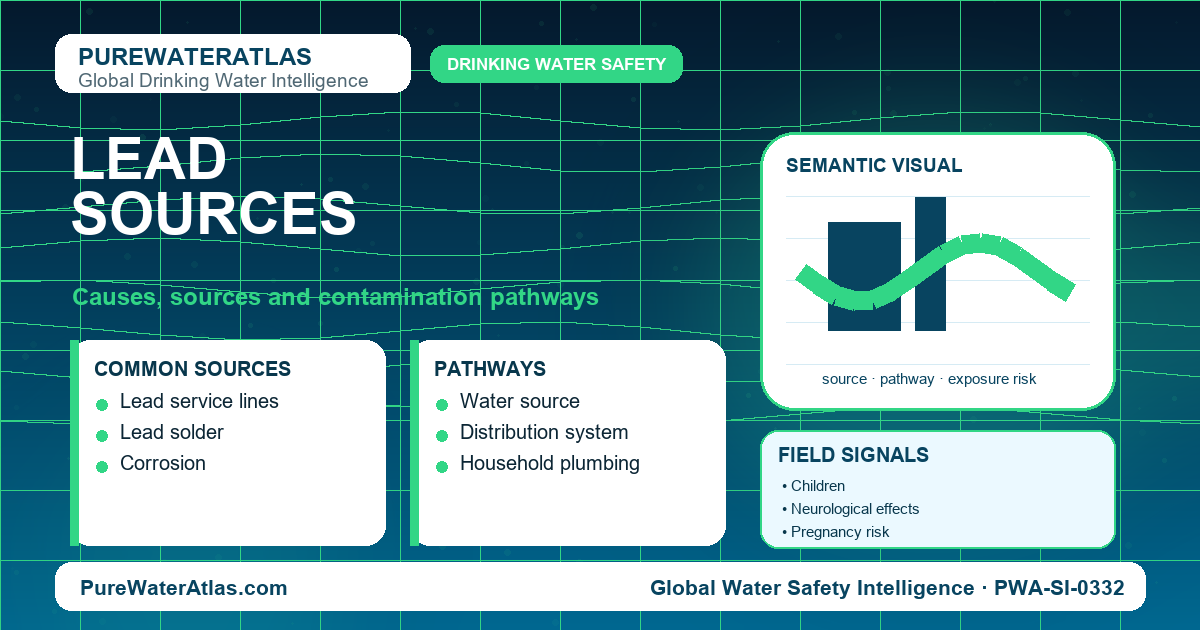
Water that leaves a treatment plant in good condition may still become contaminated before it reaches the tap. Aging infrastructure is a major factor in drinking water safety for households risk factors. Corroded service lines, old household pipes, poorly maintained building plumbing, and fixtures containing lead or other metals can release contaminants directly into drinking water.
- Lead: Often associated with lead service lines, solder, or brass fixtures.
- Copper: May leach from plumbing, especially when water is corrosive.
- Biofilm growth: Microorganisms may colonize plumbing interiors under some conditions.
- Backflow events: Contaminants can enter potable lines if pressure changes allow reverse flow.
Homes with older plumbing are often encouraged to review specialized resources on health effects and exposure pathways, such as this guide to health effects and risks.
Household treatment and storage failures
Some households use filters, softeners, reverse osmosis systems, storage tanks, or refrigerator dispensers to improve taste or quality. These systems can be beneficial, but poor maintenance may create new problems. Expired filters can lose effectiveness, and poorly sanitized equipment can harbor microbial growth.
Stored water can also become contaminated if kept in unclean containers or exposed to heat, sunlight, or environmental debris. In emergency situations, households sometimes overlook the importance of proper container sanitation and rotation schedules.
Environmental and climate-related sources
Changing environmental conditions can strongly influence water quality. Heavy storms, drought, wildfire, and flooding all alter the movement and concentration of contaminants.
- Flooding: Can introduce sewage, chemicals, and debris into wells and surface water sources.
- Drought: May concentrate contaminants and reduce dilution in source water.
- Wildfire: Can affect watersheds through ash, sediment, and changes in runoff chemistry.
- Extreme temperature shifts: May influence microbial growth and infrastructure stress.
Health and Safety Implications
The effects of unsafe drinking water depend on the contaminant, concentration, duration of exposure, and individual vulnerability. Some problems appear quickly, while others emerge only after months or years. This is why understanding drinking water safety for households household exposure is essential for prevention.
Short-term health effects
Acute effects are most commonly associated with microbial contamination. Symptoms may include nausea, vomiting, diarrhea, stomach cramps, fever, and dehydration. These can be especially dangerous for infants, older adults, and people with weakened immune systems.
Chemical exposures can also cause short-term symptoms in some cases, including headache, dizziness, irritation, or gastrointestinal distress. However, many chemical contaminants produce no immediate warning signs.
Long-term health effects
Chronic exposure to certain contaminants may increase the risk of more serious health outcomes. Examples include effects on neurological development, kidney function, cardiovascular health, liver function, and cancer risk. Lead exposure is a well-known concern because even relatively low levels can affect children’s developing brains and behavior. Arsenic has been linked with various long-term health effects, and high nitrate levels pose particular risk to infants because of the potential for reduced oxygen delivery in the blood.
Long-term health risks are often harder to identify because symptoms may not point clearly to water as the cause. This is one reason why households should not wait for illness before testing suspected water issues.
Population groups at higher risk
- Infants: More vulnerable to nitrates, lead, and microbial contamination.
- Children: Greater sensitivity to contaminants that affect growth and neurological development.
- Pregnant individuals: Exposure concerns may affect both parent and fetus.
- Older adults: More likely to experience severe outcomes from dehydration or infection.
- Immunocompromised individuals: Higher susceptibility to waterborne pathogens.
For deeper discussion of contaminant-specific outcomes, the article on household water health effects and risks can be useful.
Household safety beyond direct health effects
Unsafe water can create additional household consequences. Corrosive water may damage plumbing and appliances. Sediment and scaling may reduce heater efficiency, stain fixtures, and shorten the lifespan of water-using equipment. Odor and taste issues can lead residents to drink less water or switch to unsafe alternative sources. In emergency conditions, families may also face sanitation challenges if safe potable water is limited.
Testing and Detection
Drinking water safety for households detection depends on combining observation, routine testing, and response to local risk conditions. Because many contaminants are invisible, testing is often the only reliable way to determine whether water is safe.
Signs that suggest a possible problem
Although not definitive, certain changes may indicate the need for testing:
- Sudden changes in taste, smell, or color
- Cloudiness, sediment, or staining
- Blue-green stains that may suggest copper corrosion
- Rust-colored staining that may indicate iron or pipe corrosion
- Repeated gastrointestinal illness in the household
- Flooding, nearby construction, or recent plumbing work
- Known contamination events in the area
Routine testing for municipal water users
Households served by public systems benefit from utility monitoring, but this does not eliminate the need for occasional household-level testing. The water utility may provide consumer confidence reports or similar summaries of regulated contaminants, treatment performance, and any detected violations. Still, water quality can change between the treatment plant and the home tap, especially in older neighborhoods or buildings.
Tap testing may be appropriate when a household is concerned about lead, copper, plumbing-related contamination, or unusual changes in water quality.
Routine testing for private well owners
Private wells require a more proactive approach. At minimum, many experts recommend periodic testing for bacteria, nitrates, and other locally relevant contaminants, with additional testing after flooding, repairs, changes in taste or odor, or nearby land-use changes. Regional geology and activities often determine what should be added to the testing panel, such as arsenic, fluoride, manganese, pesticides, or industrial chemicals.
Common testing methods
- Certified laboratory analysis: The most reliable option for identifying regulated and unregulated contaminants.
- Field screening tests: Useful for some parameters, but often less comprehensive than laboratory methods.
- In-home lead or copper sampling: Often follows specific collection protocols to assess plumbing-related exposure.
- Microbial tests: May screen for total coliforms and E. coli as indicators of contamination.
Different contaminants require different sampling methods. For example, testing for bacteria may involve sterile bottles and strict timing, while metals testing may require first-draw or flushed samples depending on the question being investigated. More practical detail is available in this guide to testing and detection methods.
Interpreting results
A test result is only useful if interpreted correctly. Households should compare findings with applicable health-based guidelines, regulatory limits, or laboratory reference values. It is also important to understand that one clean result does not guarantee long-term safety if the water source is variable or the contamination source is intermittent.
If a contaminant is detected, the next steps usually include confirming the result if necessary, identifying the contamination source, evaluating immediate risk, and selecting an appropriate treatment or corrective action. Temporary measures may include using bottled water, boiling water when microbial contamination is suspected, or avoiding use for infant formula until expert guidance is obtained.
Prevention and Treatment
Drinking water safety for households prevention involves protecting the source, maintaining infrastructure, testing regularly, and selecting treatment methods that match the specific contaminant. There is no universal solution because filters and treatment systems vary widely in what they remove.
Source protection and household habits
- Keep hazardous chemicals, fuels, and pesticides away from wells and drainage areas.
- Maintain septic systems properly to reduce contamination risks.
- Inspect private wells, well caps, and surrounding grading regularly.
- Protect wells from surface runoff and floodwater intrusion.
- Dispose of medicines, oils, and chemicals safely rather than pouring them down drains or onto soil.
- Stay informed about nearby industrial activity, agricultural changes, or contamination advisories.
Plumbing-related prevention
For homes with older plumbing, reducing corrosion exposure is essential. Letting water run briefly after long periods of stagnation may reduce some metal concentrations at the tap. Cold water should generally be used for drinking and cooking because hot water can dissolve metals more readily from plumbing materials. If lead service lines or lead-bearing fixtures are suspected, replacement may offer the most reliable long-term solution.
Boiling water: when it helps and when it does not
Boiling is effective against many microbial contaminants, which is why boil-water advisories are commonly issued during suspected bacterial contamination events. However, boiling does not remove lead, nitrates, many chemicals, or dissolved minerals. In fact, boiling can concentrate some chemical contaminants by evaporating water. This is a critical point in household water safety education.
Common treatment options
Treatment should be selected based on test results, not guesswork. Common approaches include:
- Activated carbon filtration: Can reduce certain organic compounds, taste, odor, and chlorine, but does not reliably remove all metals or microbes.
- Reverse osmosis: Often effective for many dissolved contaminants such as certain metals, salts, and nitrates, depending on system design.
- Ultraviolet disinfection: Useful for inactivating microorganisms when water is adequately pretreated and the unit is properly maintained.
- Distillation: Can remove many dissolved substances but may be slower and more energy intensive.
- Ion exchange: Commonly used for water softening and for some contaminant-specific applications.
- Oxidation and filtration systems: Often used for iron, manganese, sulfur odors, or other specific water quality issues.
Readers comparing options can also review broader resources in the water purification category and the water treatment systems category.
Maintenance and verification
Even the best treatment device can fail if it is not maintained. Households should replace cartridges, membranes, bulbs, and other components according to manufacturer instructions and confirm performance through follow-up testing. A filter that is not certified for a specific contaminant should not be assumed to remove it.
When evaluating products, look for credible performance certifications, contaminant-specific claims, and clear maintenance requirements. After installation, periodic retesting helps verify that the system is actually solving the original problem.
Common Misconceptions
Several common myths can lead households to underestimate risk or choose ineffective solutions.
If water is clear, it is safe
This is false. Many serious contaminants, including lead, arsenic, nitrates, and some pathogens, may be present with no visible change in the water.
If municipal water is regulated, home testing is unnecessary
Public systems are monitored, but plumbing within the home or building can still affect water quality. Localized issues such as lead leaching, stagnant water, or fixture-related contamination may not be reflected in system-wide reports.
Boiling fixes all water problems
Boiling helps with many microbes but does not remove most chemical contaminants and may worsen some by concentration.
Any filter is better than none
Not always. A filter that is not designed for the contaminant of concern may provide little protection. Poorly maintained filters can also become ineffective or unsanitary.
Bad-tasting water is always dangerous, and good-tasting water is always safe
Taste and odor are not reliable indicators of health risk. Some nuisance issues mainly affect acceptability, while some highly dangerous contaminants are undetectable without laboratory testing.
Private well water is naturally purer
Some wells do provide excellent water, but private wells can also be vulnerable to bacteria, nitrates, arsenic, and local contamination. Without regular monitoring, problems may go unnoticed for years.
Regulations and Standards
Drinking water regulation is designed to reduce population-level risk, establish monitoring requirements, and define treatment expectations. However, standards vary by country and jurisdiction, and private wells may fall outside many public regulatory frameworks.
Public water systems
Municipal and community water systems are typically subject to legally enforceable standards for specific contaminants, operational monitoring, disinfection requirements, and public notification duties. These standards often include maximum contaminant levels, treatment technique requirements, and routine sampling schedules.
Utilities may also be required to issue annual or periodic water quality reports describing detected contaminants, treatment processes, and compliance status. These reports are valuable tools for households trying to understand the baseline quality of their water supply.
Private wells
Private wells are often not regulated in the same way as public water systems. Responsibility for water quality testing, treatment, and corrective action usually falls to the property owner. This regulatory gap is one reason private well education is so important in discussions of drinking water safety for households causes and sources.
Health-based guidelines and practical limits
Standards and guidelines are not all identical in purpose. Some are health based, while others also take technical feasibility, cost, or treatment capability into account. For households, the key message is that laboratory results should be reviewed against the appropriate benchmark and interpreted with professional guidance when needed.
Product standards for treatment devices
In addition to water quality standards, treatment products may be evaluated against independent performance standards. Certifications can help consumers identify devices tested for reduction of specific contaminants. This is especially important when selecting products for lead, cysts, nitrates, volatile organic compounds, or other targeted concerns.
Conclusion
Understanding drinking water safety for households causes and sources is essential for protecting health at home. Drinking water may be affected by microbes, naturally occurring minerals, agricultural runoff, industrial pollution, aging infrastructure, household plumbing, and environmental events such as flooding or drought. Because contamination can arise at many points between the source and the tap, households should not rely on appearance alone to judge safety.
Effective protection depends on awareness of drinking water safety for households common sources, recognition of drinking water safety for households risk factors, and consistent use of drinking water safety for households detection strategies such as routine testing and proper interpretation of results. Prevention also matters: maintaining wells and plumbing, responding quickly to unusual changes, and choosing evidence-based treatment systems can significantly reduce drinking water safety for households household exposure.
Most importantly, water safety decisions should be guided by actual test data and contaminant-specific solutions. Whether a home uses municipal water or a private well, informed monitoring and maintenance make a major difference. For readers who want to continue learning, the drinking water safety section, the complete household guide, and resources on testing methods and treatment systems provide useful next steps.
Read the full guide: Drinking Water Safety Guide
Explore more in this category: Drinking Water Safety Articles