
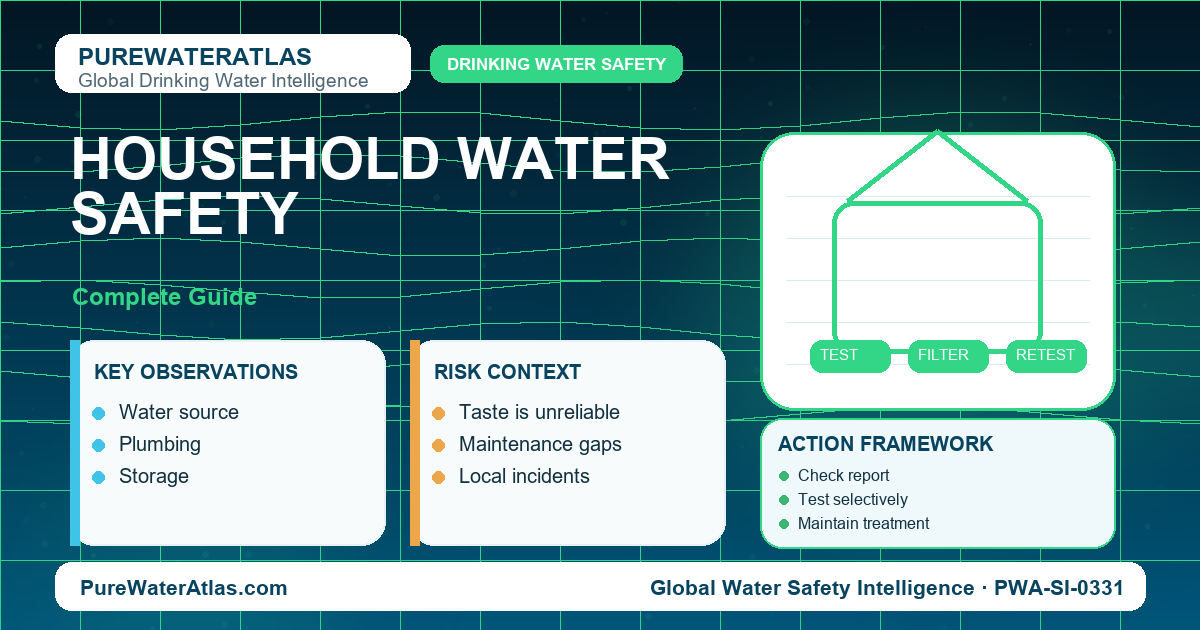
Safe household water is a source-to-tap question. The water source and treatment system matter, but so do distribution pipes, service lines, a home’s own plumbing, water heaters, fixtures, storage and treatment devices. Household water quality can be influenced by natural geology, agricultural runoff, industrial activity, treatment or distribution problems, aging or corroding plumbing, deficient or poorly maintained storage facilities, and temporary events such as storms or flooding. In some homes, source water may meet applicable standards but acquire contaminants while traveling through service lines, household pipes or fixtures.
A practical household water-safety framework begins with one key fact: appearance, taste and odor alone cannot establish that water is safe. Lead, for example, cannot be identified by sight, taste or smell. Testing and current official information—not sensory observations alone—are the basis for deciding what to do.
This guide focuses on U.S. households and separates three questions that are often confused: what a public water system is responsible for, what a private-well owner must investigate, and what can happen within a particular home’s plumbing. For a broader tap-water assessment, see Is Tap Water Safe to Drink?
A source-to-tap household safety framework
What household water safety means
Household drinking-water safety means keeping biological, chemical and other hazards below levels of health concern for the ways the water is used. It includes more than the source itself: treatment, distribution, storage, premise plumbing and water-using devices can all affect what reaches a tap.
It is useful to distinguish three broad groups of water-quality concerns. Microbiological contaminants include bacteria, viruses and parasites. Chemical contaminants include substances such as lead, nitrate, arsenic, pesticides and industrial chemicals. Physical or aesthetic characteristics include sediment, turbidity, discoloration, odor and unusual taste; these may prompt investigation but are not, by themselves, proof of a health hazard.
Health significance depends on the contaminant, concentration or dose, duration of exposure and susceptibility of the person exposed. Different contaminants therefore require different evidence, testing and response measures.
Symptoms alone do not establish that drinking water was the cause of an illness. Likewise, the absence of symptoms does not establish that a chemical contaminant is absent.
From source to tap: where risk can change
A useful sequence is: identify the water source; check whether a current advisory applies; review routine system or well information; consider service lines and household plumbing; test a defined concern when appropriate; and use treatment only when its performance matches the identified problem. Treatment devices and water-using appliances then need maintenance, and the situation may need reassessment after flooding, long stagnation, plumbing work, pressure disruptions or an official advisory.
Exposure pathways also depend on the contaminant and water use. Drinking and cooking are central for contaminants such as lead and nitrate, while some household microbial concerns involve plumbing biofilms or particular devices and procedures. Potable water is not necessarily sterile, an important distinction for uses such as nasal irrigation.
Know whether your water is public supply or private well
If you use a public water system
In the United States, public water systems covered by federal drinking-water requirements operate within the framework of the Safe Drinking Water Act and U.S. Environmental Protection Agency regulations, alongside state implementation and oversight. Community water systems provide customers with an annual Consumer Confidence Report (CCR); EPA says these reports are due each year by July 1. A CCR provides useful routine information about the system’s source, monitoring and compliance, but it is not a real-time report about an incident and does not necessarily describe conditions at every household tap. EPA provides CCR information for consumers.
The distinction matters because household plumbing can change water after it enters a property. Lead can occur in service lines, solder, plumbing materials and fixtures, and neighboring homes can produce different tap results because their plumbing differs. Public-system compliance therefore does not eliminate every building-specific question.
If you use a private well
Private wells occupy a different place in the U.S. drinking-water framework. They are generally not regulated, treated or routinely monitored by public authorities under the federal public-water-system program in the same way as public supplies, so owners usually have primary responsibility for surveillance and maintenance. State and local rules can still govern matters such as well construction, permitting, property transfers or testing.
Well water is not automatically pure because it comes from groundwater. Local geology can contribute substances such as arsenic or other naturally occurring constituents, while septic systems, agriculture, animal waste, and fuel or chemical activities are potential sources of contamination. Well defects such as damaged casing or seals or an inadequately protected wellhead can create contamination pathways.
EPA currently recommends that private wells be tested annually for total coliform bacteria, nitrate, total dissolved solids and pH, with additional tests chosen according to local conditions and suspected hazards. Its current guidance is available in Protect Your Home’s Water.
Check current advisories and utility information
Current advisory versus annual Consumer Confidence Report
For a public-supply household, current utility or local-government alerts come before the annual CCR when there is a suspected incident. The CCR describes routine system monitoring over a reporting period; an advisory tells customers what to do about a current problem. An older report showing compliance should never be used to override a current notice.
If there is no active advisory but the concern appears specific to a building—for example, possible lead plumbing, persistent discoloration at one fixture or water that has sat unused for a long period—the next evidence may need to come from the property itself rather than system-wide monitoring.
Boil-water, do-not-drink and do-not-use instructions
Not all drinking-water advisories mean the same thing. CDC distinguishes boil-water, do-not-drink and do-not-use advisories. Households should follow the exact instructions issued for the incident, including directions about drinking, cooking, brushing teeth, bathing and appliance use. CDC provides a current overview of drinking-water advisories.
Boiling is useful in appropriate microbial emergencies because it inactivates many pathogens, but it is not a universal purification method. CDC notes that boiling does not remove chemical contamination, and EPA specifically states that it does not remove lead.
Premise plumbing and household-specific risks
Lead, service lines, fixtures and stagnation
Even when source water is adequately treated, contamination can occur inside or near the home. Corrosion can release lead and copper from plumbing components. A property can have lead-containing plumbing materials even without a lead service line, so service-line information is useful but does not answer every household lead question.
EPA’s current lead guidance recommends using cold water for drinking, cooking and preparing baby formula; cleaning faucet aerators; and, where flushing is appropriate, following the water utility’s locally appropriate flushing advice rather than relying on a universal flushing time. If a filter is used for lead, it should have a performance claim appropriate for lead reduction and be maintained as directed. See EPA’s Protect Your Tap guidance.
Flushing intended to reduce everyday exposure should not be confused with laboratory sampling instructions. A lead sample may require a particular stagnation period and collection procedure; follow the laboratory’s protocol when collecting a test sample.
Biofilms, water heaters and water-using devices
Drinking water that meets applicable standards is not sterile. CDC notes that microorganisms can grow in building plumbing and water-using devices under some conditions. Stagnation, water temperature and device maintenance can influence these premise-plumbing microbial risks.
CDC recommends maintaining water heaters and water-using devices according to applicable instructions, cleaning devices appropriately, and flushing faucets and showerheads after prolonged non-use. Treatment equipment also needs maintenance: neglected filters can support microbial growth, and removing disinfectant residual throughout a home may alter conditions within household plumbing.
Changes after non-use or plumbing disruptions
Long absences, building shutdowns, plumbing work and some pressure disruptions can change conditions within a home’s plumbing. The appropriate response depends on what occurred and whether an official notice has been issued. A sudden change in color, taste or odor deserves investigation, but sensory changes alone cannot identify either the contaminant or its health significance.
When and how to test drinking water
Testing is most useful when it answers a defined question. Some serious contaminants have no obvious sensory warning, while noticeable water-quality changes can be largely aesthetic. A universal test panel for every household is therefore less useful than selecting tests from the water source, plumbing, local environmental conditions and the event that prompted concern.
Testing a public-water household concern
Public-water customers should first determine whether a current utility notice already explains the problem. For a tap-specific question such as lead, system-wide results may not characterize an individual property. Household testing can then supply evidence about that specific tap or plumbing system.
Testing may also make sense after relevant plumbing changes or where property records indicate potential lead-containing materials. Contaminants such as PFAS, pesticides or volatile organic compounds are generally better investigated when local information or a known source makes them a plausible concern rather than being added indiscriminately to every household test.
Routine and event-triggered private-well testing
EPA’s annual private-well baseline includes total coliform bacteria, nitrate, total dissolved solids and pH. Additional testing should reflect local groundwater conditions, nearby land use and events such as flooding or a known contamination release. This risk-based approach recognizes that no short standard panel can represent every aquifer or nearby activity.
Use a state-certified drinking-water laboratory
For independent drinking-water analysis, EPA directs consumers to state-certified drinking-water laboratories. Correct collection matters: the container, tap preparation, timing, preservation and transport requirements can differ among tests. Follow the laboratory’s directions rather than applying generic flushing instructions before sampling. EPA maintains contact information for drinking-water laboratory certification programs.
Home kits may provide screening information for some parameters, but they should not automatically be treated as substitutes for an appropriate certified-laboratory method when a health-relevant contaminant is being investigated. For sampling strategy and result interpretation, see the complete guide to home water testing for safety.
Interpret results against the right benchmark
A number on a laboratory report needs the correct context. An enforceable public-system standard, an action level, a health advisory and another screening value are not interchangeable. The applicable comparison depends on the contaminant, water source and jurisdiction. When the laboratory result or appropriate benchmark is unclear, consult the laboratory, water utility, state drinking-water program or local health authority as appropriate.
When household treatment makes sense
Effective household water management combines source protection, infrastructure maintenance, monitoring and, where warranted, treatment selected for the actual contaminant. A device is not inherently beneficial simply because it filters water: CDC notes that different systems address different germs and chemicals, and treatment may be unnecessary when harmful contaminants have not been identified.
Match treatment to the contaminant or germ
No single device removes every contaminant. CDC describes important differences among technologies: properly configured ultraviolet treatment can address microorganisms but does not remove chemicals; reverse osmosis can reduce germs and some chemicals; distillation removes germs and many, but not all, chemicals; and microfiltration can remove parasites while not necessarily addressing viruses or chemicals such as lead or arsenic. Water softeners primarily address hardness minerals and do not remove parasites, bacteria or viruses.
These are technology-level descriptions, not guarantees about a particular product. Actual protection depends on system design and the device’s demonstrated performance for the specific contaminant.
Point-of-use versus point-of-entry
Point-of-use systems treat water at a single tap or limited location, while point-of-entry systems treat most or all water entering a home. The distinction matters. If the concern is ingestion at a kitchen tap, targeted point-of-use treatment may be sufficient; a point-of-use unit does not protect other fixtures when the relevant exposure pathway requires whole-home control.
A detailed comparison of technologies and selection criteria is available in the household water filtration systems guide. CDC also provides an overview of home water treatment systems.
Certification and maintenance
Selection should be based on contaminant-specific performance claims and current evidence about the water. Filters, membranes, lamps and other components must then be serviced on schedule. A neglected device can lose performance, and some filters can become sites for microbial growth.
PFAS illustrates why the details of a certification claim matter. EPA recommends looking for products certified specifically for PFAS reduction under NSF/ANSI 53 or 58. EPA also cautions that current certification does not demonstrate reduction to the current federal PFAS drinking-water standard levels, so certification should not be interpreted more broadly than its tested claim. See EPA’s household PFAS filter guidance.
| Household risk | Testing/treatment response | Limitation |
|---|---|---|
| Possible lead from a service line, plumbing, fixtures or stagnation | Check service-line/plumbing information; use certified-laboratory tap testing; follow EPA exposure-reduction guidance and use appropriately certified lead filtration if needed | System-wide monitoring may not characterize an individual home’s plumbing |
| Private-well microbial, nitrate or local contaminant risk | Use EPA’s annual baseline plus analytes selected for local hazards | No fixed test panel captures every possible local contaminant |
| Microbial contamination requiring treatment | Select treatment demonstrated for the target organism; properly configured UV is one microbial-control option | UV does not remove chemical contaminants |
| Need for reduction of dissolved contaminants | Reverse osmosis may reduce some chemicals and germs; verify the product-specific claim | RO does not mean every chemical is removed |
| Hard water | Water softening can reduce calcium and magnesium hardness | Softening does not remove parasites, bacteria or viruses |
| PFAS | Look for a product certified specifically for PFAS reduction under NSF/ANSI 53 or 58 | EPA says current certification does not establish reduction to current federal PFAS standard levels |
| Greater susceptibility to premise-plumbing germs | Pay particular attention to stagnation flushing, device hygiene and appropriate water-heater/device maintenance | This does not establish a universal need for bottled or sterile water for ordinary drinking |
| Nasal rinse or water-using medical device | Follow application-specific water requirements | Potable drinking water is not necessarily sterile |
Special situations and vulnerable household members
Babies and young children
Water-safety considerations depend on the contaminant and the household’s circumstances. When lead exposure is a concern, EPA recommends cold tap water for preparing infant formula rather than hot tap water, along with the other appropriate lead-reduction measures described above.
Private-well households preparing infant formula deserve particular attention to current well-test results. EPA says private-well testing is especially important when a household has an infant or expects pregnancy, and nitrate is a particular concern: well water containing more than 10 mg/L nitrate should not be used to mix infant formula or food. This is in addition to routine annual and risk-based well testing. More detailed age-specific guidance is available in Safe Water for Babies and Children.
Weakened immunity and premise-plumbing germs
CDC identifies people with weakened immune systems among groups more likely to become ill from certain opportunistic germs associated with premise-plumbing biofilms. It also identifies infants six months or younger, adults 50 or older, people with chronic lung disease and some other health conditions as groups with increased susceptibility in this context.
That finding does not justify a blanket rule that every person in these groups must use bottled or sterile water for ordinary drinking. Appropriate precautions depend on the organism, exposure and individual medical situation. Household measures include reducing problems associated with long stagnation and maintaining water heaters and water-using devices; people with specific medical vulnerabilities should follow relevant healthcare guidance.
Flooded private wells
A flooded private well should not be judged safe by appearance alone. EPA advises households not to drink or wash with water from a flooded private well and to obtain appropriate professional cleaning and disinfection plus state or local advice on inspection and testing. Water merely becoming clear again does not establish that the well is safe.
Nasal rinsing, CPAP humidifiers and other special water uses
Water that is suitable for drinking is not necessarily suitable for every medical or body-contact application. CDC says nasal or sinus rinsing should use distilled or sterilized water, or tap water that has been boiled and allowed to cool—never water straight from the tap.
For CPAP humidifiers, follow the equipment manufacturer’s water and maintenance instructions. CDC notes that most manufacturers recommend distilled water and advises regular cleaning and replacement of humidifier water. These application-specific precautions are more useful than assuming ordinary potable tap water is sterile.
A practical household water-safety checklist
Routine checks
A strong household routine follows a short sequence: know whether the source is public water or a private well; check current official notices before relying on routine reports; understand the property’s service line and plumbing where relevant; test when there is a defined reason; and choose treatment from evidence and contaminant-specific performance rather than broad marketing claims. Private-well owners should maintain the well and follow annual and locally appropriate testing guidance.
When something changes
Changes such as flooding, prolonged non-use, plumbing work, a pressure disruption, a new official advisory or a sudden change in water characteristics can alter the evidence needed. The first action is not always testing, filtering or boiling: it depends on the situation.
| Situation | First evidence to check | Next action | Common mistake |
|---|---|---|---|
| Public supply under routine conditions | Current utility/local alerts, then the annual CCR | Investigate premise plumbing or tap-specific testing if the concern is household-specific | Treating the CCR as a live advisory or proof about every household tap |
| Possible household lead | Service-line information and plumbing history | Use appropriate certified-laboratory tap testing and EPA exposure-reduction measures | Assuming clear water rules out lead |
| Private well under routine conditions | Latest laboratory results and known local groundwater hazards | Use annual baseline testing plus risk-based analytes | Assuming public-utility monitoring covers a private well |
| Current drinking-water advisory | Utility or local-government incident instructions and advisory type | Follow boil-water, do-not-drink or do-not-use restrictions exactly | Replacing incident instructions with generic boiling or an ordinary household filter |
| Flooded private well | Well condition and state/local health or environmental guidance | Avoid drinking or washing with the well water; obtain appropriate professional cleaning/disinfection and inspection/testing advice | Resuming normal use because the water looks clear |
| Buying home treatment | Identified contaminant or germ and the product-specific performance claim | Choose an appropriately demonstrated or certified system and maintain it | Assuming any filter, RO unit, UV system or softener makes all water safe |
| Nasal irrigation | CDC and device instructions | Use distilled, sterilized, or boiled-and-cooled water | Assuming drinking-quality tap water is sterile enough for nasal rinsing |
| CPAP humidifier | Manufacturer’s instructions | Use the specified water and clean and refill components as directed | Assuming tap water is appropriate for every device |
Household water safety is therefore not a single test or appliance. The practical principles are durable: know the water source, understand where quality can change between source and tap, distinguish an active advisory from routine monitoring, test when appropriate, and match any treatment to evidence rather than appearance or marketing. These steps preserve the protections provided by public-water regulation while addressing the household-specific questions that system-wide monitoring cannot answer.
Read the full guide: Drinking Water Safety Guide
Explore more in this category: Drinking Water Safety Articles