
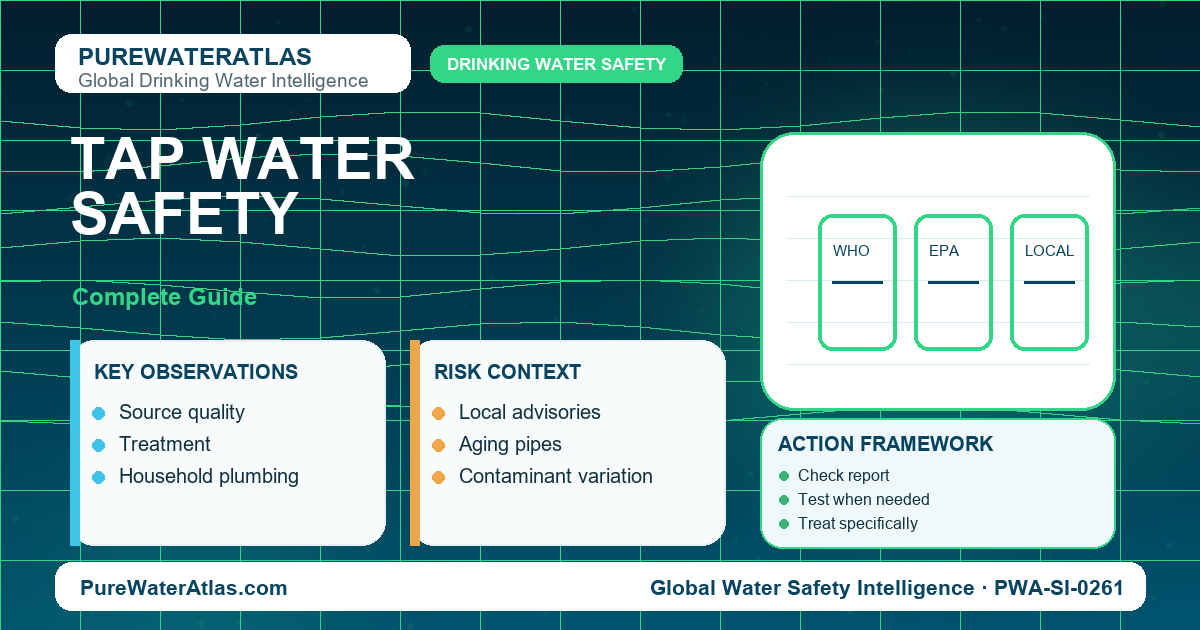
The answer depends on where the water comes from, how it is treated, the condition of the distribution system, and whether any contaminants enter the water before it reaches the glass. There is no reliable universal yes-or-no answer for every tap: a regulated public supply, a private well, an older building and a water system under a temporary advisory present different evidence and different risks.
Understanding tap water safety is not only about knowing whether water is “good” or “bad.” It is about recognizing that water quality is a system issue. Source water, treatment plants, pipes, building plumbing, and household conditions all influence the final result. The World Health Organization similarly describes drinking-water protection as risk management extending from catchment to consumer.
The short answer: safety depends on source, treatment, plumbing and current conditions
Tap water is water delivered to a faucet through household or building plumbing. Its underlying supply may be a regulated public water system, a private well, or another source. That distinction matters. In the United States, public water systems operate under drinking-water monitoring and reporting requirements, while federal public-water rules do not apply in the same way to privately owned wells; well owners are responsible for testing their water.
Safety also does not mean absolute purity. Drinking water normally contains minerals and other dissolved substances, and treated water can contain residual disinfectants and treatment byproducts. The useful question is whether relevant hazards are being adequately controlled for the water source, system, building and people using that water.
Start with your water source
Tap water quality can vary because surface water and groundwater face different contamination pressures; treatment systems use different processes; distribution mains and service lines differ in age and condition; and building plumbing can alter water after it leaves the utility system. Agriculture, industry, wastewater, natural geology and local land use can also shape which contaminants deserve attention.
Private wells require a distinct decision pathway. The U.S. EPA and CDC recommend regular well testing and additional testing when events such as flooding, repairs or local groundwater problems create a new concern. A household connected to a community water system should generally begin with utility information and current notices, then consider whether its own service line or plumbing creates a premise-specific question.
Check current conditions before historical reports
Before interpreting last year’s water-quality data, check whether the utility, health department or other responsible authority has issued a current drinking-water advisory. CDC distinguishes among boil-water, do-not-drink and do-not-use advisories because they require different responses. A current advisory takes precedence over reassurance from an older report.
Clear, odorless or good-tasting water is not proof of safety. Lead, nitrate and some other contaminants may be present without an obvious sensory warning. Conversely, a temporary change in color, odor or cloudiness does not by itself prove that the water is hazardous. Sensory properties are clues, not a comprehensive safety test. For a broader household decision framework, see the household drinking-water safety guide.
How regulated tap water is monitored
Public drinking-water systems are monitored under rules that vary by jurisdiction, system and contaminant. In the United States, community water systems monitor regulated contaminants according to applicable requirements, and the results feed into regulatory oversight and consumer reporting. Sampling frequency is not identical for every contaminant, nor does monitoring amount to continuous testing at every household faucet.
For U.S. community water systems, one of the most useful starting points is the Consumer Confidence Report (CCR). EPA requires these reports to provide information about delivered water quality and risks, if any, associated with detected contaminants. Existing community systems generally provide an annual report by July 1. Results usually concern the previous calendar year’s monitoring, while substances monitored less frequently may be represented by the most recent allowable monitoring data.
A CCR can show detected contaminants, applicable comparison values, violations and required unregulated-contaminant monitoring information. It is strong system-level evidence, but it is not necessarily a measurement of water from your kitchen faucet today. Conditions can change after treatment, and pipes, service lines, fittings and fixtures can introduce metals such as lead or copper.
Regulatory terminology and requirements differ internationally. In the United States, drinking-water rules can include maximum contaminant levels, treatment techniques, action thresholds and monitoring or reporting requirements. For a closer examination of what those terms mean, see the drinking-water safety standards guide.
Contaminants that can still matter
The safety of tap water depends on both the original water source and everything that happens afterward. Contaminants may be natural or human-caused. Some enter water before treatment; others can form during treatment or enter after the water leaves the treatment plant.
Surface waters can receive sewage, animal waste, agricultural runoff, sediment and industrial contaminants. Groundwater may be affected by septic systems, fuel or chemical releases, agriculture and naturally occurring substances in rock and soil. Treatment controls many of these hazards, while disinfection is particularly important for controlling microorganisms. Disinfectants can also react with organic matter to form byproducts that are themselves regulated.
Major drinking-water concerns can be grouped broadly as microorganisms; metals such as lead and copper; nitrate and other inorganic chemicals; organic chemicals; radionuclides; and emerging or unregulated contaminants. PFAS are an example for which both monitoring and regulation have continued to evolve in the United States, so current EPA information is more useful than treating a historical regulatory snapshot as permanent.
Detection of a substance does not automatically mean immediate danger. Health risk depends on concentration, exposure duration and individual susceptibility. Microbial contamination can produce acute illness, while some chemical exposures are principally concerns over longer periods. Infants, children, pregnant people, older adults and people with particular health conditions may also need contaminant- or event-specific guidance.
Lead illustrates another important distinction: some hazards can arise substantially after utility treatment. EPA’s current consumer information notes that lead in drinking water primarily comes from service-line and home-plumbing materials and that levels can vary over time. A single sample in which lead is not detected therefore does not prove that future exposure at that tap is impossible.
Building plumbing and premise-level risks
Why the tap can differ from the system
Even if water leaves a treatment plant in good condition, quality can change within the distribution system or building. Broken mains, pressure changes, corrosion and other distribution conditions can matter. Inside a property, service lines, pipes, fittings and fixtures create another layer between the utility and the glass.
The water quality at the tap may therefore differ from the quality measured elsewhere in the municipal system. Buildings with susceptible plumbing materials, long periods of stagnation or poorly maintained water systems can experience localized issues. Schools, offices, apartment buildings and intermittently occupied properties can present different premise-plumbing conditions from the distribution main outside.
Lead and copper as premise-level examples
Corrosion can release lead or copper from certain plumbing materials. Lead service lines and some older plumbing components are particularly important because lead exposure can originate downstream of the treatment plant. This explains why two homes served by the same utility can have different tap-level results.
Stagnation can also affect the interaction between water and plumbing. The appropriate sampling method depends on the contaminant and the question being investigated: samples intended to characterize plumbing-related exposure may use a different protocol from samples intended to investigate the incoming supply. Follow the laboratory, utility or health authority’s instructions rather than applying a generic flushing or “first-draw” procedure to every situation.
Taste, odor and appearance: useful clues with limits
Bad taste, odor, discoloration or cloudiness can make people question water safety, but these signs do not always indicate a serious health hazard. Temporary cloudiness, for example, can sometimes come from entrained air, while color can have several possible causes. A new or unexplained sensory change is nevertheless a reasonable trigger to check current notices and investigate.
The reverse inference is more dangerous: water that looks perfectly clear and tastes normal has not thereby been shown to be safe. Many contaminants cannot be reliably detected by sight, taste or smell. Evidence should come from appropriate monitoring, reports and testing rather than sensory quality alone.
| Question | Best evidence source | What it tells you |
|---|---|---|
| Is my community supply meeting monitored requirements? | Latest utility CCR plus current utility or state notices | Detected contaminants, comparison values, violations, sampling period and system information |
| Is there a problem right now? | Utility, local health department or government advisory | Whether to boil, not drink, not use, or take another event-specific action |
| Could my own plumbing be contributing contamination? | Service-line and plumbing information plus targeted certified-laboratory tap testing | Premise-specific evidence, especially for plumbing-related metals such as lead |
| Is my private well safe? | Certified-laboratory testing plus local health or environmental guidance | Baseline indicators and contaminants selected for local geology, land use and recent events |
| Does normal taste, color or odor prove safety? | Utility or health guidance and, when warranted, testing | Sensory changes can identify a reason to investigate, but normal sensory quality cannot establish comprehensive safety |
| Would filtration help? | Known contaminant or treatment objective plus independently verified treatment performance | Whether a particular device is designed to reduce the contaminant of concern |
When to test tap water
Testing a tap on a public system
Household testing can provide location-specific information when the concern lies between the distribution system and the faucet. Reasons can include suspected lead-bearing service-line or plumbing materials, a persistent unexplained water-quality change, or another credible premise-specific contamination concern.
For health-related decisions, use an appropriate laboratory certified for drinking-water testing and request tests relevant to the actual concern. Broad test panels are not automatically more informative than targeted testing. Sampling technique, container, preservation, timing and handling can all depend on the analyte.
Private-well routine and event testing
Private wells need owner-directed monitoring because U.S. federal public-water regulations do not cover privately owned wells in the same way as public systems. EPA and CDC recommend testing private wells at least annually for total coliform bacteria, nitrate, total dissolved solids and pH, while local health or environmental authorities can identify additional contaminants relevant to local geology and land use.
Additional well testing is appropriate after flooding, well-system repair or replacement, significant nearby land changes, reports of local groundwater contamination, or changes in taste, color or smell. A flooded well requires more than simply collecting a sample: follow public-health guidance on inspection, cleaning or disinfection and subsequent testing.
Why sampling method matters
A test result is only as useful as the question and sampling method behind it. This is especially important for contaminants associated with plumbing, because concentrations can change with water use and time. Follow the certified laboratory’s collection instructions and describe the problem you are trying to investigate.
Testing also should not substitute for complying with an active advisory. If authorities have instructed residents to boil, avoid drinking, or avoid using the water, follow those instructions until the advisory is lifted. For test selection, sample collection and result interpretation, see the home water testing guide.
How to use consumer confidence or utility reports
For a U.S. community water system, read the latest CCR as an evidence document rather than as a simple pass/fail label. Start by confirming which system serves the property and which reporting year the document covers. Then identify the water source, contaminants detected, reported concentrations or ranges, applicable regulatory comparisons, violations and the dates or periods represented by the monitoring data.
Also look for required unregulated-contaminant monitoring results and information relevant to lead and service lines. “Unregulated” does not necessarily mean known to be harmless; monitoring can be used to generate occurrence data before or while regulatory questions are being evaluated. Conversely, occurrence monitoring should not be mistaken for a compliance determination when EPA says the dataset does not serve that purpose.
Finally, compare the CCR with current conditions. A report based on earlier monitoring cannot resolve a new main break, contamination event or advisory. Nor can system-level results by themselves establish what is happening inside an individual building. The strongest assessment combines the report with current utility notices and, when justified, information about the property’s plumbing or targeted testing.
When filtration is justified
Match treatment to the contaminant
There is no single filter that removes everything. Household filtration is most useful when there is a defined treatment objective: for example, reducing a known contaminant or addressing a specific aesthetic issue. Different technologies have different capabilities, and performance varies among devices within the same broad technology category.
Activated carbon, reverse osmosis, ion exchange, ultraviolet treatment and other methods can serve different purposes. A technology name alone is therefore not enough to establish protection. When health is the reason for treatment, match the device’s verified contaminant-reduction claim to the contaminant of concern.
Certification and maintenance matter
Look for independent certification applicable to the specific reduction claim. A filter certified for improving chlorine taste or odor is not thereby demonstrated to reduce lead, nitrate or another unrelated contaminant. EPA’s lead guidance, for example, specifically points consumers toward filters certified by an ANSI-accredited certifier for lead reduction when filtration is used for that purpose.
Installation and maintenance also affect performance. Cartridges and other treatment components must be maintained according to their instructions; buying a suitable device does not eliminate that requirement. The household water filtration systems guide examines treatment choices in more detail.
What filtration cannot substitute for
A household filter does not override emergency instructions. CDC advises consumers under a boil-water advisory to boil tap water as directed even if it has passed through a home filter or filter pitcher. Boiling is also not a universal remedy: it can control many microorganisms, but harmful chemical or toxin contamination is not made safe simply by boiling.
High-risk households and temporary advisories
Current official instructions should govern decisions during a drinking-water incident. CDC identifies three important advisory categories, and confusing them can lead to the wrong response.
Boil-water advisories
A boil-water advisory generally addresses water that may contain disease-causing microorganisms. Follow the local advisory first. CDC’s general instruction is to bring water to a full rolling boil for one minute, or three minutes at elevations above 6,500 feet, unless the applicable authority gives different instructions. Bottled water is an alternative where recommended.
Do-not-drink and do-not-use advisories
A do-not-drink advisory can be issued when harmful chemicals or toxins may be present. CDC advises commercially bottled water for the specified drinking and food uses; boiling chemically contaminated water does not make it safe. A do-not-use advisory is more restrictive and means the tap water should not be used for any purpose while the advisory remains in effect because ingestion or contact may be dangerous.
During any drinking-water advisory, CDC also advises against using water or ice from appliances connected to the water line, including refrigerator dispensers. Follow the issuing authority’s directions for alternative water, appliance flushing and return to normal use.
| Warning/event | Immediate action | Test/filter/advisory pathway |
|---|---|---|
| Boil-water advisory | Use bottled water or boil according to the advisory; CDC’s general default is a rolling boil for 1 minute, or 3 minutes above 6,500 feet | Follow the advisory; do not rely on an ordinary household filter instead of required boiling |
| Do-not-drink advisory | Use commercially bottled water for the uses specified by authorities | Do not attempt to solve chemical or toxin contamination by boiling; follow official instructions |
| Do-not-use advisory | Do not use tap water for any purpose while the advisory remains active | Follow official alternative-water and clearance instructions |
| Flooded private well | Do not drink or wash with flooded-well water; obtain inspection and cleaning guidance | Clean or disinfect as directed and use the health or environmental authority’s testing pathway |
| New taste, odor, color or cloudiness | Check current advisories and investigate the change | For wells, test as advised; for public supplies, contact the utility and consider targeted premise testing when appropriate |
| Known or suspected lead plumbing | Investigate service-line and plumbing materials and use applicable EPA exposure-reduction guidance | Use appropriate lead testing; if filtration is selected, use a filter certified for lead reduction |
| Well repair or major nearby flood or land event | Re-evaluate the well rather than relying on an older result | EPA and CDC recommend additional well testing after relevant events |
Households that may need additional precautions
Infants, young children, pregnant people, older adults and people with particular medical vulnerabilities can require additional precautions for specific contaminants or microbial risks. The appropriate response depends on the hazard rather than on a blanket rule for “tap water.” Use contaminant-specific public-health or clinical guidance when a household member has a relevant vulnerability.
The practical sequence is straightforward: identify the water source, check current advisories, examine the latest utility report if the home uses a community system, and consider the building’s plumbing separately. Private-well owners need their own routine and event-driven testing program. When a specific concern remains, use targeted certified-laboratory testing and select treatment only for a defined objective. Clear, pleasant-tasting water is useful aesthetically, but it is not evidence by itself that a particular tap is safe.
Read the full guide: Drinking Water Safety Guide
Explore more in this category: Drinking Water Safety Articles