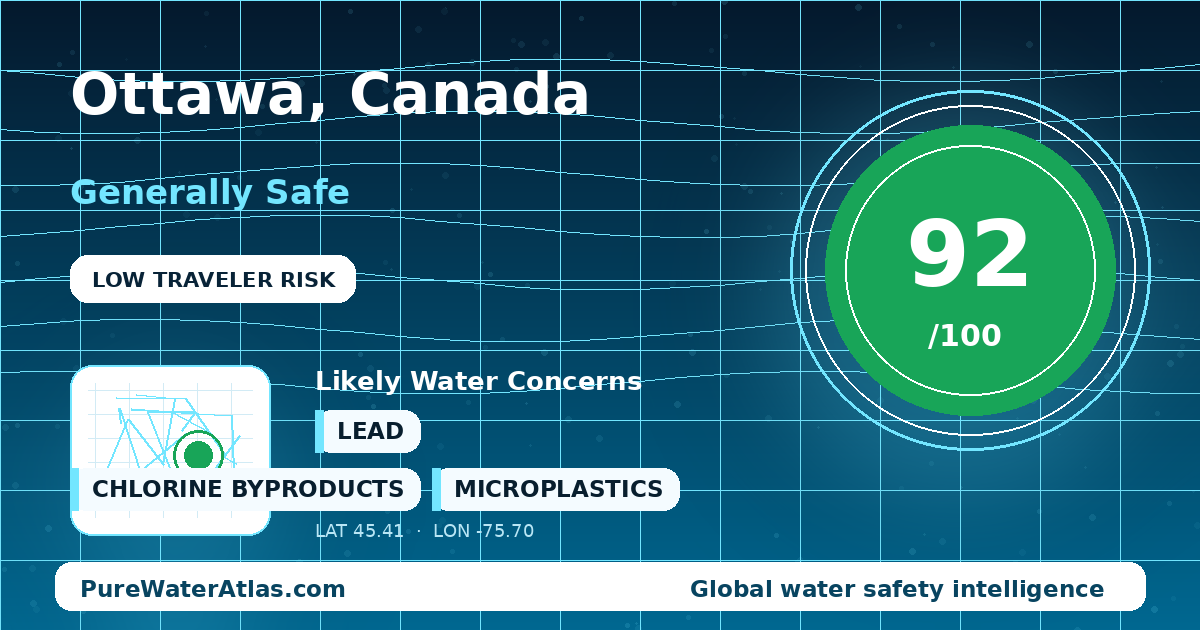
Ottawa’s central drinking-water system draws from the Ottawa River and treats the water at the Britannia and Lemieux Island purification plants. The latest available 2025 reports conclude that water from both plants met Ontario Drinking Water Standards. For most visitors and residents connected to this network, cold tap water is suitable for drinking without an additional filter or routine boiling.
That system-level conclusion does not certify every faucet. Ottawa’s most important household-specific issue is lead released by an older service line, solder or fixture after treated water leaves the plant. Rural private wells, localized watermain work, temporary service lines and building plumbing also need to be evaluated separately. The practical question is therefore not only whether Ottawa’s municipal supply complies, but also which supply serves a property and what happens between the distribution main and the tap.
Quick Answer
| Overall safety status | Generally safe on Ottawa’s central municipal system. The 2025 reports for Britannia and Lemieux Island concluded that drinking water met Ontario Drinking Water Standards, but an individual tap can still be affected by old plumbing, a localized repair or a building-specific problem. |
|---|---|
| Can visitors drink the tap water? | Yes, normally, when staying in a property connected to the municipal system and not subject to a local advisory. Visitors generally do not need bottled water or routine treatment. |
| Resident advice | Residents in older houses should check for a lead service line and request the City’s free lead test if concerned. Private-well owners need their own recurring bacterial and chemical testing. |
| Main water source | Ottawa River surface water for the central system, treated at the Britannia and Lemieux Island water purification plants. Separate municipal and private groundwater supplies serve some rural areas. |
| Responsible authority | City of Ottawa Water Services operates the municipal systems. Ontario’s Ministry of the Environment, Conservation and Parks regulates municipal drinking water, while Ottawa Public Health participates in incident review and advisories. |
| Filter recommendation | No filter is routinely required for compliant municipal water. For a confirmed or suspected lead service line, use a filter specifically certified to NSF/ANSI 53 for lead reduction while arranging testing and replacement. |
Where Does Ottawa’s Tap Water Come From?
The main urban supply comes from the Ottawa River. Raw water enters the Britannia and Lemieux Island plants through screened intakes. Both plants use coagulation, flocculation, sedimentation and filtration, followed by primary disinfection with chlorine. The City then adjusts pH to limit corrosion, adds chloramine to maintain a disinfectant residual in the distribution network and adds fluoride for dental-health protection.
These stages perform different functions rather than acting as a single treatment step. Screening and the clarification and filtration processes address material carried in the source water, while disinfection controls microbial risks. Corrosion control matters after treatment because water must then pass through mains, service lines and indoor plumbing. Chloramine helps maintain protection as water moves through the network.
Water from the two plants blends in a common network containing more than 3,000 kilometres of watermains. Consequently, most central-system customers should interpret the two plant reports together with distribution-system information rather than assuming that one plant exclusively supplies every tap at all times.
This description does not cover every property inside Ottawa’s municipal boundary. Some rural communities use separate City-operated groundwater systems, while many rural households rely on private wells. An Ottawa street address alone therefore does not establish that a property receives Ottawa River water from Britannia or Lemieux Island.
Who Manages Drinking Water?
City of Ottawa Water Services operates the plants and distribution system. The Ontario Ministry of the Environment, Conservation and Parks regulates municipal drinking water under provincial law. Ottawa Public Health reviews water-quality information with Water Services and participates in responses to potential health risks. This division of responsibility links day-to-day operation, provincial oversight and public-health review.
The City reports more than 100,000 tests each year across approximately 350 parameters. Sampling occurs during treatment and at more than 60 locations in the city. That scale provides strong evidence about treatment and the municipal distribution system, but it does not replace sampling at a specific faucet when the suspected source is a service line or building plumbing.
Plant samples show what treatment produced. Distribution samples help evaluate water moving through the shared network. A household lead sample addresses a different question: whether water is picking up lead near or inside that property. Private-well testing is different again because the well is outside the central treatment and monitoring program. Readers can use the PureWaterAtlas water-testing guide to understand why plant, distribution and household samples answer different questions.
Main Local Water Concerns
Lead is mainly a plumbing issue
Ottawa reports that water leaving its treatment plants is lead-free. Lead can nevertheless dissolve from an old service pipe, lead solder, brass fixtures or other plumbing. The City says approximately 15% of Ottawa homes were originally built with lead water-service pipes, although that historical figure does not show how many remain after replacements. The age and plumbing history of an individual property are therefore more informative than a citywide percentage.
Targeted testing in homes with lead supply pipes provides a more useful risk picture than finished-water testing alone. Across 29 sampling rounds from 2007 through 2025, the City reported first- and second-litre averages of 2.6 and 2.4 µg/L, with 90th-percentile values of 4.2 and 5.1 µg/L. The results complied with Ontario’s 10 µg/L standard, but Health Canada’s guideline is 5 µg/L. These summary values do not guarantee the result at every home, and some individual properties can have higher concentrations.
Residents of older properties can call 3-1-1 to ask about service-line information and request the City’s free lead testing. Testing is preferable to choosing treatment solely because a building looks old: lead can arise from several plumbing components, and appearance or taste cannot quantify it.
Until testing and full line replacement are completed, use cold flushed water for consumption and, where needed, a filter certified to NSF/ANSI 53 for lead reduction. Certification for the specific contaminant matters; a general taste filter should not automatically be treated as a lead-control device. Boiling does not remove lead and should not be substituted for an appropriate filter, testing or replacement. See the lead in drinking water guide and home lead-safety checklist.
Localized distribution incidents can occur
The 2025 reports recorded no adverse water-quality incidents in treated water at either central plant and six incidents in the shared distribution system. The reports describe required notification, corrective action and follow-up. These events do not show a continuing citywide failure, but they demonstrate why property-specific notices after a break, repair or temporary connection matter. A localized instruction should take priority over the general conclusion that the citywide system is compliant.
Watermain cleaning may briefly change pressure or disturb sediment, causing cloudiness or rusty water. After notified routine work, the City advises running a cold tap for at least five minutes or until it clears. Persistent or unexplained changes should be reported to 3-1-1. The City can also investigate concerns, which is more useful than guessing from colour or appearance alone. The cloudy tap water profile explains why appearance by itself cannot identify the cause.
Private wells need separate evidence
A private well does not receive the central system’s treatment or monitoring. Responsibility for testing and maintenance rests with the well owner. Ottawa Public Health encourages owners to test every spring, summer and fall, as well as after flooding, repairs or a noticeable change. Repeated seasonal sampling is important because one satisfactory result describes the sample collected at that time, not every future condition.
The free provincial public-health test addresses E. coli and total coliform. Nitrate, sodium, metals and other chemicals require a licensed laboratory. These are different testing questions: a bacteriological result cannot establish chemical quality, and a chemical panel cannot replace routine bacterial monitoring. A satisfactory municipal annual report cannot be used as evidence that a particular private well is safe.
Taste, Disinfectants and Appearance
Ottawa uses chlorine for primary disinfection and chloramine to maintain a residual in the distribution network. A resident may notice a disinfectant taste or smell without that observation demonstrating a standards violation. Conversely, water that tastes normal is not proof that an older service line is free of lead or that a private well is bacteriologically safe.
The City characterizes Ottawa’s municipal water as soft. Personal preferences about taste may lead some users to choose optional treatment, but preference should be kept separate from safety. A filter selected for taste is not necessarily certified to reduce lead, and no routine filter or boiling step is required for compliant central municipal water.
For Travelers
Visitors in central Ottawa can normally drink municipal tap water, use it for ice and brush their teeth with it. Routine bottled water, boiling or filtration is unnecessary unless the property is under an advisory or has a known plumbing issue. In a hotel, apartment or short-term rental, a posted notice or direct instruction from the property should be followed even though the wider municipal network remains suitable for drinking.
At rural accommodation, ask whether water comes from the central municipal network, a separate municipal groundwater system or a private well. If it is a private well, ask whether recent results are available rather than relying on Ottawa’s central plant reports. This distinction is especially relevant because rural properties within the city boundary may not share the same source or treatment.
At any property, follow a posted boil-water notice or instructions associated with a watermain repair. During an advisory, Ottawa instructs users to bring water to a rolling boil for one minute for ingestion uses. Continue following the advisory until authorities provide updated instructions; do not assume that clear-looking water cancels the notice.
For Residents
First determine whether the property uses the central network, a separate municipal well system or a private well. Then consult information for that exact system. Owners of older houses should ask the City about service-line records and request lead testing. A central-system annual report and a household lead test complement each other because they evaluate different parts of the source-to-tap route.
In apartment and commercial buildings, internal plumbing and backflow protection remain relevant even when water delivered to the property meets standards. Tenants who notice persistent, unexplained changes should raise them with building management and contact 3-1-1 as appropriate rather than assuming that a plant report resolves a building-specific concern.
Where a private well runs dry, temporary hauled water should come from a reputable potable-water supplier. Tanks and cisterns need inspection, cleaning and disinfection; they are separate water-quality control points. Safe water at the supplier does not by itself establish that a poorly maintained storage system will preserve that quality.
Relevant Contaminants and Water-Quality Issues
The 2025 reports show strong treatment performance. Average treated-water turbidity was 0.04 NTU at both central plants. Turbidity is useful as a treatment-performance measure, but it should not be used as a substitute for a lead test at an older home or bacterial testing of a private well.
Distribution averages for trihalomethanes and haloacetic acids were below Ontario limits. These compounds are considered in the context of disinfection and distribution-system management. The continued need to disinfect water and the monitoring of disinfection byproducts are both reflected in the municipal reporting program.
The plant tables also include PFAS and microcystin-LR monitoring. Reported total PFAS was below the laboratory reporting level in the tables, and microcystin-LR was below its cited benchmark. These findings provide current plant-level evidence for the central system. They should not be extrapolated to every private well, nor do they answer a plumbing-derived lead question at an individual faucet.
Readers investigating a laboratory result can use the PureWaterAtlas Contaminants Search Engine. Broader comparisons are available through the Global Water Quality Checker and the drinking-water safety library.
How to Verify Your Water Quality
- Identify the supply. Confirm whether the property receives central municipal water, water from a separate municipal well system or private-well water.
- Review the correct report. Use the annual report for the exact municipal system serving the property rather than assuming that the Britannia and Lemieux Island results apply everywhere in Ottawa.
- Consider property plumbing. For an older home, call 3-1-1 to ask about the service line and request free lead testing. Plant compliance cannot rule out lead released after water reaches the property.
- Test private wells appropriately. Test E. coli and total coliform regularly, including after flooding, repairs or noticeable changes, and commission chemical analysis from a licensed laboratory.
- Respond correctly to local events. After a repair, pressure event or advisory, follow City and Ottawa Public Health instructions rather than relying on a general home test kit or the normal citywide safety conclusion.
- Match treatment to evidence. Do not buy treatment merely because water has an unfamiliar taste or appearance. Identify the problem first, then select a device certified for that purpose. For lead, consult lead removal and treatment options.
- Escalate persistent concerns. Report continuing or unexplained water-quality changes to 3-1-1 and involve the property owner or building manager where internal plumbing may be relevant.
Official and Technical Sources
- 2025 Annual Report on Drinking Water Quality – Britannia Water Purification Plant — City of Ottawa
- 2025 Annual Report on Drinking Water Quality – Lemieux Island Water Purification Plant — City of Ottawa
- Britannia Water Purification Plant – 2025 Drinking Water Quality — City of Ottawa
- Lemieux Island Water Purification Plant – 2025 Drinking Water Quality — City of Ottawa
- Water purification, quality and distribution — City of Ottawa
- Drinking Water Quality Management System — City of Ottawa
- Drinking water quality and safety – Frequently asked questions — City of Ottawa
- Keeping your tap water lead-free — City of Ottawa
- Request to have your home's drinking water tested for lead — City of Ottawa
- Well Water Sampling and Results — City of Ottawa and Ottawa Public Health
- Private well safety — City of Ottawa
- What you should know during a boil water advisory — City of Ottawa
- Water service interruption/No water — City of Ottawa
- Chlorine and chloramines in drinking water — City of Ottawa
- 2024–2025 Chief Drinking Water Inspector Annual Report — Ontario Ministry of the Environment, Conservation and Parks
- Drinking water and health: Overview — Health Canada
Related Contaminant Profiles
Bottom Line
Ottawa’s central municipal tap water is generally safe to drink, supported by current 2025 compliance reports, comprehensive treatment and extensive monitoring. Most municipal customers and visitors do not need bottled water, routine boiling or an additional filter.
The main exception is property-specific lead risk in older service lines and plumbing. Rural private wells, separate municipal groundwater systems, building plumbing, temporary connections and localized advisories require their own evidence and should never be judged solely from the central plants’ results. Confirm the supply, follow local notices, test for the issue actually in question and choose treatment only when the evidence supports it.
Read the full guide: Global Water Quality Guide
Explore more in this category: Global Water Quality Articles