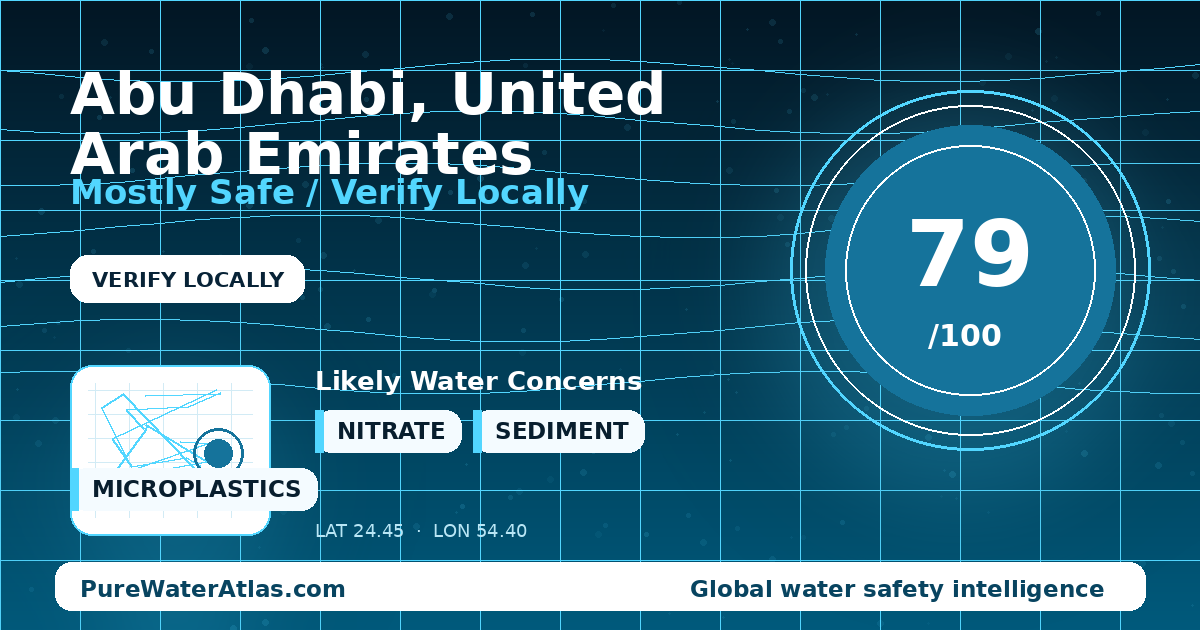
Abu Dhabi’s public water supply begins mainly as seawater and reaches customers after desalination, conditioning, transmission and regulated distribution. Under the emirate’s Water Quality Regulations 2025, water supplied for drinking, cooking, washing and food production must be “wholesome.” The regulations cover microbiological organisms, physical properties, inorganic chemicals, disinfectant residuals and disinfection by-products. That is meaningful protection, but it is not a guarantee about the condition of every kitchen, apartment or hotel tap.
The important local qualification is what happens after water leaves the distribution network. Abu Dhabi buildings may use ground-level tanks, roof tanks, pumps and extensive internal plumbing. The Department of Energy assigns responsibility for these property systems to the building’s responsible person. Poor maintenance, excessive storage time, heat, stagnation or defective plumbing can therefore create a point-of-use problem even when the water entering the property complies with the applicable requirements.
For that reason, the most accurate answer is neither “never drink the tap water” nor “every tap is automatically safe.” Regulated mains water is intended to be potable. Confidence at a particular outlet should also take account of the building’s tank maintenance, recent plumbing work, water appearance and odor, and any available test results.
Quick Answer
| Overall safety status | Regulated mains water is intended to be potable, but safety at an individual tap depends partly on building tanks, pumps and internal plumbing. |
|---|---|
| Can visitors drink the tap water? | Generally reasonable in a well-maintained property that confirms tank and plumbing maintenance. Choose sealed bottled water when the building’s arrangements are uncertain or the water looks, smells or tastes abnormal. |
| Resident advice | Obtain tank inspection, cleaning and testing records. Investigate unusual water and test the kitchen tap when records are missing or a problem continues after flushing. |
| Main water source | Desalinated water from an interconnected system using reverse-osmosis and thermal plants. |
| Responsible authority | TAQA Distribution distributes the water; the Abu Dhabi Department of Energy regulates water quality and supply requirements. |
| Main local qualification | Responsibility shifts at the property, where storage tanks and plumbing can affect water before it reaches the tap. |
| Filter recommendation | No universal filter recommendation. Test first and select treatment for the identified issue rather than assuming every property has the same problem. |
Where Does Abu Dhabi’s Tap Water Come From?
Abu Dhabi has no conventional river supply. Its municipal system relies on desalinated water produced at plants connected to the wider Abu Dhabi water network. EWEC’s 2024 statistical leaflet lists production from Taweelah RO and several thermal power-and-water plants, together with water supplied from Fujairah facilities. Reverse osmosis represented 41% of total system production in 2024.
Those figures describe the interconnected system, not a fixed recipe delivered to every address in Abu Dhabi city. Water can be transmitted and blended according to system operations. It would therefore be inaccurate to say that a particular neighborhood always receives water from one named plant, or that every city tap had exactly the system-wide reverse-osmosis share. The defensible conclusion is that Abu Dhabi receives desalinated water through a multi-plant network that includes reverse-osmosis and thermal production.
Desalination removes seawater salts and many contaminants, but production is only the first part of safe delivery. Finished water must be conditioned and then managed through storage, transmission and distribution. The regulatory framework consequently addresses more than the desalination plant itself. It includes drinking-water safety planning, sampling, accredited-laboratory requirements, annual reporting and incident response, as well as limits or performance controls for multiple water-quality categories.
The microbiological requirements are especially relevant when considering tanks and plumbing. The regulations require E. coli, total coliforms and intestinal enterococci to be absent from a 100 mL sample. These are not characteristics that a resident can reliably assess by taste or appearance alone. Clear water may still require investigation after a maintenance failure, while temporary cloudiness or a taste change does not by itself identify a specific contaminant.
Distribution Versus Building Responsibility
The Water Supply Regulations 2024 distinguish the distributor’s system from the water installations within a property. This distinction matters in a city where a building may receive water into a ground tank, pump it upward and store it again in a roof tank before it reaches an apartment. A fault anywhere along that premise-side route may affect only one building, one section of a building or even one outlet.
The associated Guide to Water Supply Regulations 2024 addresses tank design and maintenance, inspection, disinfection and testing after tank work. It also identifies stagnation and loss of disinfectant residual as issues that must be managed. Long storage time is therefore not merely a taste concern: it is a reason to check whether tanks are being operated and maintained appropriately.
The supply rules also cover normal pressure, temporary tanker supply and restrictions on mixing well water or recycled water into drinking-water fittings. If a property has recently experienced an interruption, pressure problem or temporary supply arrangement, residents should ask the responsible person what occurred and whether the building system was inspected, disinfected or tested before normal use resumed.
What Can Go Wrong at the Tap?
A citywide source problem and a building-specific problem require different responses. If several nearby properties experience the same abrupt change, the distributor should be contacted. If the issue is limited to one property, one floor or one tap, the tank, pumps, internal plumbing or the outlet itself becomes a more likely investigation point. This comparison does not prove the cause, but it helps direct the first questions.
- Stagnation: Water that remains in tanks or pipes for an extended period may lose disinfectant residual. A little-used outlet should be flushed with cold water before drinking.
- Tank maintenance: Missing inspection, cleaning, disinfection or post-work testing records reduce confidence in a building’s final delivery system.
- Sediment or discoloration: Brown water or recurring particles should be investigated rather than hidden with a filter selected without testing.
- Odor or taste changes: A sudden or persistent change is a reason to stop, flush the outlet and ask whether maintenance, an interruption or plumbing work has occurred.
- Localized plumbing issues: Water that is normal at other taps but abnormal at one outlet points toward a premise-side or fixture-specific issue.
Appearance, taste and odor are useful warning signs, but their absence is not laboratory evidence of microbiological compliance. Conversely, an unusual observation does not identify the substance or establish its concentration. Testing is the appropriate way to move from a symptom to a supported treatment decision.
For Travelers
Visitors should treat the accommodation, rather than the entire city, as the final decision point. A reputable hotel with documented tank cleaning and maintenance provides more confidence than an unknown short-term rental with no available records. Ask reception or the host whether drinking taps are supplied through maintained potable-water tanks and whether there has been a recent outage, pressure problem, plumbing repair or tank-cleaning event.
- Use the kitchen tap or a designated drinking-water outlet rather than an outdoor, irrigation or utility tap.
- After the tap has been unused, run the cold water until it becomes cool before drinking or filling a bottle.
- Do not drink water that remains brown, unusually cloudy, oily or strongly odorous after flushing.
- Use sealed bottled water if the accommodation cannot confirm its maintenance arrangements, if it issues an advisory or if an abnormal condition persists.
- Do not assume that a normal-looking hotel tap is sterile. Use sterile or appropriately treated water for nasal rinsing and contact-lens care.
The US Centers for Disease Control and Prevention’s United Arab Emirates – Traveler View provides general food-and-water precautions, but it does not establish compliance at a particular Abu Dhabi property. General destination guidance can also be checked with the PureWaterAtlas Global Water Safety Checker. In both cases, current property conditions still control the final tap.
For Residents
Apartment residents should ask the owner, facilities manager or owners’ association for the latest tank inspection, cleaning, disinfection and post-maintenance laboratory records. Useful questions include which tanks supply the apartment, when they were last serviced, whether testing followed the work and whether any recent interruption affected the building. A verbal assurance that water is “from the municipality” does not answer these premise-side questions.
Villa occupants should identify whether the kitchen has a direct mains connection or is supplied through a ground or roof tank. They should also know who is responsible for inspecting and maintaining that equipment. Where records are incomplete, a kitchen-tap sample provides more relevant information about consumed water than a general statement about desalination at the production plant.
Investigate recurring sediment, discoloration, unusual odor, loss of pressure or rapid changes in taste. Where safely accessible, compare water near the property entry point with the kitchen tap. A problem found only downstream points toward storage or internal plumbing; a widespread problem may justify contacting TAQA Distribution. Report premise-side problems to the building’s responsible person and keep a record of when and where the issue occurred.
TAQA Distribution’s KPI and Statistics page reports a 2022 water-quality KPI of 96.93%. That is useful public information, but its date and system-level scope limit what it can establish about current water at an individual address. It should not replace recent building records or tap testing when there is a specific concern.
The broader drinking-water safety guide explains how evidence from the source, treatment plant, distribution system and property plumbing fits together. Residents can also browse the drinking-water safety category.
Testing and Interpreting Results
Testing is most useful when the question and sampling point are clearly defined. A kitchen-tap test evaluates water after it has passed through the building’s tanks and plumbing. A separate sample closer to the property entry point, where accessible and appropriate, can help distinguish a network concern from a building-side concern. Samples taken before and after tank work may also help document whether the work achieved its intended result.
Use an accredited laboratory and follow its sampling instructions. Microbiological sampling is particularly sensitive to how the container, outlet and sample are handled. An improvised container or poor technique can make the result difficult to interpret. The Department of Energy framework specifically addresses accredited laboratories, sampling and testing after tank work, so residents should request the actual report rather than relying only on a maintenance invoice.
The choice of analysis should follow the observed problem and relevant history. The regulations cover physical properties, inorganic chemicals, microbiological organisms, disinfectant residuals and disinfection by-products. After suspected tank contamination or inadequate maintenance, microbiological indicators such as E. coli, total coliforms and intestinal enterococci are directly relevant. Persistent visible particles make sediment investigation important. A laboratory or responsible authority can help define an appropriate testing scope without assuming that every possible parameter is needed.
If a result is unsatisfactory, avoid treating one sample as a complete diagnosis. Notify the responsible party, investigate the tank and plumbing, take any advised corrective action and arrange follow-up sampling where appropriate. A result from one tap also should not automatically be generalized to every building or neighborhood in Abu Dhabi.
Choosing Treatment
There is no single filter recommendation for all Abu Dhabi homes. The source is desalinated, but property configurations and point-of-use problems differ. A device chosen for taste does not by itself demonstrate control of a microbiological problem, and a filter cannot substitute for cleaning, disinfecting or repairing a poorly maintained storage system.
Start with the evidence: maintenance records, the location and duration of the symptom, comparison between outlets, and laboratory results where concerns persist. Select certified treatment for the identified issue and maintain it according to its requirements. Neglected treatment equipment adds another premise-side component that must be managed. Where the cause is a tank or plumbing defect, correction at that point protects more outlets than relying only on a device at one tap.
For more detail on sampling choices and result interpretation, see the water-testing guide and the collection of Water Testing resources.
Official and Technical Sources
- Water Quality Regulations 2025 — Abu Dhabi Department of Energy
- Water Supply Regulations 2024 — Abu Dhabi Department of Energy
- Guide to Water Supply Regulations 2024 — Abu Dhabi Department of Energy
- Water Quality Regulations — TAQA Distribution / Abu Dhabi Distribution Company
- KPI and Statistics — TAQA Distribution / Abu Dhabi Distribution Company
- Statistical Leaflet 2024 — Emirates Water and Electricity Company
- United Arab Emirates – Traveler View — US Centers for Disease Control and Prevention
Related Contaminant Profiles
- E. coli in Drinking Water
- Sediment in Drinking Water
- Enterococci in Drinking Water
- Total Coliforms in Drinking Water
Explore PureWaterAtlas
Bottom Line
Abu Dhabi’s mains supply is desalinated and governed by a current drinking-water regulatory framework. It is reasonable to regard properly delivered and properly maintained mains water as intended for drinking. The available evidence does not support saying that every tap is automatically safe, because ground tanks, roof tanks, pumps and premise plumbing can alter water quality after the utility’s point of delivery.
For visitors, confidence should depend on the accommodation’s maintenance practices and the condition of the water at the designated drinking tap. For residents, the most useful evidence is a recent tank inspection and cleaning record, supported by an accredited kitchen-tap test when concerns exist. The publicly reported 2022 KPI provides system-level context, but no recent public city-level compliance report identified here can certify every current tap. When records are unavailable or water remains abnormal after flushing, use an alternative supply while the property or distribution issue is investigated.
Read the full guide: Global Water Quality Guide
Explore more in this category: Global Water Quality Articles