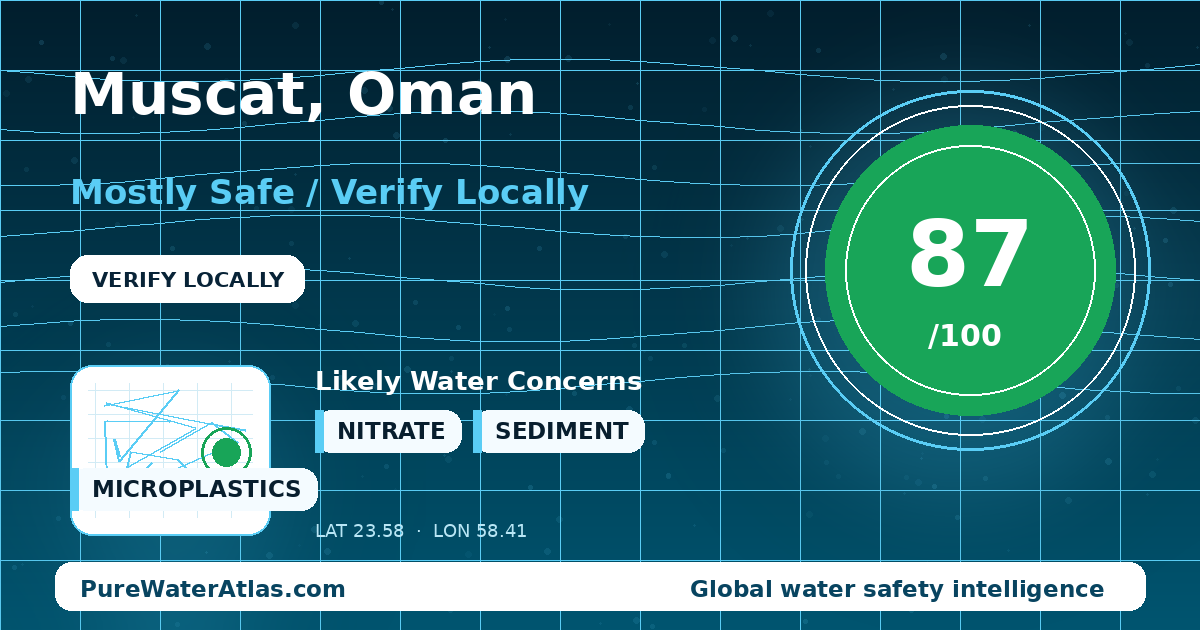
Muscat’s public water is produced mainly from desalinated seawater and distributed by Nama Water Services as potable water. That is reassuring at the production and utility-network level, but it does not answer the question for every faucet. Many hotels, apartment buildings and homes route water through storage tanks, where heat, sediment, stagnation, biofilm or poor maintenance can change its quality before use. Current official sources document a regulated supply system and accredited laboratories, but they do not provide a recent Muscat-specific table of customer-tap results.
The most accurate answer is therefore conditional: treated municipal water in a well-maintained building is generally suitable for normal domestic use, while an unknown or poorly maintained tank, private well or tanker supply deserves verification. Appearance and taste can identify some problems, but clear water is not proof that microbiological or chemical limits are met.
Quick Answer
| Overall safety status | Generally treated and regulated, but current Muscat-specific customer-tap compliance data are not publicly available. Building tanks and plumbing can determine point-of-use quality. |
|---|---|
| Can visitors drink the tap water? | Usually reasonable in a modern property with a documented, maintained potable-water tank. Use sealed bottled water when the source or tank condition is unknown, after an outage, or if the water looks or smells abnormal. |
| Resident advice | Confirm the supply source, maintain storage tanks, report pressure or quality problems, and test after contamination events or when tank history is uncertain. |
| Main water source | Desalinated seawater supplied through the interconnected potable-water system, including Ghubrah II and Qurayyat capacity. No reliable current citywide percentage breakdown was found. |
| Responsible authority | Nama Water Services operates distribution and testing; the Authority for Public Services Regulation regulates relevant sector activities, while Nama Power and Water Procurement procures bulk desalinated water. |
| Filter recommendation | No universal filter. Test first. Use microbial treatment only for a demonstrated microbial risk, RO for confirmed excess salts, and a certified metal-reduction filter for confirmed plumbing metals. |
Where Does Muscat’s Tap Water Come From?
Muscat depends principally on desalinated seawater. Nama Power and Water Procurement contracts with independent desalination projects, and Nama Water Services receives, transmits, stores and distributes the potable water. Current official documents identify Ghubrah II as a major operating desalination plant and report that the 200,000 m³/day Qurayyat Independent Water Project achieved commercial operation in 2025 specifically to strengthen Muscat’s water security.
The wider system is interconnected, so water can move between facilities and regions when demand or plant availability changes. It is not possible from the public documents reviewed to assign one plant—or a fixed source percentage—to every Muscat neighborhood. The utility’s national statement of 90% desalination and 10% groundwater for 2025 is national evidence, not a Muscat supply ratio. A Nama Water Services announcement also describes planned diversification through the Wadi Dayqah Dam Water Purification Plant and its future connection to Muscat’s distribution system, but that planned source should not be treated as a current neighborhood-level supply percentage.
Groundwater remains relevant as a backup or local source. Official research on the Wadi Adai wellfield in Mutrah documented elevated salinity and reported that blending with desalinated water did not always achieve Omani drinking-water limits. That finding applies to the studied wellfield, not automatically to desalinated taps throughout Muscat. It is most useful when evaluating a private well, a known groundwater blend or unexplained salty taste—not as evidence that all city water has excessive salinity.
Who Manages Drinking Water?
Nama Water Services, the operating name of Oman Water and Wastewater Services Company SAOC, provides public water and wastewater services in Muscat and the rest of Oman except Dhofar Governorate. Nama Power and Water Procurement arranges bulk purchases from independent desalination plants. The Authority for Public Services Regulation oversees regulated aspects of the sector. Building owners and managers remain practically important because water may enter privately managed tanks and internal plumbing after utility delivery.
Oman’s OS 8/2012 standard covers unbottled drinking water from public systems, limited systems, wells and tankers. It requires no E. coli in 100 mL of treated distribution water and sets chemical limits for parameters including arsenic, lead, boron, nitrate and disinfection byproducts. The standard also addresses disinfectant residual. Oman’s law on protecting potable-water sources includes requirements relevant to wells, tankers and distribution networks and provides for approval of private laboratories conducting drinking-water tests.
Nama Water Services reports that its Muscat central laboratory holds ISO/IEC 17025 accreditation and covers approximately 80 accredited test types. Accreditation is meaningful evidence of laboratory competence for the covered methods, but it is not a substitute for published, recent results from Muscat customer taps. The distinction matters: a regulated system and capable laboratory support confidence in utility management, while only source-specific sampling can resolve a concern about one building.
Main Local Water Concerns
Water can change inside a building
The best-documented Muscat-specific concern is not desalination failure but deterioration after utility delivery. Older research in a densely populated Muscat suburb found that pumping-station reservoirs and distribution lines met the Omani standard while household tanks supported microbial regrowth and endpoint biofilms. Because the study is old, it cannot show the current prevalence of contaminated tanks, but it establishes a credible local pathway. A broader Oman source-to-tap assessment likewise found that most tested parameters met the standard while emphasizing greater monitoring of delivery and consumer tanks.
This distinction explains why two taps receiving water from the same public system may not have identical results. Tank condition, periods of stagnation, sediment, plumbing condition and maintenance history can affect the final water. Learn more about biofilm slime in drinking-water systems.
Current city-level results are difficult to verify
Nama Water Services’ 2024 annual report gives useful system-wide information: 97.75% continuity, 37.10% water loss, 41,934 flow-and-pressure complaints and 694 water-quality complaints. None of those figures is Muscat-specific, and a complaint is not the same as a confirmed violation. The report does not publish Muscat sample results, exceedances or customer-tap compliance percentages. The figures therefore describe operational context rather than proving either safety or contamination at a particular address.
Private groundwater can be saline
Wadi Adai evidence makes salinity, chloride, sodium and total dissolved solids appropriate priorities for private or groundwater sources in the Muscat area. It does not prove a citywide problem in desalinated network water. Residents should first establish the actual source before paying for an extensive groundwater-oriented test panel or reverse-osmosis system.
Outages and low pressure require situational caution
The utility’s continuity figure is high, but outages and pressure problems can occur. After a local disruption, wait for official instructions, inspect the water and consider microbial testing if the building tank was emptied, opened or otherwise compromised. A pressure complaint alone does not establish contamination, but a disruption combined with tank work, flooding, unusual odor or visible sediment justifies greater caution.
For Travelers
U.S. State Department guidance says tap water in Oman is generally safe to drink and use for cooking, but that national advice cannot verify a particular hotel tank. In Muscat, ask whether the drinking tap is connected to a maintained potable-water tank and whether the property can confirm its maintenance. In a reputable modern property with documented maintenance and normal-looking water, drinking the tap water is generally reasonable.
Choose factory-sealed bottled water if the source is uncertain, the water is discolored or has a sewage or fuel odor, or the property has just experienced flooding, an outage or loss of pressure. Check that the bottle is sealed rather than relying only on its appearance. Travelers with weakened immune systems and families preparing infant formula should use a source whose safety is verified rather than trying to judge safety by taste.
Boiling is useful only when the concern is microbial. It does not remove salinity, lead or other dissolved chemicals. Likewise, an ordinary taste-and-odor filter should not be assumed to disinfect water or remove salts and metals. For broader background, see the PureWaterAtlas guide to determining whether tap water is safe.
For Residents
Residents should identify whether the kitchen tap receives direct municipal water, water stored in a shared building tank, tanker water, private groundwater or a blend. Ask which taps are intended for drinking and whether hot and cold services follow different storage paths. Keep potable tanks sealed, clean and structurally sound, and obtain maintenance records from the landlord or building manager. Report persistent quality or pressure problems to Nama Water Services through its app or call center at 1442.
If a tank has an unknown cleaning history, comparing samples taken before and after the tank can help distinguish a utility-side issue from a building-side issue. Microbiological testing should include E. coli and total coliforms, together with turbidity and disinfectant residual. Record where and when each sample was collected and follow the laboratory’s collection, container and cold-storage instructions; poor sampling can make a result less useful.
Where galvanized tanks, old fixtures, corrosion or metallic taste are present, consider first-draw and flushed testing for lead, copper and iron. Comparing those samples can help evaluate whether water is changing during contact with premise plumbing. The lead home-safety checklist is relevant to plumbing risk, but there is no evidence here of a citywide Muscat lead problem.
Explore the water-testing category or use the testing tools below before buying treatment equipment. Testing is especially appropriate after suspected tank contamination, flooding, tanker-source uncertainty, major plumbing work or a persistent unexplained change in the water.
Relevant Contaminants and Water-Quality Issues
- E. coli and total coliforms: Priority indicators after suspected tank contamination, tanker problems, flooding or pressure loss. No recent citywide E. coli problem was identified.
- Biofilm and microbial regrowth: Supported by older Muscat household-tank studies and most relevant inside tanks and premise plumbing. Their presence requires attention to the underlying tank or plumbing conditions.
- Salinity, chloride, sodium and total dissolved solids: Relevant to private groundwater and the Wadi Adai wellfield, not established as a network-wide Muscat violation.
- Lead, copper and iron: Possible building-plumbing contaminants where corrosion or unsuitable materials are present; not documented as citywide concerns.
- Nitrate, arsenic and boron: Parameters covered by Oman’s drinking-water standard. Source-specific testing may be appropriate for private groundwater, but no current citywide exceedance is established here.
- Disinfection byproducts: Regulated in Oman, but no recent Muscat results were found from which to assess concentrations.
Use the PureWaterAtlas Contaminants Search Engine to investigate a laboratory result, or compare broader destination information with the Global Water Quality Checker. A parameter’s inclusion in a standard does not mean it is elevated in Muscat; it identifies what regulated testing may examine.
How to Verify Your Water Quality
- Identify the source and storage path. Determine whether the tap receives municipal, tanker, well or blended water and whether it passes through a private or shared tank.
- Check official notices. Review Nama Water Services updates and report water-quality or pressure problems. Follow any incident-specific utility instructions before resuming normal use.
- Inspect the tank and plumbing. Look for an unsecured lid, sediment, corrosion, cross-connections, pest access or evidence of recent repair. Do not enter or handle a tank in an unsafe manner.
- Use an appropriate laboratory. Omani law provides for approval of laboratories conducting potable-water tests. The Ministry of Health also offers a water-sample testing service with collection and cold-storage instructions.
- Select tests based on the source. Tank water calls for microbiology and chlorine residual; groundwater calls for salinity, nitrate and hydrogeology-based metals; old plumbing calls for first-draw metals testing.
- Interpret the sampling location. A sample before a tank evaluates a different part of the system from a kitchen-tap sample. Clearly labeled paired samples can help locate where water quality changed.
- Treat the demonstrated problem. For help planning a sampling strategy, consult home water testing for safety and the broader water-testing guide.
Choosing Treatment Without Overtreating
No single filter addresses every Muscat scenario. If testing confirms microbial contamination, correct the source, clean or disinfect the affected tank or plumbing as appropriate, and verify the result with follow-up testing. An unmaintained countertop filter does not resolve a contaminated storage system. See the evidence-based E. coli treatment options.
Reverse osmosis is relevant when testing confirms excessive dissolved salts; it should not be recommended solely because Muscat relies on desalination. A certified metal-reduction filter may be appropriate when a laboratory confirms lead or another plumbing metal at the tap. If metals are confirmed, review lead removal and treatment limitations and select equipment certified for the measured contaminant. Treatment equipment itself requires maintenance, so filters should be chosen around a defined result rather than installed as a substitute for tank care and testing.
Official and Technical Sources
- Nama Water Services Annual Report 2024 — Nama Water Services
- Nama Water Services laboratories receive international accreditation for laboratory quality-management systems — Nama Water Services
- Nama Power and Water Procurement Annual Report 2025 — Nama Power and Water Procurement
- Nama Power and Water Procurement annual reports index — Nama Power and Water Procurement
- Un Bottled Drinking Water — OS 8/2012 — Environment Authority / Directorate General for Specifications and Measurements
- High Water Salinity at Wadi Adai — GIS Case Study — Oman Research Portal / Ministry of Higher Education, Research and Innovation
- Test a Water Sample — Gov.om / Oman Ministry of Health
- Law on Protection of Sources of Potable Water from Pollution — Royal Decree 115/2001 — Sultanate of Oman, hosted by Nama Water Services
- Wadi Dayqah Dam Water Purification Plant announcement — Nama Water Services
- Source to tap water quality assessment in drinking water supply system in Oman — IOP Conference Series: Earth and Environmental Science
- Opportunistic and Microbial Pathogens in Municipal Water Distribution Systems — APCBEE Procedia
- Oman Traveler View — U.S. Centers for Disease Control and Prevention
- Oman Travel Advisory — Water Quality and Food Safety — U.S. Department of State
Related Contaminant Profiles
Bottom Line
Muscat’s municipal supply is principally desalinated, treated as potable water and governed by an Omani drinking-water standard. Official records also document accredited testing capacity and an interconnected supply system. Together, those facts support a generally favorable assessment of water entering the public network. They do not prove that every household or hotel tap is safe, because water may subsequently pass through a privately managed storage tank and building plumbing.
Visitors can usually use tap water in a reputable, well-maintained Muscat property, but sealed bottled water is the prudent choice when tank maintenance or source identity is unknown or after a relevant disruption. Residents should focus on source identification, tank hygiene, incident-based microbiological testing and source-specific testing for private groundwater or suspected plumbing metals. The most useful response to uncertainty is not a universal filter: it is identifying the water path, testing the relevant point and correcting the demonstrated problem.
Read the full guide: Global Water Quality Guide
Explore more in this category: Global Water Quality Articles