
Introduction
Safe drinking water is one of the most important foundations of public health, yet many people are unsure how to judge water quality, compare treatment options, or choose the right filtration system for their home or facility. Understanding drinking water safety standards best filters requires more than knowing a few product names. It involves learning how contaminants enter water supplies, how risks are measured, which technologies remove which substances, and how regulations define acceptable quality.
In practice, water safety is not a single yes-or-no condition. Water can look clear, taste normal, and still contain dissolved metals, pesticides, microbial pathogens, industrial chemicals, or naturally occurring minerals at levels that matter for health, plumbing, or taste. That is why safety standards exist: they establish benchmarks for contaminant limits, treatment performance, monitoring, and system maintenance. For households, these standards also help people make sense of labels such as NSF certification, contaminant reduction claims, and system capacities.
This article explains the basics of drinking water safety standards, common contamination sources, health implications, testing methods, and the most effective treatment options. It also offers a practical drinking water safety standards buying guide for selecting filtration systems that match real water quality concerns instead of marketing promises. Readers who want broader background can also explore drinking water safety resources and a complete guide to drinking water standards.
What It Is
Drinking water safety standards are the scientifically informed rules, guidelines, and performance targets used to determine whether water is acceptable for human consumption. These standards may come from national regulators, public health agencies, international bodies, or independent certification organizations. They typically define maximum allowable concentrations for harmful contaminants, microbiological quality goals, and operational requirements for water treatment systems.
At the broadest level, drinking water safety covers several categories:
- Microbiological safety, including bacteria, viruses, and parasites
- Chemical safety, including lead, arsenic, nitrates, pesticides, solvents, and industrial compounds
- Physical quality, including turbidity, sediment, and color
- Radiological safety, including radium and uranium in some groundwater sources
- Aesthetic quality, including taste, odor, and hardness, which may not always affect safety directly but influence usability and consumer confidence
When people search for the drinking water safety standards best filters, they are usually trying to solve one of two problems. The first is compliance with recognized health-based water quality expectations. The second is practical performance: finding a system that actually removes the contaminants present in their water. The best filter is therefore not universal. It depends on the water source, contamination profile, installation point, budget, maintenance capacity, and treatment goal.
For example, a carbon filter may be excellent for reducing chlorine taste and some volatile organic compounds, while a reverse osmosis system may be more suitable for dissolved salts, arsenic, fluoride, and nitrates. Ultraviolet disinfection may be ideal for microbial control in certain private well systems, but it does not remove heavy metals or sediments. This is why a thoughtful drinking water safety standards treatment comparison is essential.
Water safety standards also apply differently depending on the source. Public water systems are usually regulated and monitored by utilities under legal frameworks. Private wells often fall outside routine regulatory oversight, leaving the owner responsible for testing and treatment. That difference is critical because private well users must actively interpret water reports, select treatment, and maintain equipment.
Main Causes or Sources
Contaminants enter drinking water from many pathways, and understanding these sources is key to choosing appropriate filtration and prevention strategies. Some pollutants originate in nature, while others come from human activity, aging infrastructure, or failures in treatment and distribution.
Natural Sources
Groundwater can dissolve minerals and metals from surrounding rock and soil. This process may introduce arsenic, fluoride, iron, manganese, uranium, radium, or hardness minerals such as calcium and magnesium. Natural organic matter can also affect taste, color, and disinfection byproduct formation during treatment.
Agricultural Sources
Farming can affect both surface water and groundwater through fertilizer runoff, pesticide use, manure management, and irrigation return flows. Common agricultural contaminants include:
- Nitrates and nitrites from fertilizers and animal waste
- Pesticides and herbicides
- Sediment from soil erosion
- Pathogens from livestock operations
Industrial and Commercial Sources
Manufacturing, mining, fuel storage, dry cleaning, and waste disposal can introduce solvents, heavy metals, petroleum compounds, PFAS, and other hazardous chemicals into water sources. These contaminants are especially concerning because some are persistent, mobile, and harmful even at low concentrations.
Municipal and Infrastructure Sources
Even if water leaves a treatment plant in good condition, contamination can occur during distribution. Lead and copper may leach from older pipes and plumbing fixtures. Breaks in water mains can increase microbial risks. Corrosion, biofilm development, and poor residual disinfection control may also affect quality within distribution systems and buildings.
Household and Building Sources
Water quality can change after entering a home or facility. Common internal sources include:
- Lead service lines or solder
- Corroded galvanized pipes
- Water heaters that influence sediment accumulation or bacterial growth
- Point-of-use devices that are poorly maintained
- Cross-connections or backflow incidents
Learning more about these pathways helps explain why contamination profiles vary so much between households, even within the same region. A city may meet regulatory requirements at the treatment plant, while a specific residence still faces issues from premise plumbing. For a deeper look at contamination pathways, see common causes and sources of drinking water concerns and related information in global water quality.
Health and Safety Implications
The health impact of unsafe drinking water depends on the contaminant, concentration, duration of exposure, and the vulnerability of the individual consuming it. Infants, pregnant women, older adults, and people with weakened immune systems are often at higher risk.
Microbial Risks
Bacteria, viruses, and parasites can cause acute gastrointestinal illness, fever, dehydration, and in severe cases hospitalization or death. Organisms such as E. coli, Giardia, Cryptosporidium, and noroviruses are especially important in untreated or inadequately disinfected supplies. Microbial contamination is often associated with sewage intrusion, flooding, well vulnerability, or treatment failures.
Chemical Risks
Chemical contaminants may produce short-term effects, long-term chronic effects, or both. Examples include:
- Lead: affects neurological development, especially in children
- Arsenic: linked to cancer, cardiovascular effects, and skin changes
- Nitrate: particularly dangerous for infants because it can interfere with oxygen transport in the blood
- PFAS: associated with immune, developmental, hormonal, and metabolic concerns
- Disinfection byproducts: certain long-term exposures are linked to increased cancer risk
Radiological and Mineral Concerns
Radionuclides such as uranium and radium can pose long-term health risks in certain groundwater areas. High concentrations of sodium, sulfate, or other dissolved substances can also create safety or dietary concerns for sensitive populations. Hard water is usually more of an operational and aesthetic issue than a health hazard, but associated scaling can interfere with appliances and treatment systems.
It is important to note that unpleasant taste or odor does not always mean water is unsafe, and water with no obvious warning signs is not automatically safe. Many high-priority contaminants are colorless, odorless, and tasteless. That is why health protection depends on testing, monitoring, and selecting treatment based on evidence rather than appearance alone.
For more detail on exposure concerns and vulnerable groups, readers can review health effects and risks of drinking water contaminants.
Testing and Detection
Testing is the foundation of any effective water safety strategy. Without reliable information about source water and household plumbing conditions, choosing a filter is mostly guesswork. Water testing can be done through municipal reports, certified laboratories, field screening kits, online utility databases, and in some cases continuous monitoring systems.
Consumer Confidence Reports and Utility Data
If you receive water from a public utility, start with the annual water quality report, often called a Consumer Confidence Report. This document typically lists detected contaminants, regulatory limits, treatment methods, and compliance status. It is useful, but it has limitations. The report represents system-wide conditions, not necessarily water quality at your specific tap. It may also test some contaminants only periodically rather than continuously.
Private Well Testing
Private well owners should test on a regular schedule because there is often no routine regulatory monitoring. At a minimum, many experts recommend periodic testing for:
- Total coliform bacteria and E. coli
- Nitrates and nitrites
- pH and total dissolved solids
- Hardness, iron, and manganese where relevant
- Region-specific concerns such as arsenic, fluoride, uranium, or pesticides
Household Tap Testing
Tap-level testing is especially valuable when lead, copper, plumbing corrosion, or building-specific contamination is suspected. First-draw samples can show what has accumulated in pipes and fixtures after water has been sitting for several hours. Flush samples can help distinguish plumbing issues from supply issues.
What to Test Before Buying a Filter
A smart drinking water safety standards buying guide begins with matching testing to treatment. Before selecting a system, identify:
- The water source: municipal, private well, rainwater, or mixed source
- The contaminants of concern: microbial, chemical, radiological, or aesthetic
- The concentration levels found
- The flow rate and volume needed
- Whether treatment is needed at one tap or throughout the whole building
For consumers comparing systems, third-party certification is extremely important. Rather than relying on broad advertising claims, look for certified performance against the contaminants found in your water. A filter may be certified for chlorine reduction but not for lead, arsenic, or PFAS. This difference matters greatly when evaluating the drinking water safety standards best filters for a specific application.
Prevention and Treatment
Preventing contamination is always better than removing it after the fact. Source protection, infrastructure maintenance, sanitary well construction, cross-connection control, and corrosion management are all major parts of a complete safety strategy. Still, point-of-use and point-of-entry treatment systems are often necessary as additional protection or to address household-specific concerns.
Source and Infrastructure Prevention
- Protect wells from surface runoff and flooding
- Inspect and seal well caps and casings
- Maintain septic systems properly
- Replace lead-containing plumbing components where possible
- Manage corrosion in building plumbing
- Support watershed protection and local pollution prevention efforts
Drinking Water Safety Standards Treatment Comparison
Different technologies address different contaminants. The most effective approach depends on actual water quality data.
Carbon Filtration
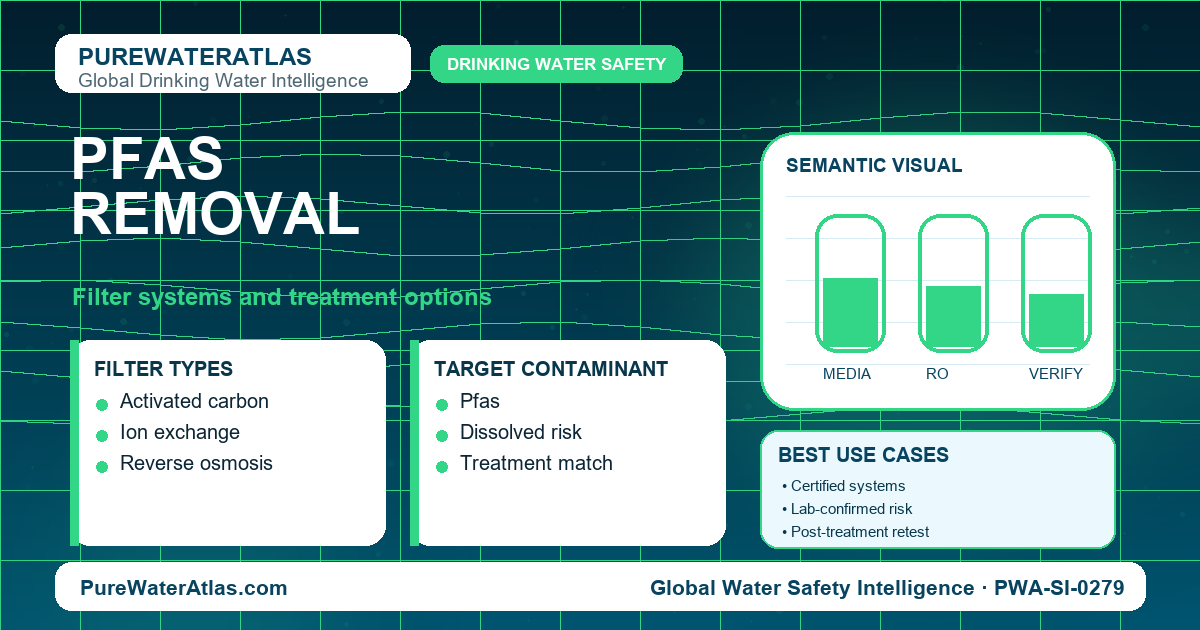
Drinking water safety standards carbon filters are among the most widely used treatment options because they are affordable, convenient, and effective for many common aesthetic and chemical concerns. Activated carbon works by adsorption, trapping certain contaminants on a porous surface.
Carbon filters are commonly used to reduce:
- Chlorine and chloramine-related taste and odor issues
- Some volatile organic compounds
- Certain pesticides and industrial chemicals
- Some PFAS, depending on system design and certification
However, standard carbon filters usually do not reliably remove dissolved salts, nitrates, fluoride, or many heavy metals unless specially designed and certified for those purposes. Carbon also does not provide dependable primary disinfection against pathogens without additional treatment steps.
Best use cases include improving taste, reducing chlorine byproducts, and serving as part of a multistage treatment train. Consumers interested in broader technologies can review options under water treatment systems.
Reverse Osmosis Systems
Drinking water safety standards reverse osmosis systems are highly effective for reducing many dissolved contaminants. Reverse osmosis pushes water through a semipermeable membrane that blocks a large range of ions, molecules, and particulates.
Reverse osmosis is often used for:
- Arsenic
- Nitrate
- Fluoride
- Lead and some other metals
- Total dissolved solids
- Many industrial chemicals and contaminants when combined with pre- and post-filtration stages
Its advantages include broad contaminant reduction and strong suitability for challenging dissolved contamination profiles. Its limitations include slower production rate, wastewater generation, need for periodic membrane replacement, and possible removal of beneficial minerals. Reverse osmosis systems are usually installed at the point of use, such as under the kitchen sink, though larger systems exist for commercial or whole-building applications.
Ultraviolet Disinfection
UV systems inactivate bacteria, viruses, and some protozoa by damaging their genetic material. They are excellent for microbiological control in clear water, especially for private wells. However, UV does not remove chemical contaminants, sediment, or turbidity. Pretreatment is often necessary so particles do not shield microorganisms from exposure.
Distillation
Distillation heats water into vapor and condenses it, leaving many contaminants behind. It can remove a wide range of dissolved substances and pathogens, though it is typically slower and more energy-intensive than other household options. Some volatile chemicals may require added carbon treatment to avoid carryover.
Ion Exchange and Water Softeners
Ion exchange is commonly used for hardness reduction and can also target certain specific contaminants with specialized resins. Standard softeners are not general safety devices; they are mainly operational tools for reducing calcium and magnesium scaling. Special media may be designed for nitrate, uranium, or other contaminants, but application-specific design is essential.
Sediment Filtration
Sediment filters remove sand, silt, rust, and other particles. They protect downstream treatment devices and improve clarity, but they do not usually remove dissolved chemicals or microorganisms. They are often used as a first stage in a multibarrier system.
How to Choose the Best Filter
The drinking water safety standards best filters are the ones that are certified for the contaminants you actually have, sized for your water demand, and maintained properly. A practical selection checklist includes:
- Use laboratory or utility data to identify contaminants
- Choose systems with third-party certification for those contaminants
- Decide between point-of-use and whole-house treatment
- Consider installation space, pressure requirements, and wastewater needs
- Compare replacement cartridge and membrane costs
- Evaluate whether multiple technologies are needed in sequence
Drinking Water Safety Standards Filter Maintenance
Even the best filtration system can fail if maintenance is neglected. Drinking water safety standards filter maintenance is not just about preserving performance; it is also about preventing a filter from becoming a source of contamination itself.
Key maintenance practices include:
- Replace cartridges and membranes on schedule
- Disinfect housings and storage tanks when required
- Monitor flow reduction and pressure changes
- Check seals, fittings, and bypass conditions
- Retest treated water periodically to confirm performance
- Follow manufacturer and certification instructions exactly
Carbon filters that are left in service too long may lose adsorption capacity. Reverse osmosis membranes can foul or scale. UV lamps may still glow while no longer delivering effective disinfection dose. Maintenance is therefore a core part of treatment reliability, not an optional extra.
Common Misconceptions
Water treatment decisions are often shaped by myths or oversimplified assumptions. Correcting these misunderstandings can help consumers avoid ineffective purchases and unsafe practices.
“Clear water is safe water.”
Many dangerous contaminants are invisible and have no noticeable taste or odor. Lead, arsenic, nitrate, and PFAS may all be present in water that appears perfectly normal.
“Any filter improves safety.”
Filters are highly specific. A pitcher filter may improve taste but do little for nitrate or arsenic. A sediment filter may protect plumbing while offering no meaningful chemical reduction. The right treatment must match the actual contaminant profile.
“Boiling water fixes everything.”
Boiling can help inactivate many pathogens, but it does not remove heavy metals, salts, nitrates, or most chemical pollutants. In some cases, boiling can even concentrate dissolved contaminants as water evaporates.
“Bottled water is always safer.”
Bottled water is not automatically better than properly treated tap water. Quality varies by source and brand, and bottled products are not a substitute for solving an ongoing household contamination issue. Long-term reliance on bottled water can also be costly and environmentally burdensome.
“Maintenance can wait if the water still tastes fine.”
Taste is not a reliable indicator of filter performance. A cartridge may be exhausted before consumers notice a change. Following replacement schedules and performance verification is essential.
“Reverse osmosis is always the best choice.”
Reverse osmosis is powerful, but not always necessary or ideal. If the main concern is chlorine taste and odor, a properly certified carbon filter may be more practical and less wasteful. Conversely, if nitrates or arsenic are present, carbon alone may be inadequate. The best solution depends on test results, not popularity.
Regulations and Standards
Drinking water safety standards are built around public health protection, but they differ by jurisdiction and by whether water is supplied publicly or privately. Understanding the major categories of standards helps consumers interpret reports and product claims.
Health-Based Standards
Regulators often establish maximum contaminant levels or similar limits for substances known to pose health risks. These values are based on toxicology, epidemiology, treatment feasibility, and risk management considerations. In many systems, there is also a distinction between enforceable legal limits and non-enforceable health goals.
Operational Standards
Public water systems are usually required to meet operational requirements for treatment, disinfection, sampling, reporting, and corrective action. These standards help ensure consistent quality from source to tap, though household plumbing can still influence final water conditions.
Certification Standards for Filters
For residential treatment devices, third-party product certification is one of the most useful quality indicators. Certified systems are tested against specific contaminant reduction claims and structural requirements. This matters because marketing language can be broad, while certified performance is tied to measurable outcomes.
When comparing filters, look for:
- Certification for the exact contaminant of concern
- Rated capacity and flow limits
- Instructions for installation and replacement
- Compatibility with your water pressure and quality conditions
Public Water Versus Private Wells
One of the biggest regulatory distinctions is that public systems are usually monitored under legal frameworks, while private wells are often the owner’s responsibility. That means private well owners must build their own testing schedule, treatment plan, and maintenance routine. In effect, they serve as both customer and system operator.
Global Perspective
Across the world, drinking water regulations vary in stringency, enforcement, infrastructure capacity, and contaminant priorities. Some regions focus heavily on microbial safety due to sanitation challenges, while others are increasingly concerned with industrial chemicals, aging infrastructure, and emerging contaminants. Global comparisons show that strong standards are only part of the solution; implementation, monitoring, and public communication are equally important.
For readers seeking broader policy context, standards summaries, and practical explanations, see the complete guide and additional materials in global water quality.
Conclusion
Understanding drinking water safety requires looking beyond simple claims and focusing on evidence, standards, and system fit. The phrase drinking water safety standards best filters is not about finding one perfect product for every situation. It is about identifying the contaminants present, understanding the health risks, interpreting relevant standards, and selecting certified treatment technologies that address those risks reliably.
For some households, a certified carbon filter is a practical solution for chlorine, odor, and selected organic chemicals. For others, drinking water safety standards reverse osmosis systems offer broader protection against dissolved contaminants such as arsenic, nitrate, and fluoride. In cases involving microbial hazards, ultraviolet disinfection or properly managed chlorination may be necessary. Often, the most effective approach is a layered system that combines sediment removal, carbon treatment, membrane separation, or disinfection.
The most important lessons are simple: test first, match treatment to the results, verify certification claims, and never ignore maintenance. A thoughtful drinking water safety standards treatment comparison and ongoing drinking water safety standards filter maintenance routine will do more to protect health than any single marketing promise. With accurate information and the right equipment, consumers can make confident decisions that support both water quality and long-term safety.
To continue learning, visit drinking water safety, explore water treatment systems, and review specialized guides on sources, risks, and standards.
Read the full guide: Drinking Water Safety Guide
Explore more in this category: Drinking Water Safety Articles