
Introduction
Water quality inside a home is often judged by taste, odor, and clarity, yet many important water characteristics are invisible. One of the most useful broad indicators of water quality is the concentration of dissolved substances, commonly measured as total dissolved solids, or TDS. A practical total dissolved solids in water home safety checklist helps homeowners, renters, and property managers understand when dissolved minerals are normal, when dissolved contaminants may signal a larger issue, and what steps to take to protect drinking water, plumbing, and appliances.
Total dissolved solids include inorganic salts, minerals, and small amounts of organic matter that are dissolved in water. Some level of dissolved solids is expected in nearly all natural water. In fact, many dissolved minerals occur naturally as groundwater moves through rock and soil. However, elevated readings can also point to contamination, aging plumbing, industrial impacts, agricultural runoff, treatment problems, or salt intrusion. This is why a thoughtful household approach matters.
An effective safety checklist does more than ask whether water is “safe” or “unsafe.” It considers the source of the water, recent changes in taste or appearance, the age of household plumbing, local environmental conditions, and whether testing has been done recently. It also distinguishes between aesthetic issues, such as scaling or salty taste, and more significant concerns that may require laboratory analysis. For readers who want broader background, the resources at /category/water-science/ and /total-dissolved-solids-in-water-complete-guide/ provide useful supporting information.
This article explains what total dissolved solids are, where they come from, how they may affect health and household systems, and how to build a practical inspection, testing, and maintenance routine. It also covers key total dissolved solids in water risk signs, methods for total dissolved solids in water household testing, and sensible total dissolved solids in water protection steps for homes using either municipal water or private wells.
What It Is
Total dissolved solids refers to the combined amount of substances dissolved in water that are small enough to pass through a fine filter. These substances can include calcium, magnesium, sodium, potassium, bicarbonates, chlorides, sulfates, nitrates, trace metals, and certain dissolved organic compounds. TDS is usually reported in milligrams per liter (mg/L), which is roughly equivalent to parts per million (ppm) for household discussion.
It is important to understand that TDS is not a single contaminant. Instead, it is a summary measurement. A high TDS reading does not automatically reveal exactly which substances are present, and a low reading does not guarantee the absence of harmful contaminants. Water can have modest TDS while still containing bacteria, lead, pesticides, or volatile chemicals. Conversely, water can have relatively high TDS because of harmless but noticeable minerals such as calcium and magnesium.
In homes, TDS matters for several reasons:
- Taste: Dissolved minerals and salts can affect whether water tastes fresh, metallic, bitter, or salty.
- Scaling: Mineral-rich water can leave deposits in kettles, heaters, faucets, and pipes.
- Corrosion balance: Water chemistry influences whether plumbing materials are protected or degraded over time.
- Appliance performance: Dishwashers, coffee makers, humidifiers, and water heaters may be affected by excessive dissolved solids.
- Water treatment decisions: TDS measurements help determine whether softening, filtration, or reverse osmosis may be useful.
TDS is often confused with hardness, but they are not the same. Hardness mainly refers to calcium and magnesium. TDS includes those minerals but also many other dissolved substances. A household can have high hardness and moderate TDS, or lower hardness but elevated sodium, chloride, or sulfate contributing to TDS.
Because TDS is a broad indicator, it is best used as part of a wider total dissolved solids in water inspection process rather than as a stand-alone decision tool. Homeowners should think of it as an early warning metric that guides further investigation when readings change or symptoms appear.
Main Causes or Sources
Dissolved solids enter water from both natural and human-made sources. Understanding the source helps determine whether the issue is mostly aesthetic, a plumbing maintenance problem, or a potential health concern. A more focused discussion of source pathways can be found at /total-dissolved-solids-in-water-causes-and-sources/ and /category/water-contamination/.
Natural Geology and Mineral Dissolution
As rainwater and groundwater move through soil and rock, they dissolve naturally occurring minerals. In many regions, groundwater contains calcium, magnesium, bicarbonates, silica, and trace salts because of contact with limestone, gypsum, sandstone, or other formations. This is one of the most common reasons well water has measurable TDS.
Natural mineralization is not always a problem. In fact, moderate mineral content is common and expected. Problems arise when levels become high enough to cause unpleasant taste, scaling, staining, or interaction with plumbing materials.
Municipal Treatment and Distribution
Municipal water systems treat source water to make it safe, but dissolved solids can still remain in finished water. Treatment chemicals, blending of multiple water sources, seasonal changes, and movement through long distribution systems can all affect TDS levels. In some regions, utilities switch between surface water and groundwater supplies at different times of year, and households may notice corresponding taste changes.
Distribution systems can also contribute dissolved material indirectly if corrosion control is inadequate or if old infrastructure affects water chemistry. While utilities monitor water quality, conditions at the point of entry to a neighborhood are not always identical to conditions at a household tap.
Private Wells and Rural Settings
Private wells are especially influenced by local geology, land use, water table changes, and nearby contamination sources. Well water may show elevated TDS because of fertilizers, road salt, septic system influence, animal operations, industrial activity, or naturally high mineral content. Since private well owners are generally responsible for their own testing, regular monitoring is essential.
Agricultural Runoff
Fertilizers and soil amendments can contribute nitrates, phosphates, potassium, and other dissolved substances to groundwater and surface water. Irrigation return flows can further concentrate salts. In farming areas, this can significantly affect private wells and even some small public systems.
Road Salt and Seasonal Salt Intrusion
In colder regions, de-icing salts can move into groundwater and surface water. Elevated sodium and chloride are common results. Homes near heavily treated roads, parking lots, or storage areas may experience changes in TDS over time. Coastal areas can also see saltwater intrusion into freshwater aquifers, especially where over-pumping or drought changes groundwater balance.
Industrial and Commercial Sources
Manufacturing, mining, energy production, and commercial discharges may introduce dissolved chemicals or metals into local water resources. Even when regulated, legacy pollution or accidental releases can create persistent water quality issues. This is one reason homeowners should not interpret TDS solely as a “mineral” issue; the reading may reflect more complex contamination pathways.
Household Plumbing and Water Treatment Systems
Sometimes the source of elevated dissolved solids is inside the home. Corroding pipes, failing water heaters, old fixtures, and poorly maintained treatment systems can alter tap water quality. Water softeners, for example, exchange hardness minerals for sodium or potassium. This may improve scale control but can change the dissolved composition and in some cases increase sodium levels in treated water. Reverse osmosis systems, if not maintained, may perform poorly and allow TDS to rise unexpectedly.
Health and Safety Implications
TDS itself is not a direct diagnosis of health risk, but it can be a meaningful signal. The health significance depends on what is making up the dissolved solids. Some dissolved minerals are relatively harmless at typical household levels, while others may indicate contamination requiring prompt attention. For a deeper review, see /total-dissolved-solids-in-water-health-effects-and-risks/.
When TDS Is Primarily an Aesthetic Issue
Moderate TDS often affects taste more than health. Water may taste flat, mineral-like, or slightly salty. Hard water can create scale buildup, soap inefficiency, and residue on dishes, but these effects are generally household maintenance concerns rather than acute medical threats.
When TDS Suggests Possible Health Concerns
Elevated readings should prompt a closer look when there are signs that dissolved solids may include substances of concern, such as nitrates, arsenic, heavy metals, excess sodium, or industrial chemicals. TDS meters do not identify these specifically, but a rising or unusually high reading can justify laboratory testing.
Potential concerns include:
- Nitrates: Particularly important for infants and private well users in agricultural areas.
- Sodium: Relevant for people on sodium-restricted diets, especially where water softeners are used.
- Sulfates: Can cause bitter taste and may contribute to digestive upset at higher levels in some individuals.
- Metals: Copper, lead, arsenic, manganese, and others require specific testing and should never be inferred from TDS alone.
- Chlorides: Often associated with salty taste, corrosion issues, road salt, or intrusion from contaminated sources.
Total Dissolved Solids in Water Risk Signs
Homeowners should watch for changes that suggest a need for further inspection. Common total dissolved solids in water risk signs include:
- A sudden salty, bitter, metallic, or chemical taste
- Increased white scale on faucets, showerheads, kettles, and coffee makers
- Frequent appliance maintenance or shortened water heater life
- Cloudy water that clears but leaves residue
- Soap that lathers poorly and residue on dishes or laundry
- Corrosion, blue-green staining, or unusual discoloration around fixtures
- Noticeable water quality changes after road salting season, drought, flooding, or nearby construction
- A meaningful rise in TDS meter readings compared with the home’s usual baseline
Who Should Be Most Cautious
Some households should pay closer attention to dissolved solids and related contaminants:
- Homes with private wells
- Homes near farms, industrial sites, busy roads, or coastal zones
- Older homes with aging plumbing
- Families with infants, pregnant individuals, elderly residents, or medically vulnerable occupants
- Households using water softeners or under-sink treatment systems without regular maintenance
In short, TDS is best viewed as a screening clue. It helps homeowners decide when deeper investigation is needed, but it does not replace a full safety assessment.
Testing and Detection
A strong total dissolved solids in water household testing plan combines simple home tools with periodic certified laboratory analysis. The goal is not only to obtain a number, but also to understand trends, detect changes early, and connect results with likely causes.
Using a Handheld TDS Meter
The most common household tool is a digital conductivity-based TDS meter. These meters estimate dissolved solids by measuring how well water conducts electricity. They are affordable, fast, and useful for routine checks. However, they provide an estimate rather than a complete chemical profile.
Best practices for home meter use include:
- Follow the manufacturer’s calibration instructions
- Test cold water unless comparing specific system outputs
- Run the tap briefly before sampling, unless evaluating standing water in pipes
- Record results with date, location, and notes about taste or appearance
- Compare results from source water, softened water, and filtered water if applicable
What Home Meters Can and Cannot Tell You
A meter can help identify whether dissolved solids are generally increasing, decreasing, or staying stable. It can also help verify whether a reverse osmosis system is reducing TDS as expected. But it cannot identify bacteria, lead, pesticides, or specific dissolved ions. Two water samples can show the same TDS while having very different safety profiles.
Total Dissolved Solids in Water Inspection Checklist
A routine total dissolved solids in water inspection should include more than one measurement. A useful home checklist includes:
- Measure TDS at the kitchen cold-water tap
- Measure TDS before and after any treatment system
- Note changes in taste, odor, or mouthfeel
- Check faucets, showerheads, and kettle interiors for scale
- Inspect under-sink filters, softeners, and reverse osmosis membranes for maintenance status
- Review appliance performance, especially water heaters, dishwashers, and humidifiers
- Consider local events such as flooding, drought, construction, or seasonal salting
- Compare readings over time instead of relying on a single number
When Laboratory Testing Is Needed
Certified laboratory testing is recommended when:
- You use a private well
- TDS rises sharply without a clear explanation
- Water develops a persistent salty, metallic, or bitter taste
- There are infants or medically sensitive people in the home
- Nearby land use creates contamination concerns
- You suspect nitrates, arsenic, heavy metals, sulfate, chloride, or sodium issues
Depending on location and risk factors, a laboratory panel may include general mineral chemistry, alkalinity, hardness, sodium, chloride, sulfate, nitrate, iron, manganese, copper, lead, arsenic, and pH. For well owners, routine testing should be part of annual home maintenance, not just a one-time event.
Establishing a Baseline
One of the smartest household testing strategies is to establish a baseline. Test the water several times over a year to understand normal seasonal variation. This way, if readings shift suddenly, you have context. Baselines are especially helpful for private wells, homes with treatment systems, and households in areas affected by drought or road salt.
If you are researching treatment options, the information at /category/water-purification/ can help frame the next steps after testing.
Prevention and Treatment
Prevention starts with knowing your water source, tracking changes, and maintaining plumbing and treatment systems properly. Treatment depends on what is causing the dissolved solids. There is no one-size-fits-all device for every TDS problem.
Total Dissolved Solids in Water Protection Steps
Effective total dissolved solids in water protection steps include:
- Test water routinely, especially for private wells
- Keep records of meter readings, lab reports, and maintenance dates
- Inspect plumbing fixtures and appliances for scaling or corrosion
- Service water treatment devices on schedule
- Protect wells from surface runoff, flooding, and nearby contamination
- Investigate sudden changes rather than ignoring them
- Use certified treatment equipment matched to the specific water problem
Source Control
Whenever possible, address the source before adding treatment. For example, improve wellhead protection, inspect septic systems, redirect runoff, seal vulnerable openings, or work with local authorities if regional contamination is suspected. Source control is often more effective and sustainable than relying only on end-of-tap treatment.
Water Softeners
Softeners remove calcium and magnesium hardness through ion exchange. They can reduce scaling and improve soap performance, but they do not truly remove all dissolved solids. Instead, they replace hardness minerals with sodium or potassium. That means softened water may still have considerable TDS, and the sodium level may rise. Softening is therefore a hardness solution, not a universal dissolved solids solution.
Reverse Osmosis
Reverse osmosis is one of the most effective household methods for reducing a broad range of dissolved solids. It can significantly lower many salts, minerals, and some contaminants. Under-sink reverse osmosis units are commonly used for drinking and cooking water rather than whole-house treatment. They require membrane and filter maintenance, adequate water pressure, and periodic performance checks using a TDS meter.
Distillation and Specialized Treatment
Distillation can reduce many dissolved substances but is less common for routine household use because of energy use and production speed. In certain cases, specialized media or treatment combinations may be needed for specific dissolved contaminants such as nitrate, arsenic, or fluoride. The right treatment depends on confirmed lab results.
Routine Total Dissolved Solids in Water Maintenance Tips
Practical total dissolved solids in water maintenance tips can reduce both nuisance problems and treatment failures:
- Replace cartridges, membranes, and filters according to manufacturer guidance
- Sanitize systems when recommended, especially after long periods of disuse
- Check bypass valves and plumbing connections to ensure treatment systems are functioning correctly
- Flush infrequently used faucets to reduce water stagnation
- Descale kettles, showerheads, coffee makers, and humidifiers regularly
- Drain and maintain water heaters based on local water conditions
- Review annual water quality reports if using municipal water
- Schedule annual well inspections where applicable
Household Safety Checklist
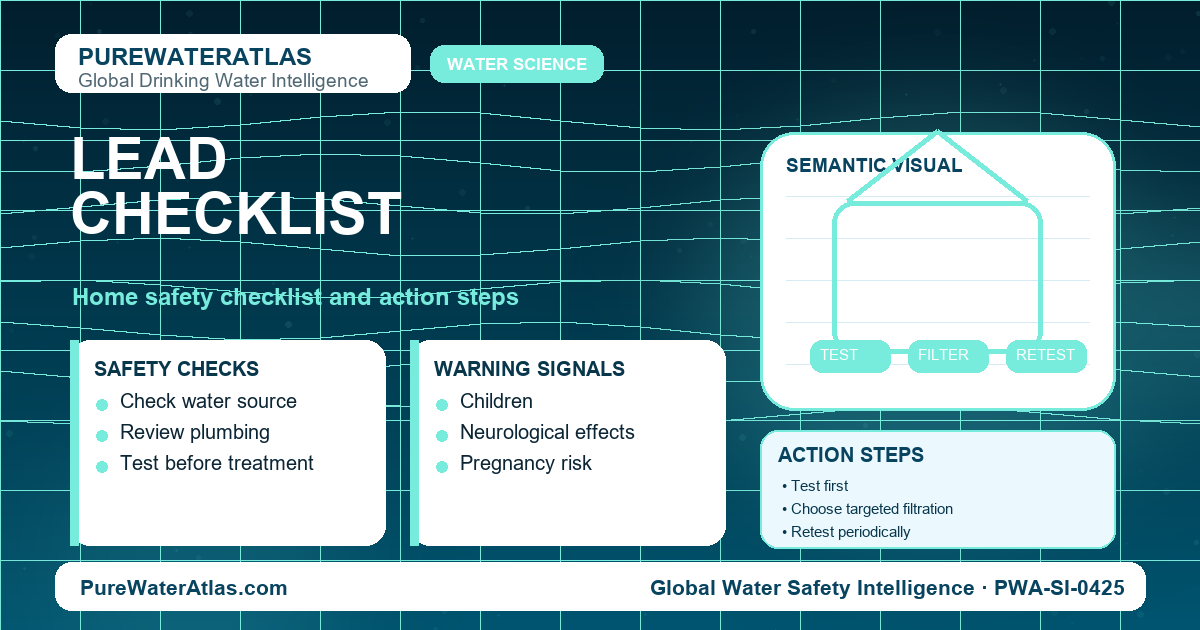
Below is a concise total dissolved solids in water home safety checklist that households can use:
- Know whether your home uses municipal water or a private well
- Measure TDS periodically and log the results
- Watch for taste changes, scale, corrosion, or appliance problems
- Test with a certified laboratory when readings change or risk factors are present
- Inspect and maintain filters, softeners, and reverse osmosis systems
- Check local environmental events that may affect source water
- Investigate sodium, nitrate, chloride, sulfate, and metals if indicated
- Use treatment matched to verified contaminants, not assumptions
- Re-test after installing or servicing treatment equipment
- Keep records so you can recognize trends over time
Common Misconceptions
Misunderstandings about TDS are common and can lead to poor decisions. Clearing them up helps households test and treat water more effectively.
“High TDS Always Means Dangerous Water”
Not necessarily. High TDS may result from naturally occurring minerals that mainly affect taste and scaling. The actual health significance depends on the composition of the dissolved solids, not just the total number.
“Low TDS Means Water Is Completely Safe”
Also false. Water can have low TDS and still contain harmful microbes, lead, pesticides, or organic contaminants. TDS is only one parameter in a complete water quality picture.
“A TDS Meter Identifies Specific Contaminants”
A handheld meter does not identify individual substances. It gives an estimated overall dissolved solids value based on conductivity. Laboratory testing is required to determine which ions or contaminants are present.
“Water Softeners Remove All Dissolved Solids”
Softening targets hardness minerals, not every dissolved substance. In fact, ion exchange often leaves overall dissolved content substantial while changing the water’s composition.
“Clear Water Has No Dissolved Solids Problem”
Many dissolved substances are invisible. Water can look perfectly clear and still have elevated sodium, nitrate, chloride, or other dissolved compounds.
“One Test Is Enough Forever”
Water quality changes over time. Seasonal shifts, plumbing aging, treatment system failures, environmental events, and source changes can all alter TDS and related parameters. Ongoing monitoring is more useful than a one-time snapshot.
Regulations and Standards
Regulatory frameworks for drinking water vary by country and region, but several general principles apply. Public water systems are typically required to monitor a wide range of contaminants and provide consumer reports. Private well owners, however, usually bear responsibility for testing and treatment on their own property.
Aesthetic Guideline vs. Health-Based Standard
For TDS, many jurisdictions treat the measurement mainly as an aesthetic or secondary standard rather than a direct health-based maximum. This is because the significance of TDS depends heavily on what substances make it up. High TDS may cause taste, odor, or scaling concerns before it indicates a clear toxicological problem.
That said, specific dissolved components such as nitrate, arsenic, lead, fluoride, sodium, sulfate, or chloride may be subject to separate guidelines or enforceable limits. Therefore, a homeowner should not stop at the TDS number when there is reason to suspect a particular contaminant.
Municipal Water Responsibilities
Public water suppliers generally must meet regulatory requirements, perform routine monitoring, and notify consumers of certain violations. Reviewing the annual consumer confidence report can help residents understand source water, treatment methods, and measured contaminants. If a household notices unusual taste or TDS changes, comparing those observations with utility reports can be useful.
Private Well Responsibilities
For private wells, no utility is automatically monitoring water quality for the homeowner. Well owners should create their own routine that includes periodic TDS checks, annual or risk-based lab testing, and inspection after flooding, repairs, or unusual environmental events. In practical terms, private well stewardship is one of the most important household water safety habits.
Product Certification and Treatment Claims
When selecting filters or purification systems, choose products certified for the specific contaminant or performance claim you need. General marketing language such as “improves water quality” is not enough. Homeowners should look for documented performance data, maintenance requirements, and compatibility with actual water test results.
Conclusion
A reliable household water strategy begins with observation, testing, and informed action. Total dissolved solids are a valuable screening measure because they reveal changes in the dissolved content of water that may affect taste, plumbing, appliances, and in some cases health-related decision-making. But TDS is most useful when interpreted in context rather than in isolation.
A smart home checklist includes knowing your water source, monitoring readings over time, watching for changes in taste and scaling, maintaining treatment equipment, and ordering laboratory analysis when risk factors or unusual results appear. This approach turns the total dissolved solids in water home safety checklist from a simple number into a practical protection tool.
For many households, the most important lessons are straightforward: do not assume clear water is problem-free, do not assume one TDS reading tells the full story, and do not ignore sudden changes. Instead, combine total dissolved solids in water household testing, routine total dissolved solids in water inspection, and steady total dissolved solids in water maintenance tips with targeted total dissolved solids in water protection steps. That balanced approach helps protect both daily water use and long-term home safety.
Read the full guide: Water Science Guide
Explore more in this category: Water Science Articles