
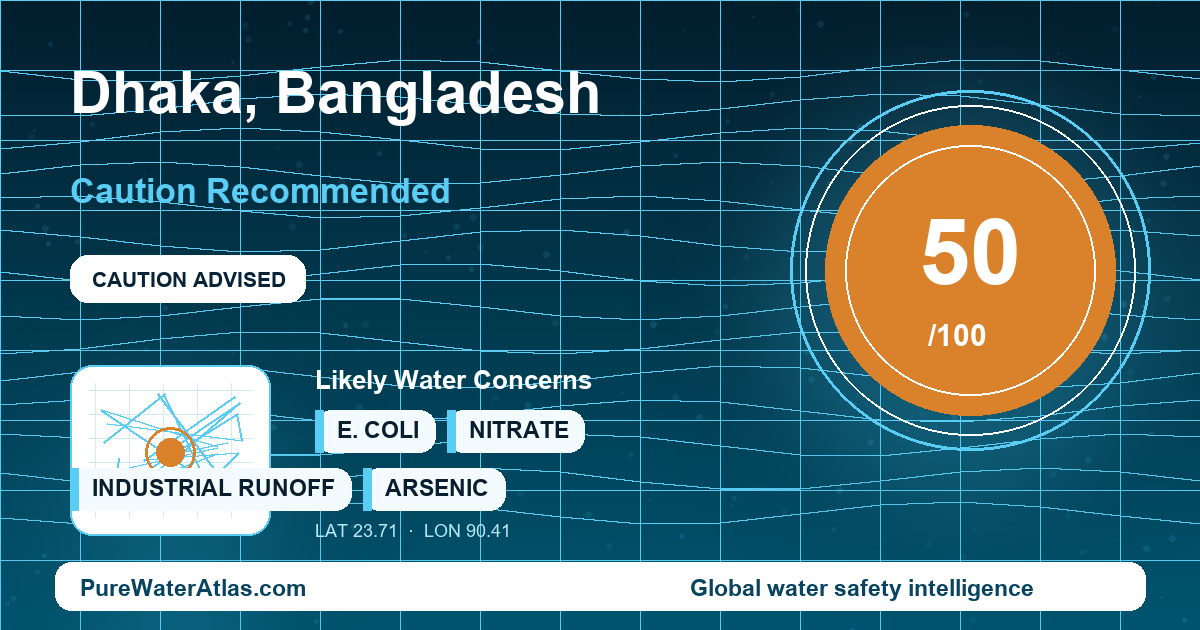
Dhaka has a formal municipal supply operated by Dhaka WASA, but tap-water safety depends heavily on distribution pipes, pressure, building storage tanks, and point-of-use treatment.
Quick Answer
| Overall status | Caution recommended. Dhaka’s municipal water is treated, but drinking directly from the tap is not the prudent default because contamination can occur between treatment, distribution, building tanks, and the kitchen tap. |
|---|---|
| Water safety score | 50 / 100 — risk level: Caution Recommended. |
| Traveler advice | Do not rely on untreated tap water. Use factory-sealed bottled water, boiled water, or properly filtered and disinfected water. |
| Resident advice | Treat drinking water at the point of use, maintain underground and rooftop tanks, and test kitchen-tap water periodically, especially for microbiological contamination. |
| Main supply identity | A mixed Dhaka WASA system: historically dominated by deep groundwater wells, now shifting toward treated surface water from major regional river systems. |
| Water authority | Dhaka Water Supply and Sewerage Authority, commonly called Dhaka WASA or DWASA. |
| Filter recommendation | Usually yes. A practical Dhaka setup is sediment prefiltration plus activated carbon and reliable disinfection such as UV or boiling. Reverse osmosis may be appropriate where testing shows high TDS, arsenic, nitrate, or other dissolved contaminants. |
Why Dhaka Is Different
Dhaka’s tap-water question is not only a question about treatment plants. The city sits in a low-lying deltaic urban area surrounded by heavily used rivers and canals, with water security shaped by rapid growth, monsoon flooding, groundwater stress, and the condition of regional rivers. In practical terms, a resident’s drinking water may pass through municipal mains, an underground reservoir, a booster pump, a rooftop tank, internal building pipes, and finally the kitchen tap. Each step can affect water quality.
The city’s water history is also distinctive. Dhaka relied heavily on groundwater for decades because nearby rivers such as the Buriganga, Turag, Balu, and Shitalakhya became polluted and difficult to use without substantial treatment. Heavy groundwater abstraction contributed to falling groundwater levels. That is why Dhaka WASA and development partners have been expanding treated surface-water infrastructure to reduce pressure on the aquifer and improve long-term reliability.
The safest city-specific conclusion is therefore cautious: Dhaka has a formal utility and treated supply, but untreated tap water should not be assumed safe at the final tap unless a specific building has recent verified microbiological and chemical test results.
Where Does Dhaka’s Tap Water Come From?
Dhaka’s municipal supply is a mixed system. Historically, the system depended heavily on deep groundwater production wells. Current planning and investment are shifting the city toward treated surface water from major regional river systems, while groundwater abstraction still remains part of the supply picture.
Important Dhaka water infrastructure includes the Dhaka WASA municipal distribution network, production wells, treatment plants, reservoirs, pumps, and distribution zones. The Sayedabad Water Treatment Plant system has been associated with surface-water treatment for Dhaka. The Padma/Jashaldia surface-water supply infrastructure brings treated river water toward Dhaka from the Padma River system. Development-bank documentation also describes planned and ongoing surface-water expansion linked to the Meghna River system, including the Gandharbpur water treatment project.
This source transition matters because Dhaka’s nearby urban rivers face sewage, industrial, solid-waste, and urban runoff pressures. Moving toward larger treated surface-water projects from more reliable source areas is intended to reduce groundwater dependence, but it does not remove the need to manage distribution and building-level risks. Treated water can still deteriorate if it passes through old or leaking mains, illegal or poorly sealed connections, low-pressure zones, or poorly maintained storage tanks.
Who Manages Drinking Water in Dhaka?
Dhaka’s main municipal water and sewerage utility is Dhaka Water Supply and Sewerage Authority. Dhaka WASA manages the city’s water-supply infrastructure through production wells, treatment facilities, reservoirs, pumps, and distribution networks. It operates within Bangladesh’s urban water supply and sewerage institutional framework, with oversight linked to the Ministry of Local Government, Rural Development and Co-operatives.
Drinking-water quality is governed by national standards and public-health expectations, while source-water pollution is also affected by environmental regulation. For household decision-making, however, a key limitation is public data availability. Dhaka has identifiable city-level infrastructure and official utility documentation, but routine public tap-level monitoring results by neighborhood, building, and season are not consistently available. Water quality can vary by distribution zone, pressure events, tank maintenance, private wells, old plumbing, and monsoon conditions. PureWaterAtlas therefore does not claim that every Dhaka tap either meets or fails a specific legal limit without verified local sampling.
Main Local Water Concerns
The main Dhaka concern is post-treatment contamination. Microbial risk can increase where pipes are damaged, where water pressure is intermittent, where drains are nearby, where connections are poorly sealed, or where building tanks are not protected and cleaned. The most important short-term health concern is contamination by fecal indicator organisms such as E. coli, especially for visitors, children, older adults, and immunocompromised people.
Dhaka residents may also see episodes of high turbidity, discoloration, or sediment, particularly during pipe repairs, nearby construction, monsoon disturbance, service interruptions, or tank cleaning. Turbid water can interfere with disinfection and can signal physical disturbance in the system.
Residual chlorine is another city-relevant issue. Chlorine can help protect water after treatment, but residual disinfectant may decline after long residence time in distribution lines and building storage tanks. This is one reason that rooftop and underground tanks are critical control points in Dhaka apartments.
Chemical risks are more building- and source-specific. Bangladesh has a national groundwater concern with arsenic, but Dhaka municipal deep supply and treated surface-water supply should not automatically be treated as the same risk profile as rural shallow wells. Private wells, building groundwater systems, and non-DWASA sources should be tested before use for drinking. Iron and manganese can occur in groundwater-derived supplies or building systems and may cause staining, metallic taste, black or reddish discoloration, and filter fouling. Lead is not well characterized in public citywide data, but older internal plumbing, brass fittings, solder, or imported fixtures can create building-specific risk.
Season matters. Monsoon rains can increase flooding, sewer overflow pressure, turbidity, and intrusion risk in damaged pipes or tanks. Dry-season low river flows can concentrate pollution in source waters and make treatment more challenging. Power outages or pump interruptions can create low-pressure events, increasing intrusion risk in vulnerable parts of the distribution and building systems.
For Travelers
Short-term visitors should not drink untreated tap water in Dhaka as a default. Use factory-sealed bottled water from reputable sources, boiled water, or water that has been properly filtered and disinfected. Check bottle seals before drinking and avoid refilled unsealed bottles.
For brushing teeth, use bottled, boiled, or filtered and disinfected water if you have a sensitive stomach, are immunocompromised, are traveling briefly, or are staying in budget lodging where tank maintenance is unknown. Many long-term residents also use treated water for brushing as an added precaution.
Avoid ice unless you know it was made from purified water. In higher-end hotels and restaurants, in-house filtration may be used, but it should not be assumed. Ask specifically whether ice and table water are made from filtered or bottled water. If uncertain, choose drinks without ice and request factory-sealed bottles.
Dhaka is hot and traffic delays can be long, so carry safe drinking water with you. Oral rehydration salts are practical during hot months or if gastrointestinal illness occurs. For baby formula, use boiled water that has cooled in a clean covered container, or another verified safe water source.
For Residents
Most Dhaka households should treat drinking water at the point of use. A practical setup is a washable sediment prefilter to reduce particles and protect equipment, followed by a certified activated-carbon stage for taste, odor, chlorine byproducts, and some organic compounds, plus a reliable disinfection step such as UV or boiling. UV systems should be paired with sediment prefiltration and maintained carefully because cloudy water and dirty sleeves can reduce performance. See PureWaterAtlas guides to boiling water purification and UV water purification.
Reverse osmosis can be useful where testing shows high TDS, arsenic, nitrate, or other dissolved contaminants. It should not be installed blindly as a substitute for testing and maintenance. Poorly maintained filters, storage tanks, or UV units can themselves become contamination points.
Residents should test kitchen-tap water for total coliform and E. coli, especially after flooding, construction, tank cleaning, illness clusters, or long service interruptions. Basic screening should also include turbidity, color, odor, pH, residual chlorine, conductivity, and TDS. If using a private tube well, building groundwater source, or non-DWASA supply, test for arsenic before drinking or cooking with it. Test for iron and manganese if water is reddish, brown, black, metallic-tasting, or staining fixtures and laundry. Test first-draw and flushed samples for lead if the building is old, plumbing materials are unknown, or infants, pregnant people, or children drink the water.
Old buildings need extra caution. Corroded internal pipes, poorly sealed underground reservoirs, aging rooftop tanks, and mixed plumbing materials can make one apartment’s water different from another’s. Do not assume that water at the building entry point is the same as water at your kitchen tap.
Storage tanks are one of the most important Dhaka controls. Underground reservoirs and rooftop tanks should be covered, screened against insects and animals, protected from floodwater entry, and cleaned on a regular schedule by competent staff. After tank cleaning or plumbing repairs, flush taps and consider microbiological testing before drinking untreated water.
Relevant Contaminants and Water-Quality Issues
The Dhaka contaminants most relevant for practical decision-making are those linked to distribution and storage. E. coli is the key warning indicator for possible fecal contamination and short-term illness risk. Turbidity and sediment matter because pipe repairs, monsoon disturbance, construction, and tank cleaning can create cloudy or particle-laden water. Chlorine is relevant because residual disinfectant helps protect treated water, but levels can decline before water reaches the final tap.
For non-municipal or building-specific sources, arsenic, iron, and manganese should be considered based on source and symptoms such as staining, metallic taste, or filter fouling. Lead is best treated as a plumbing-specific risk in older or unknown buildings rather than as a single citywide assumption.
How to Verify Your Water Quality
The only reliable way to know whether a specific Dhaka apartment, house, office, hotel, or school has safe tap water is to test the actual water being consumed. Start with microbiological testing at the kitchen tap for total coliform and E. coli. If the building uses tanks, sample after tank maintenance and after long interruptions. If there are infants, pregnant people, children, or immunocompromised residents, use a more conservative testing and treatment approach.
For a broader testing plan, use the PureWaterAtlas complete guide to water testing. For older buildings or unknown plumbing, review lead testing and detection methods. If a private well or non-DWASA groundwater source is involved, review arsenic testing methods and, where infant formula or shallow groundwater is relevant, nitrate testing methods.
You can also use the PureWaterAtlas Contaminants Search Engine to look up specific water-quality issues and the Global Water Quality Checker to compare Dhaka guidance with other cities. For background, see the PureWaterAtlas pillars on drinking water safety, water microbiology, and water treatment systems.
Official and Technical Sources
- Dhaka Water Supply and Sewerage Authority — official utility context for Dhaka’s municipal water and sewerage operations.
- Asian Development Bank: Dhaka Environmentally Sustainable Water Supply Project — documents Dhaka’s shift toward surface-water supply and reduced groundwater reliance.
- Asian Development Bank: Dhaka Water Supply Network Improvement Project — supports the importance of distribution-network condition and pressure management.
- World Bank: Clean Water for Dhaka — background on rapid urbanization, groundwater dependence, and the need for safer, more reliable water supply.
- UNICEF Bangladesh: Water, Sanitation and Hygiene — public-health context for safe water, sanitation, and hygiene in Bangladesh.
- WHO/UNICEF Joint Monitoring Programme — national Bangladesh household WASH context, not a substitute for Dhaka building-level tap testing.
- WHO Guidelines for Drinking-water Quality — general reference for microbial safety, disinfection, turbidity control, and health-based risk management.
Bottom Line
Dhaka tap water deserves a cautious rating. The city has an official utility, treated municipal water, and major investments shifting supply from groundwater toward treated surface water. The main safety uncertainty is the final path to the tap: aging distribution mains, intermittent pressure, contaminated surroundings, underground reservoirs, rooftop tanks, pumps, and internal plumbing can all affect quality. Travelers should avoid untreated tap water and use sealed bottled, boiled, or properly filtered and disinfected water. Residents should maintain tanks, use sediment filtration plus reliable disinfection, and test kitchen-tap water for bacteria and relevant chemicals. Without recent building-specific results, drinking directly from the tap in Dhaka is not recommended.
Read the full guide: Global Water Quality Guide
Explore more in this category: Global Water Quality Articles