
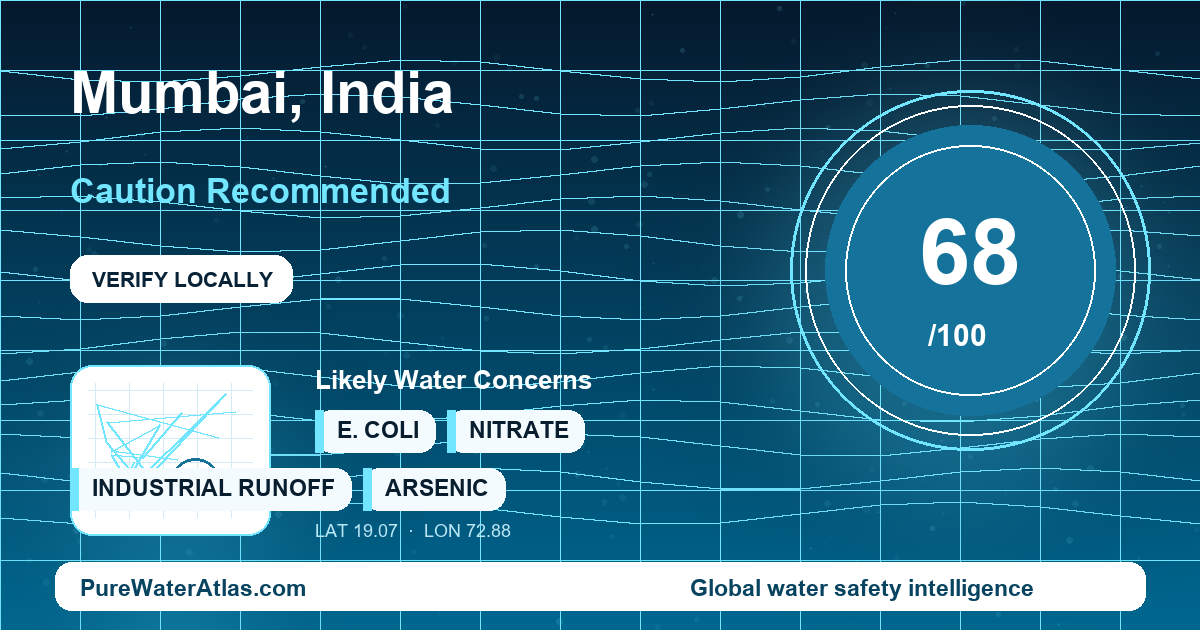
Mumbai uses a large treated reservoir-fed municipal supply, but drinking safety at the tap depends heavily on last-mile distribution, building storage tanks, plumbing, monsoon conditions, and point-of-use treatment.
Quick Answer
| City | Mumbai, India |
|---|---|
| Water safety score | 68 / 100 |
| Risk level | Caution Recommended |
| Can tourists drink the tap water? | Not recommended untreated for most travelers. Use sealed bottled water, boiled water, or water from a reputable, maintained hotel or restaurant purifier. |
| Resident guidance | Many Mumbai households should use a point-of-use purifier because building tanks, local pipes, and intermittent supply can affect water after municipal treatment. |
| Main water source | Treated rain-fed surface water from Mumbai’s reservoir and lake system, including Upper Vaitarna, Modak Sagar, Tansa, Middle Vaitarna, Bhatsa, Vihar, and Tulsi. |
| Water authority | Brihanmumbai Municipal Corporation, also known as BMC or Municipal Corporation of Greater Mumbai, through its Hydraulic Engineer Department and related operations. |
| Practical filter approach | For BMC municipal water, consider sediment prefiltration, activated carbon, and UV or another validated microbiological barrier. RO is most justified for borewell, saline, high-TDS, or confirmed dissolved-contaminant problems. |
Mumbai’s municipal supply is not best described as unsafe at the source. It is a managed, treated surface-water system. The main question is what happens after treatment: long transmission routes, intermittent pressure, leaks, local mains, service reservoirs, private underground tanks, overhead tanks, pumps, and old internal plumbing can change the quality before water reaches a kitchen tap.
Why Mumbai Is Different
Mumbai is a coastal megacity, but its main municipal drinking water is not desalinated seawater and is not primarily local coastal groundwater. The city depends mainly on treated freshwater captured in monsoon-fed reservoirs in and beyond the metropolitan region. Coastal salinity is more relevant where households or buildings use private borewells or other groundwater sources, not as the defining feature of BMC reservoir-fed mains.
The Mumbai-specific safety issue is the gap between treated municipal water and water at the actual point of use. A household may receive water that has passed through major treatment and distribution infrastructure, but then stored water may sit in a building sump or rooftop tank. If those tanks are not covered, protected, and cleaned, they can introduce sediment, insects, biofilm, microbial contamination, or sewage intrusion after the water has already left the municipal system.
Mumbai’s water security is also closely tied to monsoon rainfall and lake storage. In weak monsoon years or when reservoir storage is low, supply restrictions and water cuts can increase reliance on stored water, tankers, or private arrangements. That can make the condition of building-level storage even more important.
Where Does Mumbai’s Tap Water Come From?
Mumbai’s main drinking water supply is a rain-fed surface-water reservoir system. The municipal supply is commonly linked to the lake and reservoir network of Upper Vaitarna, Modak Sagar on the Lower Vaitarna system, Tansa, Middle Vaitarna, Bhatsa, Vihar, and Tulsi. Bulk water is conveyed from catchments north and east of Mumbai, as well as from sources within city limits, to treatment plants and then through trunk mains, tunnels, balancing reservoirs, service reservoirs, and local distribution networks.
The city’s piped water history began with local lake sources such as Vihar and Tulsi. As Mumbai expanded beyond its original island-city demand, the system grew through Tansa, Vaitarna, and Bhatsa projects. That history matters because modern Mumbai water is a long-distance surface-water supply. It relies on large conveyance infrastructure and many downstream distribution points before water reaches homes, hotels, offices, restaurants, and informal premises.
Key infrastructure includes the Bhandup Complex water treatment and distribution infrastructure, which is one of the most important treatment nodes for Mumbai’s municipal supply, and Panjrapur water treatment infrastructure serving water from the Vaitarna and related systems. Treated water then moves through large trunk mains, tunnels, service reservoirs, ward-level networks, and finally private building systems. Many areas operate with scheduled or intermittent supply rather than continuous 24-hour pressure, which is one reason last-mile contamination risk is central to Mumbai drinking water decisions.
Who Manages Drinking Water in Mumbai?
The municipal drinking water utility is the Brihanmumbai Municipal Corporation, also known as BMC or the Municipal Corporation of Greater Mumbai. Water supply operations are associated with BMC’s Hydraulic Engineer Department and related municipal functions.
Drinking water quality in India is generally benchmarked against Bureau of Indian Standards drinking water specifications, including IS 10500. The Bureau of Indian Standards is the national standards body connected to those specifications. Environmental source-water oversight is also relevant: the Maharashtra Pollution Control Board and the Central Pollution Control Board provide broader water-quality monitoring and pollution-control context. However, those resources should not be mistaken for a guarantee about an individual apartment tap, hotel tap, borewell, tanker, or building storage tank.
Publicly available information is strongest for Mumbai’s reservoir sources, utility identity, and major infrastructure. It is much less complete for recent, location-specific tap samples across every ward, old building, hotel, apartment tower, informal settlement, borewell, tanker source, and storage tank. For an individual reader, the biggest uncertainty is the final stretch between the treatment plant and the glass.
Main Local Water Concerns
Microbial contamination after treatment: The most practical Mumbai tap-water risk is not the protected reservoir system itself, but contamination after water is treated. Intermittent supply, pressure changes, pipe leaks, cross-connections, and dirty building storage tanks can allow microbial contamination to enter the distribution or building system. If water is stored in a building tank, testing for E. coli and total coliform is especially important.
Monsoon turbidity and sediment: Mumbai’s raw-water reservoirs are monsoon-fed. Heavy rainfall can increase suspended solids and turbidity in raw water, while local pipe repairs or distribution disturbance can create visible particles at taps. Avoid drinking water that is cloudy, muddy, colored, or carrying sediment. Turbidity also matters because UV systems work less effectively when water is not clear. PureWaterAtlas has background guides on turbidity and sediment in drinking water.
Residual chlorine taste or odor: Chlorination is used to maintain disinfection through the municipal network. A chlorine taste or odor can be noticeable at some taps and is often an aesthetic issue. However, a sudden strong chemical smell, or a suspected contamination event with little or no disinfectant residual, should trigger caution. Activated carbon can reduce taste and odor after microbial safety has been addressed. See PureWaterAtlas on chlorine in drinking water.
Old internal plumbing: Mumbai has many older buildings. Internal pipes, brass fixtures, solder, galvanized iron corrosion, and stagnant branch lines can affect metals, color, and taste even when municipal water has been treated. If there is metallic taste, staining, children, pregnancy, or unexplained health concerns, test the actual tap water. Learn more about lead and iron in drinking water.
Private borewell and tanker variability: Some residents supplement municipal supply with borewell or tanker water. Those sources should not be assumed equivalent to BMC water. Borewell water in vulnerable coastal zones may face salinity-related concerns, and private sources need their own testing for microbial contamination, TDS, chloride, hardness, nitrate, iron, and other parameters based on local conditions.
For Travelers
Tourists should not routinely drink untreated tap water in Mumbai. Use sealed bottled water, boiled water, or water from a reputable and maintained purifier. Check bottle seals and avoid bottles that appear refilled. Use safe water for medications and infant formula.
For brushing teeth, cautious travelers should use bottled or purified water, especially in budget accommodation, during monsoon flooding, or if they have a sensitive stomach. In higher-end hotels with verified in-house purification, tap-water exposure may be lower risk, but it is still not the safest default unless the hotel can explain its treatment and maintenance.
Avoid ice from street vendors or unclear sources. Ice is more acceptable in reputable hotels and restaurants that can confirm it is made from treated or purified water. In restaurants, ask whether drinking water is bottled, RO-treated, UV-treated, or boiled. Filtered water is common in reputable establishments, but maintenance quality is not visible to customers.
Be especially cautious during monsoon flooding, after nearby pipe repairs, when water pressure has been lost, or if water has unusual color, smell, turbidity, sediment, or sewage odor. For emergency microbial risk, see the PureWaterAtlas boiling water purification guide. The U.S. CDC India traveler health page also supports careful safe-water and food practices for travelers.
For Residents
For many Mumbai households on BMC municipal water, a home purifier is advisable because final water quality can be changed by distribution conditions, building tanks, and internal plumbing. A practical baseline is sediment prefiltration plus activated carbon plus UV or another validated microbiological barrier. UV systems are common, but they require reasonably clear water; sediment and turbidity should be controlled first. PureWaterAtlas explains this in its UV water purification guide.
RO should not be treated as the automatic default for every BMC municipal connection. It is most justified when testing shows high TDS, salinity, nitrate, or other dissolved-contaminant concerns, or where the home uses borewell water or a variable private source. Unnecessary RO can waste water and reduce mineral content.
Residents should test stored tap water at the point of use for E. coli and total coliform, especially where underground or overhead storage tanks are used. Basic screening should include turbidity, pH, TDS, residual chlorine, color, odor, and conductivity. In older buildings, compare first-draw and flushed samples to evaluate plumbing-related metals. If testing suggests lead risk, see PureWaterAtlas on lead testing and detection methods and lead filter solutions.
Building sumps and overhead tanks should be covered, protected from sewage intrusion and pests, and cleaned on a documented schedule. A kitchen purifier can reduce drinking-water risk, but it does not fix dirty water used for bathing, dishwashing, or other household exposure. Retest after flooding, sewage backflow, major pipe repair, tank cleaning, sudden taste or color changes, or unexplained gastrointestinal illness.
Relevant Contaminants and Water-Quality Issues
The most relevant Mumbai water-quality issue for day-to-day drinking decisions is microbial risk after treatment, especially E. coli and total coliforms associated with storage tanks, intermittent pressure, and intrusion. For the broader science of microbial risk, see the PureWaterAtlas Water Microbiology guide.
During monsoon periods, after repairs, or when taps run cloudy, turbidity and sediment matter both as warning signs and because they can interfere with disinfection. Chlorine is relevant because municipal water uses residual disinfectant, while taste and odor complaints may lead residents to carbon filtration. In older apartments or buildings with corroded internal plumbing, lead and iron are building-level concerns rather than proof of uniform citywide contamination.
How to Verify Your Water Quality
The safest way to answer “is my Mumbai tap water safe?” is to test the water at the tap you actually use, after it has passed through building tanks and plumbing. Use an accredited laboratory when health decisions depend on the results. Field strips and handheld meters are useful screening tools, but they do not confirm microbiological or metals safety.
Start with PureWaterAtlas guidance on how to test drinking water. If your lab report contains unfamiliar parameters, use the Contaminants Search Engine to look them up. For broader safety decision-making, see Drinking Water Safety and Water Purification Methods. Travelers comparing Mumbai with other destinations can use the Global Water Quality Checker.
Season should guide urgency. During monsoon, roughly June to September, flooding, waterlogging, sewer overflows, turbidity, and pipe intrusion risk increase the need for boiling or point-of-use disinfection. In the late dry season before monsoon, low reservoir storage can increase water cuts, stored-water time, and reliance on tankers or borewells. After repairs, roadworks, or pipe bursts, avoid untreated tap water until it runs clear and consider boiling or testing if contamination is suspected.
Official and Technical Sources
- Brihanmumbai Municipal Corporation official portal — municipal authority for Mumbai water supply, hydraulic engineering, public notices, and civic water information.
- Mumbai Climate Action Plan — official city resource relevant to monsoon rainfall, flooding, water security, and infrastructure stress.
- Maharashtra Pollution Control Board water quality information — state-level environmental water-quality monitoring context.
- Central Pollution Control Board water quality monitoring — national water-quality monitoring context for India’s rivers, lakes, and environmental water bodies.
- Bureau of Indian Standards — national standards body connected to drinking water specification IS 10500.
- U.S. CDC India traveler health information — travel health guidance supporting cautious safe-water practices.
- World Health Organization drinking-water fact sheet — public-health reference for safe drinking water, microbial contamination, and protected distribution.
Bottom Line
Mumbai’s tap water comes from a major treated reservoir-fed municipal system managed by BMC, not primarily from seawater or local groundwater. That makes the source-water story stronger than many visitors assume. The concern is the last mile: intermittent supply, aging local networks, leaks, monsoon disturbance, building sumps, overhead tanks, and old internal plumbing can change water quality after treatment. Tourists should use sealed bottled, boiled, or reliably purified water rather than untreated tap water. Residents should focus on tank hygiene, point-of-use testing, and a purifier matched to actual water quality: sediment control, carbon, and UV are often practical for municipal water, while RO is best reserved for high-TDS, saline, borewell, or confirmed dissolved-contaminant cases.
Read the full guide: Global Water Quality Guide
Explore more in this category: Global Water Quality Articles