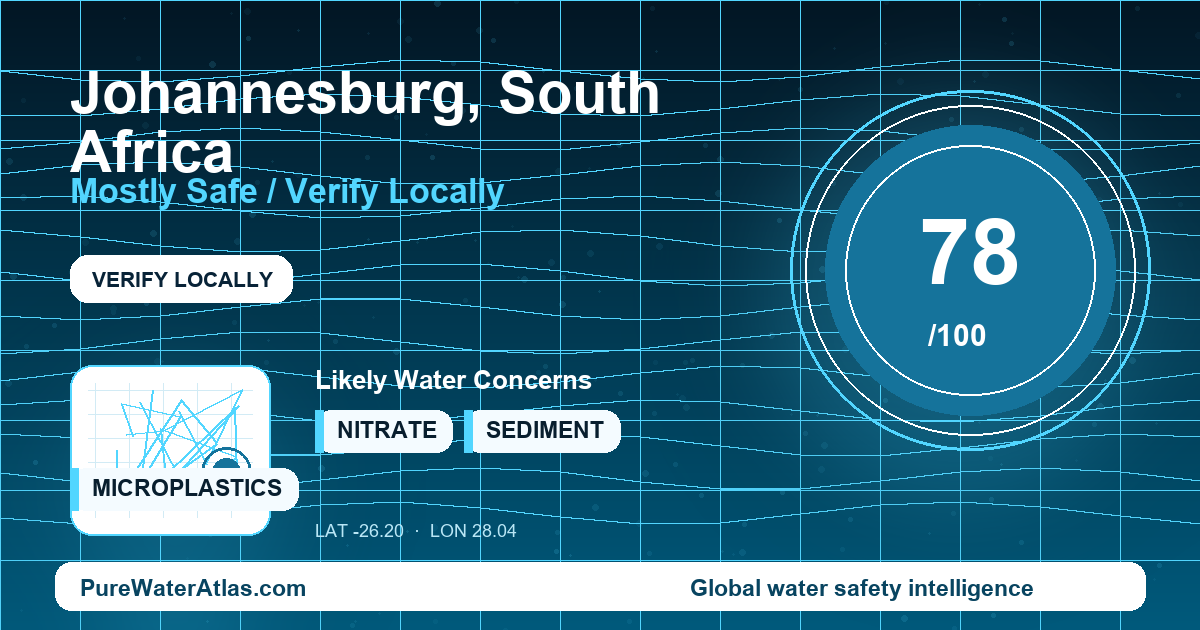
Johannesburg tap water is usually drinkable in formal municipal-supply areas, but local verification matters because outages, low pressure, reservoir problems, pipe bursts, private tanks, and building plumbing can change safety at the tap.
Quick Answer
| Overall safety status | Mostly Safe / Verify Locally — PureWaterAtlas score: 78/100. Johannesburg municipal tap water is generally treated to potable standards under normal operating conditions, but safety can vary during service interruptions or in buildings with private storage. |
|---|---|
| Can visitors drink it? | Usually yes in central, suburban, hotel, business, and airport-connected areas if the water is clear, pressure is normal, and there is no current boil-water notice, local outage, unusual smell, or brown water. |
| Resident advice | Treat the municipal supply as mostly safe when conditions are normal, but monitor Johannesburg Water and Rand Water notices, flush taps after interruptions, maintain tanks, and test if you have recurring discolouration, old plumbing, private borehole water, or low-pressure events. |
| Main water source | Bulk treated water from Rand Water, sourced mainly from the Integrated Vaal River System, including the Vaal Dam and connected transfer schemes such as the Lesotho Highlands Water Project. |
| Water authority | Johannesburg Water SOC Ltd distributes water in the City of Johannesburg. Rand Water supplies the regional treated bulk water. |
| Filter recommendation | A filter is not automatically required for normal municipal supply. A certified activated-carbon filter can improve chlorine taste and odour; a sediment prefilter may help where bursts, repairs, or old pipes cause particles. |
Why Johannesburg Is Different
Johannesburg is not a coastal city and it does not rely on a large local river running through the city for drinking water. It is a high-altitude inland city on the Witwatersrand, and large volumes of water must be pumped into the metropolitan area from a regional engineered supply system. That geography makes pumps, electricity, reservoirs, towers, pressure management, and bulk-water coordination unusually important for everyday water reliability.
The city developed as a mining centre far from abundant local surface-water sources. Early local sources were not enough for the growing mining town, which is why modern Johannesburg depends on a regional system linked to the Vaal River system rather than a local Johannesburg river source. This matters for safety because the main risk at many taps is not simply whether water can be treated at the bulk works. It is whether treated water moves through the distribution network under stable pressure and reaches a particular building without being affected by stagnation, sediment disturbance, private tanks, or internal plumbing.
Johannesburg also sits within the wider Witwatersrand and Vaal catchment context, where mining-impacted waters and acid mine drainage are important environmental issues. Those concerns should not be interpreted as proof that normal Johannesburg municipal tap water is unsafe. The drinking-water question is more specific: how Rand Water treats and supplies bulk water, how Johannesburg Water distributes it, and what happens during outages, bursts, reservoir depletion, pump failures, or building-level storage.
Where Does Johannesburg’s Tap Water Come From?
Most municipal drinking water in Johannesburg is supplied as treated bulk water by Rand Water. Rand Water draws raw water mainly from the Integrated Vaal River System, including the Vaal Dam and connected transfer schemes. The Vaal system is supported by inter-basin transfers, especially the Lesotho Highlands Water Project, which moves water into the Vaal catchment for Gauteng and other users.
Key infrastructure in the Johannesburg supply chain includes Rand Water abstraction and purification facilities, major regional treatment works such as Zuikerbosch and Vereeniging, bulk pumping and pipelines into Johannesburg, and then Johannesburg Water reservoirs, towers, pump stations, reticulation mains, and local distribution networks. In practical terms, your tap water may have passed through a major regional bulk-water system before entering a city reservoir zone and then a building, estate, complex, hotel, or household plumbing system.
This layered system helps explain why two properties in the same suburb can have different experiences. One home may receive clear, normal-pressure municipal water directly through well-maintained plumbing, while another may rely on a poorly maintained backup tank, a booster pump, or older internal pipes. A municipal sample can be acceptable while a specific private tank or building plumbing system still creates a household-level risk.
Who Manages Drinking Water in Johannesburg?
Johannesburg Water SOC Ltd is the municipal water services provider for the City of Johannesburg and distributes potable water to customers. The City of Johannesburg provides the municipal governance context for the city-owned utility. Rand Water is the regional bulk water provider that supplies treated water to Johannesburg Water and other Gauteng municipalities.
Drinking-water quality in South Africa is assessed against SANS 241 and overseen nationally by the Department of Water and Sanitation. The national Blue Drop programme audits drinking-water systems and reporting, and the Department also provides the Integrated Regulatory Information System. The National Blue Drop Report 2023 gives system-level regulatory context for South African drinking-water performance.
However, public data may describe bulk supply, a municipal water supply system, or regulatory performance rather than the exact water coming from a specific hotel tap, apartment block, estate storage tank, or private borehole. Conditions can change quickly during Rand Water maintenance, reservoir depletion, pipe repairs, low pressure, and power-related pumping interruptions. For Johannesburg, official compliance context is important, but current local service status is equally important.
Main Local Water Concerns
The main Johannesburg-specific concerns are distribution reliability and property-level conditions. Documented practical risk factors include intermittent supply, low pressure, reservoir depletion during high-demand periods or maintenance, pipe bursts, repairs, pump failures, and power interruptions. These events can cause sediment disturbance, brown water, cloudy water, pressure loss, or short-term water-quality complaints.
Chlorine taste or odour can occur in treated municipal water, especially after operational changes or flushing. A mild chlorine smell is not by itself proof of unsafe water; chlorine is used as a disinfectant residual. A strong unusual smell, visible particles, or discoloured water after an outage should be treated more cautiously.
Seasonal and operational factors also matter. Summer thunderstorms can increase runoff and raw-water turbidity in source catchments, although municipal treatment is designed to manage this before distribution. Hot summer conditions and high demand can lower reservoirs and worsen pressure problems in some zones. Dry-season restrictions or demand-management campaigns may occur during regional water stress. Major Rand Water maintenance shutdowns can temporarily affect reservoir recovery and local pressure even if the treated water itself remains potable.
Private boreholes are a separate category. They should not be assumed to match municipal water quality and should be tested independently for microbiology, nitrate, electrical conductivity, major ions, iron, manganese, and metals.
For Travelers
Most short-stay visitors in formal municipal-supply areas can usually drink Johannesburg tap water if the water is clear, pressure is normal, and there is no local advisory. This includes many established hotels, guesthouses, restaurants, cafes, business districts, suburban properties, and airport-connected areas. Still, Johannesburg service conditions can vary by reservoir zone and recent outage history, so it is sensible to ask hotel staff or your host whether there are current water restrictions, outages, boil-water notices, or tank-related concerns.
Brushing teeth with tap water is generally acceptable in hotels, guesthouses, and homes connected to the municipal supply, unless the property has just experienced an outage, is under a boil-water advisory, or uses uncertain private storage. Ice is usually acceptable in reputable hotels, restaurants, and cafes using municipal water. Avoid ice from informal or unknown sources if local water has been discoloured, if there has been a recent outage, or if tank hygiene is uncertain.
If water is brown, contains particles, smells unusual beyond mild chlorine, or has returned after a long outage, use sealed bottled water or water brought to a rolling boil for microbiological protection until the supply clears and local guidance confirms normal service. Travelers who are immunocompromised, traveling with infants, or staying in a property with private tanks should be more cautious and should verify tank maintenance.
For broader travel-health context, see CDC Travelers Health: South Africa, but local tap-water decisions should be based on Johannesburg-specific notices and conditions.
For Residents
For residents, the most practical rule is: normal municipal supply under stable pressure and clear-water conditions is usually acceptable, but post-outage and building-level risks deserve attention. Monitor Johannesburg Water, City of Johannesburg, Rand Water, and local ward communications during reservoir problems, Rand Water maintenance, pipe bursts, and power-related pumping interruptions.
A home filter is not automatically required for Johannesburg municipal water. Many households may prefer a certified activated-carbon filter to reduce chlorine taste and odour. Where old pipes, bursts, or repairs cause particles, a sediment prefilter can be useful. If there are immune-compromised household members, point-of-use UV or boiling may be considered during outage recovery, but the limitation is important: boiling helps with microbiological risk when done properly, but it does not remove metals, salinity, nitrate, or many chemical contaminants.
Testing is recommended if your home has a storage tank, private borehole, recurring low pressure, or water that returns after prolonged outages. Test for E. coli or total coliforms in those cases. If water is repeatedly brown, cloudy, or sediment-laden after flushing, test turbidity and basic physical quality. If you live in an older building, have old internal plumbing, brass fittings, soldered joints, galvanized pipes, or water that stagnates overnight, consider testing for lead and other metals. There is no verified evidence that every older Johannesburg building has lead contamination, but older materials and stagnant first-draw water can increase metal risk at the tap.
Private tanks can improve resilience during outages, but they can also become microbial risks if unsealed, warm, dirty, cross-connected, or not disinfected. Tanks should be closed to insects and dust, screened, protected from backflow, cleaned on a schedule, and sampled after contamination, flooding, repairs, or long stagnation.
Relevant Contaminants and Water-Quality Issues
Johannesburg users most often need to think about operational indicators rather than assuming one fixed citywide contaminant problem. Chlorine is relevant because it affects taste and odour and acts as a residual disinfectant in treated municipal water. Turbidity and sediment are relevant after pipe bursts, repairs, reservoir disturbance, and post-outage flushing. Brown or particle-filled water should not be consumed until it clears and local guidance supports normal use.
E. coli is the key microbiological indicator to consider after pressure loss, in private storage tanks, and for boreholes. Lead is relevant for older internal plumbing and first-draw water risk, but it should not be treated as a confirmed citywide claim without testing. Iron and manganese can be relevant to discolouration, sediment, and some source or distribution chemistry concerns.
For deeper guidance, see PureWaterAtlas resources on boiling water purification, UV water purification, lead testing and detection, and nitrate testing, especially for private boreholes and non-municipal supplies.
How to Verify Your Water Quality
Start with current local status. Check Johannesburg Water for outages, reservoir updates, service interruptions, and water-quality notices. Check Rand Water for bulk-supply maintenance or regional operational updates that may affect reservoir recovery and pressure. If you are staying in a hotel, complex, estate, or building with backup tanks, ask whether the tanks are maintained and whether the property has had recent low pressure or discoloured water.
At the tap, use practical screening: water should be clear, free of visible particles, and not have an unusual smell beyond mild chlorine. After an outage or repair, flush taps until clear before drinking. If problems recur, use a laboratory familiar with SANS 241 drinking-water analysis rather than relying only on taste, colour, or simple home strips.
PureWaterAtlas tools can help you interpret concerns: use the Contaminants Search Engine, the Global Water Quality Checker, and the guides on water testing, drinking water safety, water microbiology, water treatment systems, and global water quality.
Official and Technical Sources
- Johannesburg Water official website — local service notices, outages, reservoirs, and customer guidance.
- City of Johannesburg official website — municipal services and governance context.
- Rand Water official website — regional bulk-water supply, treatment, and infrastructure context.
- South African Department of Water and Sanitation — national water authority and drinking-water oversight.
- Department of Water and Sanitation Integrated Regulatory Information System — regulatory data portal.
- National Blue Drop Report 2023 — drinking-water quality and risk-performance reporting context.
- Lesotho Highlands Development Authority — information on the Lesotho Highlands Water Project supporting the Vaal system.
- World Health Organization drinking-water fact sheet — public-health context for safe drinking water.
- CDC Travelers Health South Africa — traveler health context.
Bottom Line
Johannesburg tap water is generally treated to potable standards in the formal municipal system, with Rand Water supplying bulk treated water from the Vaal-based regional system and Johannesburg Water distributing it locally. The main safety question is often not the treatment works alone, but what has happened recently in your reservoir zone, street, building, or storage tank. Drink the tap water when it is clear, pressure is normal, and no advisory is active. Use bottled or properly boiled water after long outages, low-pressure events, brown water, pipe repairs, or uncertain tank conditions. Residents should maintain tanks, flush after interruptions, and test where old plumbing, boreholes, sediment, or recurring odour and colour issues are present.
Read the full guide: Global Water Quality Guide
Explore more in this category: Global Water Quality Articles