Hong Kong’s centrally treated tap water is generally reliable, but safety at the tap depends heavily on each building’s tanks, pumps, fittings, and internal plumbing.
Quick Answer
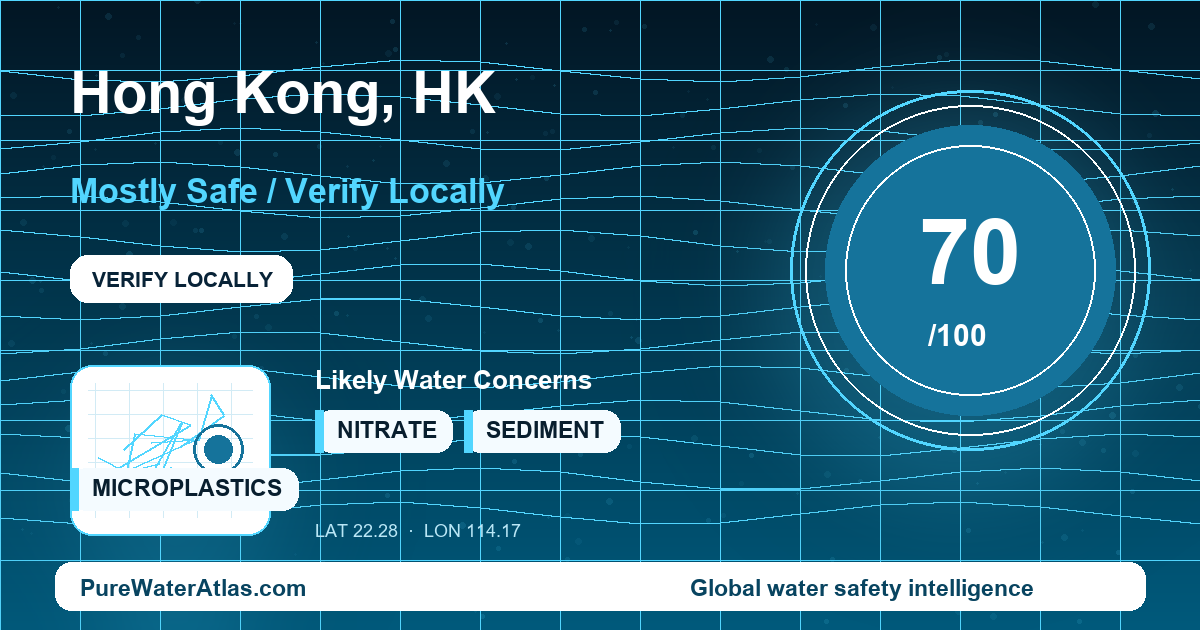
| Overall safety status | Mostly Safe / Verify Locally. Hong Kong tap water is generally safe after treatment by the Water Supplies Department, but building-level plumbing and storage can affect water quality before it reaches the tap. |
|---|---|
| Water safety score | 70 / 100 |
| Traveler advice | Usually acceptable in modern hotels, airports, major restaurants, and well-managed commercial buildings. Use boiled, bottled, or filtered water if staying in older walk-ups, budget guesthouses, subdivided flats, village houses, or any property with uncertain tank maintenance. |
| Resident advice | Do not judge only by the city supply. Check your building’s fresh-water tank maintenance, Water Safety Plan participation, plumbing history, and any signs of lead risk, discoloration, sediment, or stagnation. |
| Main water source | Imported Dongjiang water from Guangdong through the Dongshen water supply system, combined with local rainwater collected in catchments and stored in reservoirs. |
| Water authority | Hong Kong Water Supplies Department, Government of the Hong Kong Special Administrative Region. |
| Filter recommendation | A filter is not automatically required everywhere, but can be sensible in older buildings, buildings with roof tanks, homes with vulnerable occupants, or where lead, particles, taste, or tank hygiene are concerns. Choose a certified filter for the specific issue. |
Why Hong Kong Is Different
Hong Kong is not a simple “safe or unsafe” tap-water city. The treated municipal supply is generally dependable, but the point-of-use question is building-specific. The territory is dense, coastal, steep, and limited in natural freshwater storage. Its drinking-water system depends on a combination of imported Dongjiang water and rainwater captured in local reservoirs, then treated and distributed through a large public network.
The unique practical issue is what happens after treated water leaves the public mains. Many Hong Kong buildings use roof or intermediate fresh-water storage tanks, internal pumps, and private plumbing before water reaches flats, hotel rooms, restaurants, or offices. These systems are normally the responsibility of building owners and management rather than direct day-to-day condition control by the central utility. As a result, two buildings on the same street can have different tap-level risk profiles.
The 2015 lead-in-water incident in some public housing estates is central to understanding Hong Kong’s water-safety profile. It showed that water meeting treatment standards can still be affected by materials, solder, fittings, or workmanship in internal plumbing. That does not mean all Hong Kong tap water is unsafe; it means the building is a critical part of the safety chain.
Where Does Hong Kong’s Tap Water Come From?
Hong Kong relies on a dual raw-water system. A major part of the freshwater supply comes from imported Dongjiang water in Guangdong, delivered through the Dongshen water supply system. Local rainwater is also collected in catchments and stored in impounding reservoirs. Because rainfall varies, the balance between local yield and imported water can change over time, and imported Dongjiang water has historically supplied the majority of Hong Kong’s freshwater demand.
This arrangement developed because Hong Kong’s limited land area and variable rainfall made local reservoirs alone insufficient for long-term demand. Major local reservoir infrastructure, including Plover Cove Reservoir and High Island Reservoir, increased storage capacity, while imported Dongjiang supply arrangements improved resilience against drought.
Key infrastructure includes the Dongjiang and Dongshen water supply system, Muk Wu pumping and reception infrastructure near the boundary with Shenzhen, major impounding reservoirs, treatment works, pumping stations, service reservoirs, and distribution mains operated by the Water Supplies Department. Hong Kong is also developing the Tseung Kwan O Desalination Plant to diversify water resources and improve resilience against drought and climate pressure.
Hong Kong also operates a separate seawater flushing system in many urban areas. This system is non-potable and separate from drinking-water supply. It is not a normal drinking-water pathway, but it reinforces the importance of correct plumbing separation, clear tap use, and competent building maintenance.
Who Manages Drinking Water in Hong Kong?
Hong Kong’s public drinking-water supply is managed by the Water Supplies Department of the Government of the Hong Kong Special Administrative Region. The department treats and monitors public drinking water and publishes drinking-water quality information. Hong Kong’s Drinking Water Standards are stated by the government as being based on the World Health Organization Guidelines for Drinking-water Quality.
The important boundary for residents and travelers is the supply point. The Water Supplies Department manages the public supply system, but building owners and property management are responsible for internal plumbing and fresh-water storage systems after the government supply point. This is why the official public supply can be generally reliable while a specific flat, guesthouse, or older building may still require verification.
Hong Kong has official building-focused water-quality programs and guidance, including the Water Safety Plan for Buildings and the Quality Water Supply Scheme for Buildings – Fresh Water. For residents, these programs are useful signals when assessing whether a building’s internal water system is being actively managed.
Main Local Water Concerns
Lead from internal plumbing is one of Hong Kong’s most important tap-level concerns. The risk is not primarily about the treated source water; it is about solder, fittings, poor installation, old materials, or undocumented plumbing changes inside buildings. Residents in older buildings, subdivided flats, village houses, or homes with recent plumbing work should be more cautious.
Fresh-water tank hygiene is another major local issue. Many buildings store potable water in roof or intermediate tanks. If tanks are not cleaned, covered, secured, and maintained properly, microbiological deterioration can occur before water reaches the tap. Hot and humid conditions can worsen stagnation and microbial risk in poorly maintained tanks or dead-end plumbing.
Discoloration, rust particles, turbidity, and sediment can occur after mains work, tank cleaning, internal pipe corrosion, tank disturbance, or long periods of low water use. Brown, cloudy, particle-filled, salty, oily, or unusually odorous water should not be treated as normal drinking water until the cause is checked.
Chlorine taste or odor may be noticeable because Hong Kong’s treated supply is disinfected. When within operational control, this is usually an aesthetic issue rather than a safety failure. Activated carbon filtration may help taste and odor, but it should be maintained properly and should not be assumed to solve lead or microbial risks unless certified for those purposes.
Hong Kong’s dependence on Dongjiang water also means upstream drought, pollution-control performance, algal conditions, and regional water-resource management are relevant to long-term security. This does not imply a routine tap-water failure, but it is part of the city’s water identity and resilience planning.
For Travelers
For most short-term visitors, tap water in modern Hong Kong hotels, airports, major restaurants, and well-managed commercial buildings is usually acceptable for drinking and brushing teeth. These buildings are more likely to have managed plumbing and tank maintenance. Still, visitors can ask hotel staff whether the tap water is potable and whether any tank cleaning, plumbing works, or building works are ongoing.
If you are staying in an older walk-up building, budget guesthouse, subdivided flat, village house, or property where water storage and plumbing conditions are unclear, use a more cautious approach. Boil water for at least one minute, use sealed bottled water, or use a certified filter suited to the suspected issue. Boiling can reduce microbial risk, but it does not remove lead or many chemical contaminants.
Tap water is generally acceptable for brushing teeth in normal hotel and urban commercial settings. For infants, medically vulnerable travelers, or anyone with a sensitive stomach, bottled or boiled water is a reasonable precaution if building conditions are uncertain. Do not use water that is discolored, has visible particles, or has a strong unusual odor.
Ice from reputable hotels, restaurants, and chain food outlets is generally low risk because it is normally made from treated water. Avoid ice from informal vendors or premises where hygiene and water handling are uncertain. Never drink from taps marked for flushing, utility, or non-potable use, and remember that Hong Kong has separate non-potable seawater flushing systems in many urban areas.
For Residents
For Hong Kong residents, the most important question is not only “Is the city supply safe?” but “Is my building’s water system safe?” Ask your owners’ corporation, property management company, landlord, or building manager for the fresh-water tank cleaning schedule, maintenance records, and whether the building follows a Water Safety Plan for Buildings or related Water Supplies Department guidance.
A home filter is not automatically needed in every Hong Kong household. It can be sensible, however, where the building is old, water is stored in roof tanks, residents dislike chlorine taste, plumbing history is unknown, or there are infants, pregnant people, or immunocompromised residents. Match the filter to the concern: certified lead reduction for lead risk, particulate reduction for sediment, activated carbon for taste and chlorine, and appropriate microbial treatment only where maintenance and prefiltration are suitable.
Testing is especially important when risk is building-specific. Test first-draw and flushed samples for lead if your building has older plumbing, recent repairs, unknown solder or fittings, or vulnerable occupants. First-draw testing helps identify water that has been standing in internal plumbing, while flushed samples can help compare stagnant plumbing influence with incoming water after flow.
Consider microbiological testing for E. coli or total coliforms if tanks are poorly maintained, covers are damaged, pests are present, or residents report repeated gastrointestinal illness patterns. Use a laboratory or qualified sampling service for health-critical decisions. Simple home strips can be useful for screening, but they should not be treated as definitive for lead or microbial safety.
After long building shutdowns, renovations, low occupancy, tank cleaning, or plumbing works, flush stagnant taps before drinking and watch for turbidity, color, sediment, unusual taste, or odor. Boiling is useful for microbial uncertainty, but it will not remove lead, many metals, or chemical contaminants.
Relevant Contaminants and Water-Quality Issues
The most Hong Kong-specific contaminant concern is lead in drinking water, because the key risk pathway is internal plumbing materials, solder, fittings, and workmanship rather than the treated municipal supply itself. Residents deciding whether to investigate this issue can also read Lead in Drinking Water: Testing and Detection Methods and Lead in Drinking Water: Best Filters, Systems and Solutions.
Chlorine in drinking water is relevant for taste and odor in a disinfected supply. Turbidity and sediment are relevant when water becomes cloudy, brown, rusty, or particle-filled after tank disturbance, pipe corrosion, mains work, or building repairs. E. coli is relevant where fresh-water tanks are poorly maintained or microbial hygiene is uncertain.
For treatment choices, use PureWaterAtlas guides on boiling water purification, UV water purification, and water treatment systems. The key is to avoid buying a generic device without knowing whether the issue is lead, particles, chlorine taste, or microbial risk.
How to Verify Your Water Quality
Because Hong Kong’s official city-level water-quality data does not prove every individual tap is safe, verification should focus on your exact building and tap. Public sources do not provide verified real-time quality for every neighborhood, hotel, apartment, or restaurant. The treated municipal supply is generally reliable, but tap-level quality depends on private plumbing, roof tanks, maintenance records, stagnation, and recent works.
Start with the building: ask for tank cleaning records, maintenance logs, recent repair history, and participation in official building water-safety schemes. Then inspect your tap water for discoloration, particles, cloudiness, unusual odor, or changes after plumbing works. If health decisions are involved, use laboratory testing rather than relying only on taste, smell, or home strips.
PureWaterAtlas resources can help structure the decision. Use the Drinking Water Safety guide for a general safety framework, the Water Testing guide for sampling and analysis decisions, the Global Water Quality Checker for destination comparisons, and the Contaminants Search Engine to look up specific substances and indicators. Hong Kong’s profile also fits within the broader Global Water Quality context.
Official and Technical Sources
- Water Supplies Department: Drinking Water Quality — official information on Hong Kong drinking-water quality management, monitoring, and standards.
- Water Supplies Department: Total Water Management and Water Resources — official context for local yield, imported water, and diversification.
- Water Supplies Department: Dongjiang Water — official information on imported Dongjiang water as a major Hong Kong supply source.
- Water Supplies Department: Water Treatment and Supply — official overview of treatment works and supply infrastructure.
- Water Supplies Department: Water Safety Plan for Buildings — official basis for building-level water-safety management.
- Water Supplies Department: Quality Water Supply Scheme for Buildings – Fresh Water — official scheme encouraging fresh-water system management in buildings.
- Commission of Inquiry into Excess Lead Found in Drinking Water — official source for the 2015 lead-in-drinking-water investigation.
- World Health Organization: Guidelines for Drinking-water Quality — international guideline framework referenced by Hong Kong’s standards.
- Water Supplies Department: Tseung Kwan O Desalination Plant — official information on desalination and supply resilience.
Bottom Line
Hong Kong tap water is generally safe after central treatment by the Water Supplies Department, and it is usually acceptable in modern hotels, major restaurants, airports, and well-managed commercial buildings. The main uncertainty is the building, not the city supply. Roof tanks, internal pumps, old plumbing, lead-containing components, poor workmanship, stagnation, and weak maintenance can change water quality before it reaches the tap. Travelers in older or poorly managed accommodation should use boiled, bottled, or certified filtered water. Residents should check tank cleaning records, building water-safety participation, plumbing history, and test for lead or microbes when risks are credible. Hong Kong’s treated supply is mostly reliable, but tap-level verification matters.
Read the full guide: Global Water Quality Guide
Explore more in this category: Global Water Quality Articles