Nanjing’s tap water comes mainly from the Yangtze River and is treated through a modern municipal system, but travelers should usually drink boiled, bottled, or reliably filtered water because final tap quality can vary by building plumbing, secondary tanks, and short-term local conditions.
Quick Answer
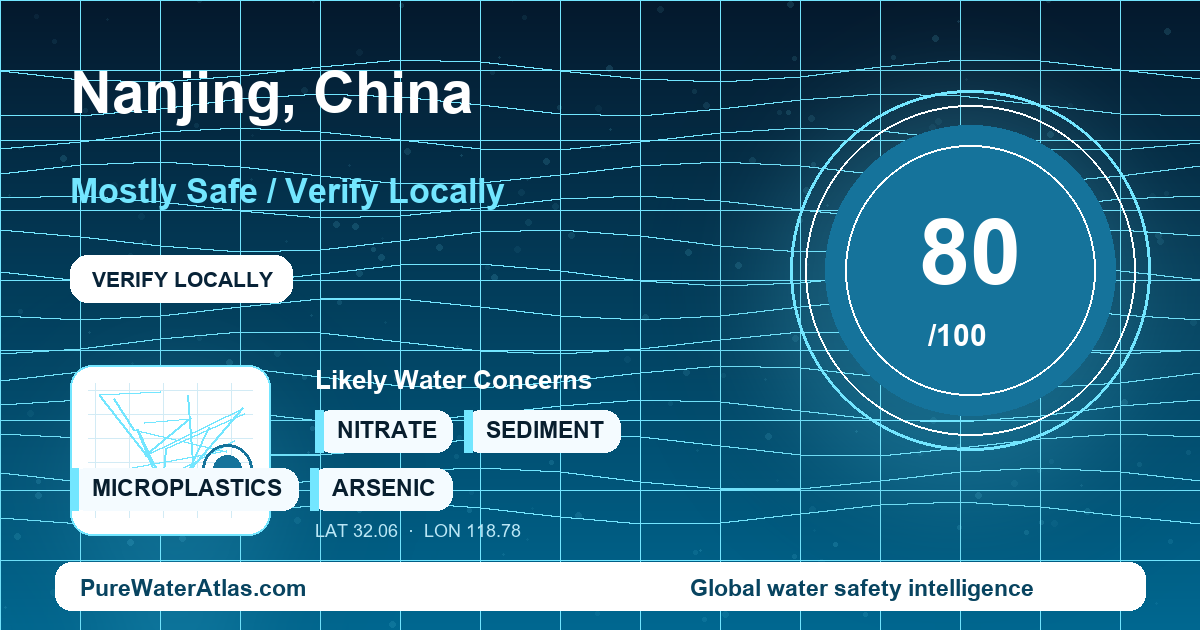
| Overall safety status | Mostly Safe / Verify Locally. Nanjing has a treated municipal supply regulated under Chinese drinking-water standards, but safety at the individual tap depends on building plumbing, storage tanks, construction disturbance, and current local notices. |
|---|---|
| Water safety score | 80 / 100 |
| Traveler advice | Use boiled, bottled, hotel-filtered, or reliably filtered water for drinking. Tap water is generally acceptable for brushing teeth in modern urban hotels unless it is discolored, unusually odorous, or subject to an advisory. |
| Resident advice | Municipal-network residents can usually treat the supply as a treated public water source, but should verify old pipes, rooftop or basement tanks, and recent maintenance history. Testing is sensible in older buildings or after pipe work. |
| Main water source | The core urban system is centered on the Yangtze River Nanjing reach, with protected centralized drinking-water source areas and intakes feeding large treatment plants. |
| Main authority / utility | Nanjing Water Group is the principal municipal water-supply utility. Oversight also involves local water affairs, health, and ecology and environment authorities. |
| Filter recommendation | A filter is not automatically required for every municipal customer, but it is practical for taste, chlorine odor, sediment, older internal pipes, and added protection. Reverse osmosis offers broader chemical reduction but needs maintenance. |
Why Nanjing Is Different
Nanjing is an inland city on the Yangtze River, and that geography shapes its drinking-water profile. Unlike coastal delta cities, seawater salinity intrusion is not normally the main issue for Nanjing’s tap water. The more relevant question is the condition of the Yangtze River at the Nanjing reach, including upstream catchment activity, river flow, storm runoff, flood-season turbidity, and possible emergency pollution incidents.
The city’s modern urban supply is a centralized treated system rather than a household-well system. For central urban districts connected to the municipal network, the highest practical risk is often not the treatment plant itself. It is the “last meter”: old internal pipes, building valves, pressure systems, rooftop tanks, basement tanks, and sediment disturbed by construction or repairs. In high-rise residential and commercial buildings, these secondary systems can strongly affect the water that actually reaches a kitchen or bathroom tap.
Local drinking practice also matters. In Nanjing, as in many Chinese cities, residents and hotels commonly boil tap water or provide filtered water for drinking. This does not mean the municipal supply is untreated; it means that boiling or filtering is the more conservative and culturally normal approach for drinking, especially for visitors with sensitive stomachs.
Where Does Nanjing’s Tap Water Come From?
Nanjing’s core municipal drinking-water supply is centered on the Yangtze River. Protected centralized drinking-water source areas and municipal raw-water intakes supply major treatment plants serving the urban network. Local water-supply materials commonly reference large urban waterworks such as Beihekou, Shangyuanmen, and Chengbei, along with large-diameter transmission mains and distribution infrastructure serving central districts.
The Yangtze provides a high-capacity water source for Nanjing, but it also requires continuous management. Nanjing is located on one of China’s most important industrial and shipping rivers. Source-water protection therefore has to account for upstream urban runoff, industrial activity, navigation, flood-season sediment, and emergency pollution risks. Treatment plants can adjust operations for changing raw-water conditions, but short-term changes in turbidity, taste, or odor can still be noticed by consumers during seasonal or local distribution events.
Source details can vary outside the main urban network. Some outer districts or district-level systems may use additional local reservoirs, lakes, rivers, or district waterworks. That is why a central Nanjing hotel, a high-rise apartment in a developed district, and a more peripheral property may not have identical water-source or building-system conditions.
Who Manages Drinking Water in Nanjing?
Nanjing Water Group is the principal municipal water-supply utility for the urban system. It is the most relevant local utility source for service information, water-supply operations, and water-related public notices.
Oversight is shared across local government functions. The Nanjing Municipal Water Affairs Bureau is relevant for water resources, water-supply management, infrastructure, and local water notices. The Nanjing Ecology and Environment Bureau is relevant for environmental quality, source-water protection, surface-water monitoring, and pollution-control information. The Nanjing Municipal Health Commission is relevant for drinking-water sanitation supervision and public-health notices.
Drinking water in Nanjing is governed under China’s national Standards for Drinking Water Quality, GB 5749-2022. The national standards portal is maintained through China’s standards system at the national standards public service platform. Broader environmental regulation and Yangtze River water-quality context also involve the Ministry of Ecology and Environment of the People’s Republic of China.
Main Local Water Concerns
The main Nanjing-specific concerns are tied to the Yangtze source, seasonal river conditions, and building-level infrastructure. The Yangtze River is a strong and centralized source, but it is exposed to upstream industry, shipping, urban runoff, catchment-scale pollution events, and flood-season changes. Heavy rain and high-flow conditions can increase turbidity and sediment load, requiring treatment adjustment and sometimes producing temporary consumer complaints about taste or clarity.
Disinfectant taste is another common practical issue. Treated municipal water may have a chlorine or disinfectant smell, especially after seasonal treatment changes, local distribution adjustments, or pipe disturbance. This is often a taste and odor concern rather than proof of unsafe water, but sudden strong odor should be checked against local notices.
Building-level systems are especially important in Nanjing. Older apartments, schools, small hotels, and commercial buildings may have aging internal plumbing, sediment accumulation, older fittings, or valves that affect tap quality. High-rise buildings may use secondary pressurization and storage systems. If rooftop or basement tanks are poorly sealed, poorly cleaned, or badly managed, final water quality can be affected even when utility water leaving the treatment plant is compliant.
Localized construction, main flushing, pipe repair, and pressure interruptions can cause temporary yellow, brown, cloudy, or sediment-containing water. After these events, residents should follow local notices and flush taps before using water for drinking or cooking. There is also uncertainty around emerging contaminants such as PFAS and microplastics because routine city-level public reporting for these issues is limited.
For Travelers
For a short visit to Nanjing, the conservative advice is simple: drink boiled, bottled, hotel-filtered, or reliably filtered water. Municipal tap water is treated, and modern urban hotels generally have water suitable for hygiene, but direct unboiled tap water is not the safest default for travelers. The issue is not only regulatory treatment; it is also building plumbing variability and personal digestive tolerance.
Brushing teeth with tap water is generally acceptable in modern urban hotels and apartments unless the water is visibly discolored, has a strong unusual odor, or a local advisory is in effect. If you are staying in an older guesthouse, long-stay apartment, or small hotel, use bottled or boiled water if the tap water looks cloudy, yellow, brown, or has sediment.
For ice, use judgment by venue. In higher-standard hotels, international restaurants, and established chains, ice is usually made from treated or purified water. In small street venues or uncertain settings, avoid ice or ask whether purified water is used. Hot tea, boiled water, sealed bottled drinks, and factory-sealed beverages are lower-risk choices in restaurants.
Most hotels in Nanjing provide bottled water, a kettle, or filtered water. If bottled water is not available, use the kettle to boil tap water. Carry bottled water during sightseeing, especially in hot weather, when dehydration risk is higher and storage conditions in small venues may vary.
For Residents
Residents connected to the municipal network can usually regard Nanjing tap water as a treated public supply, but the correct household decision depends on the building. A home filter is not automatically required for every municipal customer, yet it is practical for improving taste, reducing chlorine odor, catching sediment, and adding protection where internal plumbing or storage tanks are uncertain.
Activated carbon filters can improve chlorine taste and odor. Ultrafiltration can help with particles and some microbial concerns if the system is correctly maintained. Reverse osmosis is more protective for dissolved metals, nitrate, some industrial chemicals, and many emerging contaminants, but it requires maintenance, cartridge replacement, and responsible operation. PureWaterAtlas has a broader guide to choosing water treatment systems.
Testing is recommended in older buildings, after plumbing replacement, after tank maintenance problems, or when water has unusual color, odor, sediment, or metallic taste. Test first-draw and flushed samples for lead and other metals if the building is old or internal plumbing is unknown. Test turbidity, iron, manganese, and basic chemistry if water remains yellow, brown, metallic-tasting, or visibly sedimented after flushing. If a building uses storage tanks and has had pressure loss, flooding, or tank-cleaning concerns, consider microbiological testing for total coliform and E. coli through a qualified local laboratory or official channel.
Older buildings deserve extra caution. Flush stagnant water before drinking or cooking, especially in the morning. This is particularly important where children, pregnant people, or immunocompromised residents live. For high-rise or older residential compounds, ask the property manager for secondary tank-cleaning records and follow local advisories after pressure interruptions or repairs.
Relevant Contaminants and Water-Quality Issues
Several PureWaterAtlas contaminant guides are especially relevant to Nanjing’s practical risk profile. Chlorine in drinking water is relevant because disinfectant taste and odor can occur in treated municipal supplies. Turbidity and sediment are relevant during Yangtze flood-season conditions, after construction disturbance, or when old building pipes release particles.
Lead in drinking water is not identified here as a citywide source-water issue, but it is relevant to old internal plumbing and first-draw sampling in older buildings. E. coli is relevant where secondary storage tanks, pressure failures, or poor building maintenance create microbial risk. PFAS is included as an emerging-contaminant topic because Nanjing is in an industrialized river-basin context, while city-level public reporting is limited.
How to Verify Your Water Quality
Because final tap quality in Nanjing can vary by building, the most reliable approach is to combine local notices with targeted testing. Check current information from Nanjing Water Group and municipal authorities if there has been pipe repair, flooding, pressure loss, unusual odor, discoloration, or a reported local incident. For health-based interpretation, the World Health Organization’s Guidelines for Drinking-water Quality provide international public-health context.
For household decisions, use a qualified local laboratory or official testing channel rather than relying only on simple home strips. PureWaterAtlas resources that may help include the complete guide to water testing, the lead testing and detection guide, and the PFAS testing guide. If microbial risk is suspected after storage-tank or pressure problems, residents may also want to compare treatment options such as filtration and UV purification.
Travelers comparing destinations can use the Global Water Quality Checker. For individual substances, use the PureWaterAtlas Contaminants Search Engine. Broader background is available in the site guides to drinking water safety, global water quality, and boiling water purification.
Data limitations matter. Nanjing has identifiable official authorities and a known Yangtze-centered source-water system, but current plant-by-plant analytical results, distribution-zone trends, and building-level tap data are not consistently available in English as a single public dataset. This profile should not be read as a guarantee that every tap in every Nanjing building is safe for direct unboiled drinking.
Official and Technical Sources
- Nanjing Water Group official website — local utility source for municipal water-supply operations, service information, and public notices.
- Nanjing Municipal Water Affairs Bureau — municipal water-affairs authority for water resources, water-supply management, infrastructure, and local notices.
- Nanjing Ecology and Environment Bureau — local environmental regulator for source-water protection, surface-water monitoring, and pollution-control information.
- Nanjing Municipal Health Commission — local public-health authority relevant to drinking-water sanitation supervision and health notices.
- National standards public service platform — official standards portal relevant to China’s GB 5749-2022 drinking-water quality standard.
- Ministry of Ecology and Environment of the People’s Republic of China — national environmental authority for surface-water quality and Yangtze River environmental governance context.
- World Health Organization Guidelines for Drinking-water Quality — international public-health reference for microbial safety, chemical contaminants, and household water management.
Bottom Line
Nanjing’s municipal tap water is best understood as a treated Yangtze River supply with generally modern infrastructure, but not as water that every traveler should drink directly from every tap. In central urban areas, the main risk is usually building-level plumbing, tanks, pressure systems, construction disturbance, and short-term river or distribution events rather than the existence of treatment itself. Travelers should use boiled, bottled, hotel-filtered, or reliably filtered water for drinking, while brushing teeth is usually acceptable in modern hotels if the water looks and smells normal. Residents should pay close attention to old pipes, secondary tanks, and maintenance records, and should test water after unusual color, odor, sediment, pipe work, pressure loss, or tank problems.
Read the full guide: Global Water Quality Guide
Explore more in this category: Global Water Quality Articles