Surabaya’s tap water is supplied by a formal municipal system, but direct drinking is not the safest default because the city depends heavily on the Kali Surabaya and Brantas River system and because building-level plumbing, tanks, and private wells can change water quality after treatment.
Quick Answer
| City | Surabaya, Indonesia |
|---|---|
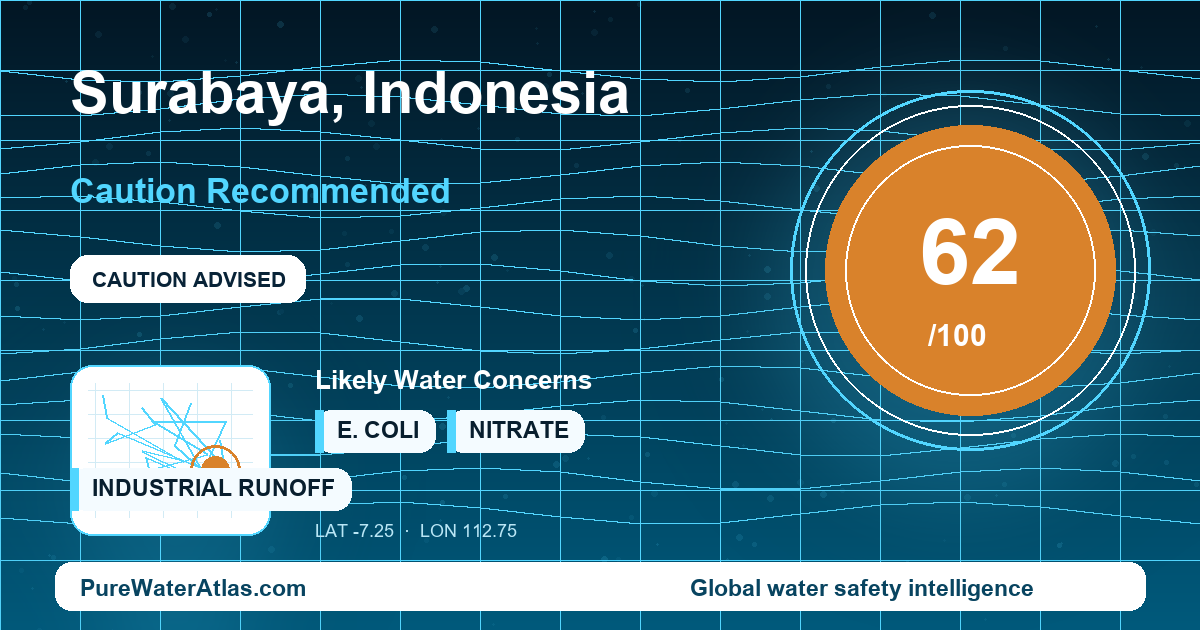
| Water safety score | 62 / 100 |
| Risk level | Caution Recommended |
| Can visitors drink the tap water? | Not recommended for direct drinking. Short-term visitors should use sealed bottled water, boiled water, or a reputable filtered refill source. |
| Resident guidance | PDAM water is generally a better-controlled source than untreated shallow wells, but most households should still boil and/or use a maintained point-of-use filter for drinking. |
| Main raw water system | Treated surface water principally tied to the Kali Surabaya, the lower part of the Brantas River system. |
| Local water authority | PDAM Surya Sembada Kota Surabaya. |
| Filter recommendation | Sediment prefiltration plus activated carbon for particles, taste, odor, and chlorine-related issues; add boiling, UV, or ultrafiltration for microbial control where needed. Reverse osmosis should be considered only when testing shows dissolved-contaminant, salinity, nitrate, or TDS concerns. |
PureWaterAtlas does not classify Surabaya tap water as a simple “drink directly from the tap” destination. The city has centralized treatment and a large piped-water network, but public, current, tap-by-tap compliance data are limited. The most conservative answer is: use bottled, boiled, or properly filtered water for drinking, especially if you are a visitor, have a sensitive stomach, are pregnant, are immunocompromised, or are preparing water for infants.
Why Surabaya Is Different
Surabaya is not a small groundwater-dependent settlement or a place without a formal water utility. It is a dense, low-lying coastal city in East Java near the mouth of the Brantas River system and the Madura Strait. That geography matters. The city sits downstream in a major river basin, so local water quality is influenced not only by what happens inside Surabaya, but also by upstream land use, domestic wastewater, industrial activity, storm runoff, and river-flow management.
The most important local distinction is that Surabaya’s drinking-water risk is shaped by both centralized treatment and post-treatment conditions. PDAM Surya Sembada operates the municipal system, and major treatment infrastructure is associated with the Ngagel and Karangpilang water treatment plant areas. However, the water people actually drink may pass through old internal pipes, apartment plumbing, booster pumps, roof tanks, ground tanks, or refill dispensers before reaching a glass. A modern building with maintained plumbing and a serviced dispenser is a different risk situation from an older kos, small hotel, warung, or house using roof storage or a private shallow well.
This is why Surabaya receives a caution rating rather than a universal safe-to-drink verdict. The concern is not simply whether the city has treatment. It does. The concern is that Kali Surabaya is a pressured raw-water corridor, and that open sources do not provide complete, recent, independently verified water-quality results for every neighborhood, hotel, apartment, storage tank, private well, or tap.
Where Does Surabaya’s Tap Water Come From?
Surabaya’s municipal drinking-water supply is principally based on treated surface water from the Kali Surabaya, the lower part of the Brantas River system. This makes the Brantas basin central to the city’s water identity. Upstream river quality, domestic wastewater pressure, industrial discharge, storm runoff, rainy-season turbidity, and dry-season river-flow conditions are all relevant to the city’s tap-water risk profile.
Historically, Surabaya developed around the Kali Mas and Kali Surabaya river corridor in a low-lying coastal delta setting. Some households and businesses have used local groundwater and wells, but for drinking-water safety a controlled PDAM connection is generally preferable to untreated shallow groundwater. Shallow wells in an urban coastal environment can be vulnerable to septic leakage, urban runoff, salinity, iron, manganese, and microbial contamination.
The municipal system includes major drinking-water treatment infrastructure linked to the Ngagel and Karangpilang treatment plant areas. These facilities treat raw water drawn from the Kali Surabaya system. After treatment, however, water safety can still depend on distribution and building-level conditions. Pipe repairs, local pressure interruptions, illegal cross-connections, dirty storage tanks, and old plumbing can all affect water quality after the water leaves the utility-controlled parts of the system.
Who Manages Drinking Water in Surabaya?
PDAM Surya Sembada Kota Surabaya is the municipal water utility serving the city. It is the primary local reference point for piped-water service in Surabaya. Drinking-water health standards are set nationally by Indonesia’s Ministry of Health, including the framework in Permenkes No. 2 Tahun 2023 for environmental health standards. Local health and environmental agencies, the Surabaya city government, East Java provincial authorities, and Brantas basin authorities also have roles in monitoring, regulation, raw-water management, and pollution control.
For practical users, this means there are two different questions. First: is there a formal treated municipal supply? In Surabaya, yes. Second: can every tap in every building be assumed to continuously meet all drinking-water parameters? Open public sources do not provide enough evidence to make that claim. This profile therefore treats PDAM water as the better-controlled baseline source, while still recommending additional precautions for drinking water at the household, hotel, and building level.
Main Local Water Concerns
Surabaya’s main water-quality concerns are tied to the city’s river-source dependence, dense urban setting, coastal geography, and downstream plumbing conditions. The most important documented concerns include:
- River-source vulnerability: The Kali Surabaya and wider Brantas system are exposed to upstream domestic wastewater, industrial discharge, solid waste, and storm runoff. Because this river corridor is a critical raw-water source, basin pollution control matters directly for Surabaya’s tap-water risk profile.
- Rainy-season turbidity: Heavy rain can increase turbidity, color, suspended sediment, organic matter, and microbial loading in the raw-water system. Treatment is designed to manage raw water, but turbidity spikes and disturbed distribution sediments can contribute to discoloration complaints.
- Dry-season concentration effects: During dry periods, reduced river dilution can concentrate pollutants in raw water. In coastal and low-lying areas, dry-season conditions can also worsen salinity concerns for groundwater and lower waterways.
- Microbial risk after treatment: If distribution pressure, household storage tanks, roof tanks, or internal plumbing are poorly maintained, microbial risk can increase after the water leaves the treatment plant.
- Chlorine taste or odor: Treated municipal water normally requires a disinfectant residual. A chlorine smell alone does not prove the water is unsafe, but sudden changes in taste or odor should be treated cautiously.
- Private shallow wells: Shallow wells can be significantly riskier than PDAM water because of septic contamination, urban runoff, salinity, iron, manganese, and local hydrogeology.
- Building-plumbing metals: Lead is not identified here as a confirmed citywide raw-water issue. In Surabaya, it should be treated mainly as a building-plumbing concern in older properties with old fixtures, brass components, solder, or stagnant water.
For Travelers
Visitors should not rely on Surabaya tap water for direct drinking. The safest routine is to use sealed bottled water, properly boiled water, or a reputable filtered dispenser. This advice is conservative, but it reflects the main uncertainty in the city: not only the municipal treatment process, but also the building plumbing, storage tanks, and handling practices between the treatment plant and the cup.
For brushing teeth, cautious travelers should use bottled or boiled water. In higher-end hotels with maintained plumbing this is often lower risk, but bottled water is still the simplest short-stay precaution. Do not assume that bathroom tap water is intended for drinking.
Ice is a judgment call. Ice in reputable hotels, malls, and established restaurants is usually lower risk when made from treated or commercial ice. Avoid ice from street stalls or informal vendors if you cannot verify the source. The same caution applies to uncooked foods washed in tap water at informal locations.
In hot weather, carry bottled water and consider oral rehydration salts if you develop diarrhea or dehydration symptoms. Infants, pregnant travelers, immunocompromised travelers, and people with sensitive stomachs should use sealed bottled or properly boiled water consistently. For immediate microbial risk reduction, see the PureWaterAtlas Boiling Water Purification: Complete Guide.
For Residents
Residents connected to PDAM should generally treat that supply as a better-controlled source than untreated shallow wells. However, most households should still use a maintained point-of-use system for drinking water. A practical Surabaya setup is sediment prefiltration plus activated carbon to reduce particles, taste, odor, chlorine-related issues, and some byproducts, combined with boiling, UV, or ultrafiltration when microbial protection is needed. For households considering UV, PureWaterAtlas has a detailed UV Water Purification: Complete Guide.
Reverse osmosis can be useful where testing confirms high TDS, salinity, nitrate, or broader dissolved-contaminant concerns, but it should not be installed blindly. RO systems require maintenance, cartridge changes, and attention to remineralization or dietary mineral intake. Testing first is especially important for coastal or low-lying private wells.
Households should test for E. coli and total coliform if using a private well, roof tank, refill source, or building with recurring stomach illness complaints. If PDAM water changes suddenly after pipe work or pressure interruptions, check turbidity, color, odor, pH, total dissolved solids, conductivity, and residual chlorine. Test iron and manganese if water is reddish, brown, blackish, metallic-tasting, or staining laundry and fixtures. Test nitrate if using a shallow well near septic systems, drains, livestock, markets, or flood-prone areas.
Older buildings require extra caution. Stagnant pipes, old valves, brass fixtures, corroded plumbing, dead-end pipe sections, and unmaintained booster systems can increase sediment, metals, taste, odor, and microbial risk. Roof tanks and ground tanks should be sealed, screened, cleaned, and disinfected on a schedule. If a tank has not been cleaned recently, do not drink from it without boiling or certified filtration, and consider microbiological testing.
Relevant Contaminants and Water-Quality Issues
Several PureWaterAtlas contaminant profiles are especially relevant to Surabaya’s local conditions. Turbidity is important because rainy-season runoff in the Kali Surabaya system can increase suspended particles and challenge treatment conditions. Sediment is relevant to discolored water after pipe work, distribution deposits, and poorly maintained tanks.
Chlorine matters because treated piped water normally depends on a disinfectant residual. A chlorine odor can be normal, but sudden changes in taste or smell should prompt flushing, temporary boiling or filtration, and follow-up if the change persists. Lead is mainly a plumbing and fixture issue in older properties rather than a confirmed Surabaya-wide raw-water problem; residents in older buildings can also review Lead in Drinking Water: Testing and Detection Methods.
For private wells, nitrate, iron, and manganese deserve attention. Nitrate is relevant near septic leakage or urban runoff, while iron and manganese are associated with staining, metallic taste, groundwater conditions, and pipe corrosion complaints. For more detail on nitrate testing, see Nitrate Contamination in Drinking Water: Testing and Detection Methods.
How to Verify Your Water Quality
The only way to know what is happening at a specific Surabaya tap is to test that tap or the storage system feeding it. City-level information can identify the utility, river-basin source, and treatment context, but it cannot prove that every hotel room, apartment kitchen, roof tank, or private well is safe at all times.
Start with the PureWaterAtlas Water Testing guide if you need a structured testing plan. Use an accredited laboratory when health decisions depend on the result, especially for microbial contamination or trace metals. Home kits can be useful for screening pH, chlorine, TDS, or visible changes, but they are not definitive for E. coli, lead, nitrate, or complex contamination problems.
You can also compare broader location-based guidance with the Global Water Quality Checker and explore specific substances in the Contaminants Search Engine. For broader background, see PureWaterAtlas resources on Drinking Water Safety, Global Water Quality, Water Microbiology, and Water Treatment Systems.
Official and Technical Sources
- PDAM Surya Sembada Kota Surabaya official website — municipal water utility reference for Surabaya’s piped-water service.
- Surabaya City Government official website — local government context for public services, health, and city administration.
- Balai Besar Wilayah Sungai Brantas — official Brantas River basin reference from Indonesia’s public works authority.
- Peraturan Menteri Kesehatan No. 2 Tahun 2023 — national Indonesian health-standard context for drinking water and environmental health media.
- WHO and UNICEF Joint Monitoring Programme for Water Supply, Sanitation and Hygiene — country-level WASH context; not a substitute for Surabaya tap-by-tap testing.
- CDC Indonesia Traveler View — traveler-health context supporting conservative food and water precautions.
- UNICEF Indonesia Water, Sanitation and Hygiene — high-level context on WASH challenges relevant to household and building-level risk.
Bottom Line
Surabaya has a real municipal water system operated by PDAM Surya Sembada, with treated surface water largely tied to the Kali Surabaya and wider Brantas River system. That makes PDAM water a more controlled choice than untreated shallow wells, but it does not make direct tap drinking the safest default. The city’s downstream river setting, rainy-season turbidity, dry-season concentration effects, and building-level plumbing or tank risks justify a caution rating. Visitors should drink sealed bottled, boiled, or reputable filtered water. Residents should maintain filters, clean tanks, test wells and suspicious water, and pay special attention to older buildings. Because public tap-by-tap compliance data are limited, local verification remains essential.
Read the full guide: Global Water Quality Guide
Explore more in this category: Global Water Quality Articles