
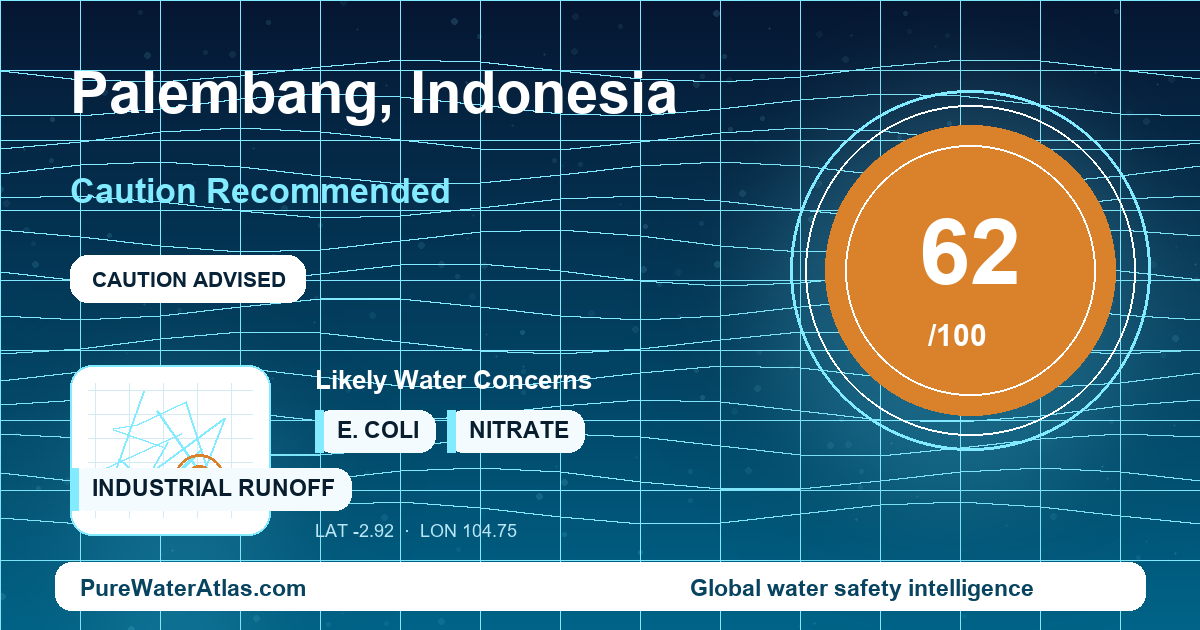
Palembang’s tap water comes from a treated Musi River surface-water system, but household-level safety can vary because of turbidity, flooding, pressure changes, storage tanks, and limited public tap-by-tap compliance data.
Quick Answer
| Water safety score | 62 / 100 |
|---|---|
| Risk level | Caution Recommended |
| Can visitors drink the tap water? | No, not without treatment. Visitors should use sealed bottled water, hotel-provided purified water, reputable refill water, or water that has been boiled or reliably filtered and disinfected. |
| Resident guidance | Residents connected to Perumda Tirta Musi generally receive treated municipal water, but a point-of-use barrier is prudent for drinking, especially where buildings use roof tanks, older plumbing, variable pressure, or private wells. |
| Main raw water source | Primarily treated surface water from the Musi River system, with local infrastructure also associated with connected urban river systems such as the Ogan. |
| Water authority | Perumda Tirta Musi Palembang, with oversight under Indonesian drinking-water quality requirements and local public-health authorities. |
| Filter recommendation | Recommended for drinking. A practical setup is sediment filtration plus activated carbon, with boiling or UV disinfection when microbial risk, storage tanks, or pressure reliability are concerns. Reverse osmosis may be appropriate for tested private-well or dissolved-contaminant issues. |
Why Palembang Is Different
Palembang is a river city. Its drinking-water story is inseparable from the Musi River, the lowland and swamp geography of South Sumatra, and the way water moves through a flat, river-divided urban area. The Musi is not only a landscape feature: it shapes transport, drainage, flood behavior, raw-water supply, and the practical risks that affect household taps.
The PureWaterAtlas verdict for Palembang is caution recommended. The city has an established municipal water utility and centralized treatment infrastructure, but that does not mean every kitchen tap has the same risk profile. Water leaving a treatment plant, water moving through distribution mains, and water stored in a household roof or ground tank can be meaningfully different. This distinction is especially important in buildings with dirty tanks, cross-connections, low pressure, old internal plumbing, or local booster systems.
Palembang’s historical identity also matters. Before widespread piped supply, households relied more directly on river water, canals, rainwater, shallow wells, and local storage. Today, many residents are connected to treated municipal supply, but river-edge settlements, private wells, and household tanks can still have different risks than treated utility water. Because PureWaterAtlas did not find a complete, current, easily accessible public dataset proving tap-level compliance across all Palembang neighborhoods, the safest advice depends on the point of use, not just the existence of a municipal treatment system.
Where Does Palembang’s Tap Water Come From?
Palembang’s municipal drinking-water supply is primarily based on treated surface water from the Musi River system. The city’s local water-supply infrastructure is commonly described around river intakes and water treatment plants operated by Perumda Tirta Musi Palembang. Some supply assets are associated with the Musi and connected tributary or river systems in the urban area, including the Ogan.
Key infrastructure serving the city includes the Perumda Tirta Musi Palembang distribution network, river intakes drawing raw surface water from the Musi River system, municipal treatment plants locally referenced around areas such as Rambutan, Karang Anyar, Ogan, and Borang, and the pumping stations, reservoirs, and distribution mains that move treated water across the city. Many homes and buildings also use household roof tanks, ground tanks, or local booster systems to manage pressure and continuity.
This infrastructure gives Palembang an organized treated-water system, but the final quality at a tap can still be affected after treatment. Pipe condition, pressure variation, service interruptions, repairs, tank hygiene, and internal plumbing can all change the quality of water that residents actually drink. In a lowland city where flooding and drainage are recurring practical concerns, tanks and low-lying service connections deserve particular attention.
Who Manages Drinking Water in Palembang?
Perumda Tirta Musi Palembang is the municipal drinking-water utility for Palembang. It is the primary local authority for municipal drinking-water service, customer information, and service notices. City-level governance context is also available through the Government of Palembang, while administrative and geographic context is supported by BPS Kota Palembang.
Indonesia’s drinking-water quality framework is set nationally, including Ministry of Health Regulation No. 2 of 2023 on environmental health quality standards. Utilities are expected to treat, disinfect, and monitor water quality under national requirements, with local public-health oversight involving the health office. Water-supply infrastructure planning also intersects with municipal government and Ministry of Public Works and Housing programs, including systems referenced through Cipta Karya information systems.
The important limitation is evidence visibility. PureWaterAtlas found enough information to identify the utility, raw-water context, river system, and broad infrastructure risks, but not enough complete public data to state that every household tap in every Palembang neighborhood consistently meets all drinking-water standards. This page therefore focuses on verified city-specific risks and practical point-of-use precautions.
Main Local Water Concerns
The most important Palembang-specific concern is the combination of river-source water and distribution-side vulnerability. The Musi River basin receives pressure from urban wastewater, shipping, markets, settlements, upstream land use, and industrial activity. These pressures do not prove that treated municipal water is unsafe, but they make raw-water treatment, turbidity control, and residual disinfectant management especially important.
- High turbidity and sediment: Heavy rain and upstream runoff can increase sediment, color, and turbidity in river raw water. Turbidity can interfere with disinfection and can also be visible as cloudy or particle-laden water.
- Microbial risk: Microbial contamination can occur from contaminated source water, insufficient residual disinfectant, pipe intrusion during pressure drops, unclean household storage, wells, or floodwater contact.
- Chlorine taste or odor: Some treated municipal water may have a noticeable chlorine taste or smell. Chlorine can be unpleasant, but it is also part of the disinfection barrier.
- Brown or yellow water: Colored or particle-laden water can occur after pipe repairs, flushing, pressure changes, or disturbance of sediment in household tanks.
- Private shallow wells: Wells may be vulnerable to septic contamination, floodwater intrusion, acidity, iron, manganese, and local drainage conditions.
- Seasonal effects: Rainy-season storms can raise turbidity and microbial load, while flooding can contaminate wells, ground tanks, and low-lying service connections. Dry-season low flows can concentrate pollutants and make taste, odor, or tidal influence more noticeable in river systems.
- Building-specific metals: Lead risk is more likely to come from old plumbing, fixtures, solder, or brass components than from the Musi River source itself.
For Travelers
Short-term visitors should not drink untreated tap water in Palembang. The safer default is sealed bottled water with an intact cap, hotel-provided purified water, reputable refill stations, or tap water that has been boiled or reliably filtered and disinfected. This conservative advice reflects the limited public tap-level verification data and the practical risk of building storage tanks, not a claim that all municipal water leaving treatment plants is unsafe.
For brushing teeth, use bottled, boiled, or treated water if you have a sensitive stomach, are traveling with children, are pregnant, are immunocompromised, or are staying in budget accommodation where the tank arrangement is uncertain. Many travelers may use tap water for brushing without illness, but the cautious recommendation is treated water.
Avoid ice unless you know it was made from purified water. Factory-made tube ice from reputable suppliers is lower risk than ice made on-site from untreated tap or tank water, but travelers cannot always verify the source. Higher-end hotels and established restaurants often use filtered or commercially supplied water for drinking and ice, but do not assume this everywhere. Ask for bottled or purified water, and be cautious with street drinks, unsealed juices, and ice in informal settings.
Palembang can be hot, so carry drinking water when moving around the city. Avoid drinking from bathroom taps, and use boiled water for infant formula. If you stay in a rental apartment long enough to rely on the kitchen supply, inspect the storage tank arrangement and consider a countertop filter plus boiling.
For Residents
Residents connected to Perumda Tirta Musi generally receive treated water, but a final household barrier is recommended for drinking. A practical Palembang setup is a sediment filter followed by activated carbon to reduce particles, improve taste and odor, and manage chlorine-related complaints. Where water is stored in roof or ground tanks, pressure is unreliable, or microbial risk is suspected, boiling or UV should be considered as the microbial barrier. See PureWaterAtlas guides to boiling water purification and UV water purification for treatment details.
Private wells require more caution than treated municipal supply. Test at least for E. coli or thermotolerant coliforms, pH, turbidity, iron, manganese, nitrate, total dissolved solids, and salinity or conductivity if the well is low-lying or flood-prone. Reverse osmosis or other certified systems may be appropriate where testing shows dissolved contaminants or where well water chemistry is a concern.
For municipal users, test the actual water after the household tank or kitchen tap if that is what the family drinks. Testing only at the utility connection may miss contamination introduced by tanks or internal plumbing. After flooding, pipe repairs, long service interruptions, or tank cleaning, check turbidity and microbial safety before drinking untreated water.
Older buildings need special attention. Corroded internal pipes, old valves, brass fittings, dead-end plumbing, and rarely legacy lead-containing components can add metals and sediment after water has entered the building. Flush stagnant water before use, and consider first-draw and flushed samples for lead and other metals if children, pregnant people, or long-term residents drink from the tap. The PureWaterAtlas guide to lead testing and detection explains how to approach this kind of building-specific concern.
Storage tanks are one of the most important household risk points in Palembang. Roof tanks and ground tanks should be covered, screened from insects and animals, cleaned periodically, protected from floodwater, and disinfected after contamination events. Water from a dirty or recently contaminated tank should be boiled or otherwise disinfected before drinking.
Relevant Contaminants and Water-Quality Issues
Palembang’s local issues are best understood through a small group of water-quality topics. Turbidity in drinking water is especially relevant because Musi River raw water can become more turbid during rain and runoff. Sediment in drinking water is relevant to brown water, particles after pipe work, and disturbance in household tanks.
For health risk, E. coli in drinking water is a key indicator issue for wells, flooding, storage tanks, and possible contamination during pressure loss. Chlorine in drinking water matters because chlorination is the main municipal disinfection barrier and can affect taste and odor.
For private wells and colored water complaints, see iron in drinking water and manganese in drinking water. For older buildings, lead in drinking water is relevant as a plumbing-related risk rather than a confirmed Palembang-wide source-water issue.
How to Verify Your Water Quality
The most reliable way to know whether your Palembang tap is suitable for drinking is to test the water at the point you actually use it. For residents, this means sampling from the kitchen tap after the household tank, not only from an outdoor connection. For private wells, include microbial indicators and basic chemistry, and repeat testing after floods or major changes in taste, odor, color, or clarity.
Use PureWaterAtlas resources to plan the next step: the complete guide to water testing, the broader drinking water safety framework, the water microbiology guide, and the water treatment systems guide. You can also search specific issues in the Contaminants Search Engine or compare destinations with the Global Water Quality Checker.
For well users near septic systems or drainage-affected areas, nitrate is also worth considering; see nitrate contamination testing methods. Where possible, use an accredited local laboratory or a health-office-recognized route, and keep results by date because river conditions, rainfall, flooding, and distribution events can change over time.
Official and Technical Sources
- Perumda Tirta Musi Palembang official website — local utility information for municipal drinking-water service.
- Government of Palembang official website — municipal government context for public services and city information.
- BPS Kota Palembang — official statistics and geographic context for Palembang.
- Indonesia Ministry of Health Regulation No. 2 of 2023 — national environmental health quality standards, including drinking-water parameters.
- Indonesia Ministry of Public Works and Housing, Cipta Karya information systems — infrastructure planning and SPAM-related context where available.
- Asian Development Bank, Metropolitan Sanitation Management Investment Project — background on urban sanitation pressures relevant to river-source water quality.
- World Health Organization drinking-water fact sheet — public-health background on safe drinking water and microbial contamination.
- CDC Travelers’ Health: Indonesia — traveler health context supporting conservative use of bottled, boiled, or treated water when tap-water safety is uncertain.
Bottom Line
Palembang has a real municipal drinking-water system operated by Perumda Tirta Musi and primarily supplied by treated Musi River surface water, but PureWaterAtlas rates the city as Caution Recommended because household-level safety is not easy to verify publicly. Visitors should not drink untreated tap water; use bottled, purified, boiled, or reliably filtered and disinfected water. Residents can generally treat municipal supply as a better starting point than wells, but should still use a point-of-use barrier for drinking, especially with roof tanks, older plumbing, variable pressure, or flood exposure. The biggest local issues are turbidity, sediment, microbial risk, tank hygiene, private-well vulnerability, chlorine taste, and building-specific metals. Testing at the actual tap or tank outlet is the best way to confirm safety.
Read the full guide: Global Water Quality Guide
Explore more in this category: Global Water Quality Articles