
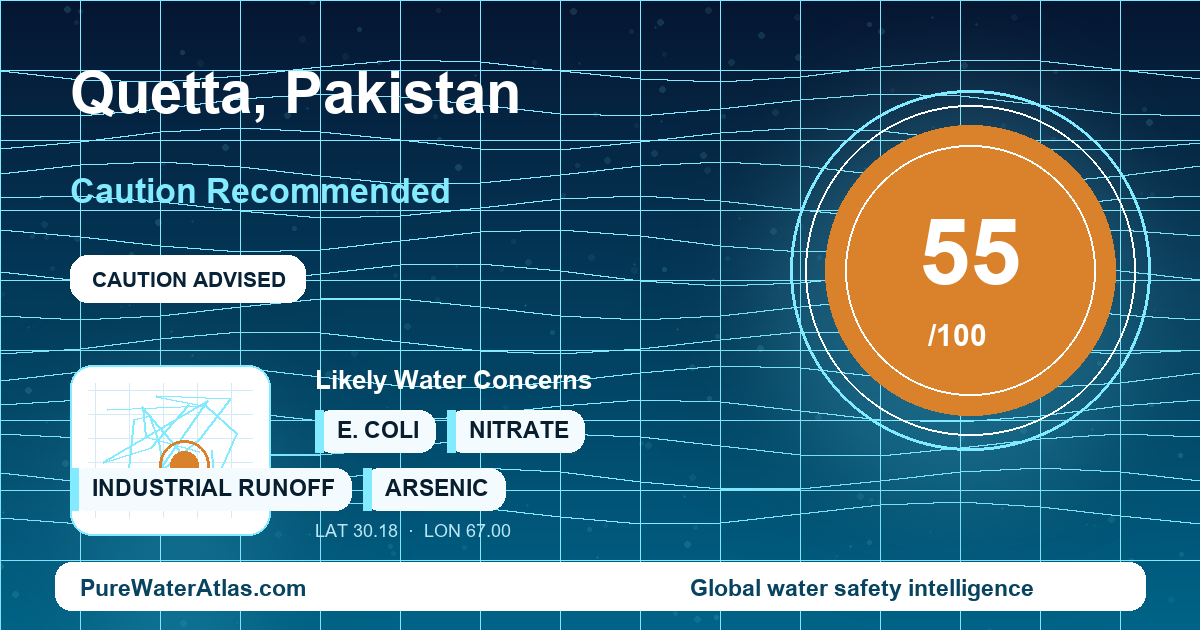
Quetta’s drinking water safety depends heavily on the specific source, building storage, and treatment system. The city is groundwater-dependent, water-stressed, and subject to variable quality between WASA supply, private boreholes, tanker water, and hotel or household filtration.
Quick Answer
| Water safety score | 55 / 100 |
|---|---|
| Overall status | Caution recommended. Quetta tap water should not be assumed safe to drink untreated, especially for visitors, children, pregnant people, immunocompromised people, or anyone using water from private boreholes, tankers, or poorly maintained storage tanks. |
| Traveler advice | Do not rely on untreated tap water. Use sealed bottled water from reputable suppliers, or water that has been boiled, UV-treated, or treated through a maintained hotel or restaurant system. Avoid ice unless its treated-water source is confirmed. |
| Resident advice | Test the actual water at the kitchen tap, especially after rooftop or underground tanks, private bores, or tanker delivery. Choose treatment based on results, not assumptions. |
| Main water source | Primarily groundwater from municipal and private tube wells in the Quetta valley and surrounding basin. |
| Main authority | Water and Sanitation Agency Quetta, commonly known as WASA Quetta, with broader environmental and public-health context from provincial and national agencies. |
| Filter recommendation | Often advisable: sediment filtration plus reliable disinfection such as UV, boiling, or correctly dosed chlorination. Reverse osmosis should be added only when testing shows high TDS, nitrate, fluoride, arsenic, or other dissolved contaminants. |
Why Quetta Is Different
Quetta is not a city where drinking water can be judged by a single citywide tap-water claim. It sits in an arid, high-altitude basin in Balochistan with limited dependable surface-water resources. The practical result is a groundwater-dependent city where the safety of drinking water can vary sharply between neighborhoods, buildings, and even households on the same street.
One household may receive groundwater supplied through WASA Quetta, another may use a private borehole, and another may rely on tanker water stored in an underground tank. A hotel may run water through reverse osmosis or UV treatment, while a nearby guesthouse may depend on ordinary storage tanks with uncertain maintenance. In Quetta, the building-level system often matters as much as the original source.
The main concern is not one confirmed contaminant affecting every tap across the city. The concern is variability: intermittent supply, falling groundwater levels, ageing or leaking pipes, private and tanker sources with uneven oversight, and storage tanks that can allow contamination after water leaves the source. Because publicly accessible, current, neighborhood-level compliance data are limited, a cautious approach is appropriate.
Where Does Quetta’s Tap Water Come From?
Quetta’s drinking water system is primarily groundwater-based. Municipal and private tube wells abstract water from aquifers in the Quetta valley and surrounding basin. Unlike cities with large, continuously treated river-reservoir systems, Quetta depends heavily on pumping groundwater, storing it, and distributing it through local networks or building-level systems.
Historically, Quetta and nearby valleys used springs, karezes, and shallow groundwater systems. Over time, population growth, urban expansion, drought, and extensive tube-well pumping shifted the city toward deeper groundwater abstraction. Many traditional sources have declined or become unreliable as groundwater levels fell.
Important parts of Quetta’s water system include WASA Quetta municipal tube wells and pumping stations, private boreholes used by homes and institutions, intermittent distribution networks, rooftop and underground storage tanks, and water tankers used during shortages or where piped supply is unreliable. Government and development-bank documents have also discussed bulk-water and dam-based augmentation projects intended to reduce pressure on groundwater.
This source mix affects both quantity and quality. Falling groundwater levels can increase pumping depth, raise operating costs, reduce service reliability, and change dissolved-mineral profiles. During scarcity, users may switch to private or tanker water, which can have weaker verification and greater handling risks.
Who Manages Drinking Water in Quetta?
The main urban water utility is the Water and Sanitation Agency Quetta, commonly referred to as WASA Quetta. It is the key local institution for urban water-supply and sanitation services in the city. Public Health Engineering Department functions are also relevant in Balochistan outside the main urban WASA service context.
Pakistan’s National Standards for Drinking Water Quality provide the national benchmark for potable water parameters. Environmental oversight is linked to Pakistan Environmental Protection Agency frameworks and the Balochistan Environmental Protection Agency. The Pakistan Council of Research in Water Resources has conducted drinking-water quality monitoring and research nationally.
However, Quetta does not have an easily accessible, current, consumer-facing dashboard showing routine tap-level results for every neighborhood. There is credible city-specific evidence on groundwater dependence, scarcity, and infrastructure stress, but not a verified address-level dataset for E. coli, residual chlorine, arsenic, nitrate, TDS, lead, and other parameters across consumer taps. This is why household-level testing is especially important.
Main Local Water Concerns
Microbiological contamination risk is the most important short-term concern. Intermittent supply, low or fluctuating pressure, damaged pipes, sewage proximity, tanker handling, and neglected storage tanks can introduce fecal indicator organisms such as total coliforms or E. coli. For travelers, this is the main reason untreated tap water is not recommended.
Groundwater depletion is a safety issue as well as a supply issue. Quetta’s groundwater stress has been repeatedly identified in development-agency and provincial planning discussions, including the Asian Development Bank’s Balochistan Water Resources Development Sector Project. Declining aquifers can affect reliability, increase reliance on private sources, and contribute to changes in dissolved minerals.
Dissolved minerals, salinity, hardness, and taste can vary. Groundwater in arid basins may contain elevated dissolved solids or hardness, but Quetta should not be treated as having one uniform TDS or salinity level. Quality can vary by bore depth, location, and handling. Testing the specific bore, tap, or tanker source is the only practical way to know.
Nitrate and sewage-related impacts should be considered. Urban sanitation leakage, septic systems, and agricultural inputs around recharge areas can contribute nitrate and microbial risks in groundwater. Nitrate is especially important for infants and pregnant people, and it should be included in testing for private boreholes and tanker water.
Sediment and turbidity can reduce treatment effectiveness. Particles from pumping, pipe disturbance, or tank cleaning can clog filters and shield microbes from disinfection. Water with visible particles, cloudiness, or unusual disturbance should be filtered and disinfected before drinking. See PureWaterAtlas guides to sediment and turbidity for more detail.
Old plumbing can change water quality at the tap. Lead is not documented as a uniform Quetta-wide contaminant, but older internal plumbing, brass fittings, solder, and storage infrastructure can contribute metals at the point of use. Older homes, schools, clinics, and buildings with unknown plumbing materials should consider tap-level metal testing, including lead.
For Travelers
Short-term visitors should not drink untreated tap water in Quetta. Use sealed bottled water from reputable brands, and check that bottle caps are intact. Avoid refilled bottles. If bottled water is unavailable, use water that has been brought to a full boil, UV-treated, or treated through a properly maintained filtration and disinfection system.
Use bottled, boiled, or otherwise treated water for brushing teeth if you are a short-term visitor, immunocompromised, traveling with children, or staying in accommodation with uncertain storage tanks. Avoid ice unless the hotel or restaurant can confirm it was made from treated water. Ice made from ordinary tap, bore, or tanker water can carry the same microbiological risk as the source water.
Higher-end hotels and restaurants may use RO, UV, or bottled water, but do not assume this automatically. Ask whether drinking water and ice come from a maintained treatment system. Hot tea or coffee is safer when the water has been brought to a full boil. Be cautious with raw salads and foods washed in untreated water.
For Residents
Residents should treat Quetta tap, bore, or tanker water as source water that needs verification and risk management. The most useful test is the water actually used for drinking at the kitchen tap, after the building’s storage tanks, pipes, pumps, and filters. Testing only the borehole or street connection may miss contamination introduced inside the property.
For many homes, a practical baseline is sediment filtration followed by reliable disinfection, such as UV, boiling, or correctly dosed chlorination. If chlorination is used, residual disinfectant should be checked where possible; see the PureWaterAtlas guide to chlorine in drinking water. Reverse osmosis can be useful when testing shows high dissolved contaminants, but it should not be installed blindly. In water-stressed Quetta, RO reject water should be considered and reused where safe rather than wasted.
Recommended testing includes E. coli and total coliform bacteria; turbidity; residual chlorine if chlorinated; pH; electrical conductivity; TDS; hardness; alkalinity; nitrate; fluoride; arsenic; chloride; sulfate; sodium; iron; and manganese. Older buildings, schools, clinics, and rented properties with unknown plumbing should consider first-draw and flushed lead testing.
Retest after bore deepening, pump replacement, pipe repairs, flooding, unusual taste or odor, illness clusters, or any change in tanker or water supplier. If using RO or UV, test before and after the system and maintain cartridges, membranes, UV lamps, and treated-water tanks on schedule.
Storage tanks are a major point-of-use risk in Quetta because intermittent supply encourages storage. Keep tanks covered, insect-proofed, sealed from dust and sewage intrusion, and cleaned and disinfected regularly. Inspect for cracks, cross-connections, dirty hoses, and practices such as dipping containers into tanks, which can introduce contamination.
Relevant Contaminants and Water-Quality Issues
The most relevant PureWaterAtlas contaminant profiles for Quetta are not presented as proof of uniform citywide contamination. They are the issues residents and travelers should understand because they match the city’s groundwater dependence, intermittent supply, tanker use, and storage-tank risks.
- E. coli in Drinking Water — key indicator for fecal contamination and the most important short-term illness concern.
- Turbidity in Drinking Water — relevant to cloudy water, pipe disturbance, tank cleaning, and disinfection performance.
- Sediment in Drinking Water — useful for borehole, pipe, and tank-related particles.
- Nitrate in Drinking Water — important for private boreholes, sewage-impacted groundwater, and infant health.
- Lead in Drinking Water — relevant to older buildings and point-of-use plumbing, not a claim of citywide lead contamination.
- Chlorine in Drinking Water — relevant where disinfection residual is used or monitored.
How to Verify Your Water Quality
The safest way to answer “Is my Quetta water safe?” is to test the water you actually drink. Start with the PureWaterAtlas Water Testing Guide, then compare any detected contaminants using the Contaminants Search Engine.
For microbial treatment decisions, review Water Microbiology, Boiling Water Purification, and UV Water Purification. For choosing household systems, use the Water Treatment Systems guide.
If your test results show nitrate, lead, or arsenic, use the specific PureWaterAtlas testing explainers: Nitrate Testing and Detection, Lead Testing and Detection, and Arsenic Testing and Detection. Travelers comparing precautions across destinations can also use the Global Water Quality Checker.
Official and Technical Sources
- Water and Sanitation Agency Quetta official website — local urban water utility source.
- Asian Development Bank: Balochistan Water Resources Development Sector Project — technical context for Quetta water-supply infrastructure and groundwater challenges.
- Pakistan National Standards for Drinking Water Quality — national drinking-water quality benchmark.
- Pakistan Council of Research in Water Resources — national water-research and monitoring authority.
- Balochistan Environmental Protection Agency — provincial environmental regulator.
- WHO Guidelines for Drinking-water Quality — international reference for interpreting health risks.
- WHO/UNICEF Joint Monitoring Programme data for Pakistan — national water-service context.
- World Bank: Pakistan, Getting More from Water — national water-security context relevant to groundwater-stressed cities.
Bottom Line
Quetta tap water deserves caution because the city is groundwater-dependent, water-stressed, and highly variable at the point of use. Untreated tap, bore, or tanker water should not be assumed safe, especially for travelers. The most immediate concern is microbiological contamination from intermittent supply, low pressure, damaged infrastructure, tanker handling, or poorly maintained storage tanks. Residents should test the water actually used at the kitchen tap and choose treatment accordingly: sediment filtration plus disinfection is often prudent, while reverse osmosis should be reserved for confirmed dissolved-contaminant problems. Because current neighborhood-level public monitoring data are limited, building-specific testing and maintenance are essential.
Read the full guide: Global Water Quality Guide
Explore more in this category: Global Water Quality Articles