
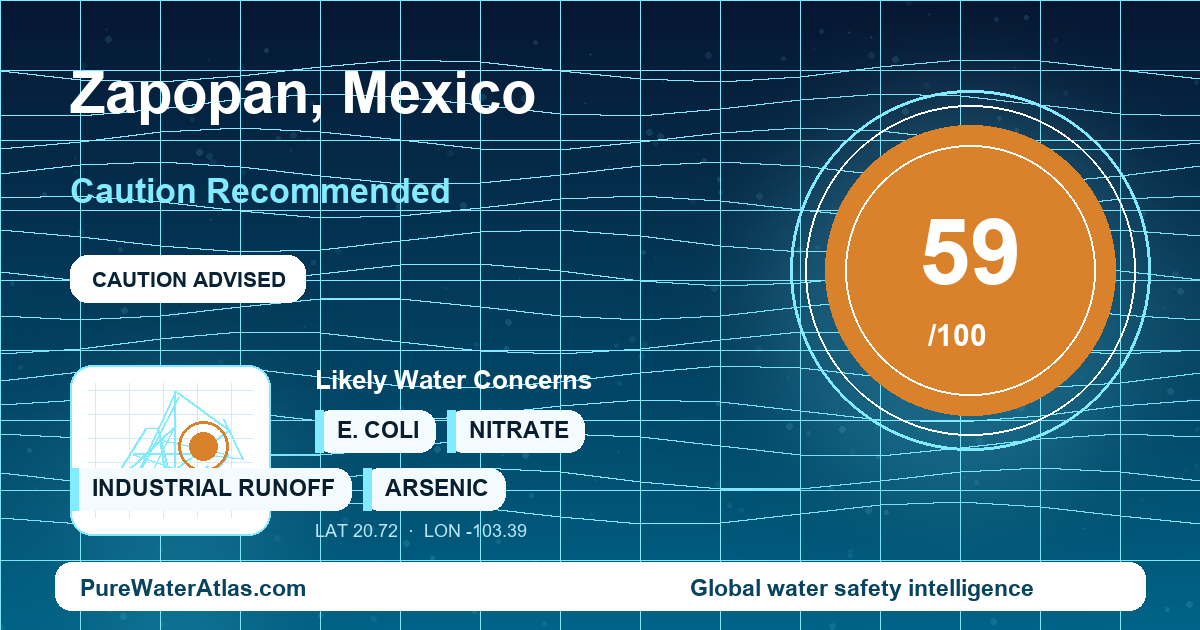
Zapopan, Jalisco: treated metropolitan water from the Guadalajara system, but drinking straight from the tap requires caution because final quality can change in distribution pipes, cisterns, tinacos and building plumbing.
Quick Answer
| Overall safety status | Caution recommended. Zapopan’s municipal water is treated and chlorinated, but drinking it unfiltered is not recommended as a default because the final tap may be affected by mixed sources, intermittent pressure, older pipes, private storage tanks and limited city-specific public lab transparency. |
|---|---|
| Water safety score | 59 / 100 — risk level: Caution Recommended. |
| Traveler advice | Use sealed bottled water, hotel-provided purified water or a verified filtered source for drinking. Tap water is generally acceptable for showering and handwashing, but conservative travelers should not drink it unfiltered. |
| Resident advice | Use point-of-use protection for drinking and cooking water, maintain tinacos and aljibes, and test household tap water when there are children, pregnant people, immunocompromised residents, old plumbing, repeated outages, turbidity, taste or odor concerns. |
| Main water source | Zapopan is part of the Guadalajara Metropolitan Area supply, with a regional mix that includes Lake Chapala water, the Calderón dam/system and supplemental groundwater from metropolitan wells and aquifers. |
| Water authority | Urban Zapopan is served principally by SIAPA, the Sistema Intermunicipal de los Servicios de Agua Potable y Alcantarillado. |
| Filter recommendation | For most homes, use sediment prefiltration plus activated carbon at minimum. Add reverse osmosis, UV or other certified treatment only when household testing shows a need for dissolved minerals, metals, nitrate, microbial risk or another specific contaminant. |
Why Zapopan Is Different
Zapopan is not a stand-alone drinking-water system with a single local source and a simple path to the tap. It is part of the Guadalajara Metropolitan Area, and its water is tied to a large intermunicipal network operated mainly by SIAPA. That matters because the water reaching a home, hotel, office or restaurant in Zapopan may have passed through long-distance conveyance, treatment, chlorination, pumping stations, storage tanks, pressure sectors, neighborhood pipes and then private building storage before it reaches the faucet.
This makes the practical safety question more local than a raw-water-source description suggests. A modern hotel or maintained business property in a central or high-income district may use purified water systems or well-maintained internal storage. An older apartment, school, office or house may rely on aging plumbing, a dirty cistern, an uncovered rooftop tinaco or a service line affected by low pressure. Fast-growing peripheral areas, including corridors such as Tesistán, can have different practical risks from established urban districts because pressure, maintenance conditions and building infrastructure vary.
Another important Zapopan-specific reality is local behavior. Many households and businesses in the Guadalajara-Zapopan area use garrafón water, sealed bottled water or point-of-use filters for drinking. That does not prove that all municipal water is unsafe at the treatment plant. It reflects the combined concerns people have about taste, mineral character, chlorine odor, storage hygiene, distribution infrastructure and the uncertainty of the final tap.
Where Does Zapopan’s Tap Water Come From?
Zapopan’s drinking water is part of the broader Guadalajara metropolitan supply, not a separate Zapopan-only network. The regional raw-water mix includes surface water from Lake Chapala conveyed toward Guadalajara, surface water from the Calderón dam and associated system, and supplemental groundwater from metropolitan well fields and local aquifers. The exact blend at a specific Zapopan address can vary by hydraulic sector, season, maintenance conditions and pressure management.
Historically, the Guadalajara-Zapopan urban area also depended on local springs, shallow groundwater and well fields, including sources associated with the Atemajac valley and the Colomos area. Today those local sources sit within a much larger regional system dominated by surface-water transfers and groundwater supplementation. Zapopan is inland, high-elevation and located in the Atemajac valley region, so its drinking-water security is linked to regional hydrology rather than to a single local river running through the municipality.
Key infrastructure affecting Zapopan includes the SIAPA metropolitan drinking-water distribution network serving Guadalajara, Zapopan, San Pedro Tlaquepaque and Tonalá; Lake Chapala aqueduct infrastructure; the Calderón dam system; groundwater wells; water treatment and chlorination facilities; storage tanks; pumping stations; pressure sectors; and private building-level cisterns and rooftop tanks known locally as aljibes and tinacos. Those private tanks are especially important because they are often the final storage point before the kitchen or bathroom tap.
Who Manages Drinking Water in Zapopan?
The principal drinking-water and sewerage utility for urban Zapopan is SIAPA, the Sistema Intermunicipal de los Servicios de Agua Potable y Alcantarillado. SIAPA operates the intermunicipal system for the Guadalajara metropolitan core, including Guadalajara, Zapopan, San Pedro Tlaquepaque and Tonalá. State-level water planning and infrastructure roles involve the Comisión Estatal del Agua de Jalisco.
Health-based drinking-water requirements in Mexico are governed by NOM-127-SSA1-2021, the federal standard for water for human use and consumption. Oversight sits within the Secretaría de Salud and COFEPRIS sanitary-risk framework, with local and state health authorities involved in surveillance.
For Zapopan users, the key data limitation is that public information is generally not presented as address-level or neighborhood-level consumer confidence reporting. SIAPA information is often metropolitan or system-level, and the water at the final tap can be changed by private plumbing, cisterns and rooftop tanks. This profile therefore does not claim universal potability for every Zapopan tap or assign contaminant concentrations by neighborhood without a current household lab report.
Main Local Water Concerns
- Mixed sources and changing taste: Because Zapopan can receive a blend of Lake Chapala water, Calderón system water and groundwater supplementation, taste, hardness, chlorine odor and mineral character may vary by sector and season.
- Drought and reservoir dependence: Reliance on Lake Chapala and the Calderón system creates vulnerability to drought, reservoir levels, pumping constraints and metropolitan allocation stress.
- Pressure interruptions: Intermittent service, pressure reductions or repair work can increase the chance of sediment disturbance and intrusion risk in weak parts of the distribution network.
- Turbidity and discoloration: After repairs, flushing, heavy rainfall or flow changes, water may appear cloudy, brownish or sediment-laden. Visibly turbid water should not be consumed until it clears, and drinking water should come from a purified or properly filtered source.
- Cisterns and tinacos: Even well-treated, chlorinated water can become microbiologically unsafe if a household tank is uncovered, cracked, dirty or poorly maintained.
- Older plumbing: Older buildings may contribute metals such as lead from legacy components, solder, brass fixtures or stagnant internal lines. Public evidence is not sufficient to make a Zapopan-wide lead claim, but premise-plumbing risk should be evaluated in older properties.
- Groundwater mineral character: Groundwater-influenced sectors may have more noticeable hardness, dissolved minerals or salinity-like taste. Exact local concentrations require testing.
Season also matters. During the rainy season, roughly June to October, raw-water turbidity and runoff-related contamination pressure can increase. During the dry season and drought periods, pressure management, supply rotations, taste changes or greater groundwater supplementation may become more noticeable. After low-pressure events or repairs, flush taps, avoid visibly turbid water and rely on purified water until normal pressure and clarity return.
For Travelers
Do not rely on unfiltered tap water for drinking in Zapopan. Short-term visitors should use sealed bottled water, purified garrafón water or water from a reputable hotel or restaurant filtration system. The municipal supply is treated, but the traveler-relevant risk is the final tap, not only the treatment plant. Building storage, old plumbing and local pressure conditions can change water quality before it reaches the faucet.
For brushing teeth, conservative travelers, children, pregnant travelers and immunocompromised people should use bottled or purified water. Many locals may brush with tap water, but visitors trying to minimize gastrointestinal risk should avoid swallowing it. For ice, use it only in established hotels, cafes and restaurants that appear to use purified water or state that they do. Avoid uncertain ice from street vendors or informal sources if you are not acclimated.
Hotels and restaurants in better-served districts commonly provide purified water systems or garrafón water for drinking. Ask for agua purificada or bottled water if unsure. Do not assume that bathroom tap water is the same as the water served at the table. If staying in an apartment rental, ask whether the building has a maintained cistern, a point-of-use filter and a recent cleaning schedule for the tinaco or aljibe. Carry bottled water on day trips, and be especially cautious after heavy rain, repair work or reported outages.
For Residents
For Zapopan residents, municipal water should be treated as a source that normally needs point-of-use protection for drinking and cooking. A practical home setup starts with sediment prefiltration to reduce particles, followed by activated carbon to improve chlorine taste and odor and reduce some organic byproduct concerns. If household testing shows elevated dissolved minerals, nitrate, arsenic, lead or other specific contaminants, a certified reverse-osmosis system or another targeted technology may be appropriate. UV can help manage microbial risk only when water is clear and the lamp is properly maintained; it does not remove metals, nitrate or dissolved chemicals.
Testing should be done at the kitchen tap, not only at the street connection, because household storage and plumbing can change the water. Test for total coliform and E. coli if there are storage tanks, intermittent service, sewage odors, illness concerns, flooding or recent plumbing work. Test turbidity, residual chlorine, pH, conductivity or total dissolved solids if water has changing taste, odor, color or sediment. Test for lead if the building is old, plumbing materials are unknown, water sits overnight in pipes or children or pregnant people live in the home. Consider nitrate, arsenic, fluoride and metals testing if relying on private wells, peripheral groundwater or when selecting a treatment system for health reasons.
Tinacos and aljibes deserve routine attention. They should be sealed, screened, cleaned and disinfected on a regular schedule. A dirty or uncovered tank can turn treated chlorinated water into unsafe household water by allowing sediment, insects, biofilm or fecal contamination to enter. Retest after tank cleaning, filter installation, plumbing changes, repeated outages or any sudden change in water appearance, taste or odor.
Relevant Contaminants and Water-Quality Issues
Zapopan’s most practical water-quality issues are not limited to one contaminant. Chlorine is relevant because the municipal supply is disinfected and users may notice taste or odor. Turbidity and sediment are especially important after repairs, outages, heavy rainfall, tank disturbance or flow changes in older pipes. If water is visibly cloudy or discolored, do not drink it until it clears and use purified water for drinking.
Microbial safety is a key point-of-use concern in Zapopan because private cisterns and rooftop tanks are common. Learn more about E. coli and the broader principles in Water Microbiology. Older buildings may justify testing for lead, especially when plumbing materials are unknown or water stagnates overnight. Groundwater-influenced or private-well situations may call for nitrate testing, particularly in urbanizing or agricultural-edge areas.
For broader context, PureWaterAtlas guides on Drinking Water Safety, Water Contamination and Water Treatment Systems can help residents connect lab results to practical treatment choices.
How to Verify Your Water Quality
The best way to verify drinking-water safety in a Zapopan home or rental is to test the water actually being consumed. Start at the kitchen tap after the water has passed through the building’s plumbing, cistern, tinaco and any existing filter. If you receive a lab report, use the PureWaterAtlas Contaminants Search Engine to look up detected substances and health significance.
For sampling strategy, see the PureWaterAtlas complete guide to water testing and analysis. Residents concerned about older plumbing can use Lead in Drinking Water: Testing and Detection Methods. Households using wells or concerned about groundwater influence can review Nitrate Contamination in Drinking Water: Testing and Detection Methods.
If there is a suspected microbial issue after an outage or tank contamination, boiling may be useful as a temporary precaution, but it does not remove dissolved chemicals or metals. UV treatment may help with microbes when designed and maintained correctly. Travelers comparing advice across destinations can use the Global Water Quality Checker.
Official and Technical Sources
- SIAPA – Sistema Intermunicipal de los Servicios de Agua Potable y Alcantarillado — primary utility for the metropolitan system serving Zapopan.
- SIAPA Transparencia — official access point for institutional documents, reports and public information requests.
- Comisión Estatal del Agua de Jalisco — state water authority for planning, infrastructure and Jalisco water-sector information.
- CONAGUA Sistema Nacional de Información del Agua — federal water resources and hydrology information.
- CONAGUA Presas de México — federal reservoir information relevant to regional surface-water systems.
- NOM-127-SSA1-2021 — Mexican federal drinking-water quality standard.
- COFEPRIS — federal sanitary-risk authority connected to drinking-water surveillance.
- CDC Travelers’ Health – Mexico — traveler guidance supporting conservative use of safe bottled, treated or disinfected water.
- WHO Guidelines for Drinking-water Quality — international reference for microbial safety, turbidity, disinfection and household water safety principles.
Bottom Line
Tap water in Zapopan should be approached with caution for drinking. The city is served by the SIAPA Guadalajara metropolitan system, using a mix that includes Lake Chapala, the Calderón system and groundwater supplementation. The water is treated and chlorinated, but the final faucet can be affected by long distribution paths, pressure changes, repairs, private cisterns, rooftop tinacos and older plumbing. Travelers should use sealed bottled, purified or verified filtered water. Residents should maintain storage tanks, use an appropriate point-of-use filter or purified-water service, and test kitchen-tap water when there are vulnerable people, old buildings, repeated outages, turbidity, odor or taste changes. Public data is not granular enough to guarantee safety at every Zapopan tap.
Read the full guide: Global Water Quality Guide
Explore more in this category: Global Water Quality Articles