
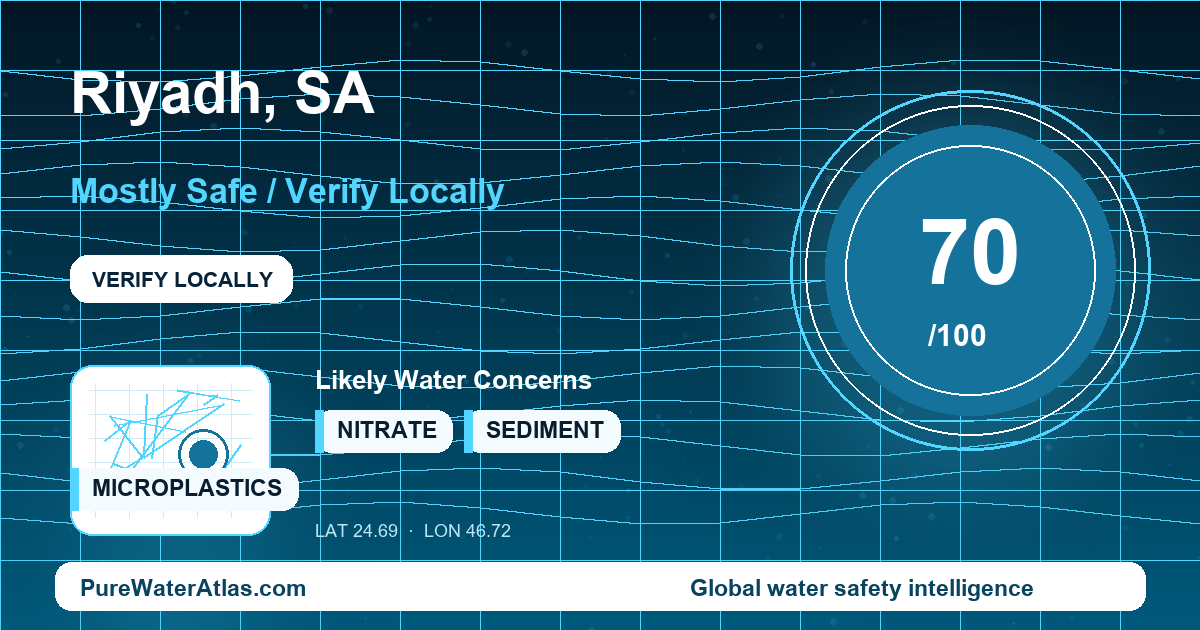
Riyadh’s tap water is generally treated municipal water from a desalination-and-transmission system, but the safety of the water at your actual tap depends heavily on building storage tanks, internal plumbing, and local maintenance.
Quick Answer
| Overall safety status | Mostly Safe / Verify Locally. Riyadh municipal water is generally treated and commonly suitable for household use, but it should be verified at the building level before relying on it as a primary drinking source. |
|---|---|
| PureWaterAtlas score | 70 / 100 |
| For travelers | Use bottled water for routine drinking if you are on a short visit, sensitive to taste changes, staying in older accommodation, or unable to confirm tank maintenance. Brushing teeth with tap water is usually acceptable in reputable hotels and modern buildings. |
| For residents | Municipal tap water can often be used after confirming the condition of the building’s tanks and plumbing. Test at the kitchen tap, not only at the building inlet. |
| Main water source | Desalinated seawater produced on Saudi Arabia’s Gulf coast and transmitted inland to Riyadh, with groundwater also historically and operationally relevant in the wider Riyadh water context. |
| Main authorities | National Water Company for municipal service, with Saudi Water Authority, Water Transmission and Technologies Company, Ministry of Environment, Water and Agriculture, and Saudi water-sector regulators involved in the broader system. |
| Filter recommendation | A home filter is not automatically required for every Riyadh home, but point-of-use treatment is reasonable for taste, chlorine, sediment, and added protection after building storage. Choose carbon, sediment filtration, reverse osmosis, UV, or other treatment only after testing. |
Why Riyadh Is Different
Riyadh is not a city where drinking water safety can be understood by looking at a nearby river, lake, or mountain reservoir. It is an inland desert capital on the Najd plateau, with no dependable local river source for municipal drinking water. The city’s water identity is therefore built around national-scale infrastructure: desalinated seawater from the Arabian Gulf, long-distance transmission pipelines, reservoirs, municipal distribution, and, in many buildings, private roof or underground storage tanks.
This makes Riyadh different from many city water systems. The main question is usually not whether residents are being served untreated surface water. The more practical question is whether treated desalinated and groundwater-supplemented water remains protected through every step after production: bulk transmission, storage, municipal distribution, private building tanks, internal plumbing, fixtures, and finally the tap.
PureWaterAtlas rates Riyadh as Mostly Safe / Verify Locally because the broad supply system is modern and treated, but publicly accessible, current, neighborhood-level consumer water-quality results are limited. Building-level conditions can vary. A well-maintained hotel, villa, office, or apartment tower may have lower practical risk than an older or poorly maintained property with dirty tanks, stagnation, sediment, or questionable plumbing maintenance.
Where Does Riyadh’s Tap Water Come From?
Riyadh’s municipal supply depends heavily on desalinated seawater produced on Saudi Arabia’s Gulf coast and transmitted hundreds of kilometers inland. Major coastal systems associated with Jubail and Ras Al-Khair are part of the national desalination infrastructure supplying central Saudi Arabia. This water is moved through long-distance treated-water transmission pipelines toward Riyadh, stored in large strategic and operational reservoirs, and then distributed through municipal networks serving homes, apartments, hotels, offices, restaurants, and public buildings.
Groundwater is also historically and operationally relevant. Before the expansion of modern desalination and transmission infrastructure, Riyadh relied much more heavily on deep aquifers and local wells. Saudi Arabia’s broader water history includes major abstraction of non-renewable groundwater, and Riyadh’s rapid growth pushed the city toward a supply model based on desalination, bulk transmission, reservoirs, and demand management rather than a conventional local watershed.
For a person standing at a kitchen tap in Riyadh, the final stage of the water pathway matters a great deal. Water may be treated before entering the distribution network, but many buildings use private storage tanks. These may include roof tanks exposed to extreme heat and dust, or underground tanks that require regular inspection and cleaning. If tanks are uncovered, cracked, poorly screened, rarely cleaned, or disturbed during maintenance, they can become a point where sediment and microbial risk enter the household water system.
Who Manages Drinking Water in Riyadh?
The main municipal water and wastewater service provider for Riyadh customers is the National Water Company. For residents, this is the most relevant utility-facing institution for municipal water service, distribution issues, local service notices, and customer contact.
Riyadh’s water supply also depends on national institutions because the city is supplied through large-scale desalination and transmission infrastructure. The Saudi Water Authority is a high-authority source for Saudi desalination, water production, and national water-sector functions. The Saline Water Conversion Corporation has historically been central to Saudi desalination, and remains relevant for understanding the desalinated-water systems that support inland cities such as Riyadh. The Water Transmission and Technologies Company is associated with bulk water transmission systems that move treated water from coastal production areas to inland demand centers.
National policy and regulatory context also matters. The Ministry of Environment, Water and Agriculture has national water-policy responsibilities, while the Saudi Water Regulator is relevant for water service regulation and consumer-facing regulatory context. International background on Saudi Arabia’s arid water resources, groundwater dependence, and desalination role is available through FAO AQUASTAT’s Saudi Arabia country profile.
A key limitation: PureWaterAtlas did not find a single routinely published Riyadh neighborhood-level consumer confidence report equivalent to the detailed local reports available in some North American or European cities. For that reason, this guide does not claim exact contaminant concentrations, exact compliance percentages, or neighborhood-by-neighborhood safety conditions.
Main Local Water Concerns
The most common Riyadh-specific concerns are practical and point-of-use related. Taste and mineral balance can differ from what visitors expect because the supply may include desalinated water, blended sources, and changes introduced through transmission and distribution. Some users may also notice a disinfectant taste or odor from chlorine residual, especially where water is protected for distribution and storage.
Cloudiness, particles, or discoloration can occur after plumbing work, tank disturbance, pressure changes, or local maintenance. These symptoms should not be ignored, especially if they persist after flushing. Residents should avoid drinking visibly discolored water until it clears, and should investigate the building tank and internal plumbing if the problem continues.
Private storage tanks are one of the most important local control points. Riyadh’s extreme summer heat can warm tanks and increase taste, odor, and microbial-regrowth concerns if disinfectant residual is low or tanks are poorly maintained. Dust storms can increase contamination risk for poorly sealed roof tanks, especially around damaged covers, vents, or fittings. High-demand periods may also make storage logistics more important.
Older internal plumbing or fixtures can contribute stagnation-related taste, corrosion, sediment, or metal concerns. However, PureWaterAtlas does not make a Riyadh-wide lead claim without building-specific testing. If an apartment, villa, school, or workplace has unknown plumbing materials, visible particles, metallic taste, or discoloration, laboratory testing is the appropriate next step.
For Travelers
For short visits to Riyadh, bottled water is the lowest-friction choice for routine drinking. This is especially sensible if you are staying in older accommodation, have a sensitive stomach, are medically vulnerable, are traveling with an infant, or cannot confirm whether the building’s storage tanks are maintained. The issue is not that Riyadh lacks modern water treatment; the issue is that the final building-level storage and plumbing conditions are not always visible to a visitor.
Brushing teeth with tap water is generally acceptable in reputable hotels and modern buildings. If you are immunocompromised, have gastrointestinal sensitivity, or notice unusual odor, discoloration, or particles, use bottled water. Carry bottled water during summer because heat, travel distance, and outdoor exposure make hydration planning more important.
Ice in reputable hotels, cafes, and restaurants is usually lower risk, but travelers should ask whether ice is made from treated municipal water or bottled water. Avoid ice from informal sources if tank hygiene is uncertain. Higher-end hotels and established restaurants usually manage guest water more carefully than small or informal premises, but the meaningful question is still whether storage tanks and ice machines are maintained.
For general destination comparisons, travelers can use the PureWaterAtlas Global Water Quality Checker.
For Residents
Many Riyadh residents can use municipal tap water after confirming their building’s tank and plumbing conditions. A point-of-use filter is reasonable, particularly for taste, chlorine, sediment, and added protection after building storage. However, the correct filter depends on test results. Activated carbon is commonly used for chlorine taste and odor. Sediment filtration is useful where particles or turbidity are present. Reverse osmosis may be appropriate if testing shows high dissolved solids, nitrate, certain metals, or other dissolved contaminants of concern.
Residents should test water at the kitchen tap, not only at the building inlet. The inlet may reflect municipal delivery, while the tap reflects the real water after roof tanks, underground tanks, internal pipes, fixtures, and stagnation. Start with total dissolved solids, conductivity, pH, turbidity, free chlorine residual, hardness, and microbial indicators such as heterotrophic bacteria or total coliform/E. coli if tank hygiene is uncertain.
If the building is older or plumbing materials are unknown, include lead, copper, iron, and other metals in a certified laboratory test. If a home uses private groundwater, tanker water, or any non-municipal backup supply, testing should be broader and include salinity, nitrate, fluoride, arsenic, and microbiological indicators. Retest after tank cleaning, plumbing replacement, unusual discoloration, a long vacancy, or any suspected cross-connection or sewage intrusion.
Storage tank management is essential in Riyadh. Tanks should be covered, screened, structurally intact, protected from dust and pests, cleaned on a regular schedule, and checked after storms, nearby construction work, or long periods of low use. Boiling can help in some microbial situations, but it does not remove chemical contamination, heavy sediment, or metals from a dirty tank.
Relevant Contaminants and Water-Quality Issues
Several PureWaterAtlas contaminant and issue profiles are especially relevant for Riyadh homes and buildings. Chlorine in drinking water is relevant because treated municipal water may have a noticeable disinfectant taste or odor after distribution and storage. Turbidity and sediment are important when water appears cloudy, contains visible particles, or changes after tank cleaning, pressure changes, or plumbing work.
E. coli is relevant where private tanks, non-municipal backup supplies, or poor tank hygiene raise microbiological questions. Lead is relevant for older plumbing and fixtures, but it should be treated as a building-specific testing issue rather than a Riyadh-wide assumption. For older buildings or unknown plumbing materials, see Lead in Drinking Water: Testing and Detection Methods.
If a suspected microbial event occurs, the Boiling Water Purification Guide explains what boiling can and cannot fix. Residents considering microbial control after storage tanks may also find the UV Water Purification Guide useful.
How to Verify Your Water Quality
The best way to verify Riyadh tap water is to test the water you actually drink. Municipal treatment and national desalination infrastructure are only part of the picture. The tap result can be changed by building tanks, internal pipes, stagnation, fixtures, and maintenance practices.
Start with a structured testing plan using PureWaterAtlas resources: How to Test Drinking Water explains how to choose parameters and interpret results, while Drinking Water Safety provides a practical decision framework for judging whether water is safe at point of use. If test results show specific contaminants, use the Contaminants Search Engine to research health significance and treatment options.
Choose treatment based on results rather than assumptions. The PureWaterAtlas Water Treatment Systems guide can help match filters to tested problems. For storage-tank hygiene and microbial risk, the Water Microbiology guide is directly relevant. Additional background is available in the Drinking Water Safety, Global Water Quality, and Water Testing sections.
Official and Technical Sources
- National Water Company — municipal water and wastewater service provider for Saudi cities including Riyadh.
- Saudi Water Authority — national authority relevant to desalination, water production, and sector functions.
- Saline Water Conversion Corporation — official source historically central to Saudi desalination.
- Water Transmission and Technologies Company — relevant to long-distance bulk water transmission systems serving inland demand centers.
- Ministry of Environment, Water and Agriculture — national policy authority for water resources and water-sector governance.
- Saudi Water Regulator — water service regulation and consumer-facing regulatory context.
- FAO AQUASTAT Saudi Arabia country profile — international reference for Saudi Arabia’s arid water resources, groundwater dependence, and desalination role.
- World Health Organization drinking-water fact sheet — general public-health reference for safe drinking-water principles and microbial risk.
Bottom Line
Riyadh tap water is generally treated municipal water and is often suitable for household use, but it should be verified locally before becoming your main drinking source. The city depends on desalinated water produced on the Gulf coast, transmitted inland, stored, distributed, and often stored again in private building tanks. That makes building-level maintenance central to real tap safety. Tourists should default to bottled water for routine drinking unless a reputable hotel confirms potable water and tank maintenance. Residents should inspect and clean tanks, flush after plumbing work, and test kitchen-tap water for basic chemistry, disinfectant residual, turbidity, microbes, and metals where plumbing is older or unknown.
Read the full guide: Global Water Quality Guide
Explore more in this category: Global Water Quality Articles