
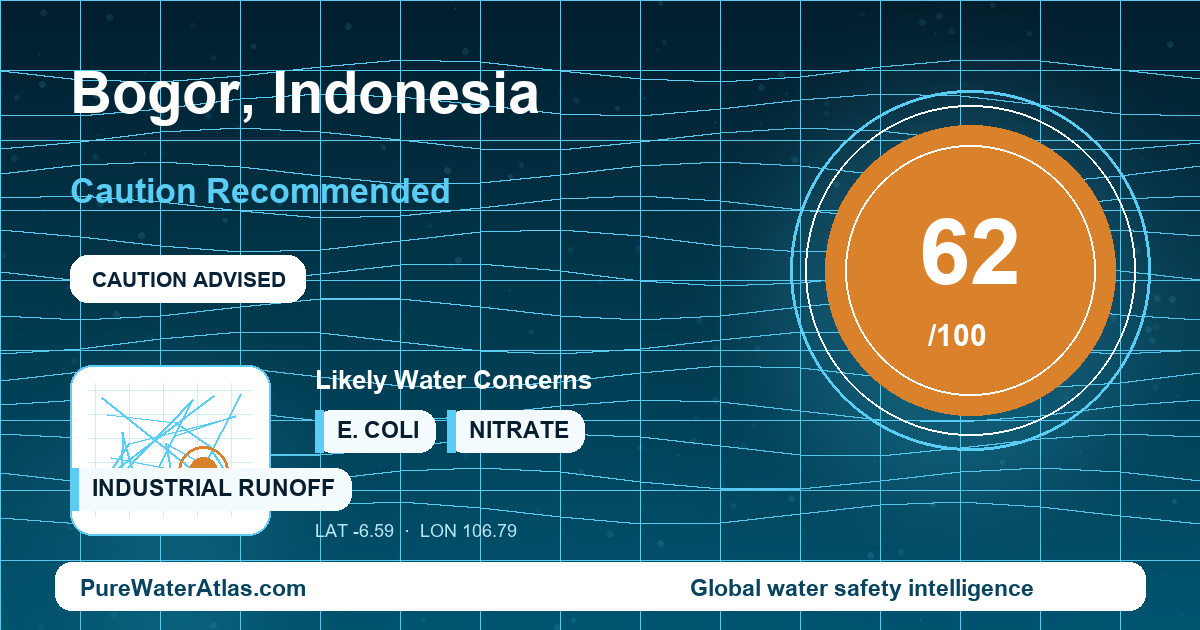
Bogor has a formal municipal water system operated by Perumda Tirta Pakuan, but untreated tap water is not recommended for visitors and should be treated with caution by residents because last-mile plumbing, storage tanks, rainfall-driven turbidity, and limited public tap-level data can affect safety.
Quick Answer
| Overall safety score | 62 / 100 |
|---|---|
| Risk level | Caution Recommended |
| Can you drink the tap water? | Not recommended untreated. Use sealed bottled water, boiled water, or properly filtered and disinfected water for drinking. |
| Traveler advice | Visitors should avoid relying on untreated tap water, especially during the rainy season or when staying in older buildings, small guesthouses, villas, boarding houses, or places using roof tanks. |
| Resident advice | Residents connected to Perumda Tirta Pakuan generally have a better starting point than private wells, but point-of-use treatment is still prudent for drinking water. |
| Main water sources | Treated surface water associated with the Cisadane and Ciliwung river systems, plus local spring sources where available. |
| Water authority | Perumda Tirta Pakuan Kota Bogor. |
| Recommended home treatment | Sediment prefiltration, activated carbon, and either UV disinfection or boiling. Reverse osmosis may be considered for private wells or where testing shows nitrate, metals, or dissolved contaminants. |
Why Bogor Is Different
Bogor is not a coastal Indonesian city where seawater intrusion is the dominant concern for central tap water. It is an inland upland city south of Jakarta, strongly shaped by the Cisadane and Ciliwung river catchments and by its high-rainfall environment. Bogor is widely known as Kota Hujan, the rain city, and that identity matters for drinking water because heavy rainfall can increase suspended solids, river color, microbial loading, and operational stress on surface-water treatment systems.
The most important local issue is not simply whether Bogor has a utility. It does: Perumda Tirta Pakuan operates the municipal piped-water system. The practical question is what happens between treated water and the consumer’s glass. Water may pass through older distribution pipes, pressure interruptions, building pumps, roof tanks, ground tanks, and internal plumbing before reaching the tap. A well-managed hotel or household with clean storage and reliable treatment may have much better drinking-water conditions than a nearby building with a dirty tank or stagnant plumbing.
PureWaterAtlas rates Bogor as Caution Recommended, not because there is evidence that every tap is unsafe, but because publicly accessible, recent, neighborhood-level customer-tap water-quality data are limited. The correct approach in Bogor is therefore practical and risk-based: use the municipal supply where available, but treat water intended for drinking unless you have verified the specific tap and building system.
Where Does Bogor’s Tap Water Come From?
Bogor’s municipal piped water is supplied by Perumda Tirta Pakuan Kota Bogor. The city’s raw-water portfolio is generally understood to include treated surface-water sources in the Cisadane and Ciliwung river systems, along with local spring sources in the Bogor upland setting where available.
Key infrastructure associated with Bogor’s piped-water supply includes the municipal distribution network, surface-water intake and treatment infrastructure connected to the Cisadane River system, including the Dekeng treatment area commonly referenced for Bogor’s supply, and surface-water infrastructure associated with the Ciliwung River system, including the Katulampa area. Katulampa is also a major hydrological control point in the Ciliwung catchment.
This source profile explains why turbidity and runoff are recurring practical issues. During intense rain, river-fed raw water can become more turbid and carry higher microbial pressure. During drier periods, lower river flow can reduce dilution and concentrate pollutants in urban waterways. Local spring sources historically mattered to Bogor because of the city’s upland setting and abundant rainfall, but as the city expanded, the system became more dependent on larger surface-water intakes and treatment plants rather than simple spring capture alone.
The final tap result can differ from treatment-plant quality. Household and building-level roof tanks, ground tanks, pumps, and internal plumbing are part of the real water system from a consumer perspective. In Bogor, the “last mile” is especially important for travelers, renters, and residents in older buildings.
Who Manages Drinking Water in Bogor?
The local drinking-water utility for Bogor City is Perumda Tirta Pakuan Kota Bogor. It is responsible for municipal piped-water service and customer information in the city. The Pemerintah Kota Bogor provides the official local-government context for municipal services and city administration.
Nationally, drinking-water quality in Indonesia is governed by the Ministry of Health framework, including Permenkes No. 2 Tahun 2023, which sets health-based environmental and drinking-water standards. Local implementation involves the utility, Bogor City government, health authorities, and national public-works and water-sector oversight. The Ciliwung and Cisadane river-basin context is also relevant, with basin-level information available from Balai Besar Wilayah Sungai Ciliwung Cisadane.
This profile does not claim that every Bogor tap meets standards at all times. The regulatory framework and utility identity are clear, but recent, independently auditable, neighborhood-level tap-water results are not consistently published in an easily verifiable format. That limitation is central to the safety recommendation.
Main Local Water Concerns
The main water-quality concerns in Bogor are linked to the city’s upland river catchments, high rainfall, and building-level water handling. The most important documented concerns are:
- Rainfall-driven turbidity: Heavy storms can increase suspended solids and river color in raw water from the Cisadane and Ciliwung systems.
- Microbial risk: Contamination risk rises if distribution pressure drops, pipes leak, flooding affects infrastructure, or building storage tanks are not cleaned.
- Sediment and discoloration: Brown, rusty, or visibly dirty water can occur after pipe repairs, pressure changes, outages, or disturbance of building tanks.
- Chlorine taste or odor: Treated piped water may have a chlorine taste or smell. The presence or absence of chlorine odor alone does not prove water is safe or unsafe.
- Private-well vulnerability: Wells in dense urban or peri-urban areas may be vulnerable to septic leakage, nitrate, and microbial contamination where sanitation separation is poor.
- Older internal plumbing: There is not enough public evidence to make a citywide lead claim for Bogor, but older plumbing, brass fittings, solder, galvanized pipe corrosion, and renovations can affect tap quality in individual buildings.
Season also matters. Rainy-season storms and localized flooding can increase contamination risk for shallow wells, ground tanks, and poorly sealed household plumbing. After outages or major pipe work, residents should flush taps and avoid drinking visibly dirty water until it clears and has been treated.
For Travelers
Visitors to Bogor should not drink untreated tap water. Use sealed bottled water, boiled water, or water treated by a reliable filter and disinfection system. This is especially important for short-term visitors, people with sensitive stomachs, children, elderly travelers, pregnant travelers, and immunocompromised visitors.
For brushing teeth, bottled, boiled, or properly filtered water is the more conservative choice. Some long-term residents may use treated tap water for brushing, but visitors do not have time to adapt to local water conditions or assess the building’s storage system.
Ice should be treated with the same caution as drinking water. Use ice only in reputable hotels, cafes, and restaurants that state they use commercial or treated water. Avoid unlabeled ice from street settings if you cannot confirm the source. Better hotels and restaurants in Bogor commonly use bottled water, gallon-refill dispensers, or in-house filtration for drinking water, but it is still reasonable to ask whether drinking water and ice are made from treated water.
If boiling water, bring it to a rolling boil and let it cool in a clean, covered container. A simple taste filter is not enough for uncertain tap or tank water because taste improvement does not necessarily remove microbes. For short stays, sealed bottled water or trusted hotel-filtered water is usually the simplest option. The CDC Travelers’ Health guidance for Indonesia supports conservative food and water precautions for visitors.
For Residents
For Bogor residents, municipal piped water from Perumda Tirta Pakuan is generally a more reliable starting point than an untested private well, but point-of-use treatment is still advisable for drinking and cooking. A practical household setup is sediment prefiltration followed by activated carbon and either UV disinfection or boiling. UV can work well when water is already clear and prefiltered; it is not a substitute for sediment control. For a broader comparison of treatment options, see Water Treatment Systems, Boiling Water Purification: Complete Guide, and UV Water Purification: Complete Guide.
Residents using private wells should test more actively. At minimum, test for E. coli or total coliform, nitrate, turbidity, pH, iron, manganese, and basic dissolved solids. After flooding, septic failure nearby, well repairs, or suspected tank contamination, test for microbial indicators before using the water untreated. Households with infants, pregnant residents, elderly residents, or immunocompromised residents should prioritize microbial testing and use boiled or properly disinfected water until results are known.
Storage tanks deserve special attention in Bogor. A safe treatment plant cannot compensate for a dirty roof tank or ground tank at the building. Tanks should be covered, protected from insects and rodents, cleaned on a schedule, and disinfected after contamination, flooding, or long stagnation. If morning water tastes metallic, looks discolored, or has visible particles, flush stagnant water and investigate plumbing or tank sediment.
There is insufficient public evidence to describe Bogor as having a citywide lead problem, but older buildings with unknown plumbing materials may justify targeted testing. Where laboratory access is available, residents in older properties can consider first-draw and flushed samples for metals such as lead, especially if there is metallic taste, discoloration, or recent renovation work.
Relevant Contaminants and Water-Quality Issues
The most relevant Bogor water-quality topics are microbial risk, turbidity, sediment, chlorine residual, private-well nitrate, and building-level plumbing issues. For microbial risk from tanks, wells, leaks, or flood-affected water, see E. coli in Drinking Water and the PureWaterAtlas guide to Water Microbiology.
Because Bogor’s river-fed sources can become more turbid after heavy rain, Turbidity in Drinking Water is directly relevant. For brown water, pipe disturbance, or tank deposits, see Sediment in Drinking Water. For treated municipal water taste and residual disinfectant questions, see Chlorine in Drinking Water.
Private-well users should pay particular attention to Nitrate in Drinking Water, especially where septic or agricultural influence is possible. For older buildings, Lead in Drinking Water is relevant as a plumbing-specific concern, not as a confirmed citywide claim for Bogor.
How to Verify Your Water Quality
The safest way to answer the question for a specific Bogor home, boarding house, hotel, or shop-house is to test the water at the actual tap used for drinking. Utility treatment information is useful, but it does not automatically verify roof tanks, ground tanks, pumps, or old internal pipes.
Start with the PureWaterAtlas Water Testing guide to understand sampling, laboratory analysis, and which parameters matter. If you are troubleshooting symptoms or visible changes, use the Contaminants Search Engine to look up specific issues such as turbidity, nitrate, chlorine, E. coli, sediment, or lead. Travelers comparing destinations can also use the Global Water Quality Checker.
For municipal water users, testing is most important when there are recurring odor, color, sediment, stomach illness, or pressure-interruption issues. For well users, testing should be routine rather than occasional. For buildings with tanks, test after cleaning or suspected contamination if the water will be used for drinking.
Official and Technical Sources
- Perumda Tirta Pakuan Kota Bogor official website — local municipal water utility responsible for Bogor City piped-water service.
- Pemerintah Kota Bogor official website — official city-government context for Bogor.
- Permenkes No. 2 Tahun 2023 — Indonesian Ministry of Health regulation establishing national health-based environmental and drinking-water standards.
- CDC Travelers’ Health: Indonesia — conservative travel-health guidance for food and water precautions.
- WHO/UNICEF Joint Monitoring Programme: Indonesia household water data — national WASH context; national improved-water access does not prove safety at every tap.
- BMKG Indonesia — national meteorological context for rainfall, floods, and weather-driven water-quality relevance.
- Balai Besar Wilayah Sungai Ciliwung Cisadane — basin-level context for the Ciliwung and Cisadane systems influencing Bogor’s raw-water environment.
Bottom Line
Bogor has an organized municipal water utility and treated piped-water system, but untreated tap water should be approached cautiously for drinking. The city’s upland position, heavy rainfall, and reliance on the Cisadane and Ciliwung catchments make turbidity, storm runoff, and microbial pressure more relevant than coastal salinity. For travelers, sealed bottled water, boiled water, or reliably filtered and disinfected water is the safest choice. For residents, Perumda Tirta Pakuan service is generally preferable to untested wells, but drinking water should still be treated at the point of use. Storage tanks, older plumbing, and private wells deserve special attention. Because public neighborhood-level tap data are limited, the best answer for any specific building is testing plus well-maintained treatment.
Read the full guide: Global Water Quality Guide
Explore more in this category: Global Water Quality Articles