
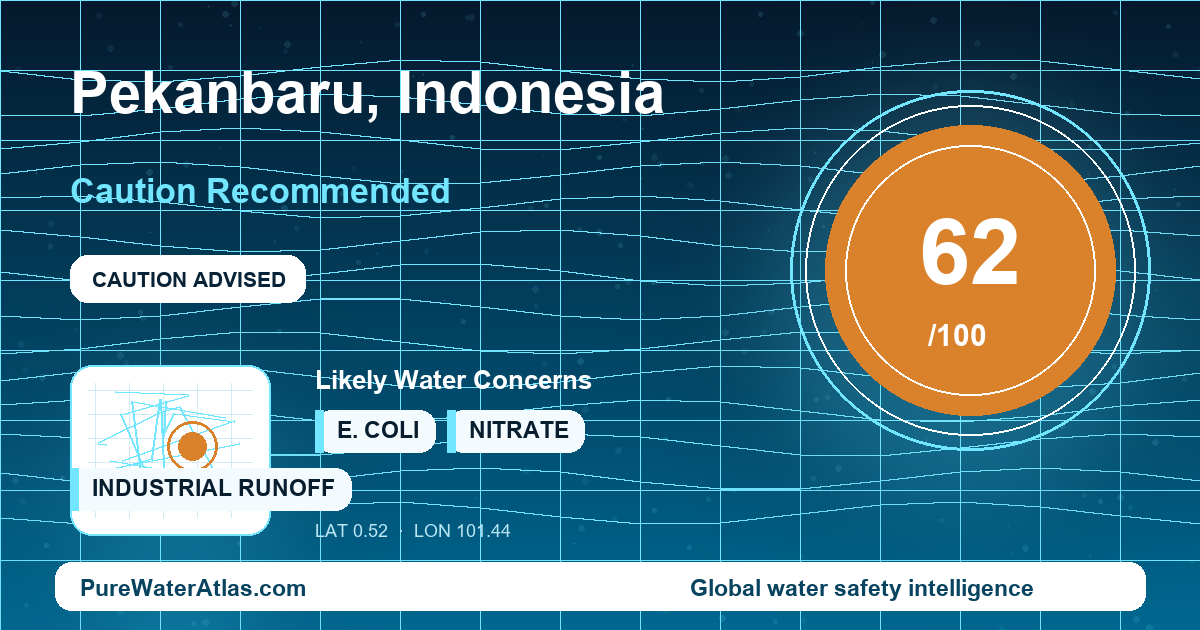
Pekanbaru, Indonesia: municipal water exists, but untreated tap water should be treated before drinking because source-water, distribution, storage, and public reporting limitations create real safety uncertainty.
Quick Answer
| Overall safety status | Caution recommended. Pekanbaru has a formal treated piped-water system, but public consumer-facing water quality reporting is limited, coverage is not universal, and building-level storage or plumbing can affect safety. |
|---|---|
| Water safety score | 62 / 100 — Risk level: Caution Recommended |
| Can tourists drink the tap water? | No for ordinary travelers. Do not drink untreated tap water unless it has been boiled, reliably filtered, or clearly verified as potable by the hotel or facility. |
| Resident advice | Residents using Perumda Tirta Siak water should consider point-of-use treatment and maintain tanks, dispensers, and internal plumbing. Well and refill-depot water need closer verification. |
| Main local water source | The municipal SPAM system is associated with Perumda Air Minum Tirta Siak, with the Siak River identified in local water-sector context as the central surface-water source for Pekanbaru. |
| Water authority | Perumda Air Minum Tirta Siak Pekanbaru, with public-health oversight involving local health authorities and Indonesian Ministry of Health standards. |
| Filter recommendation | Often advisable: sediment prefilter plus activated carbon, followed by UV disinfection or a properly maintained reverse-osmosis system if drinking directly. Wells should be tested before choosing treatment. |
Why Pekanbaru Is Different
Pekanbaru is a lowland inland city in Riau Province on Sumatra, located along the Siak River. That setting matters for drinking water safety. The surrounding region includes peatland and plantation landscapes, which can contribute naturally colored, acidic, organic-rich runoff to rivers and shallow groundwater. This does not mean every tap is unsafe, but it does mean the raw-water source can be challenging and treatment must manage color, organic matter, turbidity, and microbial risk before water reaches customers.
The city is also not a single-water-source experience for many people. In Pekanbaru, a visitor may use piped utility water in a hotel bathroom, drink dispenser gallon water in the lobby, encounter refill-depot water in a guesthouse, and see well water used in peri-urban areas. For residents, the practical safety question is often not simply “is Pekanbaru water treated?” but “what source supplies this building, how is it stored, and has the final drinking water been verified?”
PureWaterAtlas rates Pekanbaru as Caution Recommended because official institutions and infrastructure exist, but a recent, easy-to-access consumer-style annual water quality report with routine finished-water and distribution-zone results was not identified in the reviewed public sources. Conditions can differ sharply between Perumda piped water, private wells, refill-water depots, hotel tanks, and individual building plumbing.
Where Does Pekanbaru’s Tap Water Come From?
Pekanbaru’s municipal supply is associated with the SPAM, or piped drinking-water system, operated by Perumda Air Minum Tirta Siak. The Siak River is identified in the local water-sector context as the central surface-water source for the city. Pekanbaru developed on the banks of the Siak River, and the river has long been important for settlement, transport, and water supply.
The key infrastructure includes the Perumda Air Minum Tirta Siak municipal piped-water distribution network, surface-water intakes, and water treatment plants locally known as IPA, or instalasi pengolahan air, within the Pekanbaru SPAM system. After central treatment, water may move through distribution pipes and then into household or building-level storage tanks. In Indonesian urban systems where pressure or continuity may vary, roof tanks, ground tanks, pumps, and dispenser reservoirs can become important final risk points.
Not all households or buildings should be assumed to rely fully on piped utility water. In areas without reliable piped service, people may use shallow groundwater, private wells, boreholes, rainwater storage, delivered water, bottled water, or refill drinking-water depots known as depot air minum isi ulang. These alternatives vary greatly in quality. They should not be treated as automatically safe without proper treatment, hygienic handling, or testing.
Who Manages Drinking Water in Pekanbaru?
The local municipal water company is Perumda Air Minum Tirta Siak Pekanbaru. Its role is central for piped-water service, customer information, and SPAM operations. Local public-health oversight involves Dinas Kesehatan Kota Pekanbaru, while national water-quality health requirements are set by the Indonesian Ministry of Health.
The relevant national regulation is Permenkes No. 2 Tahun 2023, which covers environmental health and drinking-water quality requirements in Indonesia. This regulatory framework is important, but it is not the same as a building-level guarantee that water from every tap, tank, depot, or well in Pekanbaru is drinkable at the point of use.
Source-water and river-basin context also involves public works and environmental agencies, including Balai Wilayah Sungai Sumatera III, Kementerian PUPR and Dinas Lingkungan Hidup dan Kehutanan Provinsi Riau. Citywide statistics and public-service context may be checked through Badan Pusat Statistik Kota Pekanbaru and the Pemerintah Kota Pekanbaru portal.
Main Local Water Concerns
The most important health concern for untreated tap water, wells, tanks, and refill water in Pekanbaru is microbial risk. Water can become unsafe if it is not properly disinfected, if storage tanks are dirty, if hoses and dispensers are unhygienic, or if wells are affected by surface contamination. For this reason, E. coli and total coliform testing are especially relevant for wells and stored drinking water.
Turbidity is another practical issue. Heavy rain, river disturbance, runoff, and distribution-network work can increase suspended particles and visible cloudiness. High turbidity can interfere with disinfection and can indicate that additional filtration or operational attention is needed. Residents seeing deposits in tanks, pipes, or filters should also understand sediment as a separate water-quality issue.
Pekanbaru’s Riau setting also raises concerns about high natural color and dissolved organic matter associated with peat-influenced source water. Peatland runoff can be acidic and organic-rich, creating taste, color, pH, and treatment-control challenges. Some groundwater supplies may also show iron or manganese staining and taste issues, especially in private wells. See PureWaterAtlas guides to iron and manganese for treatment context.
Seasonally, heavy rain can increase river turbidity, runoff, drain overflow, and flood-related contamination of wells or tanks. Flooded shallow wells should be disinfected and tested before being used for drinking. During dry periods, lower flows can concentrate pollutants and increase taste, odor, color, or salinity-related stress in parts of river systems, although salinity is not the primary documented citywide drinking-water concern for central Pekanbaru.
For Travelers
Tourists should not drink untreated tap water in Pekanbaru. Use sealed bottled water, reputable filtered water, or water that has been properly boiled. This is especially important for short-stay travelers, who may be more vulnerable to stomach illness from unfamiliar microbes or from water that has passed through poorly maintained tanks or dispensers.
For brushing teeth, bottled or filtered water is the safer choice if you are a short-stay visitor, pregnant, immunocompromised, traveling with young children, or prone to stomach illness. In better hotels, some travelers may use tap water for rinsing, but bathroom tap water should not be assumed to be drinking water.
Use ice only in reputable restaurants, hotels, or cafes where it is commercially produced or made from treated water. Avoid uncertain street-vendor ice, shaved ice, or drinks mixed with unknown water if you have a sensitive stomach. Better hotels and restaurants usually provide bottled water, dispenser water, or boiled water for drinking, but you should still check whether the kettle, dispenser tap, and refill containers look clean.
For conservative travel-health practice in Indonesia, the CDC Travelers’ Health Indonesia page supports careful food and water precautions. For emergency or practical treatment, see the PureWaterAtlas guide to boiling water purification.
For Residents
Residents using Perumda Air Minum Tirta Siak water should consider point-of-use treatment if drinking directly. A practical household setup is a washable sediment prefilter followed by activated carbon, then a final disinfection barrier such as UV or a properly maintained reverse-osmosis system. UV can be effective as a final microbial barrier only when turbidity is controlled first; see UV Water Purification: Complete Guide for details.
For private wells or boreholes, do not choose a filter only by taste or appearance. Test first for E. coli or total coliform, pH, turbidity, TDS or conductivity, nitrate, nitrite, iron, manganese, hardness, and basic odor or color indicators. If infants, pregnant people, elderly residents, or immunocompromised people live in the home, prioritize microbial testing and consider a certified final barrier such as UV or boiling for drinking water. The PureWaterAtlas article on nitrate testing and detection is especially relevant for private wells and peri-urban households.
Older buildings and renovated shop-house style properties may have unknown internal plumbing, galvanized pipes, corroded fittings, or stagnant pipe sections. Even if water leaves the treatment plant in acceptable condition, building plumbing can change taste, turbidity, and metal levels. If a building is old, has metal pipes, brass fittings, solder, or unexplained metallic taste, test first-draw and flushed samples for lead and other metals. See also Lead in Drinking Water: Testing and Detection Methods.
Storage tanks are a major practical risk point in Pekanbaru. Roof tanks, ground tanks, and dispenser reservoirs should be covered, screened from insects and animals, cleaned on a schedule, and disinfected after flooding, construction, or visible sediment. A dirty tank can recontaminate treated water after it has left the utility system.
Relevant Contaminants and Water-Quality Issues
The most relevant PureWaterAtlas contaminant and issue profiles for Pekanbaru are Turbidity, Sediment, E. coli, Chlorine, Iron, Manganese, and Lead. These topics match the city’s documented risk pattern: river-source treatment challenges, rain-related turbidity, microbial uncertainty in tanks and wells, disinfection management, groundwater staining, and old-building plumbing risk.
For a broader safety framework, read Drinking Water Safety: How to Know if Your Tap Water Is Safe to Drink, Water Microbiology, and Water Treatment Systems.
How to Verify Your Water Quality
Because Pekanbaru does not have a reviewed, easily accessible consumer-style report proving routine safety at every tap, verification should focus on the specific water you actually drink. Ask whether your building uses Perumda piped water, a well, a tank, a refill depot, bottled gallons, or a combination. Then test or treat according to that source.
For structured testing decisions, use How to Test Drinking Water: Complete Guide to Water Testing and Analysis. To compare Pekanbaru’s risk profile with other destinations, use the Global Water Quality Checker. If you receive a lab report and need to understand the parameters, search the PureWaterAtlas Contaminants Search Engine.
For residents, testing is most important after flooding, well repair, new pump installation, long non-use, unexplained taste or odor changes, visible turbidity, tank contamination, or when vulnerable household members rely on the water. For refill-depot water, verify hygienic handling, sealed or clean containers, and current local inspection documentation where available.
Official and Technical Sources
- Perumda Air Minum Tirta Siak Pekanbaru — local municipal water utility for Pekanbaru piped-water service and SPAM operations.
- Badan Pusat Statistik Kota Pekanbaru — official statistics agency for city context and public-service indicators.
- Pemerintah Kota Pekanbaru — official city government portal.
- Kementerian Kesehatan Republik Indonesia, Permenkes No. 2 Tahun 2023 — national drinking-water and environmental-health requirements.
- CDC Travelers’ Health, Indonesia — travel-health guidance supporting conservative food and water precautions.
- Balai Wilayah Sungai Sumatera III, Kementerian PUPR — river-basin and water-resources context.
- Dinas Lingkungan Hidup dan Kehutanan Provinsi Riau — provincial environmental monitoring and river-pollution context.
- World Health Organization, Guidelines for Drinking-water Quality — global evidence base for microbial, chemical, and operational drinking-water risk management.
Bottom Line
Pekanbaru has a real municipal water system operated by Perumda Air Minum Tirta Siak, and the Siak River is the central surface-water source in the local water-supply context. However, untreated tap water is not recommended for tourists, and residents should not assume every tap, tank, well, or refill container is safe without verification. The city’s lowland Riau setting brings peat-influenced color, organic matter, turbidity, and microbial-risk concerns, while building storage tanks and private wells can create additional point-of-use risks. Use bottled, boiled, or reliably filtered water for drinking. Residents should maintain tanks, test wells, and use treatment matched to the actual source.
Read the full guide: Global Water Quality Guide
Explore more in this category: Global Water Quality Articles