
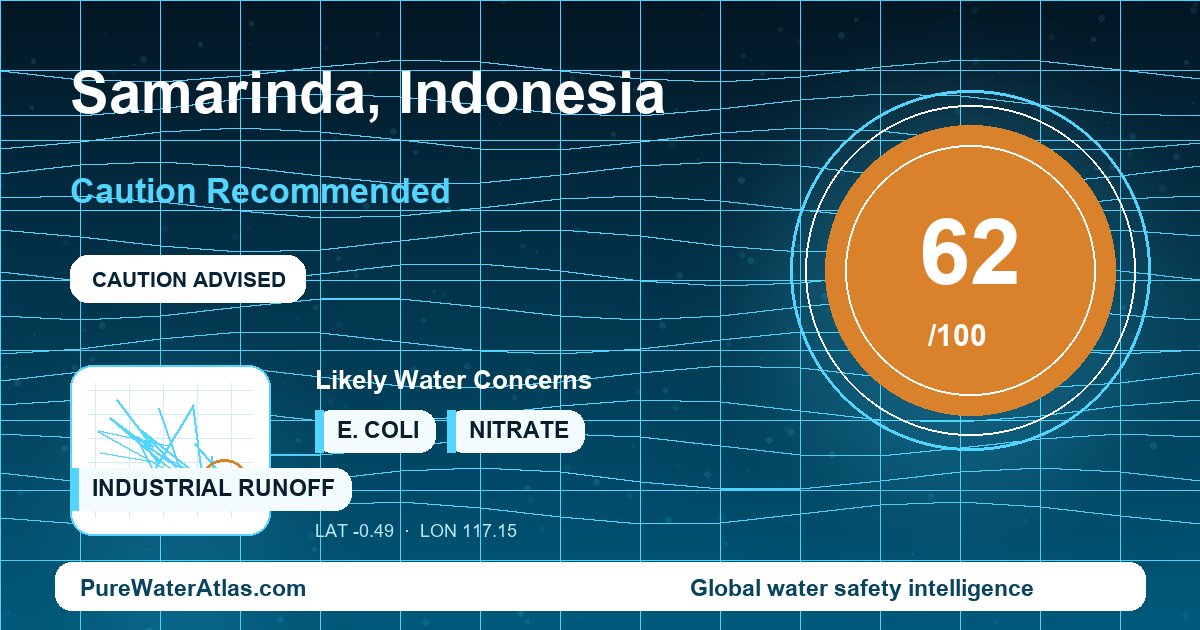
Samarinda, East Kalimantan: a Mahakam River surface-water city where treated municipal water exists, but visitors and households should use caution because local finished-water data is limited and river, flood, storage, and distribution risks matter.
Quick Answer
| Overall tap water status | Caution recommended. Samarinda has an organized municipal water utility and treated piped water, but untreated tap water is not the best default choice for drinking, especially for visitors. |
|---|---|
| Water safety score | 62 / 100 — treated utility supply is present, but public neighborhood-level finished-water results are not consistently easy to verify. |
| Risk level | Caution Recommended |
| Traveler advice | Do not rely on untreated tap water for drinking. Use sealed bottled water, reputable refill-gallon water, or water that has been boiled or properly filtered and disinfected. |
| Resident advice | Perumdam Tirta Kencana customers can generally regard the supply as treated utility water, but should manage risks from outages, storage tanks, sediment, flooding, and private plumbing. |
| Main raw-water identity | Samarinda is primarily a surface-water city associated with the Mahakam River system, with local references also involving Karang Mumus and Lempake or Benanga catchment context in some service areas. |
| Water authority | Perumdam Tirta Kencana Kota Samarinda, formerly commonly referred to as PDAM Tirta Kencana. |
| Filter recommendation | For treated municipal water with sediment or taste issues, consider a sediment prefilter plus activated carbon. Add boiling or UV when microbial risk is suspected after outages, flooding, or tank contamination. Test first for wells, salinity, metals, nitrate, or industrial concerns. |
Why Samarinda Is Different
Samarinda is not a city whose drinking-water profile can be understood only by asking whether a treatment plant exists. It sits directly on the Mahakam River in East Kalimantan, and the city’s water reality is shaped by river hydraulics, heavy rainfall, lowland drainage, urban runoff, flood exposure, and household storage practices. The municipal supply is treated, but the local risk picture starts with surface water rather than a protected mountain spring or deep confined aquifer.
The Mahakam basin is a major economic and transport corridor, and Samarinda’s urban settlement pattern is closely tied to the Mahakam and Karang Mumus river corridors. That does not prove that treated tap water at the consumer tap is unsafe, but it does mean raw-water protection, treatment performance, pipe integrity, and household handling are all important. Rainfall can raise turbidity and color in the raw water. Flooding can threaten shallow wells, ground tanks, and low-lying plumbing. Low-pressure periods and pipe work can disturb sediment or create intrusion risk. These are practical, city-specific issues that affect how Samarinda residents and visitors should use tap water.
The most accurate verdict is therefore cautious rather than absolute. Samarinda has a formal municipal water company and treated piped-water infrastructure, but recent public data showing finished-water compliance by treatment plant, service zone, month, residual chlorine, turbidity, E. coli, metals, PFAS, or salinity is not consistently available in a single public, traveler-friendly dashboard. PureWaterAtlas therefore does not claim that every tap in Samarinda is either safe or unsafe. The safer approach is to recognize the treated utility system while managing the local risk pathways.
Where Does Samarinda’s Tap Water Come From?
Samarinda is primarily a surface-water city. The municipal drinking-water system is associated mainly with the Mahakam River system, while some service-area and operational references also involve local rivers or reservoirs such as the Karang Mumus and Lempake or Benanga catchment context. Because service zones can differ, customers should verify their exact supply area with the utility when they need source-specific information.
The city’s key drinking-water infrastructure includes the Perumdam Tirta Kencana Kota Samarinda municipal network, river and surface-water intakes, water treatment plants locally referred to as IPA, distribution reservoirs, pumping stations, and pressurized pipe networks on both sides of the Mahakam River. After water leaves the utility system, many households also use roof tanks, ground tanks, gallon dispensers, and private pumps to manage pressure or interruptions. Those household components can be just as important as the treatment plant when judging the water that actually reaches a glass.
Samarinda’s older and continuing development as a river city means water supply, drainage, sanitation, flood control, and raw-water protection are linked. During rainy periods, storm runoff can increase turbidity, organic matter, color, and microbial loading in river raw water. During flood periods, wells and ground-level tanks can be exposed to contamination. During dry or low-flow periods, pollutants may be more concentrated, and salinity or taste complaints may become more relevant in river-influenced systems depending on intake location and operating conditions.
Who Manages Drinking Water in Samarinda?
The local municipal drinking-water company is Perumdam Tirta Kencana Kota Samarinda, formerly commonly referred to as PDAM Tirta Kencana. It is responsible for piped-water service, treatment and distribution operations, customer information, and service-related announcements in Samarinda. For citywide governance context, the Samarinda City Government portal is also relevant, while local statistics and infrastructure context can be checked through BPS Kota Samarinda publications.
Indonesian drinking-water quality is governed nationally by Ministry of Health standards, including Permenkes No. 2 Tahun 2023, which sets environmental health and drinking-water requirements. Local surveillance and consumer protection involve the municipal utility, health authorities, and relevant city or provincial agencies. River-basin and water-resources context is also connected to Indonesian water authorities such as Balai Wilayah Sungai Kalimantan IV, while national river-water and pollution-control context is addressed by the Ministry of Environment and Forestry water pollution control portal.
The important limitation for consumers is transparency at the tap level. Samarinda has identifiable institutions and a known surface-water setting, but routine public finished-water data for every treatment plant, neighborhood, and month is not consistently easy to verify. Residents who need certainty for a baby, an immunocompromised person, a private well, a refill-water business, or a building with old plumbing should use targeted testing rather than relying only on citywide assumptions.
Main Local Water Concerns
The main Samarinda-specific concerns are tied to river water, floods, distribution conditions, and household storage. High turbidity and sediment can occur after heavy rain or river disturbance. Consumers may notice brown, muddy, cloudy, or particle-laden water after storms, service interruptions, repairs, or pressure changes. When water suddenly changes appearance, taste, or odor, it should not be used untreated for drinking until the cause is understood and the water is flushed or treated appropriately.
Microbial risk is another practical concern. Treated municipal water should include disinfection barriers, but risk can rise when water is stored in dirty tanks, when pressure drops, when pipes are repaired, or when floodwater contaminates wells and ground-level systems. Untreated private wells, uncertain refill water, and household tanks that are not cleaned or protected can carry risk even if the original source looked clear.
Samarinda also has aesthetic and chemistry concerns that may matter in specific homes. Iron and manganese can contribute to staining, black or brown particles, or metallic taste in some groundwater or distribution contexts. Private wells or mixed sources may need checks for nitrate, ammonia, pH, conductivity or TDS, chloride, iron, manganese, and microbial indicators. In homes near workshops, fuel handling, industrial activity, dumps, or heavily urban drains, broader testing such as hydrocarbons, VOC screening, or metals may be appropriate through an accredited laboratory.
The lower Mahakam system may also face dry-season or tidal salinity influence during low-flow periods depending on intake location and operations. If tap water becomes noticeably salty or has a sudden unusual taste, households should seek utility updates and avoid using it for sensitive uses until it is clarified.
For Travelers
Short-term visitors to Samarinda should not rely on untreated tap water for drinking. The safer routine is sealed bottled water, reputable gallon-refill water, or water that has been boiled vigorously and stored in a clean covered container. This is especially important for travelers with sensitive stomachs, children, pregnant travelers, older adults, and immunocompromised visitors.
For brushing teeth, many healthy travelers staying in reliable hotels can usually use tap water if they avoid swallowing it, but cautious travelers should use bottled or boiled water. Be more conservative during flooding, after outages, or when tap water is cloudy, brown, salty, muddy, or has an unusual odor. If a hotel provides drinking water, ask whether it is sealed bottled water, a maintained dispenser, or treated by filtration, UV, reverse osmosis, or another disinfection process.
Ice should be treated with caution. Ice in established hotels, malls, and reputable restaurants is more likely to be made from treated or commercial water, but uncertain ice from street stalls or informal vendors is avoidable if you are reducing gastrointestinal risk. Hot beverages are lower risk when served steaming hot. General Indonesia travel health guidance from the U.S. Centers for Disease Control and Prevention also supports using food and water precautions while traveling.
For Residents
Residents connected to Perumdam Tirta Kencana can generally treat the supply as a treated utility supply, but the safety of water at the tap depends on what happens after treatment. Low pressure, pipe breaks, intermittent service, sediment resuspension, old internal plumbing, and poorly maintained household tanks can all affect quality. If service has been interrupted, flush taps before use and consider boiling or UV disinfection if microbial safety is uncertain.
A home filter can be practical in many Samarinda households, but it should match the problem. For treated municipal water with sediment, discoloration, or chlorine taste, a sediment prefilter plus activated carbon can improve clarity and taste. If microbial risk is suspected after outages, floods, or tank contamination, use boiling or a properly maintained UV system in addition to particle filtration. PureWaterAtlas has practical guides to boiling water purification and UV water purification.
For private wells, mixed sources, refill businesses, or water with salinity, metals, nitrate, or industrial concerns, testing should come before treatment selection. Reverse osmosis may be useful for some dissolved contaminants, but it should not be chosen blindly. If the concern is nitrate for infants, use a laboratory result and see PureWaterAtlas guidance on nitrate testing and detection.
Older buildings in Samarinda should not be assumed to have a citywide lead problem, but internal plumbing can still matter. Corroded galvanized pipe, brass fittings, solder, sediment buildup, imported fixtures, and rooftop tanks can degrade water quality. If metals or corrosion are suspected, test both first-draw and flushed samples. A targeted guide is available here: lead in drinking water: testing and detection methods.
Storage tanks are a major control point. Roof tanks, ground tanks, and dispensers should be covered, screened from insects and rodents, protected from floodwater, cleaned periodically, and disinfected after contamination. A clean municipal supply can become unsafe if stored in a dirty or exposed tank.
Relevant Contaminants and Water-Quality Issues
For Samarinda, the most relevant water-quality issue is often not a single named contaminant but a chain of river-source and post-treatment risks. Turbidity in drinking water is important because rainy-season raw water can become cloudy and particle-rich. Related sediment can show up after pipe disturbances, tank problems, or changes in pressure.
Microbial safety should be managed carefully because flood exposure, private wells, and dirty storage tanks can create contamination pathways. Learn more about E. coli in drinking water and the broader PureWaterAtlas guide to water microbiology. For piped municipal water, chlorine is relevant because residual disinfectant is a key protection in distribution systems, particularly where low pressure or long pipe networks are involved.
Aesthetic complaints such as staining, metallic taste, or dark particles may involve iron or manganese. Private wells and sanitation-affected groundwater should also be checked for nitrate, especially where infants, pregnant residents, or vulnerable people are present.
How to Verify Your Water Quality
The best way to verify Samarinda tap water is to combine official utility information with site-specific testing. Start with Perumdam Tirta Kencana service notices and customer information, especially after outages, repairs, flooding, or unusual taste and color events. If your household experiences repeated stomach illness, visible brown water, cloudy water, strong odor, or unexpected salinity, do not rely on appearance alone.
For municipal tap water, useful tests include total coliform, E. coli, turbidity, residual chlorine, iron, manganese, color, and basic chemistry. For wells or mixed sources, add nitrate, ammonia, pH, conductivity or TDS, chloride, iron, manganese, and arsenic where local advice or groundwater conditions suggest concern. Near workshops, fuel handling, industrial activity, dumps, or heavily urban drains, ask an accredited laboratory about hydrocarbons, VOC screening, and broader metals testing.
PureWaterAtlas resources that can help include the complete guide to water testing, the drinking water safety framework, the water purification methods guide, the Global Water Quality Checker, and the Contaminants Search Engine. These tools are especially useful in Samarinda because public finished-water data is not always available in a single, easy-to-interpret local dashboard.
Official and Technical Sources
- Perumdam Tirta Kencana Kota Samarinda official website — local water utility source for service notices, company identity, and customer information.
- Samarinda City Government official portal — official city context for governance, public services, and local announcements.
- BPS Kota Samarinda publications — local statistics source for city geography, population, infrastructure, and development context.
- Permenkes No. 2 Tahun 2023 — Indonesian national regulatory reference for drinking-water and environmental health quality requirements.
- CDC Indonesia travel health information — traveler food and water precaution guidance.
- WHO Guidelines for Drinking-water Quality — international reference for microbial safety, disinfection, turbidity, and contaminant risk management.
- Balai Wilayah Sungai Kalimantan IV — official water-resources authority context for East Kalimantan river-basin management.
- Ministry of Environment and Forestry water pollution control portal — Indonesian national context for river-water quality, pollution control, and watershed management.
Bottom Line
Samarinda’s tap water should be approached with caution, not panic. The city has a formal treated municipal supply managed by Perumdam Tirta Kencana, and its water system is closely tied to the Mahakam River and local surface-water infrastructure. The main risks for consumers are not limited to treatment plants: rainy-season turbidity, flooding, urban runoff, low-pressure events, pipe disturbances, household tanks, private wells, and possible dry-season salinity stress can all affect real-world water quality. Visitors should use bottled, reputable refill, boiled, or properly treated water for drinking. Residents should maintain storage tanks, flush after interruptions, use suitable filtration where needed, and test wells or problem taps rather than relying on taste or appearance.
Read the full guide: Global Water Quality Guide
Explore more in this category: Global Water Quality Articles