
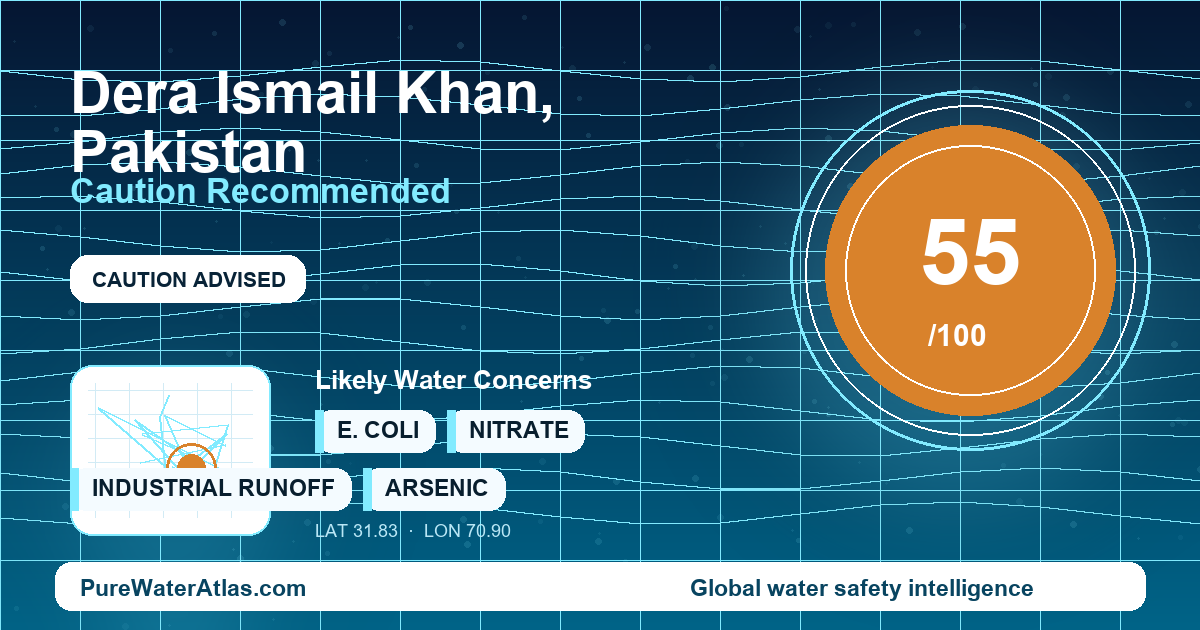
Dera Ismail Khan, Pakistan: groundwater-based urban supply, intermittent distribution risks, household storage concerns, and practical tap-water guidance for visitors and residents.
Quick Answer
| Water safety score | 55 / 100 |
|---|---|
| Overall status | Caution recommended. Do not assume Dera Ismail Khan tap water is consistently safe at the point of use. |
| Traveler advice | Visitors should avoid untreated tap water. Use sealed bottled water, boiled water, or properly filtered and disinfected water. |
| Resident advice | Do not rely on taste or clarity. Test water at the tap, clean storage tanks, and use treatment matched to confirmed risks. |
| Main water source | Primarily groundwater from municipal tube wells and boreholes, with household-level private boreholes, hand pumps, wells, and stored water also used in the wider district. |
| Responsible institutions | Urban water services are associated with Tehsil Municipal Administration Dera Ismail Khan, with the Public Health Engineering Department Khyber Pakhtunkhwa involved in public water-supply schemes. |
| Filter recommendation | Use testing first. Sediment filtration plus UV or chlorination can reduce microbial risk where water is clear enough. Reverse osmosis may be appropriate only where tests confirm high TDS, salinity, nitrate, arsenic, or other dissolved contaminants. |
The practical answer is different for tourists and residents. Tourists should treat Dera Ismail Khan tap water as unsafe unless it has been reliably treated. Residents can often reduce risk through source testing, tank hygiene, disinfection, and properly selected filtration, but the best solution depends on building plumbing, storage conditions, and local groundwater chemistry.
Why Dera Ismail Khan Is Different
Dera Ismail Khan is in southern Khyber Pakhtunkhwa on the Indus alluvial plain, near the Indus River and the Chashma Right Bank Canal command area. That geography matters for drinking water because the city’s supply is best understood as a groundwater-based system rather than a fully treated surface-water system. The nearby Indus and canal network are major hydrologic and irrigation features, but available public information does not support saying that fully treated Indus surface water is the dominant direct source of city tap water.
This makes Dera Ismail Khan a city where water safety can vary strongly by source, building, and handling practice. One household may receive municipal tube-well water stored in a clean covered tank, while another may rely on a private borehole, hand pump, underground tank, rooftop tank, or cooler that is not regularly disinfected. A hotel with a maintained filtration and disinfection system may provide safer water than a private building with an unclean storage tank. At the same time, clear-looking groundwater can still contain bacteria, nitrate, salinity, arsenic, iron, manganese, or other dissolved substances that cannot be judged by appearance.
The city’s hot, semi-arid setting also increases the importance of storage. When supply is intermittent or demand is high, water may sit in rooftop or underground tanks long enough for disinfectant residual to decline and microbial regrowth to become more likely. For that reason, the point of use—the actual tap, cooler, or bottle being served—matters as much as the municipal source.
Where Does Dera Ismail Khan’s Tap Water Come From?
Dera Ismail Khan’s urban drinking-water supply is best characterized as a groundwater system using municipal tube wells or boreholes that pump water into reservoirs, overhead tanks, and piped distribution. In the wider district, households may also use private boreholes, hand pumps, shallow wells, or stored water. This pattern is consistent with the city’s location on the Indus alluvial plain, where groundwater has historically been a practical local source.
The city’s water pathway typically involves several risk points: tube wells or boreholes, electricity-dependent pumping cycles, ground-level reservoirs, overhead storage tanks, municipal distribution lines, and then building-level tanks or coolers. The main concern is not only the raw groundwater; it is the delivery pathway between the source and the glass. Intermittent supply can create low-pressure conditions in pipes, and low pressure can allow contaminated water to enter through leaks, especially where drains, sewers, or wastewater are nearby.
Dera Ismail Khan has long depended on local water sources in a hot environment. Modern supply has expanded through tube-well schemes, reservoirs, overhead tanks, and piped distribution, but many buildings still store water on-site because of pumping schedules, summer demand, or interruptions. This makes storage-tank hygiene a central part of household water safety.
Who Manages Drinking Water in Dera Ismail Khan?
Urban water services in Dera Ismail Khan are associated with the Tehsil Municipal Administration under the Khyber Pakhtunkhwa local government system. The Public Health Engineering Department Khyber Pakhtunkhwa is also relevant because it is involved in planning and implementing public water-supply schemes. Provincial and national bodies, including Khyber Pakhtunkhwa environmental and health authorities and the Pakistan Council of Research in Water Resources, are important for monitoring, standards, and water-quality evidence.
Pakistan uses National Standards for Drinking Water Quality and WHO-aligned public-health principles. However, unlike some countries where each water utility publishes a regularly updated consumer confidence report, a recent, easily accessible, citywide tap-water compliance report for Dera Ismail Khan is not readily available. That limitation is important. PureWaterAtlas does not claim that all municipal tap water in the city is unsafe, and it also does not claim that all tap water is consistently safe. The evidence supports a caution-based approach, especially for visitors, children, pregnant people, elderly people, and immunocompromised residents.
Main Local Water Concerns
- Microbial contamination: The leading concern is bacteria or other pathogens entering water through intermittent supply, leaking pipes, sewer proximity, shallow sources, poor tank hygiene, or unclean coolers. This is the most immediate reason tourists should avoid untreated tap water.
- Turbidity and sediment: Monsoon rain, flooding, line repairs, pumping changes, or tank disturbance can increase visible particles. Turbid water can also interfere with UV disinfection and may protect microbes from treatment.
- High TDS, salinity, and hardness: Some groundwater sources in arid-zone and irrigation-influenced settings may have elevated dissolved minerals, salty taste, hardness, or unpleasant taste. These are not solved by boiling.
- Nitrate: Shallow groundwater or peri-urban areas affected by septic systems, livestock, fertilizer, wastewater infiltration, or agriculture may have nitrate risk. This is especially important for infants.
- Arsenic and trace metals: Because Dera Ismail Khan sits within the broader Indus-basin groundwater environment, arsenic should be treated as a testing priority. The available dataset does not support claiming uniform citywide arsenic contamination.
- Iron and manganese: Some borehole supplies may show staining or taste issues, although citywide occurrence is not well documented publicly.
- Residual chlorine uncertainty: Chlorine protection may be absent or inconsistent at household taps if chlorination, contact time, or distribution integrity is weak, especially after storage.
Season also matters. Monsoon conditions can increase runoff contamination, turbidity, drain overflows, and flood-related microbial risk. Hot summers increase water demand and storage time, which can worsen taste, chlorine loss, and microbial regrowth. Power interruptions or pumping limitations can make supply intermittent and increase intrusion risk through pressure drops.
For Travelers
Visitors should not drink untreated tap water in Dera Ismail Khan. The safest routine is to use sealed bottled water from reliable shops or water that has been boiled, properly filtered, or UV treated. Keep bottles sealed until use and check that the seal is intact. In hot weather, carry oral rehydration salts and plan for higher water intake.
For brushing teeth, use bottled, boiled, or properly filtered water if you are a short-term visitor, immunocompromised, pregnant, traveling with children, or staying in a building where tank hygiene is unknown. Avoid swallowing water in the shower if you are particularly sensitive to gastrointestinal illness.
Ice is a common avoidable exposure route. Avoid ice unless you know it was made from treated or bottled water. Be especially cautious with ice from street vendors, roadside drink stalls, open coolers, and drinks mixed with local water. In restaurants, hot tea and fully boiled beverages are generally safer than cold drinks mixed with unverified water or ice.
In hotels, ask direct questions: Is the drinking water bottled, RO filtered, UV treated, or boiled? Are filters maintained? Are bottles opened in front of guests? If the answer is unclear, choose sealed bottled water. Boiling is reliable for bacteria, viruses, and protozoa, but it does not remove salinity, nitrate, arsenic, metals, or chemical contamination.
For broader travel context, see the CDC Travelers’ Health guidance for Pakistan and PureWaterAtlas guidance on boiling water purification.
For Residents
Residents in Dera Ismail Khan should manage water safety at the household level, not just at the municipal-source level. The correct treatment system depends on test results. At minimum, households using municipal supply with storage tanks should focus on safe storage, regular tank cleaning, and disinfection. A dirty rooftop tank or underground tank can make otherwise acceptable source water unsafe by the time it reaches the tap.
If microbial risk is the main concern, a sediment prefilter followed by UV treatment or proper chlorination can help, provided the system is maintained and the water is clear enough for disinfection to work. If testing confirms high TDS, salinity, nitrate, arsenic, or certain metals, reverse osmosis or another certified contaminant-specific system may be needed. Reverse osmosis should not be chosen simply because water tastes unusual; it is most appropriate when dissolved contaminants are confirmed.
Testing should be done at the point of use, not only at the borehole, pump, or municipal source. Recommended household tests include E. coli or thermotolerant coliforms, total coliforms, turbidity, pH, electrical conductivity, TDS, residual chlorine, hardness, nitrate, and chloride. For private boreholes or groundwater sources, include arsenic, fluoride, iron, manganese, sulfate, and basic heavy metals where affordable. Retest after floods, sewer overflows, pipe repairs, new borehole installation, filter installation, or major changes in taste, odor, or appearance.
Older buildings need special attention. Corroded pipes, dead legs, low-pressure plumbing, contaminated underground tanks, brass fittings, solder, and older fixtures can add building-level risk. Lead is not proven as a citywide Dera Ismail Khan problem from public data, but older plumbing should be treated as a testing concern. Storage tanks should be covered, screened against insects and rodents, protected from sewage or drain backflow, cleaned regularly, and disinfected after cleaning or flooding.
Relevant Contaminants and Water-Quality Issues
The most important issue for everyday safety is microbial contamination, especially where supply is intermittent or storage tanks are poorly maintained. Learn more about E. coli in drinking water and why a clear glass of water can still be unsafe.
During monsoon periods, after flooding, or after pipe repairs, Dera Ismail Khan households should also watch for turbidity in drinking water and sediment in drinking water. Particles are not just an aesthetic issue; they can indicate disturbance and can reduce the effectiveness of UV treatment.
Groundwater users should consider chemical testing as well as microbial testing. Nitrate in drinking water is important for shallow or peri-urban sources influenced by septic systems, livestock, wastewater, or fertilizer. Arsenic in drinking water should be treated as a groundwater testing priority in the broader Indus-basin context, without assuming it is present everywhere in Dera Ismail Khan. Older buildings may also warrant fixture-level checks for lead in drinking water.
Disinfection is another local issue because chlorine residual may be inconsistent by the time water reaches household taps or tanks. PureWaterAtlas has a separate guide to chlorine in drinking water, including why chlorine can protect water but may decline during storage.
How to Verify Your Water Quality
The strongest way to know whether your Dera Ismail Khan water is safe is to test the water you actually drink. A municipal source test is useful, but it may not reflect contamination introduced by old service lines, rooftop tanks, underground tanks, coolers, or building plumbing. Use a certified or reputable laboratory where possible, especially for microbial indicators, nitrate, arsenic, and metals.
PureWaterAtlas resources that can help include the complete guide to water testing, the drinking water safety guide, the water microbiology guide, and the water treatment systems guide. For comparing city-level safety guidance, use the Global Water Quality Checker. To research individual contaminants, use the Contaminants Search Engine.
If nitrate or arsenic is confirmed, see PureWaterAtlas guides on nitrate testing, nitrate treatment options, and arsenic testing methods. For older plumbing concerns, see lead testing methods. For disinfection options, compare UV water purification with boiling and chlorination approaches.
Official and Technical Sources
- Pakistan Council of Research in Water Resources — national water-resources research and drinking-water quality monitoring context.
- Public Health Engineering Department Khyber Pakhtunkhwa — provincial department involved in public water-supply schemes.
- Local Government, Elections and Rural Development Department Khyber Pakhtunkhwa — provincial local-government context for urban services including water supply and sanitation.
- District Administration Dera Ismail Khan — official district context and local geography.
- Pakistan Environmental Protection Agency — national environmental standards and drinking-water policy context.
- WHO Guidelines for Drinking-water Quality — global public-health reference for microbial, chemical, and operational drinking-water risk management.
- WHO/UNICEF Joint Monitoring Programme data for Pakistan — national WASH service context, not a substitute for Dera Ismail Khan tap testing.
- Provincial Disaster Management Authority Khyber Pakhtunkhwa — relevant for monsoon, flood, and emergency conditions affecting water safety.
Data limitation: there is enough public information to identify Dera Ismail Khan’s likely groundwater-based supply model, local institutions, geography, and risk mechanisms. However, recent continuous tap-level compliance data for the city is not readily available in a consumer-report format. This profile therefore avoids neighborhood-level claims and exact contaminant concentrations.
Bottom Line
Dera Ismail Khan is a caution-recommended tap-water city. The urban supply is best understood as groundwater-based, using tube wells, reservoirs, overhead tanks, and piped distribution, with many households also depending on building-level storage or private sources. The main risks are microbial contamination from intermittent supply, leaking pipes, sewer proximity, and dirty tanks, plus possible groundwater chemistry concerns such as salinity, hardness, nitrate, arsenic, iron, or manganese in some sources. Tourists should use sealed bottled, boiled, or properly treated water and avoid unverified ice. Residents should test at the point of use, clean and disinfect tanks, and choose filtration only after identifying the actual contaminant problem.
Read the full guide: Global Water Quality Guide
Explore more in this category: Global Water Quality Articles