
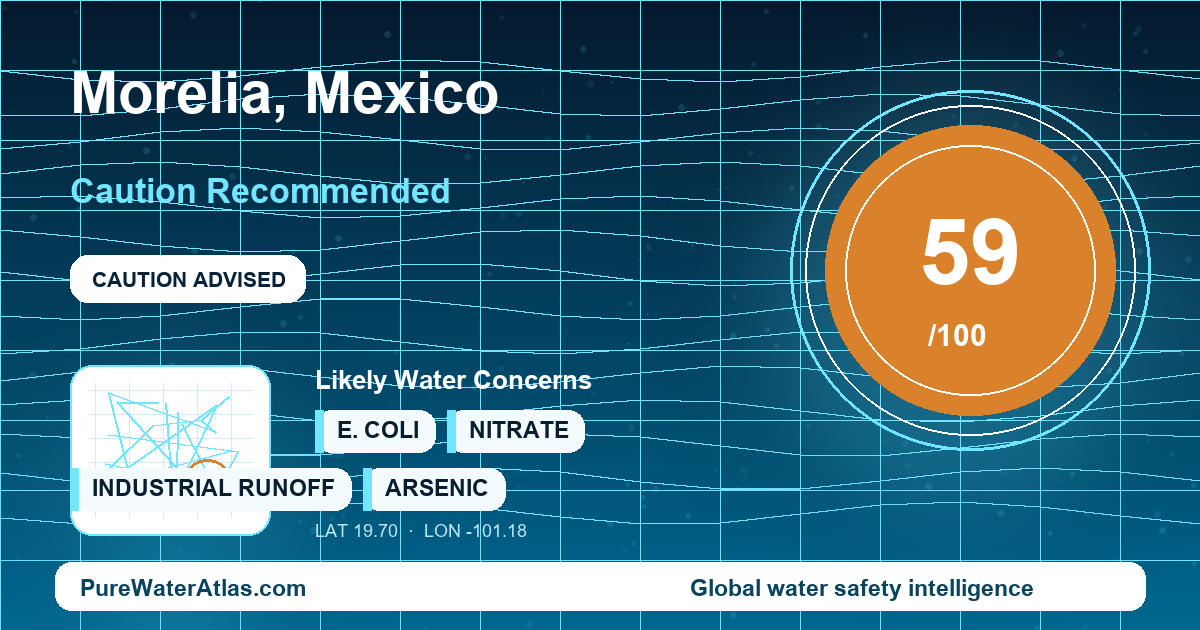
Morelia, Michoacán has a treated municipal water system, but drinking directly from the tap requires caution because local risk depends on mixed water sources, pressure interruptions, aging distribution lines, household cisterns, rooftop tinacos and limited public neighborhood-level testing transparency.
Quick Answer
| Overall safety status | Caution recommended. Morelia’s public supply is organized and treated, but tap water is better treated as utility water unless it is additionally filtered, disinfected or verified by recent testing. |
|---|---|
| Water safety score | 59 / 100 — Caution Recommended |
| Traveler advice | Short-term visitors should not rely on Morelia tap water as their main drinking water. Use sealed bottled water, reputable garrafón water or water treated by a reliable hotel or restaurant system. |
| Resident advice | Residents should focus on point-of-use safety: sediment filtration, activated carbon and either UV disinfection or reverse osmosis depending on test results and household conditions. |
| Main water sources | A mixed system using municipal groundwater wells, spring water including La Mintzita, and surface-water infrastructure associated with the Cointzio reservoir. |
| Water authority | Organismo Operador de Agua Potable, Alcantarillado y Saneamiento de Morelia, commonly known as OOAPAS Morelia. |
| Filter recommendation | A maintained sediment filter plus activated carbon is a practical baseline; add UV disinfection or reverse osmosis when microbial risk, dissolved solids, nitrate, metals or other test results justify it. |
Why Morelia Is Different
Morelia is not a city whose drinking-water picture can be explained by one simple source or one universal neighborhood result. It sits in the highland basin of central Michoacán, where the urban supply depends on a combination of groundwater, spring systems and nearby surface-water infrastructure rather than a single large imported-water source. That mixed-source identity matters because operating conditions, season, drought, maintenance work and local pressure patterns can influence what arrives at a specific building.
The practical risk in Morelia is not only about whether water is treated before entering the distribution system. It is also about what happens afterward. Intermittent pressure, leaks, pipe repairs, low residual chlorine, sediment movement, cisterns and rooftop tinacos can all affect water quality before the water reaches a kitchen tap. A household with a clean, covered and disinfected storage system may have a different risk profile than a nearby property with an old cistern, poorly sealed rooftop tank or aging internal plumbing.
Morelia also has a strong local water heritage. The city’s colonial aqueduct is an important historic symbol, but it should not be interpreted as the modern drinking-water delivery system. Current service depends on OOAPAS-operated wells, intakes, treatment, pumping, storage and distribution lines. Another distinctive feature is La Mintzita: not merely a scenic wetland, but an internationally recognized Ramsar wetland documented as an important freshwater system for Morelia. Source-area protection, urban growth and land-use pressure are therefore directly relevant to the city’s long-term drinking-water resilience.
Where Does Morelia’s Tap Water Come From?
Morelia uses a mixed raw-water system. The municipal supply includes groundwater wells in and around the urban area, spring water including the La Mintzita spring and wetland system, and surface-water infrastructure associated with the Cointzio reservoir. The relative contribution from these components can vary over time depending on operating conditions, the season, drought, pumping schedules and maintenance.
The city’s key water infrastructure includes the OOAPAS municipal water-supply and sewerage network, groundwater wells and well-field pumping infrastructure, La Mintzita as an important spring and wetland source area, the Cointzio reservoir and associated surface-water supply infrastructure, municipal storage tanks, pumping stations, sectorized distribution lines and household-level storage such as cisterns and rooftop tinacos.
This mix creates both resilience and variability. Groundwater can be important during dry periods, while spring and surface-water components may be more sensitive to runoff, turbidity and sediment during heavy rains. Dry-season or drought conditions can reduce spring or reservoir reliability and increase dependence on wells and pumping. During the rainy season, generally May to October, surface-influenced supply components can experience more runoff-related turbidity and sediment load. Heavy storms, pipe repairs and low-pressure events can also mobilize sediment in the distribution network.
Because publicly accessible, recent, neighborhood-level results are limited, it is not possible to say that every colonia in Morelia has the same tap-water quality at the same time. Conditions can vary by well sector, reservoir contribution, outages, building age, cistern maintenance and the time since the last pipe repair or flushing event.
Who Manages Drinking Water in Morelia?
Morelia’s municipal water and sewer service is operated by OOAPAS Morelia, the Organismo Operador de Agua Potable, Alcantarillado y Saneamiento de Morelia. The Gobierno de Morelia provides the broader municipal context for local public services, planning and infrastructure governance.
At the national level, drinking water for human use in Mexico is regulated under sanitary standards including NOM-127-SSA1-2021. Health surveillance and sanitary control roles involve federal and state health authorities, including COFEPRIS and local health services. CONAGUA is the federal authority for national water resources, aquifer availability and surface-water information, including groundwater availability materials relevant to Michoacán aquifers.
The important consumer takeaway is that a formal utility and regulatory framework exists, but the publicly available record does not consistently provide recent, easy-to-reuse, neighborhood-level tap results for microbial indicators, metals, residual chlorine and turbidity across the city. For drinking decisions, especially inside older buildings or homes with storage tanks, building-level testing remains important.
Main Local Water Concerns
The main drinking-water concerns in Morelia are practical and location-specific. The city’s mixed-source supply can make water quality variable by operating sector and season. Groundwater stress in the Morelia-Queréndaro aquifer region is a long-term supply concern documented by CONAGUA availability materials, while surface-water and reservoir inputs can be more vulnerable to turbidity and runoff during heavy rains.
La Mintzita is another local concern because it is hydrologically important for Morelia. The Ramsar listing for Manantiales de La Mintzita documents the wetland’s significance. Urbanization, land-use change and source-area protection therefore matter for both ecology and drinking-water resilience.
Inside the distribution system, aging pipes, pipe repairs and intermittent pressure can increase the chance of sediment movement or intrusion in parts of the network. Even if water leaves treatment with disinfectant, low residual chlorine, leaks, depressurization or repairs can change conditions before water reaches a building. At the property level, household cisterns and rooftop tinacos can become contamination points if they are not cleaned, tightly covered, screened and disinfected. In the historic center and older neighborhoods, internal plumbing may include older galvanized lines, fixtures or materials that justify lead and metals testing before using tap water for daily drinking.
For Travelers
Travelers should not use Morelia tap water as their routine direct drinking water. The safer choice for short stays is sealed bottled water, reputable garrafón water or water treated by a reliable hotel or restaurant system. This is especially important for children, pregnant travelers, older adults and anyone with a sensitive stomach.
For brushing teeth, most healthy travelers can reduce risk by using bottled or purified water, particularly because short-term visitors may have less stomach adaptation. If you use tap water, avoid swallowing it and be more cautious after water outages, pressure changes, visible discoloration or recent repairs near the property.
Ice in established hotels, cafés and restaurants is commonly made from purified water in tourist-oriented settings, but it should not be assumed everywhere. Ask if the ice is made with purified water if you are uncertain. Avoid ice from informal street vendors or places that cannot confirm purified-water use. The same caution applies to juices, aguas frescas, rinsed produce and drinks prepared with water.
When staying in Morelia’s historic center or taking day trips, carry bottled water rather than relying on bathroom taps, public taps or refill containers of uncertain origin. Choose hotels and restaurants that explicitly use purified water for drinking, ice and food preparation. The local habit of using garrafón water for drinking while using tap water for washing, bathing and cleaning is a practical signal: many residents treat the municipal tap as useful household water, but not necessarily as water to drink untreated.
For Residents
For residents, the key question is not simply “does Morelia have treated municipal water?” but “what is the quality at my kitchen tap after the municipal network, my building plumbing and my storage tanks?” A home treatment barrier is advisable for routine drinking. A practical baseline is sediment prefiltration plus activated carbon to reduce particulates, chlorine taste and some aesthetic issues. Depending on test results, household risk and plumbing conditions, residents may add UV disinfection or reverse osmosis. Boiling can address many microbial risks, but it does not remove metals, nitrate, salts or chemical contaminants; PureWaterAtlas explains this distinction in its boiling water purification guide.
Testing should be done at the kitchen tap, not only at the street connection, because cisterns, rooftop tinacos and internal plumbing can change water quality. At minimum, households that drink water without boiling or UV should test for total coliform and E. coli. After outages, repairs or supply-schedule changes, check residual free chlorine, turbidity, color, odor and TDS. Test nitrate if the home uses a private well, is near agricultural or peri-urban areas, or has infants in the household. Test lead and other metals in older homes, historic-center buildings, recently renovated properties or buildings with old fixtures.
Residents should also investigate hardness, iron and manganese if they notice scale, staining, metallic taste, black particles, reddish sediment or frequent visible particles. Filters must be maintained on schedule; neglected cartridges can become microbial reservoirs. Cisterns and rooftop tinacos should be tightly covered, screened, cleaned and disinfected regularly. After low-pressure events, repairs, flooding around the property or visible sediment, flush lines and consider microbiological testing before drinking untreated tap water.
For households using UV, see the PureWaterAtlas UV water purification guide. For older buildings, the guide to lead testing and detection is especially relevant before using tap water for infant formula or daily drinking.
Relevant Contaminants and Water-Quality Issues
Morelia’s most relevant drinking-water issues are linked to microbial safety, sediment, turbidity, residual disinfectant and older premise plumbing. E. coli in drinking water is an important indicator for possible fecal contamination and is relevant after low-pressure events, cistern contamination or poor storage-tank maintenance. Turbidity matters because rainy-season runoff, surface-water influence and sediment mobilization can interfere with water clarity and treatment performance.
Sediment in drinking water is relevant to pipe repairs, old plumbing, storage tanks and visible particles. Chlorine is relevant because disinfectant residual helps protect water as it moves through the network, but low residual levels, storage conditions or long residence time can reduce that protection. In older buildings, lead can be a premise-plumbing issue even when the municipal supply is treated. Nitrate is worth screening where private wells, peri-urban groundwater concerns or infants are involved.
How to Verify Your Water Quality
The most reliable way to decide whether your Morelia tap water is suitable for drinking is to test the water you actually consume. Because public city-level data do not reliably show tap-by-tap conditions across all colonias, household testing is more useful than assuming citywide uniformity. Start with microbiological indicators such as total coliform and E. coli, then add residual free chlorine, turbidity, TDS, nitrate, lead and metals depending on the building age, water source, storage tanks and visible symptoms.
PureWaterAtlas resources can help interpret results and choose treatment. Use the complete guide to water testing and analysis to plan a sampling strategy. The Contaminants Search Engine can help you understand specific parameters, while the Global Water Quality Checker can compare Morelia with other destinations. For broader decision-making, see the guides on drinking water safety, choosing water treatment systems and water microbiology.
Official and Technical Sources
- OOAPAS Morelia — municipal water and sewer operator responsible for drinking-water service in Morelia.
- Gobierno de Morelia — municipal context for public services, planning and local infrastructure governance.
- Ramsar Sites Information Service: Manantiales de La Mintzita — documents La Mintzita as an internationally recognized wetland and important freshwater source area near Morelia.
- CONAGUA Sistema Nacional de Información del Agua — national water-resource context including aquifers, surface-water infrastructure and water availability.
- CONAGUA groundwater availability materials for Michoacán aquifers — context for aquifer availability and groundwater stress affecting the Morelia region.
- Diario Oficial de la Federación: NOM-127-SSA1-2021 — national drinking-water standard for water for human use and consumption in Mexico.
- COFEPRIS: Agua de uso y consumo humano — health-authority context for surveillance and sanitary control of drinking water in Mexico.
- INEGI geographic information for Morelia municipality — geographic and municipal identification context for Morelia, Michoacán.
Bottom Line
Morelia’s tap water should be approached with caution for drinking. The city has an organized municipal utility and treated public supply, but its real-world drinking-water risk is shaped by mixed sources, seasonal runoff, groundwater dependence, pressure interruptions, aging pipes and building-level storage in cisterns and rooftop tinacos. Travelers should use sealed bottled water, reputable garrafón water or purified water from reliable hotels and restaurants. Residents can often make tap water practical for household drinking with testing, maintained sediment and carbon filtration, and UV or reverse osmosis when conditions justify it. Because recent neighborhood-level public lab data are limited, the safest decision is based on the water at your own tap.
Read the full guide: Global Water Quality Guide
Explore more in this category: Global Water Quality Articles