
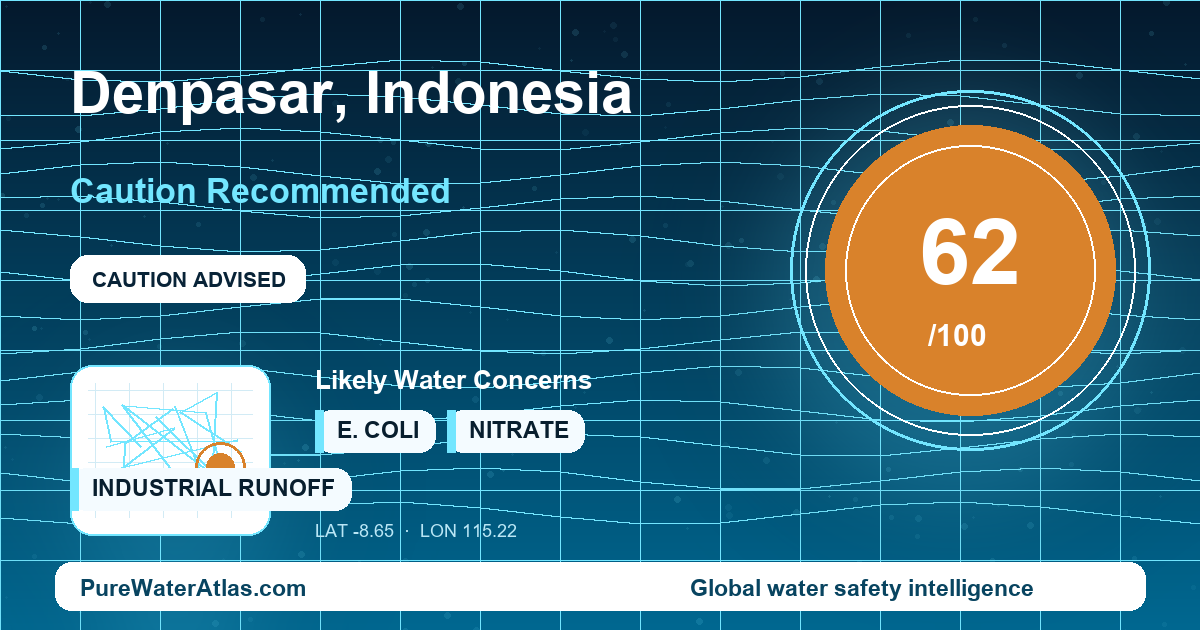
Denpasar has a formal treated municipal supply, but tap-water safety can vary sharply by building, storage tank, pressure conditions, and private-well use. PureWaterAtlas rates Denpasar tap water as Caution Recommended with a water safety score of 62/100.
Quick Answer
| Safety status | Caution recommended. Denpasar has a regulated utility and treated piped-water system, but untreated tap water is not the conservative drinking choice for visitors because final tap quality can be affected by local distribution conditions, building plumbing, roof tanks, and household storage. |
|---|---|
| Traveler advice | Use sealed bottled water, properly treated refill water, boiled water, or a verified hotel filtration system. Do not assume villa, bathroom, or guesthouse tap water is potable unless treatment and maintenance are specifically confirmed. |
| Resident advice | Use the municipal utility supply where available, but consider point-of-use treatment for drinking and cooking, especially in homes with storage tanks, intermittent pressure, old plumbing, infants, elderly residents, immunocompromised residents, or private wells. |
| Main water source | Denpasar’s formal piped supply is primarily surface-water based within South Bali river systems and regional Sarbagita water-supply infrastructure. Private groundwater wells remain important for some premises. |
| Water authority | Perumda Air Minum Tirta Sewakadarma Kota Denpasar is the local municipal water utility. |
| Filter recommendation | A home filter is strongly worth considering. For utility water, sediment filtration plus activated carbon and either UV or reverse osmosis may address common practical risks, but private wells should be tested before choosing treatment. |
Why Denpasar Is Different
Denpasar is not a simple “safe or unsafe” tap-water city. It is a dense, low-lying coastal city in southern Bali, including the Sanur coastal area, and it sits within urban catchments influenced by South Bali’s river systems, tourism growth, and groundwater demand. The city has an official piped-water utility, yet the water that reaches a kitchen tap may have passed through building-level storage tanks, roof tanks, booster pumps, ground tanks, and premise plumbing before anyone drinks it.
That building-level step is central to Denpasar’s risk profile. A treated municipal supply can still become less reliable at the point of use if tanks are unclean, pipes are stagnant, pressure is intermittent, or private groundwater is mixed into the building system. For travelers, this means a hotel room, villa kitchen, cafe, and boarding-house bathroom can have very different practical risk even within the same city. For residents, it means water safety is partly a household and building-management issue, not only a municipal issue.
South Bali’s rapid urban and tourism growth has also increased pressure on surface-water and groundwater resources. Regional water-supply schemes for the Denpasar-Badung-Gianyar-Tabanan area exist because local demand is larger than what isolated municipal systems and private wells can reliably support. Public information is sufficient to identify the utility, regulatory framework, and major risk pathways, but current public reporting does not provide a simple neighborhood-by-neighborhood, contaminant-by-contaminant tap dataset for Denpasar.
Where Does Denpasar’s Tap Water Come From?
Denpasar’s formal piped-water supply is operated through Perumda Air Minum Tirta Sewakadarma Kota Denpasar. The raw-water system serving the urban area is primarily surface-water based, connected to South Bali river systems and regional Sarbagita water-supply infrastructure. Major Bali rivers and treated bulk-water schemes help serve water demand across Denpasar and nearby Badung, Gianyar, and Tabanan.
Important infrastructure includes the municipal distribution network, treatment plants and bulk-water connections serving Denpasar, surface-water intakes and river-basin infrastructure managed in the Bali-Penida basin context, and the many building-level systems that sit downstream of the utility network. Those building systems include roof tanks, ground tanks, booster pumps, and internal plumbing. In practice, they can be just as important as the source-water system for the quality of water that comes out of a tap.
Private wells also remain part of the local water identity. Before wider piped coverage and regional bulk-water development, many Denpasar premises relied on shallow or deep groundwater. Some homes, villas, boarding houses, small hotels, and businesses still use wells as a backup or for non-potable use. Coastal groundwater in South Bali is vulnerable to salinity and contamination when overused or poorly protected, so private well users should not assume groundwater is automatically safe for drinking.
Who Manages Drinking Water in Denpasar?
The local municipal water utility is Perumda Air Minum Tirta Sewakadarma Kota Denpasar. River-basin and bulk-water infrastructure is linked to provincial or national public-works agencies, including the Bali-Penida river-basin context described by the Balai Wilayah Sungai Bali-Penida, Ministry of Public Works.
Indonesia’s health-based drinking-water and hygiene-sanitation requirements are set nationally, including Ministry of Health Regulation No. 2 of 2023. Local implementation involves the water utility, local government, and health offices. Denpasar municipal context can be followed through the Kota Denpasar official government portal, while city statistics and demand context are available from Badan Pusat Statistik Kota Denpasar.
The existence of a regulated utility should not be interpreted as proof that every tap inside every building is safe. Water can change after leaving the utility network. For Denpasar, the strongest practical question is often whether the specific property has clean tanks, protected plumbing, adequate disinfection residual at the tap, and verified drinking-water treatment.
Main Local Water Concerns
- Microbial contamination at the point of use: Risk can increase where water passes through unclean roof tanks, stagnant pipes, poorly maintained dispensers, or private wells. This is especially relevant for short-term visitors and sensitive residents.
- Turbidity and sediment: Heavy rain, pipe repairs, pressure changes, and distribution disturbance can increase cloudy water, particles, or sediment. Rainy season can increase river turbidity, runoff, and drain overflow.
- Storage-tank weakness: Roof tanks and ground tanks are common practical weak points. A clean utility supply can become unsafe if stored in an unclean tank or pulled through contaminated premise plumbing.
- Private-well risks: Wells may face microbial, nitrate, total dissolved solids, chloride, salinity, iron, or manganese concerns, depending on location, construction, nearby septic influence, and coastal groundwater pressure.
- Salinity in coastal groundwater: Low-lying coastal parts of South Bali can be vulnerable where groundwater is over-pumped or poorly protected.
- Premise-plumbing metals: Older buildings and unknown plumbing can introduce corrosion products, sediment, or metals from fixtures. Denpasar-specific public lead data are not detailed enough for neighborhood-level claims.
- Limited public contaminant reporting: Current, easily accessible Denpasar-specific compliance datasets by contaminant, zone, and month are limited, especially for E. coli, nitrate, metals, PFAS, and disinfection byproducts.
For Travelers
Travelers should treat untreated tap water in Denpasar as not reliably safe to drink. The conservative choice is sealed bottled water, professionally treated refill water, boiled water, or water from a reliable hotel filtration system. This is consistent with general travel-health caution for Indonesia from CDC Travelers’ Health.
For brushing teeth, most healthy adults reduce risk by using bottled or treated water, especially during short stays. If you use tap water, avoid swallowing it and be more cautious in budget accommodation, villas with roof tanks, or properties that cannot explain their water maintenance. Use bottled or treated water for oral medications, and avoid drinking shower water.
Use ice only in established hotels, restaurants, and cafes that use treated water or commercial ice. Avoid unknown ice from street stalls or small venues if you have a sensitive stomach, are immunocompromised, pregnant, or traveling with young children. Higher-end hotels and reputable restaurants often use treated water for drinking, ice, and food preparation, but this is a property-level practice, not a citywide guarantee. Ask whether drinking water is filtered, boiled, or commercially supplied.
Be more cautious after heavy rain, floods, major storms, pipe repairs, or supply interruptions. If tap water is cloudy, salty, rusty, or has an unusual odor, do not drink it untreated.
For Residents
Residents connected to Perumda Air Minum Tirta Sewakadarma should use the utility supply where available, but a point-of-use treatment system is strongly worth considering for drinking and cooking. This is especially important for households with roof tanks, intermittent supply, private wells, infants, elderly residents, immunocompromised residents, or unexplained taste, odor, sediment, or salinity.
For municipal water, a practical treatment train may include a sediment prefilter, activated carbon, and either UV or reverse osmosis depending on the problem being addressed. UV is most useful as a microbial barrier after sediment is controlled; reverse osmosis can be relevant where dissolved solids or salinity are a concern. Filter choice should follow testing, not guesswork. For private wells, testing should come before selecting treatment.
Private wells should be tested at least for E. coli or thermotolerant coliforms, nitrate, total dissolved solids, chloride or salinity indicators, pH, turbidity, iron, and manganese. Homes with babies, pregnant residents, or wells near septic systems should prioritize nitrate and microbial testing. If a building is old, recently renovated, or has unknown metal plumbing, test first-draw and flushed samples for lead and other metals rather than assuming the utility source is the only exposure source.
If water is stored in a roof tank or ground tank, test at the kitchen tap, not only at the meter or well. Tanks should be covered, screened from insects and animals, cleaned on a schedule, protected from floodwater, and disinfected after maintenance. After tank cleaning, pipe work, flooding, or long interruptions, use boiled or reliably filtered water until microbiological quality is verified.
Relevant Contaminants and Water-Quality Issues
For Denpasar, the most relevant water-quality issues are those that can arise from stored water, private wells, seasonal turbidity, and premise plumbing. E. coli in drinking water is the key microbial indicator to understand for traveler illness risk, tank hygiene, private wells, and post-distribution contamination. Turbidity and sediment matter during rainy season, after pipe repairs, and when tanks or pipes release particles.
Chlorine is relevant because municipal treatment normally relies on disinfection, although chlorine taste or odor does not prove that every tap is safe. Nitrate is important for private wells, septic influence, and families with infants or pregnant residents. Lead should be considered as a building-level plumbing concern in older or unknown systems, even where the municipal supply is treated.
For deeper background, PureWaterAtlas also provides guides to boiling water purification, UV water purification, nitrate testing and detection, and lead testing and detection.
How to Verify Your Water Quality
The most reliable way to evaluate Denpasar tap water is to test the water people actually drink, at the tap after the building’s tank, pump, filters, and plumbing. This is especially important because public city-level data do not currently provide a simple, independently verified, tap-by-tap dataset by neighborhood, season, contaminant, and building type.
Residents and property managers can use the PureWaterAtlas complete guide to water testing to plan sampling. For broader decision-making, see Drinking Water Safety, Water Microbiology, and Water Treatment Systems.
Travelers comparing destinations can use the Global Water Quality Checker. If a lab report or hotel filter specification lists unfamiliar substances, use the PureWaterAtlas Contaminants Search Engine to research them. Related PureWaterAtlas categories include Drinking Water Safety, Global Water Quality, Water Testing, and Water Purification.
Official and Technical Sources
- Perumda Air Minum Tirta Sewakadarma Kota Denpasar — official local water-utility identity for Denpasar.
- Kota Denpasar official government portal — municipal public-service and local-government context.
- Badan Pusat Statistik Kota Denpasar — demographic and infrastructure context for city density and demand.
- Balai Wilayah Sungai Bali-Penida, Ministry of Public Works — Bali river-basin and public-works infrastructure context.
- Indonesian Ministry of Health Regulation No. 2 of 2023 — national health-based drinking-water and environmental-health framework.
- CDC Travelers’ Health: Indonesia — traveler food and water precaution context.
- WHO Guidelines for Drinking-water Quality — international guidance on drinking-water safety, microbial risk, disinfection, and household water management.
Bottom Line
Denpasar has a formal municipal water utility and treated piped-water supply, but untreated tap water is still a caution category for drinking. The main issue is not only source treatment; it is what happens after water enters South Bali’s dense urban distribution and building systems. Roof tanks, ground tanks, pumps, premise plumbing, private wells, rainy-season turbidity, and coastal groundwater pressure can all affect final tap quality. Tourists should use bottled, boiled, professionally treated refill, or verified hotel-filtered water. Residents should prefer utility water where available, test private wells and tank-fed taps, maintain storage tanks, and consider point-of-use treatment for drinking and cooking.
Read the full guide: Global Water Quality Guide
Explore more in this category: Global Water Quality Articles