
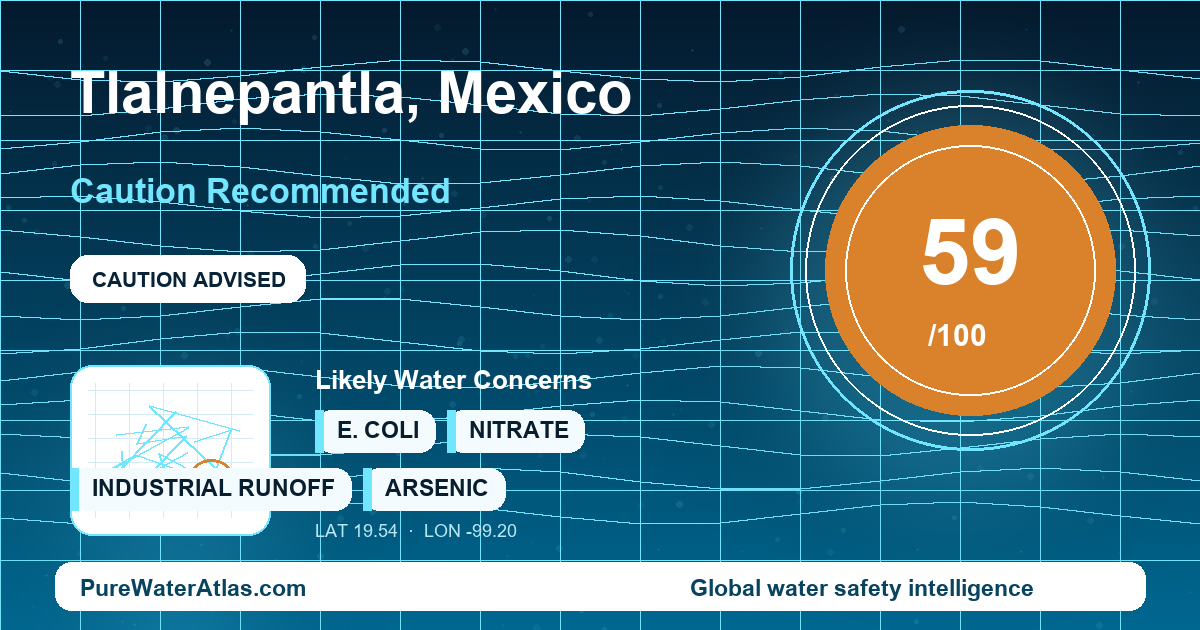
Tlalnepantla de Baz has an organized, chlorinated metropolitan water supply, but drinking directly from the tap is still a caution decision because household storage tanks, pressure changes, older plumbing, intermittent service, and limited public neighborhood-level test data can affect water quality at the faucet.
Quick Answer
| Overall safety status | Caution recommended. PureWaterAtlas score: 59/100. Tlalnepantla is not a no-treatment rural supply, but delivered tap water can vary by building, colonia, storage condition, and service continuity. |
|---|---|
| Can visitors drink the tap water? | Not recommended untreated. Visitors should use sealed bottled water, verified purified hotel or restaurant water, or water that has been properly boiled or filtered. |
| Resident guidance | Treat safety as building-specific. A clean, sealed cistern or tinaco and stable plumbing can reduce risk; dirty storage, old pipes, stagnation, and outages can increase it. |
| Main water source | A blended metropolitan supply: local and regional groundwater from the Valley of Mexico aquifer system plus imported or bulk surface-water supply, especially systems serving the northwest Mexico City metropolitan area such as Cutzamala. |
| Water authority | Local service is managed by OPDM Tlalnepantla, with regional roles involving the Comisión del Agua del Estado de México and federal water policy and infrastructure involving CONAGUA. |
| Filter recommendation | For daily drinking, many households should consider certified point-of-use treatment. Depending on test results, this may mean carbon plus ultrafiltration, UV, or reverse osmosis for specific dissolved contaminants. |
Why Tlalnepantla Is Different
Tlalnepantla de Baz is an Estado de México municipality inside the Mexico City metropolitan area. Its drinking-water risk profile is not the same as a small isolated town and not the same as a single-source city with simple gravity distribution. Tlalnepantla is dense, urbanized, and industrialized, with a mature municipal network, regional interconnections, pressure zones, storage infrastructure, local wells, and widespread household cisterns and rooftop tinacos.
The most important practical point is that tap-water safety in Tlalnepantla can change after water leaves the municipal main. Two homes on the same street may face different risks. One building may have a clean sealed cistern, regular disinfection, stable plumbing, and adequate disinfectant residual. Another may have stagnant water, an uncovered rooftop tank, old internal pipes, sediment, or recent low-pressure events. This means the question “is tap water safe in Tlalnepantla?” is best answered at the building and faucet level, not only at the municipal level.
Tlalnepantla is also unusual because the municipality includes separated western and eastern urban sections. That geography can complicate distribution, pressure management, and continuity of service. In a metropolitan basin under water stress, supply patterns can shift, imported water can be reduced, and stored household water can become more important during shortage periods.
Where Does Tlalnepantla’s Tap Water Come From?
Tlalnepantla receives a blended metropolitan supply. The practical source picture is a combination of local and regional groundwater from the Valley of Mexico aquifer system and imported or bulk surface-water supply managed through Estado de México and federal systems. The Cutzamala system and other regional sources serving the northwest Mexico City metropolitan area are part of the broader supply context.
Because the municipality is connected to a wider metropolitan water network, the exact source blend can vary by sector, pressure zone, season, and operational condition. A household in one colonia may not receive the same source proportion year-round, and a single building’s water quality may be influenced by storage after delivery. This is one reason PureWaterAtlas does not treat Tlalnepantla as a simple “safe” or “unsafe” tap-water city.
The older water context matters as well. Tlalnepantla sits inside the long-developed Mexico City basin, where historical reliance on groundwater has contributed to aquifer stress and land subsidence across the region. To reduce pressure on local aquifers, the broader metropolitan area also depends on imported systems such as Cutzamala. Recent drought and low reservoir storage have made imported water less reliable in the region, increasing the chance of low pressure, rationing, scheduled cuts, or heavier reliance on stored water.
Key infrastructure affecting drinking water in Tlalnepantla includes the OPDM municipal distribution network, local wells and pumping infrastructure, bulk-water interconnections with Estado de México and federal systems, municipal storage tanks, sectorized distribution areas, pressure zones, and household cisterns and tinacos. For many residents, those last-stage storage systems are the critical link between treated public supply and actual kitchen-tap quality.
Who Manages Drinking Water in Tlalnepantla?
The local drinking-water operator is OPDM Tlalnepantla, the municipal decentralized public body responsible for potable water, sewerage, and sanitation services in Tlalnepantla de Baz. Municipal service information may also be available through the Municipio de Tlalnepantla de Baz official site.
Regional and bulk-supply functions involve the Comisión del Agua del Estado de México. Federal water policy, hydrologic information, and national infrastructure context involve CONAGUA, including information on the Sistema Cutzamala.
Drinking water quality in Mexico is governed by federal health standards, including NOM-127-SSA1-2021 for water for human use and consumption. Health surveillance roles involve authorities such as COFEPRIS and state health authorities. However, the existence of a federal drinking-water standard does not prove that every household tap in Tlalnepantla meets microbiological and chemical targets at all times. Building plumbing, storage tanks, pressure loss, and maintenance can change water quality before it reaches the glass.
Data availability is a key limitation. There is enough public information to identify the operator, regulatory framework, and regional supply context, but recent downloadable lab reports at the colonia, building, or tap level are not consistently available in an easy-to-audit format. For that reason, this profile avoids claiming universal contamination or universal compliance.
Main Local Water Concerns
- Intermittent supply and low pressure: During regional shortages, dry-season stress, or operational disruptions, low pressure can increase the chance of intrusion and sediment disturbance in distribution pipes.
- Cisterns and tinacos: Household storage is common in Tlalnepantla. If tanks are uncovered, poorly sealed, rarely cleaned, or not disinfected, they can become microbial reservoirs even when incoming water is chlorinated.
- Sediment and discoloration: Rusty, cloudy, or particle-filled water may appear after repairs, pressure changes, or periods without service. First-draw water after an interruption should not be treated as automatically safe for drinking.
- Older internal plumbing: Older apartments, schools, workshops, and commercial buildings may have legacy plumbing materials, solder, brass fixtures, or corrosion that can contribute metals such as lead at the tap. This is a building-level risk, not a confirmed citywide contaminant claim.
- Groundwater-related aesthetics and minerals: Regional groundwater stress can be associated with mineralization, hardness, salinity, iron, manganese, and similar aesthetic or operational issues. Testing is needed before making household-specific contaminant claims.
- Industrial urban setting: Tlalnepantla’s industrial and highly urbanized land use increases the importance of source-water protection and monitoring. Public evidence is not sufficient, however, to claim a specific industrial contaminant is present at all taps.
Seasonal conditions can also matter. Dry periods and drought can reduce imported-water availability. Rainy-season runoff can increase turbidity challenges for surface-water sources and can worsen risk where drainage and water infrastructure are compromised. Warm weather can increase biological growth risk in poorly maintained rooftop tanks and cisterns.
For Travelers
Short-term visitors should not rely on untreated tap water for drinking in Tlalnepantla. Use sealed bottled water, water from a verified hotel or restaurant purification system, or water that has been properly boiled or filtered. This is a practical travel recommendation based on distribution and building-level uncertainty, not a claim that all municipal water is contaminated.
Brushing teeth with tap water is generally lower risk than drinking a full glass, but cautious travelers should use bottled or treated water, especially when staying in older rentals, small hotels, or properties with visible rooftop tanks or recent outages. Children, pregnant travelers, immunocompromised people, and travelers with sensitive stomachs should be more conservative.
Use ice only from reputable restaurants, hotels, or packaged commercial sources. Larger hotels and established restaurants commonly use garrafón water or internal purification for drinking water and ice, but it is still reasonable to ask whether the ice and drinking water are purified. Do not assume bathroom tap water is the same as restaurant purified water.
Carry sealed water for drinking, baby formula, and medications. Avoid swallowing shower water. If tap water is cloudy, has particles, smells unusual, or follows a service interruption, switch immediately to bottled, boiled, or verified treated water.
For Residents
Residents should evaluate Tlalnepantla tap-water safety at the kitchen faucet and storage-tank level. A home filter is advisable for daily drinking in many households, but the best system depends on test results. At minimum, many homes benefit from certified point-of-use treatment designed for chlorine taste, sediment, and microbial barrier needs. If testing shows high dissolved solids, nitrate, arsenic, lead, or another specific contaminant, choose treatment certified for that contaminant. Reverse osmosis is often considered when dissolved ions or metals are the concern, while carbon alone is not a universal solution.
Test water at the kitchen faucet rather than relying only on information from the street main. Useful field checks include free chlorine residual, pH, conductivity or total dissolved solids, turbidity, color, and odor. Use a certified laboratory for E. coli or total coliforms if there are water outages, dirty cisterns, sewage backups, or household gastrointestinal illness concerns.
Lead testing is especially important in older buildings, recently remodeled units, properties with brass fixtures, or homes where water sits overnight in pipes before use. Flush first-draw water after overnight stagnation, especially when children, pregnant people, or vulnerable adults drink the water regularly.
Cisterns and rooftop tinacos should be sealed, screened, cleaned, and disinfected on a routine schedule. A dirty or uncovered storage tank can defeat municipal chlorination. Retest after major plumbing work, tank cleaning, floods, long vacancies, or a change in supply pattern.
Relevant Contaminants and Water-Quality Issues
Several PureWaterAtlas contaminant and issue profiles are especially relevant to Tlalnepantla’s building-specific water risk. Chlorine matters because municipal water should maintain disinfectant residual, while strong taste or odor can lead residents to seek filtration. Turbidity and sediment are relevant after outages, repairs, pressure changes, and rainy-season source-water challenges.
E. coli is relevant for cisterns, rooftop tanks, pressure loss, and post-outage microbiological safety. Lead is most relevant here as a possible internal plumbing issue rather than a confirmed citywide contaminant. Groundwater-influenced supplies can also make iron and manganese worth investigating when water causes staining, tastes metallic, or leaves black or brown deposits.
For treatment planning, see PureWaterAtlas guides on lead testing and detection, lead filter options, boiling water purification, UV purification, and nitrate testing.
How to Verify Your Water Quality
The most reliable way to answer the drinking-water question in Tlalnepantla is to combine official notices with household-level testing. Start with the local operator and municipal channels for service interruptions, repairs, and shortage notices. Then test the water that people actually drink: the kitchen faucet after it has passed through the building’s cistern, tinaco, pipes, and fixtures.
PureWaterAtlas resources can help residents and travelers understand results and treatment choices. Use the Water Testing guide to plan sampling, the Contaminants Search Engine to interpret specific parameters, and the Global Water Quality Checker for broader city-safety context. For general decision-making, see Drinking Water Safety, Water Purification, Water Treatment Systems, and Water Microbiology.
For more reading across related topics, visit the PureWaterAtlas categories for Global Water Quality, Drinking Water Safety, Water Testing, and Water Purification.
Official and Technical Sources
- OPDM Tlalnepantla official site — local municipal water operator for potable water, sewerage, and sanitation services.
- Municipio de Tlalnepantla de Baz official site — municipal government source for local service notices and public works information.
- Comisión del Agua del Estado de México — state water authority involved in regional infrastructure and bulk supply.
- CONAGUA official site — federal water authority for national water policy, infrastructure, and hydrologic information.
- CONAGUA Sistema Cutzamala information and updates — official information on a major imported-water system serving the Mexico City metropolitan area.
- Diario Oficial de la Federación NOM-127-SSA1-2021 — official Mexican drinking-water quality standard.
- COFEPRIS water and environmental health information — federal health regulator relevant to sanitary surveillance.
- INEGI geographic information for Tlalnepantla de Baz — official municipal reference.
- CDC Travelers Health Mexico — traveler-health guidance supporting conservative food and water precautions.
- CONAGUA Estadísticas del Agua en México — national water statistics for basin stress and regional water-management context.
Bottom Line
Tlalnepantla tap water should be treated with caution for drinking. The municipality has an organized water operator, chlorinated public supply, and metropolitan infrastructure, but the final quality at the faucet can be affected by blended sources, pressure changes, intermittent service, old plumbing, sediment, cisterns, and rooftop tinacos. Visitors should use sealed bottled water or verified purified water for drinking and ice. Residents should focus on their own building: maintain tanks, flush after stagnation, test kitchen-tap water, and choose certified treatment based on results. The strongest conclusion is not that every tap is unsafe, but that untreated tap water is not a reliable drinking choice without building-level verification.
Read the full guide: Global Water Quality Guide
Explore more in this category: Global Water Quality Articles