
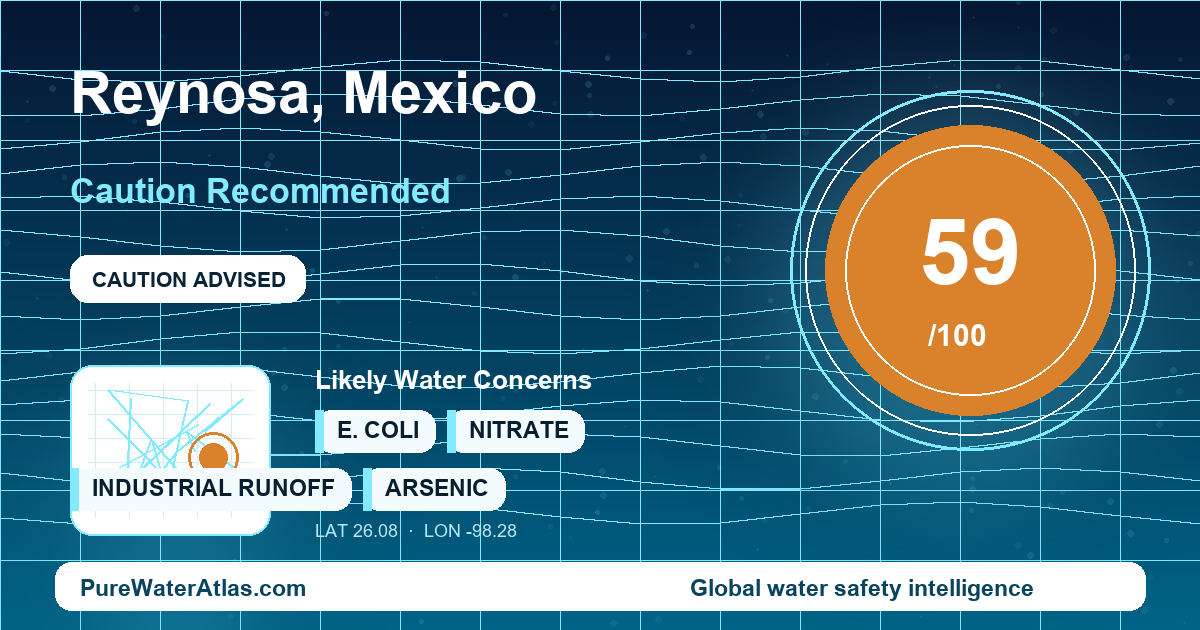
Reynosa, Tamaulipas relies on a treated lower Rio Bravo/Rio Grande surface-water system, but travelers and many residents should use extra caution because tap-level verification, building storage, pressure interruptions, and hot-climate water handling can affect safety between the treatment plant and the glass.
Quick Answer
| City | Reynosa, Mexico |
|---|---|
| Water safety score | 59 / 100 |
| Risk level | Caution Recommended |
| Is tap water safe to drink? | Caution recommended. Reynosa has a formal municipal water utility and treatment system, but recent, easily verifiable, citywide tap-water compliance data are limited in the public record. |
| Traveler advice | Do not rely on untreated tap water. Use sealed bottled water, reputable garrafón water, or water that has been boiled or otherwise treated. |
| Resident advice | Municipal water can generally be treated as a chlorinated public supply for washing and household use, but drinking-water decisions should be building-specific, especially where cisterns, rooftop tanks, old plumbing, or intermittent pressure are present. |
| Main water source | Lower Rio Bravo/Rio Grande surface-water system, with regional diversion and canal infrastructure around Reynosa. |
| Local authority | COMAPA Reynosa, the Comisión Municipal de Agua Potable y Alcantarillado de Reynosa. |
| Filter recommendation | For many homes, use a maintained point-of-use system. Carbon can improve taste and chlorine issues; UV, ultrafiltration, or boiling is needed for microbial protection; reverse osmosis is more appropriate where salinity, dissolved solids, nitrate, arsenic, or metals are concerns. |
Why Reynosa Is Different
Reynosa’s drinking-water question is closely tied to its border geography. The city sits in northern Tamaulipas on the south side of the Rio Bravo/Rio Grande, directly across from the McAllen-Hidalgo area of Texas. That places Reynosa in the lower Rio Grande basin, where municipal, agricultural, industrial, and cross-border water demands compete for a heavily managed river system.
The key issue is not that Reynosa lacks a formal water utility or treatment system. It has COMAPA Reynosa and municipal potable-water infrastructure. The caution comes from the full chain of risk: source-water stress in the Rio Bravo/Rio Grande, possible pressure interruptions or repairs, distribution age, hot-weather storage, and building-level water handling. In Reynosa, the last 100 meters often matter as much as the citywide supply: the hotel tank, apartment cistern, rooftop tinaco, internal plumbing, recent outages, and whether drinking water comes directly from a tap, a filter, or a sealed garrafón.
Publicly available information identifies the utility, the regional water setting, and the applicable Mexican drinking-water framework. However, recent, comprehensive, neighborhood-level tap-sampling results for Reynosa are not readily available in a format comparable to annual consumer confidence reports used in some other countries. For that reason, this profile should be read as a practical safety guide, not as a certified statement that every Reynosa neighborhood either meets or fails a legal limit.
Where Does Reynosa’s Tap Water Come From?
Reynosa’s municipal drinking water is best characterized as a lower Rio Bravo/Rio Grande surface-water supply. Raw water is associated with the border river and regional canal and diversion infrastructure around Reynosa, then treated by the municipal utility before distribution through city mains, pressure zones, valves, pumping stations, and storage assets.
This source-water identity is important. Reynosa is not mainly defined by a single protected mountain reservoir or a purely local groundwater field. Its water context is tied to a binational river system shaped by reservoir conditions, irrigation return flows, municipal wastewater management, drought concentration effects, storm runoff, and international water-management arrangements. During dry periods, lower-basin surface water can have more noticeable dissolved minerals, salinity, hardness, taste, or total dissolved solids. After heavy rain, tropical storms, canal disturbances, floods, repairs, or main breaks, turbidity and sediment can become more relevant.
Local public references identify municipal treatment plants and related assets such as Pastor Lozano, Benito Juárez, Rancho Grande, pumping systems, and storage infrastructure. After treatment, water quality can still change in distribution mains and inside buildings. Low pressure, stagnant lines, dirty cisterns, uncovered rooftop tanks, and old internal plumbing can reduce disinfectant protection or introduce sediment, microbes, or metals after water has left the utility’s control.
Who Manages Drinking Water in Reynosa?
The local water and sewer utility is COMAPA Reynosa, the Comisión Municipal de Agua Potable y Alcantarillado de Reynosa. COMAPA is the practical authority residents look to for potable-water service, repairs, operations, pumping issues, and public notices. Municipal context is also available through the Gobierno Municipal de Reynosa.
At the state level, water coordination is associated with the Comisión Estatal del Agua de Tamaulipas. At the federal level, Mexico’s national water administration is led by CONAGUA, including the Sistema Nacional de Información del Agua and CONAGUA’s Calidad del Agua resources.
Mexico’s sanitary quality requirements for water for human use and consumption are set nationally under NOM-127-SSA1-2021, issued through the Secretaría de Salud framework and published in the Diario Oficial de la Federación. Because Reynosa is part of the Rio Bravo/Rio Grande border region, technical context also comes from binational institutions such as the International Boundary and Water Commission and Mexico’s CILA Sección Mexicana.
Main Local Water Concerns
The main documented concerns for Reynosa are practical and system-specific rather than a verified claim of one contaminant exceeding a limit citywide. The lower Rio Bravo/Rio Grande basin faces drought, reservoir depletion, agricultural demand, and urban growth. Those pressures can make salinity, hardness, taste, total dissolved solids, and treatment challenges more noticeable during low-flow periods.
Turbidity and sediment are also relevant. Storm runoff, canal disturbances, floods, emergency repairs, and main breaks can temporarily change water clarity and pressure. Low-pressure events matter because they can increase the risk of microbial intrusion in damaged or depressurized lines. Even if treatment is adequate at the plant, dirty storage tanks, stagnant rooftop storage, or poorly maintained cisterns can allow disinfectant residual to decline and bacterial regrowth to occur.
Agricultural runoff indicators such as nutrients, pesticides, and sediment are relevant to the basin, although the public record does not support assigning specific Reynosa-wide tap concentrations. Older premise plumbing and fixtures can contribute metals such as lead or copper after water leaves the public system. Industrial and urban border-region activity makes broad contaminant screening prudent, but there is not enough public evidence to claim a specific Reynosa-wide PFAS, arsenic, or heavy-metal exceedance at the tap.
For Travelers
Short-term visitors should not rely on untreated tap water for drinking in Reynosa. Use sealed bottled water, reputable garrafón water, or water that has been boiled or otherwise treated. This conservative approach is consistent with travel-health guidance for Mexico from the U.S. Centers for Disease Control and Prevention Mexico Traveler View, and it is especially sensible when visitors cannot verify a hotel’s plumbing, cistern, or rooftop tank maintenance.
For brushing teeth, visitors, pregnant people, immunocompromised travelers, families with young children, and anyone staying in a building with unknown tank maintenance should use bottled, boiled, or properly filtered water. Many local residents may use tap water for brushing, but traveler risk tolerance should be more conservative.
Avoid loose or uncertain ice. In better hotels and restaurants, ice may be made from purified water, but ask whether it is made from agua purificada. Factory-made bagged ice from reputable stores is safer than ice from unknown taps or tanks. In restaurants, ask for bottled water or purified water rather than assuming tap-served water is treated. Be cautious with fountain drinks, raw produce washed in tap water, and informal food settings where the water source is unclear.
In hot weather, carry sealed water and check bottle seals. If gastrointestinal illness occurs, oral rehydration salts can be useful. When microbial safety is uncertain, boil water for at least 1 minute. A bottle with an integrated purifier can help, but a simple carbon taste filter alone should not be treated as full microbial protection.
For Residents
Residents connected to COMAPA can generally treat municipal water as a chlorinated public supply for washing and routine household uses, but drinking-water decisions should be building-specific. A home filter or purification barrier is advisable in many Reynosa homes, especially where water is stored in cisterns or rooftop tanks, pressure is intermittent, taste or sediment is noticeable, or infants, pregnant people, older adults, or immunocompromised people live in the home.
For microbial risk, use boiling, UV, ultrafiltration, or another validated disinfection barrier. For salinity, dissolved solids, nitrate, arsenic, or metals, reverse osmosis is often more appropriate than carbon alone. Carbon filters can improve taste, odor, and chlorine-related concerns, but they do not automatically make unsafe water microbiologically safe.
Testing should be done at the kitchen tap, not only at the street connection, because internal plumbing and tanks can change water quality. If the home has a cistern or tinaco, test after the tank and clean the tank regularly. Include total coliform and E. coli testing if there have been odors, illness, low pressure, flooding, or visible tank contamination. If the home has old plumbing, brass fixtures, repaired pipes, or unknown pipe materials, test first-draw and flushed samples for lead and copper.
If water tastes salty, bitter, or mineral-heavy, test total dissolved solids, chloride, sulfate, hardness, and conductivity. If infants or pregnant people drink the water, include nitrate and basic microbial testing. After main breaks, local outages, floods, or visible turbidity, use bottled or boiled water until the water clears and, ideally, microbial safety is confirmed. Keep cisterns and rooftop tanks covered, screened, cleaned, and disinfected on a schedule; warm, uncovered, cracked, or sediment-filled tanks can undermine municipal chlorination.
Relevant Contaminants and Water-Quality Issues
Several PureWaterAtlas contaminant guides are especially relevant to Reynosa’s practical risk profile. Chlorine in drinking water is important because disinfectant residual can decline in long distribution lines, hot weather, cisterns, and rooftop tanks. Turbidity and sediment are relevant after storms, canal disturbances, line breaks, repairs, and tank disturbance.
For microbial safety, E. coli is a key indicator after low-pressure events, flooding, dirty storage tanks, or suspected sewage intrusion. In a river-basin and agricultural region, nitrate is a sensible screening concern, particularly for households with infants or pregnant people. In older buildings, lead can be a premise-plumbing issue even when water leaving the municipal system is treated.
For deeper background, see PureWaterAtlas guides on boiling water purification, UV water purification, lead testing and detection, nitrate testing, and agricultural runoff in drinking water.
How to Verify Your Water Quality
The most reliable way to answer “Is my Reynosa tap water safe?” is to test the water actually used for drinking. For health decisions, use a certified laboratory rather than relying only on home strips. Home strips can screen for chlorine, pH, hardness, or nitrate, but they are not a substitute for microbiological testing or metals analysis.
Start with the actual drinking point: the kitchen tap, filter outlet, garrafón dispenser, or post-tank line. If there is a cistern or rooftop tank, sample after storage. If there has been a recent outage, main repair, pressure loss, flood, odor, sediment event, or illness concern, include total coliform and E. coli. If the building is older or has brass fixtures, solder, corroded pipes, or stagnant lines, include lead and copper.
PureWaterAtlas resources that can help include the complete guide to water testing, the drinking water safety framework, the water microbiology guide, and the water treatment systems guide. You can also use the PureWaterAtlas Contaminants Search Engine and compare city-level guidance with the Global Water Quality Checker.
Official and Technical Sources
- COMAPA Reynosa — local potable-water and sewer utility for Reynosa.
- Gobierno Municipal de Reynosa — municipal public-service context.
- Comisión Estatal del Agua de Tamaulipas — state water authority context.
- CONAGUA Sistema Nacional de Información del Agua — national water information system.
- CONAGUA Calidad del Agua — federal water-quality monitoring and policy context.
- NOM-127-SSA1-2021 — Mexico’s national sanitary standard for water for human use and consumption.
- International Boundary and Water Commission — binational Rio Grande/Rio Bravo water-management context.
- CILA Sección Mexicana — Mexican counterpart for northern border boundary and water matters.
- CDC Mexico Traveler View — travel-health guidance supporting bottled, boiled, or treated water precautions.
- North American Development Bank projects and publications — border-region water and wastewater infrastructure context.
Bottom Line
Reynosa’s tap water should be approached with caution for drinking. The city has a formal municipal utility, COMAPA Reynosa, and a treated water system tied to the lower Rio Bravo/Rio Grande, but the public record does not provide easily verifiable, recent, neighborhood-level tap results for every user. For visitors, the safest practical choice is sealed bottled water, reputable garrafón water, or water that has been boiled or properly treated. For residents, the decision depends heavily on the building: cisterns, rooftop tanks, old plumbing, pressure interruptions, sediment, taste changes, and recent repairs can all affect water after treatment. Use testing and a maintained point-of-use system when drinking-water safety matters.
Read the full guide: Global Water Quality Guide
Explore more in this category: Global Water Quality Articles