
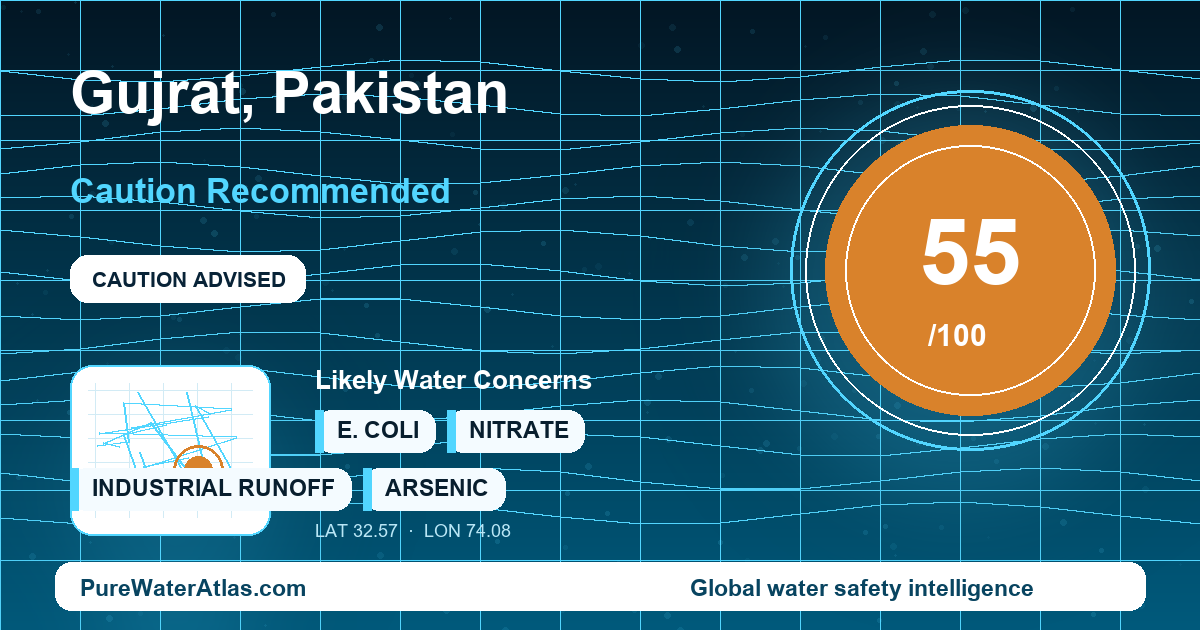
Gujrat, Punjab: a groundwater-based city supply where safety depends heavily on tube-well quality, distribution integrity, household storage, and point-of-use treatment.
Quick Answer
| Water safety score | 55 / 100 |
|---|---|
| Risk level | Caution Recommended |
| Can visitors drink tap water? | No. Short-term visitors should use sealed bottled water, boiled water, or reliably filtered and disinfected water. Avoid untreated tap water and avoid ice unless it is clearly made from purified water. |
| Resident guidance | Treat Gujrat tap water or private bore water as source-dependent. Test the actual drinking-water tap and use treatment matched to the results. |
| Main water source | Primarily groundwater from municipal tube wells and private bore wells in the Chenab-Jhelum doab region of Punjab. |
| Local authority context | Urban water supply and sanitation functions are associated with Municipal Corporation Gujrat and Punjab local-government arrangements, with infrastructure roles linked to Punjab Public Health Engineering Department and provincial water initiatives. |
| Filter recommendation | Strongly advisable unless recent laboratory results confirm both microbial and chemical safety at the drinking tap. Sediment prefiltration plus UV or boiling can address microbes; reverse osmosis or specialty media may be needed only when testing shows arsenic, nitrate, high TDS, or other dissolved contaminants. |
Editorial verdict: caution is recommended in Gujrat. The main practical concern is not one confirmed citywide contaminant, but variable microbial safety, intermittent supply, aging or leaky distribution, inconsistent disinfection, household storage conditions, and groundwater-quality variability common in Punjab. Publicly accessible routine neighborhood-level tap-water results for Gujrat are limited, so this profile avoids claiming universal safety or universal contamination.
Why Gujrat Is Different
Gujrat is not a city where the drinking-water question can be answered only by asking whether the municipal source exists. The city is in northern Punjab, in the agriculturally and hydrologically important area between the Chenab and Jhelum river systems. That setting supports productive alluvial groundwater resources, but it also means water quality can be influenced by river and canal systems, rainfall, irrigation return flows, flood-season runoff, and local recharge conditions.
The practical difference in Gujrat is that many households do not rely on a single, uniform water pathway. A home may use municipal supply part of the time, a private bore well at other times, stored water from an underground or rooftop tank, bottled water, or water from a public or private filtration point. Two homes on the same street can therefore face different risks, depending on the tube well, bore depth, plumbing, storage tank hygiene, and whether any treatment is actually maintained.
Gujrat is also a long-established urban and industrial center associated with manufacturing, ceramics, fans, furniture, and surrounding agriculture. These activities make source-water protection and testing important. However, the available public information is not sufficient to assign one specific industrial contaminant to all Gujrat taps. The safer, evidence-based conclusion is that household-specific verification is necessary.
Where Does Gujrat’s Tap Water Come From?
Gujrat’s urban drinking-water supply is understood to be primarily groundwater-based. Water is drawn from alluvial aquifers by municipal tube wells, while many residents and businesses also use private bore wells or hand pumps. The aquifer is part of the Chenab-Jhelum doab region of Punjab and is influenced by river, canal, rainfall, irrigation, and urban recharge conditions rather than by a large conventional surface-water treatment plant.
Historically, households in Gujrat and surrounding settlements relied on dug wells, hand pumps, shallow bores, and later deeper tube wells. Modern use still reflects that history: municipal groundwater supply exists, but it is commonly supplemented by private bores, filtration points, bottled water, and household storage.
The local drinking-water pathway can include municipal groundwater tube wells, distribution mains and neighborhood pipelines, overhead or ground storage reservoirs where present, household underground and rooftop storage tanks, private bore wells, hand pumps, and public or private drinking-water filtration points. Local sewerage and drainage networks are also part of the risk picture because they can become contamination pathways when nearby water pipes leak, pressure drops, or water is stored in poorly protected tanks.
For everyday users, the most relevant safety issue is often the condition between the tube well and the drinking glass. Even if a groundwater source is nominally protected, intermittent pumping, low pressure, pipe leakage, cross-contamination from drains or sewers, and unclean tanks can introduce microbial risk before the water is consumed.
Who Manages Drinking Water in Gujrat?
Urban water supply and sanitation functions in Gujrat are associated with Municipal Corporation Gujrat and Punjab local-government arrangements. The broader provincial framework is linked to the Local Government and Community Development Department, Government of Punjab. Project and infrastructure roles may also involve the Public Health Engineering Department, Government of Punjab, especially in water-supply and sanitation infrastructure outside major WASA-style systems.
Gujrat does not have the same widely documented WASA utility identity as Lahore, Faisalabad, Rawalpindi, Gujranwala, or Multan. That matters for consumers because public reporting may be less centralized and less visible than in cities with large, named utilities.
Pakistan’s drinking-water quality context includes national drinking-water quality standards, the Pakistan Standards and Quality Control Authority, and the Pakistan Environmental Protection Agency. The Pakistan Council of Research in Water Resources is a high-authority source for water-quality monitoring and research, including groundwater and drinking-water concerns. In Punjab, the Punjab Aab-e-Pak Authority is relevant to safe drinking-water and filtration initiatives.
The main data limitation for Gujrat is that a routinely updated, public, neighborhood-level consumer confidence report was not found. Available Pakistan and Punjab evidence is often based on periodic surveys, research reports, or project documents rather than continuous tap-level compliance reporting. Conditions can vary by tube well, private bore, distribution zone, building plumbing, and storage tank.
Main Local Water Concerns
- Microbial contamination: Gujrat’s most immediate practical risk is microbial contamination from intermittent supply, sewage proximity, leaking pipes, pressure drops, and household storage tanks. Learn more about E. coli and related fecal-indicator risks.
- Variable disinfection: Residual chlorine may not be reliable at the point of use. A protected source can become unsafe if water loses disinfectant residual in distribution or storage. See the PureWaterAtlas guide to chlorine.
- Turbidity and sediment: Cloudy water or particles may appear after pipe repairs, pump restarts, monsoon runoff, or disturbance of a household tank. Read more about turbidity and sediment.
- Hardness and dissolved minerals: Some groundwater sources can have high dissolved solids or hardness, affecting taste, scale, and treatment choices. This is not the same as microbial safety; mineral-heavy water may still need disinfection.
- Arsenic screening: Arsenic is documented in parts of Punjab groundwater, so Gujrat bore or tap water should be tested rather than assumed safe by appearance or taste. See arsenic.
- Nitrate risk: Nitrate can occur where agriculture, septic systems, sewer leakage, or shallow groundwater influence drinking sources. This is especially important for infants and pregnant people. See nitrate.
- Lead from plumbing: Lead risk is more likely from old internal plumbing, fittings, solder, or fixtures than from the raw groundwater itself. Older Gujrat buildings should consider first-draw testing. See lead.
Season matters in Gujrat. Monsoon rains can increase runoff, flooding, sewer surcharging, and short-term microbial risk. Summer demand and power interruptions can reduce pressure and disrupt pumping or chlorination. After heavy rain, visible turbidity, odor changes, or sudden taste changes should be treated as warning signs.
For Travelers
Visitors should not drink untreated tap water in Gujrat as a routine practice. The safer approach is sealed bottled water from reputable brands, water brought to a rolling boil, or water treated by a reliable purifier. This recommendation is consistent with general traveler food-and-water precautions for Pakistan, including guidance from CDC Travelers’ Health: Pakistan.
Use bottled, boiled, or properly filtered water for brushing teeth, especially for children, pregnant travelers, older adults, and anyone with a sensitive stomach or weakened immune system. Avoid ice from unknown sources. Ice should be considered safe only when a hotel or restaurant can confirm it was made from purified water.
In hotels and restaurants, higher-end or established places may use filtered water, but travelers should still ask. Prefer sealed bottles opened at the table, hot tea or coffee made with boiled water, and cooked foods served hot. Carry sealed bottled water during local travel, avoid refilled bottles with broken seals, and use bottled or treated water when taking medications. During hot weather, oral rehydration salts can be useful if dehydration becomes a concern.
If tap water must be used, bring it to a rolling boil and store it in a clean, covered container. For method details, see Boiling Water Purification: Complete Guide.
For Residents
For Gujrat residents, the safest assumption is that tap or bore water is source-dependent. A household treatment system is strongly advisable unless recent laboratory results confirm both microbial and chemical safety at the actual tap used for drinking. Testing only the bore or source is not enough, because household tanks, pipes, and fixtures can change the final water quality.
A practical treatment sequence for many homes is sediment prefiltration followed by UV disinfection or boiling for microbial risk. UV can be effective only when water is clear enough and the unit is maintained; see UV Water Purification: Complete Guide. Chemical issues require different treatment. Reverse osmosis or certified specialty cartridges may be appropriate if testing shows arsenic, nitrate, high TDS, or other dissolved contaminants, but those systems should be selected based on actual lab results rather than taste alone.
At minimum, residents should test for E. coli or thermotolerant coliforms, total coliforms, turbidity, pH, electrical conductivity or TDS, hardness, residual chlorine, nitrate, arsenic, iron, and manganese. If infants, pregnant people, kidney patients, or immunocompromised people live in the home, prioritize microbial, nitrate, and arsenic testing.
Retest after installing a new bore, changing a pump, cleaning a storage tank, major pipeline repair nearby, flooding, or any sudden change in taste, color, odor, or sediment. Use an accredited or government-recognized laboratory where possible, and keep results with the sample date, sampling point, and whether the sample was first-draw or flushed.
Older buildings, renovated properties, and homes with unknown plumbing materials should treat lead and metal leaching as possible plumbing-related risks. First-draw testing is the reliable way to assess lead at the tap. Letting water run after long stagnation can reduce some plumbing-related exposure, but it does not replace testing or certified treatment.
Household storage tanks are a major practical risk point in Gujrat. Tanks should be covered, screened from insects and dust, cleaned and disinfected on a schedule, and protected from sewage seepage or roof runoff. Water that is acceptable at the tube well can become unsafe in a dirty rooftop or underground tank.
Relevant Contaminants and Water-Quality Issues
The most relevant Gujrat water-quality issues are those connected to groundwater, distribution leakage, intermittent pressure, and household storage. Start with microbial safety: E. coli is a key warning organism for fecal contamination, while turbidity and sediment can signal disturbed pipes, tanks, or bore-water solids that interfere with disinfection.
For chemical testing, Gujrat residents should not rely on taste or appearance to rule out arsenic or nitrate. Punjab groundwater can require screening, and nitrate is especially important where agriculture, sewer leakage, septic influence, or shallow groundwater may affect drinking sources. For old buildings, lead is most relevant as an internal-plumbing issue. Chlorine is also important because a measurable residual can indicate whether disinfected water remains protected through distribution and storage.
How to Verify Your Water Quality
The best way to verify drinking-water safety in Gujrat is to test the water you actually drink, at the tap or storage outlet you use daily. Do not assume municipal supply, a private bore, bottled refills, or filtration-plant water is safe without documentation. Sampling location matters because contamination can occur in the household tank, building plumbing, or final container.
Use PureWaterAtlas resources to plan a test and interpret results. Start with How to Test Drinking Water: Complete Guide to Water Testing and Analysis, then review the broader Drinking Water Safety guide. For microbial risks, see Water Microbiology. For treatment selection, use Water Treatment Systems, and for contamination pathways, see Water Contamination.
For targeted chemical issues, see Arsenic in Drinking Water: Testing and Detection Methods, Nitrate Contamination in Drinking Water: Testing and Detection Methods, and Lead in Drinking Water: Testing and Detection Methods. You can also browse the Contaminants Search Engine or compare broader location guidance with the Global Water Quality Checker.
Official and Technical Sources
- Municipal Corporation Gujrat — local municipal identity and urban service context.
- Local Government and Community Development Department, Government of Punjab — provincial framework for municipal corporations and local service delivery.
- Public Health Engineering Department, Government of Punjab — water-supply and sanitation infrastructure context outside major WASA systems.
- Pakistan Council of Research in Water Resources and PCRWR Publications — national water-quality research and monitoring context.
- Punjab Aab-e-Pak Authority — Punjab filtration and safe drinking-water initiative context.
- Pakistan Standards and Quality Control Authority — standards context for drinking water and bottled water.
- Pakistan Environmental Protection Agency — national environmental and drinking-water quality standards context.
- CDC Travelers’ Health: Pakistan — traveler food and water precautions.
- WHO Guidelines for Drinking-water Quality — international health-based drinking-water risk management reference.
- Encyclopaedia Britannica: Gujrat, Pakistan — geographic context.
- World Bank: Pakistan Getting More from Water — Pakistan water-sector and groundwater-management context.
Bottom Line
Gujrat’s tap water should be approached with caution. The city relies mainly on groundwater from municipal tube wells and private bores, with final safety affected by distribution pipes, intermittent pressure, household storage tanks, and inconsistent point-of-use practices. Visitors should not drink untreated tap water and should use sealed bottled, boiled, or reliably purified water. Residents should test the actual drinking tap for microbial indicators, turbidity, TDS, hardness, residual chlorine, nitrate, arsenic, iron, manganese, and plumbing-related metals where relevant. Boiling or UV can reduce microbial risk, but dissolved contaminants require targeted treatment. Because public neighborhood-level tap-water reporting for Gujrat is limited, household-specific testing and storage-tank hygiene are essential.
Read the full guide: Global Water Quality Guide
Explore more in this category: Global Water Quality Articles