
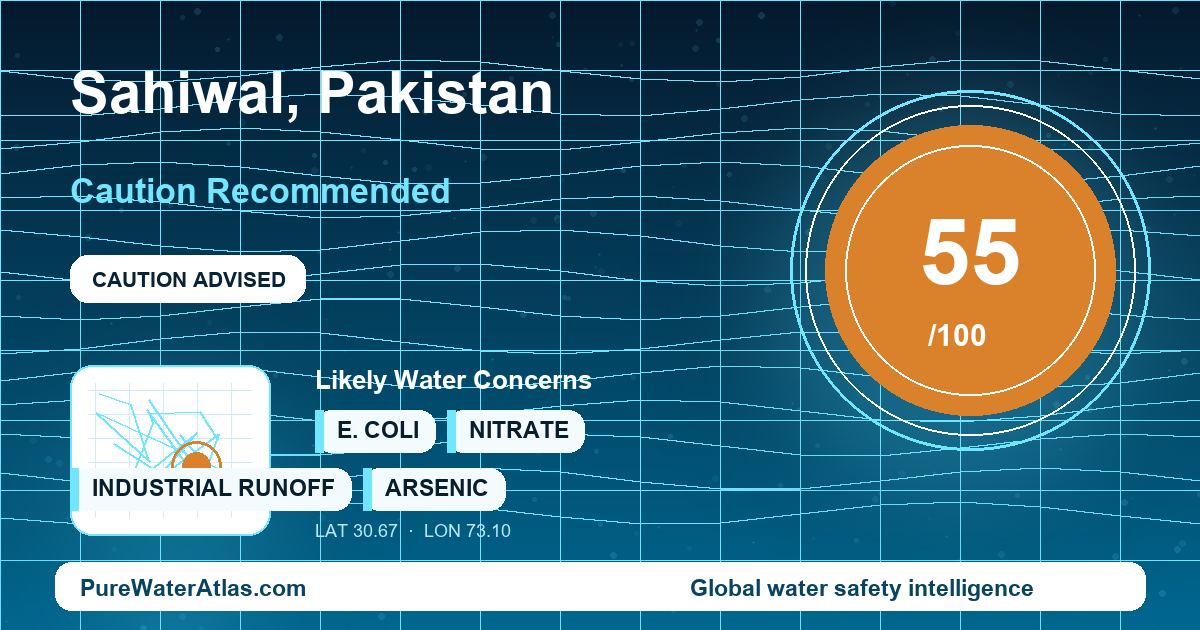
Sahiwal, Pakistan: a groundwater-based Punjab city where tap-water safety depends heavily on tube-well quality, sewer and drain proximity, household storage, filtration maintenance, and building-level plumbing.
Quick Answer
| Water safety score | 55 / 100 |
|---|---|
| Risk level | Caution Recommended |
| Can travelers drink the tap water? | Not recommended for most short-stay visitors. Use sealed bottled water, properly boiled water, or verified hotel or restaurant filtered water. |
| Resident advice | Test the actual water used for drinking, especially after rooftop or underground storage tanks and household plumbing. Conditions can vary by building, bore, tank, and filter maintenance. |
| Main water source | Primarily groundwater from municipal and private tube wells drawing from central Punjab’s alluvial aquifer. |
| Key authority context | Municipal Corporation Sahiwal and Punjab local-government structures, with relevant provincial roles including Public Health Engineering Department Punjab, Local Government and Community Development Department Punjab, and Punjab Aab-e-Pak Authority for selected safe-water initiatives. |
| Filter recommendation | A home treatment system is advisable for many households, but it should be selected from test results. Carbon filters alone do not address all possible risks such as nitrate, arsenic, salinity, or microbes. |
Overall verdict: caution is recommended. Sahiwal’s drinking-water risk is not defined by one confirmed citywide contaminant. The main issue is the combination of variable groundwater quality, intermittent pumping and pressure, aging or variable-condition pipes, sewer and drain proximity, household storage tanks, and limited public reporting of recent ward-level water-quality results.
Why Sahiwal Is Different
Sahiwal is an inland city in central Punjab on the Lahore-Multan corridor. Its drinking-water identity is different from cities that rely mainly on a large treated river-water plant or a protected upland reservoir. Sahiwal sits in a flat, alluvial, canal-irrigated agricultural landscape, so the safety of drinking water is closely tied to groundwater conditions, urban sanitation, irrigation-influenced recharge, and the condition of the local distribution and household storage system.
The city, historically known as Montgomery, developed in the canal-colony and agricultural belt of Punjab. The wider area is associated with the Lower Bari Doab canal-irrigation system and irrigated agriculture between the Ravi and Sutlej river systems. That context matters for water safety: groundwater availability is important locally, but aquifer quality can be influenced by salinity patterns, fertilizer and manure sources, wastewater seepage, urban drains, and sewer integrity.
For Sahiwal, the most practical safety question is often not simply “is the city water treated?” A visitor or resident may encounter different water quality depending on whether a building uses municipal supply, a private borehole, a rooftop tank, a reverse-osmosis unit, a public filtration point, or delivered bottled water. Water that is acceptable at a tube well can become unsafe after pumping if pipes leak, pressure drops, tanks are dirty, or the final dispenser is poorly maintained.
Where Does Sahiwal’s Tap Water Come From?
Sahiwal’s public and private drinking-water supply is understood to rely mainly on groundwater pumped by tube wells. These wells draw from the alluvial aquifer of central Punjab. Recharge can come from irrigation canals, agricultural fields, rainfall, and seepage in the wider Bari Doab setting. Because the supply is groundwater-based, local variation is expected: bore depth, local geology, nearby sanitation conditions, and the condition of pumps and pipes can all affect the quality seen at a tap.
Important water infrastructure in Sahiwal includes municipal groundwater tube wells and pumping stations, overhead or service reservoirs used for pressure balancing and local storage, urban distribution mains, household service connections, private boreholes and suction pumps, rooftop and underground storage tanks, and public or institutional filtration plants where installed and maintained.
Urban sewers, open drains, and wastewater channels are also part of the safety picture. They are not drinking-water infrastructure, but they can become contamination pathways if water pipes are depressurized, cracked, or close to sewage. Intermittent pumping, power interruptions, and pressure loss can increase the chance of contaminated water entering leaky distribution lines. After the municipal or private supply reaches a building, rooftop and underground tanks may become the dominant risk point if they are uncovered, unclean, or exposed to insects, dust, monsoon water, or drain ingress.
Who Manages Drinking Water in Sahiwal?
Local water supply and sanitation functions in Sahiwal are associated with Municipal Corporation Sahiwal and Punjab local-government structures. Larger water, sanitation, and urban infrastructure projects may involve provincial bodies such as the Local Government and Community Development Department Punjab, the Public Health Engineering Department Punjab, and the Punjab Aab-e-Pak Authority for selected filtration or safe-water initiatives.
Pakistan’s drinking-water quality is guided by the National Standards for Drinking Water Quality and related Pakistan Standards and Quality Control Authority and Pakistan Environmental Protection Agency frameworks. In Punjab, environmental and public-health oversight is spread across provincial and local institutions. However, publicly available enforcement data and routine monitoring information for Sahiwal are not as transparent as in cities where utilities publish monthly zone-by-zone water-quality dashboards.
This limitation is important. The available evidence is enough to identify Sahiwal’s likely source pattern and common risk categories for Punjab urban groundwater systems, but recent public, ward-level compliance results, residual-chlorine records, pressure data, pipe-age maps, and private-bore test results are limited. This profile should therefore be read as cautious public guidance, not a certified statement that every tap in Sahiwal is safe or unsafe.
Main Local Water Concerns
- Microbial contamination: The main immediate health concern is contamination from sewer leakage, low pressure, intermittent supply, unclean tanks, or handling of stored water. E. coli in drinking water is a key warning indicator because it signals fecal contamination risk.
- Turbidity and sediment: Cloudiness, visible particles, or dirty water may occur after pipe repairs, pump restarts, monsoon runoff, or disturbance inside storage tanks. See PureWaterAtlas guides to turbidity and sediment in drinking water.
- TDS, hardness, and salinity: Groundwater can vary in total dissolved solids, hardness, and salinity. These affect taste, scaling, and suitability for long-term use. A TDS meter can show dissolved-mineral load, but it cannot prove microbiological safety.
- Nitrate: Nitrate risk is relevant where shallow groundwater is influenced by agriculture, animal waste, septic leakage, or wastewater seepage. Learn more about nitrate in drinking water.
- Arsenic: Arsenic is a known regional concern in parts of Punjab’s alluvial groundwater. The available dataset does not justify labeling every Sahiwal neighborhood as arsenic-affected, but testing is prudent where groundwater is used. See arsenic in drinking water.
- Iron and manganese: Staining or metallic taste may occur in some groundwater supplies. These are often aesthetic or operational warning signs, but they should still prompt testing.
- Lead: Lead risk is more likely to be building-specific from old plumbing, solder, brass fittings, or fixtures than from the aquifer itself. See lead in drinking water.
- Chlorine uncertainty: Where chlorination is claimed, residual chlorine should be measured at the point of use. Learn how chlorine behaves in water from PureWaterAtlas.
Seasonal conditions can raise risk. Monsoon rains may increase drain overflows and microbial contamination, especially where pipes or tanks are not sealed. Summer heat increases demand and can worsen storage-tank hygiene. Power outages or pumping interruptions can reduce network pressure. After heavy rain, sewer work, main repairs, or long stagnation, residents should flush lines and avoid drinking untreated tap water until the supply is clear and disinfected.
For Travelers
Short-stay visitors should not treat ordinary tap water in Sahiwal as reliably safe to drink. The safest default is sealed bottled water from a reputable brand, hotel-provided filtered water from a maintained system, or water that has been boiled or treated correctly. Check bottle seals before drinking, especially during travel between Lahore, Sahiwal, and Multan.
For brushing teeth, bottled or treated water is the more cautious choice, particularly for new visitors, pregnant travelers, infants, immunocompromised people, or anyone prone to stomach illness. Many long-term residents may brush with tap water, but that is not the safest general recommendation for travelers who have not adapted to local microbial exposure.
Avoid ice unless the hotel or restaurant can confirm it was made from filtered or bottled water. Street-vendor ice should be treated as higher risk. In hotels and restaurants, do not assume that a cooler, dispenser, or RO tap is safe simply because the water looks clear. The system is only as reliable as its filter replacement, tank cleaning, disinfection, and handling. Risk-averse travelers should also be cautious with raw salads or foods washed in unknown water.
For boiling guidance, see Boiling Water Purification: Complete Guide. For treatment systems that use ultraviolet disinfection, see UV Water Purification: Complete Guide.
For Residents
Many Sahiwal households should consider a home treatment system, but the correct system depends on test results. If the main concern is microbial contamination, boiling, UV, or chlorination can help when properly applied. If salinity, arsenic, nitrate, or high TDS are present, a simple carbon filter is not enough; reverse osmosis or another targeted system may be required. RO wastewater and mineral balance should be managed responsibly.
Residents should test the exact water they drink, not only the tube-well source. The sample should ideally come from the kitchen tap after the building’s storage tank and plumbing. A practical baseline laboratory panel should include E. coli or total coliform, turbidity, pH, electrical conductivity or TDS, hardness, nitrate, arsenic, iron, manganese, and chloride or salinity indicators. If chlorination is claimed, residual chlorine should also be checked at the tap.
If a building is old or has unknown plumbing materials, test first-draw and flushed samples for lead and other metals. Older buildings, schools, clinics, and rented properties may have corroded galvanized pipes, old fittings, dead-end plumbing, or unclean underground tanks. Let stagnant water run before use, avoid hot tap water for cooking or drinking, and test when plumbing age is uncertain.
Storage tanks deserve special attention in Sahiwal. Rooftop and underground tanks should be covered, screened against insects and dust, protected from sewer or drain ingress, cleaned and disinfected on a schedule, and inspected after monsoon rains. A good filter cannot compensate for a dirty tank upstream of the drinking tap unless final point-of-use treatment is maintained.
Relevant Contaminants and Water-Quality Issues
The most relevant PureWaterAtlas contaminant profiles for Sahiwal are those linked to groundwater variability, sanitation risk, storage tanks, and building plumbing. Start with E. coli for microbial contamination, turbidity and sediment for visible water-quality changes, nitrate for agriculture and wastewater-influenced groundwater, arsenic for regional alluvial-aquifer risk, lead for older plumbing, and chlorine for understanding disinfection residuals.
For deeper technical guidance, see Arsenic in Drinking Water: Testing and Detection Methods, Nitrate Contamination in Drinking Water: Testing and Detection Methods, and Lead in Drinking Water: Testing and Detection Methods.
How to Verify Your Water Quality
The most reliable way to answer “is my tap water safe in Sahiwal?” is to test your own point-of-use water. A TDS meter alone is not enough because it cannot detect E. coli, viruses, arsenic, nitrate, lead, or many chemical contaminants. Use a certified laboratory where possible, and retest after flooding, sewer backups, new bore installation, pipe repairs, unusual taste or odor, illness clusters in the household, or major changes in color or sediment.
PureWaterAtlas resources that can help include the Water Testing guide, the Drinking Water Safety guide, Water Microbiology, and Water Treatment Systems. You can also use the Global Water Quality Checker and browse the Contaminants Search Engine. For wider context, see Global Water Quality.
Official and Technical Sources
- Pakistan Council of Research in Water Resources, Water Quality Reports — national research source for Pakistan drinking-water monitoring and recurring urban water-quality concerns.
- Pakistan Environmental Protection Agency, National Standards for Drinking Water Quality — official national benchmark for key drinking-water parameters.
- Punjab Public Health Engineering Department — relevant provincial institution for water-supply and sanitation schemes.
- Local Government and Community Development Department Punjab — provincial local-government department relevant to municipal services.
- Municipal Corporation Sahiwal, Local Government Punjab portal — local municipal identity source for Sahiwal.
- Punjab Aab-e-Pak Authority — provincial authority associated with safe drinking-water filtration facilities.
- Punjab Irrigation Department — official source for Punjab canal and irrigation context.
- WHO and UNICEF Joint Monitoring Programme: Pakistan WASH data — household water, sanitation, and hygiene context for Pakistan.
- World Health Organization Guidelines for Drinking-water Quality — global reference for microbial and chemical drinking-water risk management.
Bottom Line
Sahiwal’s tap water should be treated with caution. The city’s supply is primarily groundwater-based, supported by tube wells, local distribution pipes, household storage tanks, private bores, and some filtration points. That means quality can vary street by street and building by building. Travelers should use sealed bottled water, verified filtered water, or properly boiled water, and should avoid unverified ice. Residents should test the water they actually drink after tanks and plumbing, with attention to E. coli or coliform, turbidity, TDS, hardness, nitrate, arsenic, iron, manganese, salinity indicators, and lead where plumbing is old. Because public ward-level data are limited, Sahiwal should not be judged by taste or clarity alone.
Read the full guide: Global Water Quality Guide
Explore more in this category: Global Water Quality Articles