
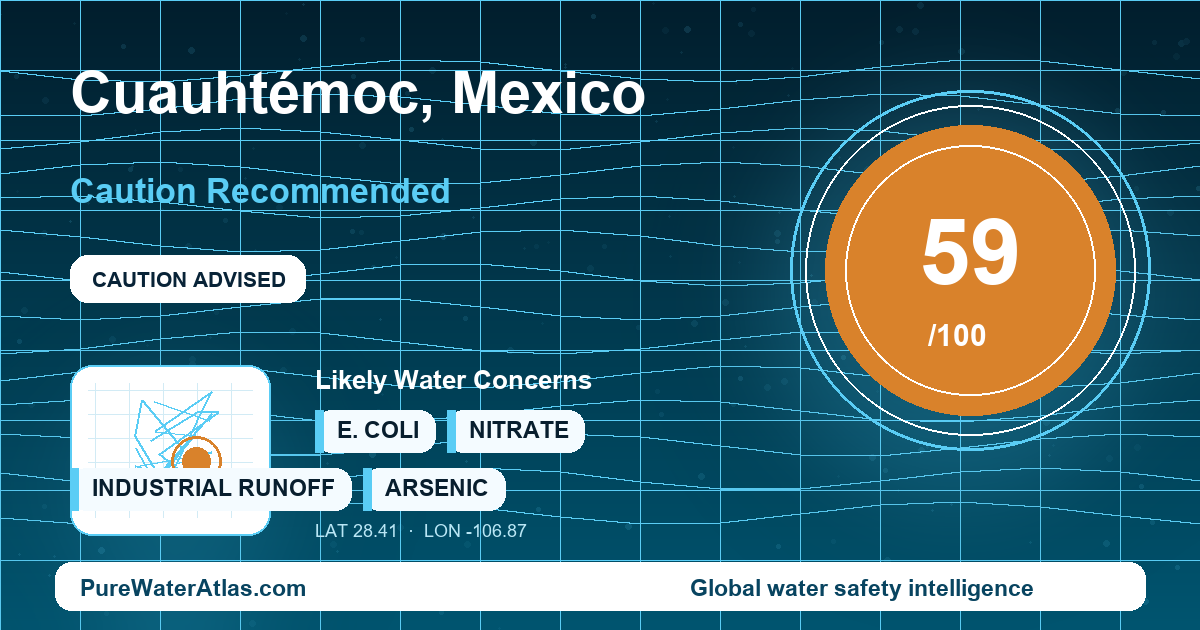
Cuauhtémoc, Chihuahua is a groundwater-dependent high-plains city where municipal disinfection is expected, but limited public tap-level data, aquifer stress, agricultural surroundings, household storage, and building plumbing mean caution is recommended for drinking.
Quick Answer
| Water safety score | 59 / 100 |
|---|---|
| Risk level | Caution Recommended |
| Can travelers drink the tap water? | Not recommended as a primary drinking source. Visitors should use sealed bottled water, reputable garrafón water, or properly treated water. |
| Resident guidance | Use municipal tap water as household water, but verify drinking quality at the tap before relying on it untreated. |
| Main water source | Primarily groundwater wells associated with the Cuauhtémoc aquifer area and the Laguna de Bustillos closed-basin setting. |
| Local authority | Junta Municipal de Agua y Saneamiento de Cuauhtémoc, commonly referred to as JMAS Cuauhtémoc. |
| Filter recommendation | Sediment prefiltration plus activated carbon is a practical baseline. Consider reverse osmosis or another certified system if testing shows high TDS, nitrate, arsenic, fluoride, or related groundwater contaminants. |
Editorial verdict: Caution is recommended. Cuauhtémoc’s municipal system is understood to rely mainly on groundwater and is expected to use disinfection, but PureWaterAtlas does not rate untreated tap water as reliably drinkable for all users. The reason is not a confirmed citywide failure; it is the combination of limited current, easy-to-find consumer water-quality reporting, groundwater stress, potential agricultural and geochemical contaminants, and final-mile risks inside homes, tinacos, cisterns, and older plumbing.
Why Cuauhtémoc Is Different
Cuauhtémoc is not a city whose drinking-water identity is defined by a large imported surface-water reservoir or a highly visible metropolitan treatment plant. It sits on a high, semi-arid plateau west of Chihuahua City in an agricultural and commercial region tied to the Laguna de Bustillos closed basin. That geography matters because the city’s water security and quality depend heavily on groundwater conditions.
The surrounding region is one of Chihuahua’s important agricultural areas, with apple production, dairy, livestock, agroindustrial activity, and Mennonite farming communities. This does not mean every tap in Cuauhtémoc is contaminated. It does mean that nitrate, dissolved minerals, salinity indicators, and other groundwater-related parameters deserve more attention here than they might in a city supplied primarily by a protected surface reservoir with published treatment-plant summaries.
Another Cuauhtémoc-specific reality is the role of final barriers. Like many northern Mexico communities, many households and businesses use garrafón water or point-of-use treatment for drinking even where municipal water is chlorinated. In Cuauhtémoc, that behavior is a practical precaution because source and utility responsibility are identifiable, while recent neighborhood-level tap-water analytical results are not readily available in a single consumer-facing format.
Where Does Cuauhtémoc’s Tap Water Come From?
Cuauhtémoc’s municipal supply is understood to come mainly from groundwater production wells drawing from the Cuauhtémoc aquifer area in central-western Chihuahua. The city developed as a high-plains agricultural and commercial center, and local groundwater has long been the practical source for urban and rural users. The basin is also heavily used for irrigation, livestock, and agroindustrial activity, so source-water management is central to any realistic safety assessment.
The public water system depends on several layers of infrastructure: municipal groundwater wells, disinfection points, storage tanks or distribution reservoirs, pressure management, distribution mains, service connections, and the plumbing inside individual buildings. That type of system can deliver safe water when wells are protected, disinfection is maintained, and system pressure is continuous. It becomes more vulnerable during line breaks, low-pressure periods, intermittent service, repairs, or when household storage tanks are dirty or poorly sealed.
Seasonal conditions can also affect practical risk. Dry-season and irrigation-season demand can increase stress on groundwater production and pressure management. Summer monsoon storms can create runoff, localized flooding, sediment intrusion during repairs, and short-term turbidity or microbial concerns if distribution integrity is compromised. Winter cold snaps in Chihuahua can contribute to pipe breaks or service interruptions. After any outage, low-pressure event, repair, or period of cloudy or discolored water, residents should flush plumbing and use bottled, boiled, or otherwise verified water until normal clarity and pressure return. Boiling helps with microbes but does not remove groundwater chemicals such as nitrate, arsenic, fluoride, salts, or dissolved metals.
Who Manages Drinking Water in Cuauhtémoc?
The local drinking-water and sanitation utility is the Junta Municipal de Agua y Saneamiento de Cuauhtémoc, commonly known as JMAS Cuauhtémoc. It is the primary local point of contact for service notices, repairs, payments, and operational information. At the state level, the broader Chihuahua water and sanitation structure is connected to the Junta Central de Agua y Saneamiento del Estado de Chihuahua.
Mexico’s national drinking-water health standard is NOM-127-SSA1-2021, which governs water for human use and consumption. Sanitary surveillance is associated with health authorities such as COFEPRIS and state health authorities. Water-resource context, including aquifer availability and concessions, falls under CONAGUA aquifer availability documentation and the Sistema Nacional de Información del Agua.
Data limitation: PureWaterAtlas found credible information on the local utility, groundwater dependence, and federal aquifer context. However, a single current, consumer-friendly Cuauhtémoc water-quality report with routine tap sampling by distribution zone, recent chlorine residual statistics, microbiological summaries, nitrate, arsenic, fluoride, and metals data was not readily available. This profile therefore identifies relevant local risk factors and practical precautions; it does not claim that every neighborhood is unsafe or that specific contaminants exceed Mexican legal limits.
Main Local Water Concerns
- Groundwater dependence and aquifer stress: Cuauhtémoc’s supply is tied to wells and the local aquifer setting. Official CONAGUA aquifer documents for Chihuahua make availability and extraction pressure central issues, so source resilience is a key concern.
- Nitrate potential: Because the surrounding basin includes agriculture, livestock, and rural properties, nitrate is a sensible parameter to test, especially for private wells and homes with infants or pregnant residents.
- Dissolved minerals, hardness, and salinity indicators: Closed-basin groundwater can contain elevated dissolved solids in some settings. Taste, scale, conductivity, TDS, and hardness testing are useful in Cuauhtémoc, but should not be assumed uniform across all taps.
- Arsenic and fluoride screening: Parts of northern Mexico and Chihuahua have documented groundwater geochemistry concerns. Residents using wells or unverified water should include arsenic and fluoride in a laboratory panel rather than relying on taste or odor.
- Microbial risk after pressure loss: Even chlorinated systems can experience short-term contamination risk after pipe breaks, low-pressure events, flooding around infrastructure, or dirty household tanks. E. coli testing is the key verification step for fecal contamination.
- Premise plumbing: Older buildings, brass fixtures, solder, valves, unknown service materials, and stagnant water can affect metals at the tap. Lead risk is usually a building-plumbing question, not just a utility-source question.
For Travelers
Travelers should not rely on untreated Cuauhtémoc tap water as their main drinking water. Use sealed bottled water, garrafón water from a reputable supplier, or water treated by a well-maintained point-of-use system. This is a precautionary recommendation based on limited public city-level testing visibility, groundwater-related concerns, and the fact that visitors may be more sensitive to unfamiliar microbes.
Brushing teeth with tap water is usually a lower-risk exposure than drinking full glasses, especially in established hotels, but cautious travelers, children, immunocompromised visitors, and anyone with a sensitive stomach should use bottled or purified water. Avoid refilling from bathroom taps during day trips or hotel stays.
For ice, ask for hielo purificado or skip ice if the source is uncertain. Higher-end hotels, established restaurants, cafés, and many businesses commonly use purified water for beverages and ice, but visitors should still ask. Do not assume that water served in a pitcher is purified unless staff confirm it.
Boiling can reduce microbial risk when done correctly, but it is not a complete solution for Cuauhtémoc’s groundwater-related concerns. Boiling does not remove nitrate, arsenic, fluoride, dissolved salts, or metals. For travel convenience, sealed bottled water or confirmed purified water is the safer default.
For Residents
Residents should treat Cuauhtémoc tap water as usable household water, while verifying drinking quality at the kitchen tap before relying on it untreated. A practical baseline is sediment filtration followed by activated carbon. Sediment filtration helps with particles, cloudy water, and clogged fixtures. Activated carbon can improve taste and odor and reduce some chlorine-related issues. If testing shows high TDS, nitrate, arsenic, fluoride, or other inorganic contaminants, consider a certified reverse osmosis system and maintain it carefully. UV can be useful for microbiological protection, but only after sediment is controlled and only when the lamp and quartz sleeve are maintained.
Test kitchen-tap water at least annually if your household drinks it regularly. Test immediately after major plumbing work, repeated outages, flooding, unusual taste, odor, color, or recurring sediment. For municipal tap water, a useful panel includes total coliform and E. coli, free chlorine residual at the tap, turbidity, pH, conductivity or TDS, hardness, nitrate, fluoride, arsenic, iron, manganese, and lead if the building is older or plumbing materials are unknown.
Private wells and rural properties near Cuauhtémoc need more caution. Use a certified laboratory panel that includes microbiology, nitrate, arsenic, fluoride, TDS or conductivity, major ions, hardness, and any agrichemical parameters recommended by local health or water professionals. If infants, pregnant residents, older adults, or immunocompromised people live in the home, do not rely on taste or odor. Use bottled or properly treated water until microbiological and nitrate results are verified.
Premise plumbing and storage are important final barriers. In older buildings, flush water after overnight stagnation, avoid using hot tap water for cooking or infant formula, and test first-draw and flushed samples if metals are a concern. Tinacos, cisterns, and building storage tanks should have sealed lids, protected vents and overflows, and routine cleaning and disinfection. A tank can become the weak point in an otherwise disinfected supply, especially after low-pressure events.
Relevant Contaminants and Water-Quality Issues
Several PureWaterAtlas contaminant profiles are especially relevant for Cuauhtémoc’s groundwater-based context. Chlorine is important because a disinfectant residual is a key safety barrier in a municipal well system. Turbidity and sediment matter after repairs, outages, storms, tank disturbance, or visible cloudiness. E. coli is the practical indicator for fecal contamination risk after pressure loss or in private wells and household tanks.
For chemical screening, nitrate is relevant because of the agricultural and livestock setting around the Cuauhtémoc basin. Arsenic should be included when evaluating groundwater or unverified supplies in northern Mexico. Lead is relevant where older premises, unknown fixtures, solder, valves, or stagnant building plumbing may affect water at the tap.
How to Verify Your Water Quality
The most reliable answer for a Cuauhtémoc household is a recent test from the actual tap used for drinking. Start with the PureWaterAtlas guide How to Test Drinking Water: Complete Guide to Water Testing and Analysis. For microbial risk, review Water Microbiology: Bacteria, Viruses and Microbial Risks in Drinking Water. For selecting a filter, see Water Treatment Systems: Choosing the Right Solution for Safe Drinking Water.
If your test indicates nitrate, arsenic, or lead concerns, use the focused guides on nitrate testing, arsenic testing, and lead testing. For treatment methods, compare the role and limits of boiling and UV purification. You can also use the Contaminants Search Engine and the Global Water Quality Checker for broader context.
Official and Technical Sources
- Junta Municipal de Agua y Saneamiento de Cuauhtémoc — local water and sanitation utility for Cuauhtémoc.
- Junta Central de Agua y Saneamiento del Estado de Chihuahua — state-level water and sanitation institution.
- CONAGUA – Disponibilidad por acuíferos — federal groundwater availability documentation, including Chihuahua aquifer context.
- CONAGUA – Sistema Nacional de Información del Agua — national water-resource and hydrologic information system.
- Diario Oficial de la Federación – NOM-127-SSA1-2021 — Mexican drinking-water health standard.
- COFEPRIS — federal sanitary risk authority relevant to public-health surveillance.
- INEGI – Cuauhtémoc municipality data — official geographic and demographic reference.
- World Health Organization – Drinking-water fact sheet — public-health reference on microbial and chemical drinking-water risks.
Bottom Line
Cuauhtémoc’s tap water should be approached with caution for drinking. The city is mainly supplied by groundwater wells in a semi-arid agricultural basin, with municipal handling and expected disinfection, but PureWaterAtlas did not find current, neighborhood-level tap-water results in a consolidated public format. Travelers should use sealed bottled water, reputable garrafón water, or confirmed purified water, especially for drinking and ice. Residents can use tap water for household purposes, but should test kitchen-tap water before drinking it untreated and maintain filters, tinacos, cisterns, and plumbing. Key local checks include microbiology, chlorine residual, turbidity, TDS, hardness, nitrate, fluoride, arsenic, and lead where plumbing is older or unknown.
Read the full guide: Global Water Quality Guide
Explore more in this category: Global Water Quality Articles