
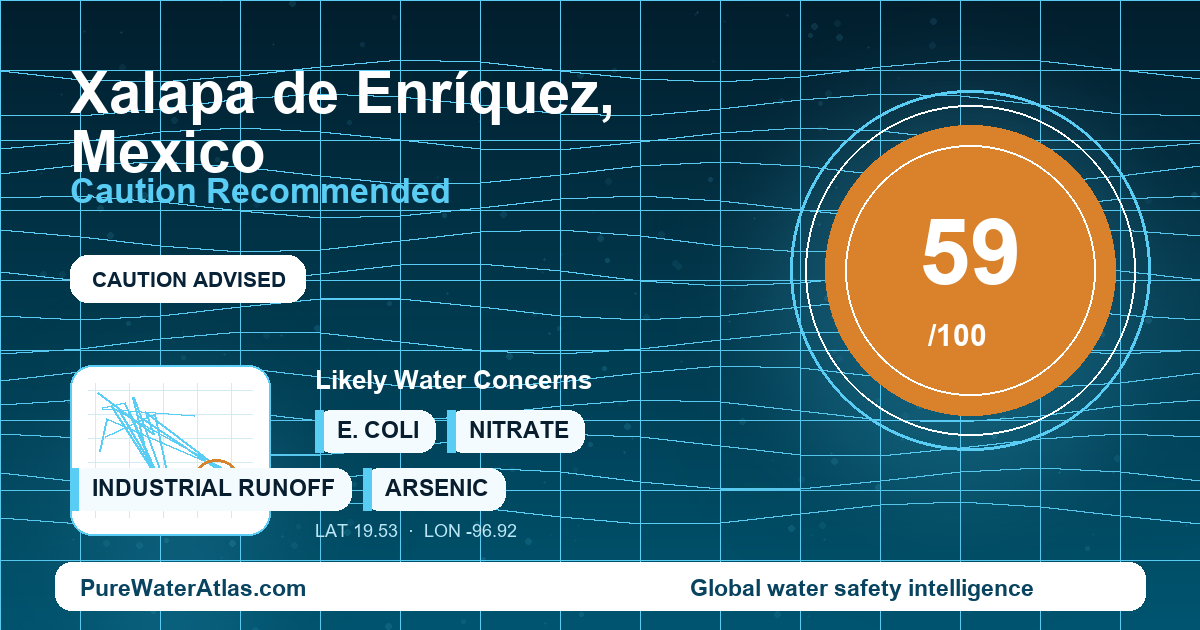
A Xalapa de Enríquez-specific assessment of municipal tap water, mountain source waters, tandeos, storage tanks, traveler precautions and household treatment options.
Quick Answer
| Water safety score | 59 / 100 |
|---|---|
| Risk level | Caution Recommended |
| Can visitors drink the tap water? | Most short-term visitors should not drink untreated tap water in Xalapa de Enríquez. Use sealed bottled water, purified garrafón water or water treated by a well-maintained certified system. |
| Resident guidance | Municipal tap water can often be used for washing, bathing and cooking with precautions, but drinking water should usually be filtered, boiled, UV-treated or obtained from a trusted purified-water source, especially where tinacos, cisterns, old plumbing or service interruptions are involved. |
| Main water identity | A mixed mountain raw-water system using surface-water and spring catchments from the upper La Antigua basin, Cofre de Perote region, Huitzilapan system, Pixquiac watershed, Xocoyolapan and other highland sources. |
| Local authority | Comisión Municipal de Agua Potable y Saneamiento de Xalapa, commonly known as CMAS Xalapa. |
| Filter recommendation | For most homes, use sediment prefiltration plus activated carbon, with UV or boiling for microbial risk. Reverse osmosis may be useful only where testing supports it and maintenance is planned. |
Editorial verdict: caution is recommended. Xalapa has a formal municipal water system and is not an untreated informal supply, but its safety at the tap depends on pressure stability, recent rain, local repairs, storage tank hygiene, building plumbing and whether current testing is available for the specific location.
Why Xalapa de Enríquez Is Different
Xalapa de Enríquez is not a coastal city relying on desalination or a simple local aquifer. Its drinking-water security is tied to humid, high-elevation mountain catchments on the eastern slopes of the Cofre de Perote and near the transition between volcanic highlands and the Gulf of Mexico coastal plain. That geography matters because the city depends on cloud-forest and upper-basin water sources that are sensitive to dry-season flow reductions, storm runoff, landslide-prone terrain and upstream land-use pressures.
The most important Xalapa-specific drinking-water issue is variability. Tap water may be chlorinated and acceptable for many non-drinking uses in one building or season, yet become higher risk after heavy rainfall, pipe repairs, low-pressure periods, a long tandeo interval or storage in an unclean tinaco. This is why the answer is not simply “safe” or “unsafe” for the whole city. The municipal supply chain includes source waters, aqueducts, distribution zones, storage infrastructure and the household’s own cisterns or rooftop tanks.
Xalapa’s growth has increased demand on mountain catchments that also serve ecological and rural community needs. The Pixquiac watershed is especially important in local water-security discussions because it is both a supply area and a conservation target. This makes source-water protection central to the city’s long-term drinking-water reliability, not just an environmental issue.
Where Does Xalapa de Enríquez’s Tap Water Come From?
Xalapa de Enríquez is supplied by a mixed mountain raw-water system rather than a single local wellfield. Public and local technical references describe reliance on surface-water and spring sources from the upper La Antigua basin and the Cofre de Perote region. Important supply names in local water discussions include the Huitzilapan system from the Quimixtlán area of Puebla, the Pixquiac watershed, Xocoyolapan and other highland spring or stream intakes.
Water is conveyed through aqueducts and conduction lines into municipal storage, treatment or disinfection points and then into the urban distribution network. Key infrastructure includes the CMAS Xalapa municipal water and sewerage network, pressure zones, distribution pipes, valves, tanks and pumping or gravity-fed sectors. The Huitzilapan aqueduct or conduction system is commonly cited as one of the major external mountain-water supply routes serving Xalapa, while Pixquiac watershed intakes and additional local stream and spring systems serve part of the municipal supply.
Household-level infrastructure is also part of the real water safety chain. In Xalapa, as in many Mexican cities with intermittent pressure, homes and buildings commonly rely on cisterns and rooftop tinacos. These storage systems can help residents cope with tandeos and pressure changes, but they also create a point where disinfected water can become unsafe if tanks are dirty, lids are not sealed, sediment accumulates or chlorine residual falls too low.
Who Manages Drinking Water in Xalapa de Enríquez?
The local drinking-water and sewerage utility is Comisión Municipal de Agua Potable y Saneamiento de Xalapa, or CMAS Xalapa. CMAS handles municipal service delivery, operational notices and local water-service management. The Ayuntamiento de Xalapa provides the municipal government context for the city and its public-service institutions.
Drinking-water quality in Mexico is governed federally by Secretaría de Salud standards, especially NOM-127-SSA1-2021, the federal standard for water for human use and consumption. Sanitary surveillance involves health authorities such as COFEPRIS and state health services, while CONAGUA regulates national water resources, concessions and hydrological information.
A key limitation for Xalapa is transparency of recent, granular water-quality data. Public information is sufficient to identify the utility, general source-water dependence, federal regulatory framework and recurring operational risks. However, this review did not find one easily accessible, current, citywide database of routine drinking-water lab results by distribution zone covering E. coli, residual chlorine, turbidity, metals, nitrate and disinfection byproducts. For that reason, this page does not claim universal potability or universal contamination across the city.
Main Local Water Concerns
- Intermittent service and tandeos: Scheduled or recurring supply interruptions can create pressure drops, increase reliance on storage tanks and raise the importance of household hygiene.
- Dry-season stress: Lower mountain source flows and higher demand can contribute to rationing and stronger dependence on stored water, especially in late dry periods.
- Rainy-season turbidity: Heavy rain, storm runoff and mountain terrain can increase raw-water sediment and turbidity, particularly after intense rainfall or tropical-storm periods affecting Veracruz.
- Aging or repaired infrastructure: Pipe breaks, street works, service restoration and pressure changes can introduce sediment, discolored water or air in pipes at the building level.
- Private storage tanks: Cisterns and tinacos can create microbial risk when not cleaned and disinfected regularly, even if water entered the property with disinfectant residual.
- Older internal plumbing: In some buildings, metals such as lead may be a premise-plumbing concern, not a verified citywide source-water claim.
- Limited public testing detail: The lack of easily accessible, sample-by-sample municipal results increases uncertainty for individual homes and neighborhoods.
For Travelers
Short-term visitors should not rely on untreated tap water for routine drinking in Xalapa de Enríquez. The municipal system is formal and may be disinfected, but traveler risk is shaped by intermittent service, storage tanks, turbidity potential and limited public access to current neighborhood-level testing. The safer default is sealed bottled water, purified garrafón water or water from a clearly maintained purification system.
For brushing teeth, healthy adults in reputable hotels may consider tap water a lower-risk exposure than drinking full glasses of it. Cautious travelers, children, pregnant travelers and anyone with a sensitive stomach should use bottled or purified water even for brushing. If tap water looks cloudy or brown, smells strongly unusual or has just returned after an outage, do not use it for oral exposure unless treated.
Use ice only if it is commercial bagged ice or if the restaurant, café or hotel confirms that it is made with purified water. Many hotels, cafés and restaurants in Xalapa use garrafón or purified water for drinking service, but visitors should ask for agua purificada or agua de garrafón if unsure. In vacation rentals, check whether the kitchen tap is direct municipal water, a filtered tap or a separate purified-water dispenser.
During dry-season rationing or when staying outside the city center, carry purified water with you. Boiling can reduce microbial risk, but it does not remove metals, nitrate, salts or chemical contaminants. For more detail on when boiling helps and when it does not, see the PureWaterAtlas guide to boiling water purification.
For Residents
For most Xalapa households, a point-of-use treatment system is advisable for drinking water unless the home has recent lab results and a well-maintained storage system. A practical setup is sediment prefiltration plus activated carbon for taste, odor and chlorine management, with UV or boiling when microbial risk is suspected. UV can be effective as a microbial barrier when water is first clarified by sediment filtration; see the PureWaterAtlas UV water purification guide for treatment principles.
Reverse osmosis may be appropriate where testing shows nitrate, elevated dissolved solids or specific metals, but it should not be chosen blindly. RO systems require maintenance, cartridge changes and an understanding of what problem they are intended to solve. Residents using private wells, rural extensions, springs or mixed non-municipal sources around the urban edge should be especially careful not to assume that municipal source-water conditions apply to their supply.
Recommended testing for Xalapa homes includes total coliforms and E. coli when water is stored in a cistern or tinaco, after long service interruptions or when recurrent gastrointestinal illness is a concern. Free chlorine residual should be measured at the tap, especially at the far end of plumbing or after water has sat in storage. Turbidity and visible sediment should be checked after heavy rains, pipe repairs and tandeo restoration.
Older buildings need extra attention. Lead solder, brass fixtures, galvanized pipe corrosion, old valves and stagnant water in long internal lines can affect first-draw water in the morning. If infants, pregnant people or children live in the home, test first-draw and flushed samples for lead and other plumbing-related metals. The PureWaterAtlas article on lead testing and detection methods explains why first-draw sampling matters.
Tinacos and cisterns are major control points in Xalapa. Keep lids sealed, remove sediment and biofilm, clean and disinfect tanks periodically and avoid drinking from storage systems that have not been maintained. Even if water enters the property disinfected, insects, cracked tanks, dirty lids and low residual chlorine can create microbial risk before the water reaches the glass.
Relevant Contaminants and Water-Quality Issues
The most relevant Xalapa water-quality issues are not limited to one famous contaminant. Chlorine is important because municipal water is commonly disinfected, but residual levels may decline after storage in cisterns and tinacos. Turbidity matters because mountain surface-water supplies can respond to heavy rain, runoff and service restoration after interruptions. Sediment is relevant after pipe repairs, pressure changes, aging infrastructure disturbances and tank accumulation.
Microbial risk is a practical concern where pressure drops, storage tanks or poor tank hygiene are present. E. coli testing is one of the clearest indicators that fecal contamination may have reached a water sample. Lead should be treated as a building-level plumbing concern in older properties rather than a verified citywide source-water claim. Nitrate is especially relevant for private, rural, mixed or non-municipal sources and should be tested rather than assumed.
How to Verify Your Water Quality
The strongest way to reduce uncertainty in Xalapa is building-level testing. Start with the PureWaterAtlas complete guide to water testing and analysis to understand sample types, lab selection and which contaminants match your situation. For general decision-making, the Drinking Water Safety guide explains how to evaluate whether tap water is safe in a specific building.
If your concern is bacteria, viruses, storage tanks or boil-water decisions, review Water Microbiology. If you are choosing between sediment filters, activated carbon, UV, reverse osmosis or other household systems, use the PureWaterAtlas guide to Water Treatment Systems. Travelers comparing Xalapa with other destinations can use the Global Water Quality Checker, and residents researching specific substances can search the Contaminants Search Engine.
For households using wells, rural extensions or mixed supplies, nitrate screening can be important; the PureWaterAtlas guide to nitrate testing and detection methods is a useful starting point. When test results will guide health decisions, rental property decisions or expensive treatment equipment, use an accredited local laboratory.
Official and Technical Sources
- Comisión Municipal de Agua Potable y Saneamiento de Xalapa, CMAS Xalapa — primary local authority for municipal water and sewer service in Xalapa.
- Ayuntamiento de Xalapa — municipal government context for Xalapa and local public-service institutions.
- Diario Oficial de la Federación, NOM-127-SSA1-2021 — federal Mexican standard for water for human use and consumption.
- Comisión Nacional del Agua, CONAGUA — national authority for water resources, concessions, hydrology and water infrastructure policy.
- CONAGUA Servicio Meteorológico Nacional, Monitor de Sequía en México — official drought monitoring relevant to dry-period stress and source-flow variability.
- INEGI Xalapa municipality geographic data — official geographic and municipal reference for Xalapa, Veracruz.
- World Health Organization drinking-water fact sheet — public-health reference on drinking-water safety, microbial risk and household water safety principles.
- COFEPRIS — federal sanitary authority involved in public-health protection and water-related sanitary surveillance in Mexico.
Bottom Line
Xalapa de Enríquez has a formal municipal water system operated by CMAS Xalapa and supplied mainly by mountain surface-water and spring catchments, including systems associated with Huitzilapan, Pixquiac, Xocoyolapan and the Cofre de Perote region. The main concern is variability: dry-season rationing, pressure changes, heavy-rain turbidity, pipe repairs and household cisterns or tinacos can all affect what reaches the tap. Visitors should use sealed bottled or purified garrafón water and avoid uncertain ice. Residents should treat drinking water with appropriate point-of-use filtration, boiling or UV when needed, maintain storage tanks and test for microbiology, chlorine residual, turbidity and plumbing-related metals where relevant. Because recent distribution-zone lab data are not easily public, caution is the safest default.
Read the full guide: Global Water Quality Guide
Explore more in this category: Global Water Quality Articles