
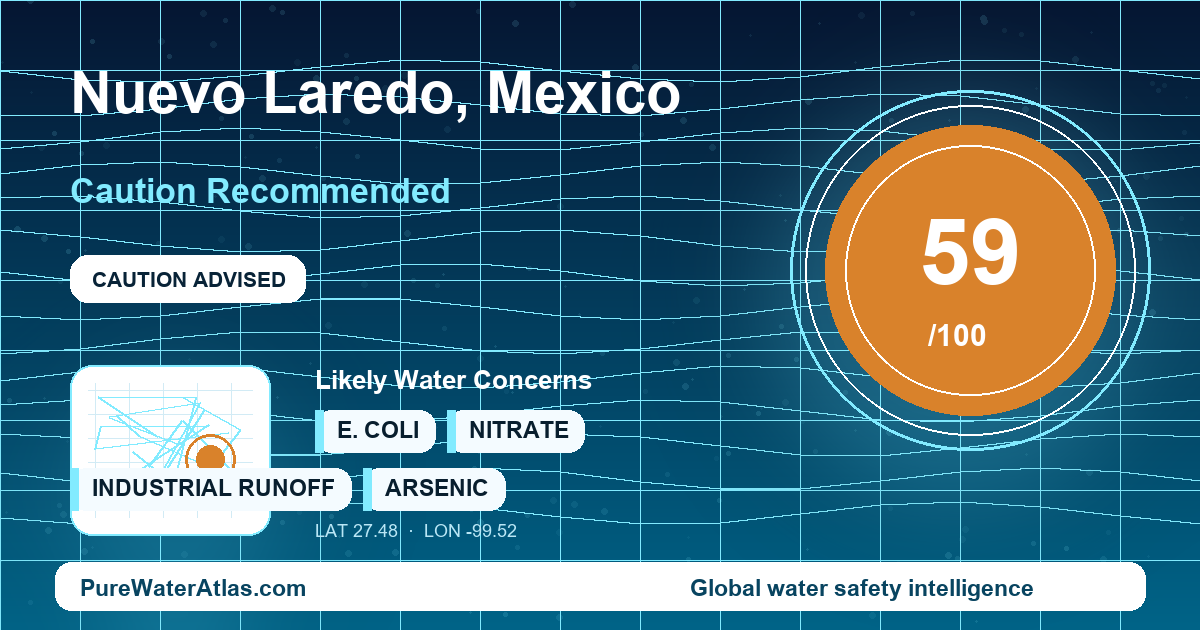
Nuevo Laredo’s tap water is tied to the Rio Bravo/Rio Grande, municipal treatment by COMAPA, and building-level storage practices that can strongly affect water quality at the faucet.
Quick Answer
| Water safety score | 59 / 100 |
|---|---|
| Risk level | Caution Recommended |
| Can visitors drink the tap water? | Not as the safest default. Most short-term visitors should use sealed bottled water or clearly maintained filtered and disinfected water. |
| Resident guidance | Use a maintained point-of-use system where appropriate, clean and disinfect cisterns or tinacos, and test water at the actual tap when service, plumbing, taste, sediment, or vulnerable occupants raise concern. |
| Main raw-water source | Rio Bravo, known in the United States as the Rio Grande. |
| Local water authority | Comisión Municipal de Agua Potable y Alcantarillado de Nuevo Laredo, commonly known as COMAPA Nuevo Laredo. |
| Filter recommendation | A home filter is advisable for many households, but the right system depends on testing. Carbon and sediment filtration may help with taste, odor, chlorine, and sediment; reverse osmosis may be more appropriate for dissolved salts or broader chemical reduction; microbial risk from tanks also requires cleaning and disinfection. |
Overall verdict: Caution is recommended. Nuevo Laredo is not a no-water city: it has a municipal utility, treatment infrastructure, and a defined river source. The reason for caution is that safe drinking at the faucet depends not only on central treatment, but also on Rio Bravo/Rio Grande variability, pressure and distribution reliability, household storage tanks, building plumbing, and limited public access to recent citywide finished-water test results.
Why Nuevo Laredo Is Different
Nuevo Laredo sits directly on the Rio Bravo/Rio Grande opposite Laredo, Texas. That geography matters. Unlike a city supplied mainly by deep protected aquifers, Nuevo Laredo is tied to a major international river corridor. The river is a boundary, a source-water system, and part of a heavily managed basin affected by drought, reservoir operations, irrigation demand, municipal growth, and cross-border allocation issues.
This makes the practical tap-water question more layered than simply asking whether the city has a treatment plant. Nuevo Laredo’s municipal system depends on surface-water intake, treatment, pumping, storage, and distribution. After water leaves the utility system, it may pass through private cisterns, rooftop tanks, internal building plumbing, or older fixtures before reaching the kitchen faucet. In a hot border city where water storage is common, those building-level conditions can create a separate risk from the treatment plant itself.
For this profile, PureWaterAtlas rates Nuevo Laredo as Caution Recommended rather than broadly safe for direct tap-water drinking. The confidence level is medium: the source-water identity and utility framework are clear, but recent, comprehensive, neighborhood-level public tap-water quality data for Nuevo Laredo was not identified in the high-authority sources used for this assessment.
Where Does Nuevo Laredo’s Tap Water Come From?
Nuevo Laredo’s municipal drinking-water supply is primarily associated with the Rio Bravo, called the Rio Grande in the United States. The river forms the border between Nuevo Laredo and Laredo, Texas, and has historically been the defining water source and boundary feature for the city.
The city’s drinking-water infrastructure includes Rio Bravo surface-water intake or intakes, municipal drinking-water treatment plants operated by COMAPA Nuevo Laredo, pumping stations and cárcamos, storage tanks and elevated tanks, and a distribution network serving homes, businesses, hotels, restaurants, and public facilities. These components are essential because surface water generally requires active treatment and ongoing disinfection control before it can be distributed as potable water.
The Rio Bravo/Rio Grande basin is water-stressed and heavily managed. Low river flows and drought can concentrate dissolved minerals and pollutants. Heavy rain can increase turbidity and runoff-related contamination pressure. Repair work, pipe breaks, or pressure changes can disturb sediment and affect chlorine residual at the tap. These factors do not prove that every faucet is unsafe, but they explain why Nuevo Laredo’s tap water should be assessed as a source-to-tap system rather than only as a treated-water product leaving a plant.
Who Manages Drinking Water in Nuevo Laredo?
Municipal water service in Nuevo Laredo is managed by COMAPA Nuevo Laredo, the Comisión Municipal de Agua Potable y Alcantarillado. COMAPA is the local water and sewer utility responsible for municipal service, utility operations, and local water-system information. Local public works and service announcements may also be issued through the Gobierno Municipal de Nuevo Laredo.
Drinking water in Mexico is governed by national health and water regulations, including NOM-127-SSA1-2021, the potable-water quality standard for water for human use and consumption. Oversight roles involve health and water authorities such as COFEPRIS, state health agencies, CONAGUA, and the municipal utility.
Because Nuevo Laredo depends on the Rio Bravo/Rio Grande, broader basin context also matters. The CONAGUA Sistema Nacional de Información del Agua provides national water-management and hydrologic information relevant to the basin. Binational water context is also relevant through the International Boundary and Water Commission, United States and Mexico, which addresses Rio Grande/Rio Bravo boundary and water-management issues affecting border communities.
Main Local Water Concerns
The main water-quality concerns in Nuevo Laredo begin with the city’s surface-water source. The Rio Bravo/Rio Grande is exposed to upstream urban, agricultural, and industrial pressures. During storms or river disturbance, turbidity can rise, making treatment more challenging. During drought and low-flow periods, dissolved minerals and some pollutants may become more concentrated in the broader river system.
Distribution and premise plumbing are equally important. Intermittent pressure or local service interruptions can increase the chance of intrusion in weak parts of a distribution network. Pipe repairs, pressure changes, or flushing events can temporarily disturb sediment, discolor water, or affect taste and odor. If residual disinfectant is lost in pipes, cisterns, tinacos, or stagnant building plumbing, microbial risk can increase.
Household storage is a major practical issue. A home, hotel, or restaurant may receive municipally treated water but store it in a cistern or rooftop tank before it reaches the faucet. If that tank is uncovered, dirty, poorly sealed, or not disinfected, it can degrade treated water after it leaves the public system. Older buildings can also add risk through lead, copper, iron, sediment, biofilm, stagnant water, fixtures, solder, or unknown premise pipes.
These concerns should be interpreted carefully. This profile does not claim that every tap in Nuevo Laredo exceeds any legal limit. It reflects known system vulnerabilities and data limitations: a recent, complete, publicly accessible set of finished-water compliance results by neighborhood or tap location was not identified in the high-authority sources used here.
For Travelers
For visitors, direct tap-water drinking in Nuevo Laredo is not the safest default. Use sealed bottled water or water from a clearly maintained hotel or restaurant filtration and disinfection system, especially for children, pregnant travelers, older adults, immunocompromised people, and travelers with sensitive stomachs.
For brushing teeth, exposure is lower than drinking full glasses of water, but cautious travelers should use bottled or filtered water, especially on short trips when avoiding stomach illness is important. This is a practical risk-reduction step in a city where the final water quality at a bathroom sink may depend on building plumbing or storage tanks.
Avoid ice from unknown street vendors or informal sources. Ice in higher-standard hotels and established restaurants may be made from purified water, but ask if unsure. Do not assume tap water from a bathroom sink is the same as the drinking water served by a hotel, restaurant, or café.
Carry bottled water during border crossings, bus travel, and hot-weather walking. If tap water must be used in an emergency, bringing it to a rolling boil can reduce microbial risk where feasible. However, boiling does not remove salts, metals, or many chemicals. For background on what boiling can and cannot do, see Boiling Water Purification: Complete Guide. The CDC Travelers’ Health guidance for Mexico is also relevant for food and water precautions.
For Residents
For many Nuevo Laredo households, a home water filter is advisable, but it should be chosen based on the problem being addressed. If the main issues are taste, odor, chlorine, and sediment, a certified carbon and sediment system may help. If testing shows concerns involving dissolved salts, nitrate, arsenic, or broader chemical reduction, reverse osmosis may be more appropriate. If the concern is microbial contamination from a cistern, tinaco, or stagnant plumbing, filtration alone is not enough without tank cleaning and disinfection.
Testing should be performed at the tap after water has passed through the home’s actual plumbing and storage system, not only at the street connection. Prioritize total coliform and E. coli testing if the home has a cistern, rooftop tank, intermittent service, recent flooding, or a history of stomach illness. Also consider turbidity, free chlorine residual, pH, conductivity or total dissolved solids, hardness, taste, odor, cloudiness, and sediment when the water looks or smells unusual.
Older homes, schools, childcare settings, and buildings with unknown plumbing materials should consider lead and copper testing. Private wells, hauled water, and non-municipal sources should be tested separately; municipal assumptions should not be applied to private supplies. Retest after plumbing repairs, tank cleaning, installation of a new filter, pipe breaks, pressure changes, or any event that changes water conditions.
Cisterns and rooftop tanks should be covered, sealed against insects and dust, cleaned, and disinfected on a regular schedule. A dirty tank can make treated municipal water unsafe by the time it reaches the kitchen tap.
Relevant Contaminants and Water-Quality Issues
The most relevant issues for Nuevo Laredo are those connected to surface-water variability, disinfection control, distribution conditions, household storage, and premise plumbing. Microbial indicators such as E. coli in drinking water are especially important when cisterns, tinacos, intermittent service, or stagnant plumbing are involved. Turbidity matters because storm runoff and river disturbance can increase particle loads that make treatment more challenging.
Sediment, discoloration, and particles may come from pipes, tanks, repairs, or flushing events. Chlorine is relevant because disinfectant residual helps control microbial risk through the distribution system, but residual can decline in stagnant tanks or long plumbing runs. In older buildings, lead risk may come from plumbing, fixtures, solder, or premise pipes rather than from the river source itself. Nitrate is more relevant for private wells, hauled water, or non-municipal supplies, and should be tested rather than assumed.
How to Verify Your Water Quality
The most reliable way to assess a specific Nuevo Laredo home, hotel, school, or business is to test the water at the point where it is actually consumed. Citywide source descriptions cannot resolve property-specific conditions caused by old plumbing, roof tanks, cisterns, pressure events, or service interruptions.
Start with the PureWaterAtlas Water Testing guide to choose parameters and understand sampling. For broader safety context, see Drinking Water Safety. If microbial risk is the concern, review Water Microbiology and, for treatment choices, Water Treatment Systems.
For specific concerns, PureWaterAtlas also provides practical resources including Lead in Drinking Water: Testing and Detection Methods, Nitrate Contamination in Drinking Water: Testing and Detection Methods, and UV Water Purification: Complete Guide. You can also use the Global Water Quality Checker or search specific substances in the Contaminants Search Engine.
Official and Technical Sources
- COMAPA Nuevo Laredo — local municipal water and sewer utility for Nuevo Laredo.
- Gobierno Municipal de Nuevo Laredo — municipal government source for local service and city information.
- CONAGUA Sistema Nacional de Información del Agua — national hydrologic and water-management data system.
- CONAGUA — Mexican federal water authority.
- NOM-127-SSA1-2021 — official Mexican potable-water quality standard.
- COFEPRIS — federal health-protection agency relevant to potable-water oversight.
- International Boundary and Water Commission, United States and Mexico — binational Rio Grande/Rio Bravo boundary and water-management institution.
- CDC Travelers’ Health: Mexico — public-health travel guidance.
- World Health Organization Guidelines for Drinking-water Quality — international drinking-water risk-management reference.
Bottom Line
Nuevo Laredo has a municipal water system, a defined Rio Bravo/Rio Grande source, treatment infrastructure, and a local utility, so it should not be treated as a city without organized drinking-water service. The caution comes from the source-to-tap chain: river variability, drought and storm effects, distribution pressure, pipe condition, cisterns, rooftop tanks, and older building plumbing can all affect the water that reaches a faucet. Visitors should use sealed bottled water or verified purified water. Residents should maintain storage tanks, choose filters based on testing, and test at the tap when water quality, plumbing age, or service interruptions raise concern. Current neighborhood-level public tap-water data is limited, so property-specific verification is important.
Read the full guide: Global Water Quality Guide
Explore more in this category: Global Water Quality Articles