
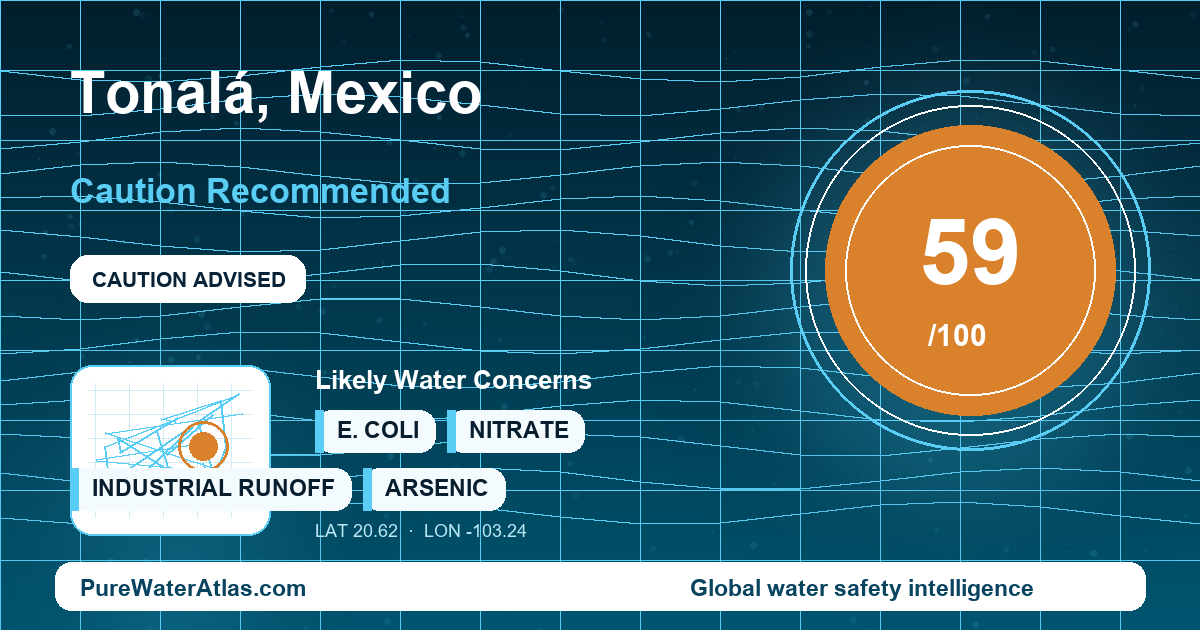
Tonalá, Jalisco is served by the Guadalajara metropolitan water system, but tap safety at the faucet depends heavily on distribution reliability, household cisterns, rooftop tanks, and building plumbing.
Quick Answer
| Overall status | Caution recommended. Tonalá receives treated public water through the Guadalajara metropolitan system, but drinking directly from the tap is not recommended for most visitors and should be approached carefully by residents. |
|---|---|
| Water safety score | 59 / 100 — risk level: Caution Recommended. |
| Traveler advice | Use sealed bottled water, reputable garrafón water, purified dispenser water, boiled water, or water treated by a suitable purifier. Do not assume a hotel, rental, restaurant, or home tap is safe without knowing how its cistern, tinaco, and plumbing are maintained. |
| Resident advice | If drinking tap water regularly, maintain and disinfect cisterns and rooftop tanks, use a certified point-of-use system, and consider laboratory testing after discoloration, sediment, low-pressure events, repairs, or recurring illness. |
| Main water source | A blended Guadalajara metropolitan supply: Lake Chapala via the Chapala-Guadalajara conveyance system, the Calderón system, and supplemental groundwater wells. The exact mix can vary by season and operations. |
| Water authority | Sistema Intermunicipal de los Servicios de Agua Potable y Alcantarillado, commonly known as SIAPA. |
| Filter recommendation | For regular household drinking use: sediment prefiltration plus activated carbon, with reverse osmosis or another certified purifier when broader contaminant reduction is needed. UV can help with microbial control only after sediment is controlled and the unit is maintained correctly. |
Why Tonalá Is Different
Tonalá is not a simple untreated-water case. It is an eastern municipality in the Guadalajara Metropolitan Area of Jalisco and is connected to the larger metropolitan supply operated by SIAPA. That means the water delivered into the public network is part of a treated regional system rather than a stand-alone local spring or isolated municipal well. The more important question for many homes, rentals, hotels, and small businesses in Tonalá is what happens after treatment: pressure interruptions, pipe repairs, sediment movement, aging distribution infrastructure, household cisterns, rooftop tinacos, and internal plumbing can all change the quality of water by the time it reaches the faucet.
This distinction matters for both travelers and residents. A city can have a public treatment and distribution system and still have variable tap safety at the point of use, especially where buildings store water in private tanks. In Tonalá, the practical risk is often the “last mile” between the SIAPA network and the glass: whether the building storage is sealed, screened, cleaned, disinfected, and turned over regularly; whether the neighborhood has recently experienced low pressure or repairs; and whether old plumbing or fixtures are contributing sediment, metals, or microbial regrowth.
Publicly accessible, neighborhood-level finished-water testing results for Tonalá are limited. This profile therefore does not claim that every tap in every colonia either meets or fails a specific legal limit. The most defensible conclusion is more practical: Tonalá has treated metropolitan supply, but direct tap drinking should be treated with caution unless the building-level system and recent water quality are known.
Where Does Tonalá’s Tap Water Come From?
Tonalá’s drinking water is tied to the broader Guadalajara metropolitan water system. The raw-water mix for this system includes surface water from Lake Chapala conveyed through Chapala-Guadalajara infrastructure, water from the Calderón river and dam system, and groundwater wells used to supplement surface-water supplies. The exact blend reaching a specific Tonalá neighborhood can vary with season, drought conditions, maintenance, storage levels, pumping decisions, and system operations.
Lake Chapala has long been a strategic source for Guadalajara and its metropolitan municipalities. As the metropolitan area expanded eastward into municipalities such as Tonalá, the system became dependent on a combination of imported surface water, wells, storage reservoirs, pumping stations, distribution interconnections, and neighborhood-scale delivery infrastructure. Tonalá therefore does not have a single simple “local source” that explains every tap. It is part of a regional supply network whose performance depends on basin conditions, treatment, conveyance, pressure management, and the condition of both public and private infrastructure.
The key water infrastructure relevant to Tonalá includes the Lake Chapala intake and Chapala-Guadalajara conveyance system, the Calderón supply system, SIAPA treatment and pumping infrastructure, metropolitan groundwater wells, storage and distribution facilities, and household-level cisterns and rooftop tanks. The last item is especially important. Even if water leaves treatment in acceptable condition, it can be re-contaminated or degraded inside a dirty cistern, an uncovered tinaco, a cracked tank, a low-turnover storage system, or old internal plumbing.
Who Manages Drinking Water in Tonalá?
The main public water and sewer utility for Tonalá is SIAPA, the Sistema Intermunicipal de los Servicios de Agua Potable y Alcantarillado. SIAPA serves the Guadalajara metropolitan municipalities that include Guadalajara, Zapopan, San Pedro Tlaquepaque, and Tonalá. Its role is central for public supply, distribution, and sewer services in the metropolitan system.
Drinking water quality in Mexico is regulated under federal health standards, principally NOM-127-SSA1-2021, the standard for water for human use and consumption. The federal framework defines health-based requirements for potable water, while SIAPA operates the metropolitan supply. CONAGUA, the Comisión Nacional del Agua, is the national water authority responsible for water resources, concessions, hydrologic information, and basin context. CONAGUA’s National Water Information System is relevant for understanding regional water availability, storage, and basin conditions that affect supply reliability. At the state level, the Comisión Estatal del Agua Jalisco is also relevant to water planning and infrastructure context.
For consumers, the important limitation is that broad regulatory and utility identity does not provide a tap-by-tap answer for every Tonalá building. The public system exists and is treated, but finished-water results are not consistently available to the public at the colonia, street, hotel, restaurant, or household storage-tank level.
Main Local Water Concerns
The main drinking-water concerns in Tonalá are linked to a blended metropolitan source system and to reliability after treatment. The Guadalajara metropolitan region faces supply stress connected to dependence on Lake Chapala, variability in surface-water storage, drought pressure, urban demand, and broader water-quality pressures in the Lerma-Chapala-Santiago region. These factors do not automatically mean a specific Tonalá tap is unsafe, but they help explain why operations, blending, groundwater supplementation, pressure management, and public confidence can vary over time.
At the faucet, the most relevant issues are distribution and building-level risks. Intermittent pressure, pipe repairs, pressure changes, and network disturbances can mobilize sediment or allow water-quality changes inside pipes. After interruptions or repairs, first-flush water may appear cloudy, discolored, aerated, or sediment-laden. That water should not be used immediately for drinking; it should be flushed and, for drinking purposes, treated or replaced with purified water.
Household storage is another major risk point. Many homes and small businesses rely on cisterns and rooftop tinacos. Warm weather can accelerate microbial growth in neglected storage tanks, hoses, or low-turnover systems. A clean municipal supply can become unsafe if stored in a dirty, uncovered, cracked, or poorly maintained tank. Chlorine taste or odor may indicate a disinfectant residual, but it does not prove that all risks at the tap have been eliminated, especially if water has passed through private storage or old plumbing.
Older buildings may add separate concerns through corroded pipes, brass fixtures, solder, stagnant water, and unknown plumbing materials. In these situations, residents should be alert to possible metals risk, sediment, and changes in taste, odor, or color.
For Travelers
Visitors should not assume Tonalá tap water is safe to drink directly. The conservative recommendation is to use sealed bottled water, garrafón water from a reputable supplier, water from a trusted purified-water dispenser, boiled water, or water treated with a reliable purifier. This is especially important for short-stay travelers who have no information about the building’s cistern, rooftop tank, or internal plumbing.
For brushing teeth, many healthy adults may use tap water without swallowing, but cautious travelers should use bottled or purified water. This is also the better choice for children, pregnant travelers, and immunocompromised visitors. Avoid using untreated tap water for baby formula; use purified or properly boiled water instead.
Ice should be treated carefully. Use ice only if the hotel or restaurant confirms that it is made from purified water. Factory-made bagged ice from reputable suppliers is generally preferable to ice made on-site from unknown tap or tank water. Better hotels and established restaurants commonly use purified water for drinking, ice, and food preparation, but travelers should still ask. In small eateries, street stalls, rentals, and private homes, assume tap or tank water may not be suitable for drinking unless it has been treated.
Practical travel precautions in Tonalá include carrying bottled or purified water, avoiding swallowing shower water, being cautious with raw produce washed in unknown water, and boiling or purifying tap water in rentals before using it for drinking. The U.S. Centers for Disease Control and Prevention Mexico traveler health guidance supports conservative food and water precautions for travelers.
For Residents
Residents in Tonalá commonly use garrafón water, point-of-use filtration, boiling, or a combination depending on household risk tolerance. If a household drinks tap water regularly, a home treatment strategy is advisable. A practical setup for typical Tonalá conditions is sediment prefiltration plus activated carbon to improve taste and reduce chlorine-related taste and some byproducts, with reverse osmosis or another certified purifier when broader contaminant reduction is desired. UV can be useful for microbial control only after sediment is controlled and the UV unit is maintained correctly. Boiling is effective for microbial risk, but it does not remove metals, nitrate, salts, or many chemical contaminants. For method comparisons, see PureWaterAtlas guides to boiling water purification and UV water purification.
Testing is important when water is consumed directly from the tap or when conditions change. Residents should test for total coliform and E. coli after flooding, repeated low-pressure events, cistern or tinaco neglect, or recurring gastrointestinal illness. Basic field checks such as turbidity, residual chlorine, pH, conductivity, and total dissolved solids are useful when water has unusual taste, odor, cloudiness, or visible sediment. Consider metals testing, including lead, in older homes, buildings with old fixtures, unknown service plumbing, or water that sits overnight in pipes. If a property uses a private well, semi-formal local source, or non-SIAPA source, request a full laboratory potability panel rather than assuming it has the same treatment and monitoring as the metropolitan system.
Cisterns and rooftop tinacos deserve special attention. They should be sealed, screened, cleaned, and disinfected on a routine schedule. Avoid using first-draw hot water for drinking or cooking, flush stagnant water before use, and retest after major plumbing changes, new filter installation, tank cleaning, discoloration, or persistent odor.
Relevant Contaminants and Water-Quality Issues
The most relevant Tonalá water-quality issues are not limited to one contaminant. They involve microbial risk, sediment, turbidity, disinfectant residual, and building-level plumbing concerns. Turbidity and sediment can appear after pressure changes, pipe repairs, or tank disturbance and can interfere with confidence in water quality. Chlorine taste or odor may reflect disinfection residual, but it is not a guarantee that water remained protected through private storage.
Microbial contamination is the highest practical concern when cisterns, tinacos, or internal plumbing are poorly maintained. Learn more about E. coli in drinking water and broader microbial risks in the PureWaterAtlas Water Microbiology guide. In older buildings, lead and other metals may be introduced after municipal treatment through fixtures or plumbing components; see also the guide to lead testing and detection methods. For private wells or non-SIAPA sources, nitrate may be relevant, particularly for infants; see nitrate testing and detection methods.
How to Verify Your Water Quality
The most reliable answer for a Tonalá home, hotel, restaurant, or rental is a combination of source awareness, building inspection, and testing. Start by identifying whether the property is served by SIAPA or by another source. Check whether water is stored in a cistern or rooftop tinaco, whether those tanks are sealed and cleaned, and whether there have been recent service interruptions, repairs, discoloration, odors, or low-pressure events.
For a structured approach, use the PureWaterAtlas Water Testing guide and the broader Drinking Water Safety guide. To compare common treatment options, see Water Purification Methods. You can also use the Global Water Quality Checker and the Contaminants Search Engine to research specific contaminants, health concerns, and treatment methods.
Because detailed public test results are not consistently available at Tonalá neighborhood or building level, laboratory testing is the best way to verify drinking-water quality for a specific tap. This is particularly important for infants, pregnant people, elderly residents, immunocompromised people, and households with unexplained gastrointestinal symptoms.
Official and Technical Sources
- SIAPA official website — primary utility source for the Guadalajara metropolitan water and sewer system serving municipalities including Tonalá.
- NOM-127-SSA1-2021, Water for human use and consumption — Mexican federal drinking-water quality standard published in the Diario Oficial de la Federación.
- CONAGUA National Water Information System — national hydrologic and water-resources data source for basin conditions, storage, and water availability.
- CONAGUA official portal — federal water authority responsible for national water administration and hydrologic information.
- Comisión Estatal del Agua Jalisco — state-level water institution relevant to Jalisco water infrastructure and planning.
- CDC Mexico traveler health information — traveler health guidance supporting conservative food and water precautions.
- WHO Guidelines for Drinking-water Quality — international reference for drinking-water risk management, microbial safety, distribution systems, and household water handling.
Bottom Line
Tonalá’s tap water should be approached with caution. The municipality is part of SIAPA’s treated Guadalajara metropolitan supply, drawing from a changing mix that includes Lake Chapala, the Calderón system, and groundwater wells. The main risk is not simply the raw source, but what happens after treatment: pressure interruptions, sediment, aging distribution lines, cisterns, rooftop tinacos, and older building plumbing. Visitors should use bottled, garrafón, purified, boiled, or properly treated water for drinking and should confirm that ice is made from purified water. Residents who drink tap water should maintain storage tanks, use appropriate point-of-use treatment, and test when water quality changes or vulnerable people are in the home.
Read the full guide: Global Water Quality Guide
Explore more in this category: Global Water Quality Articles