
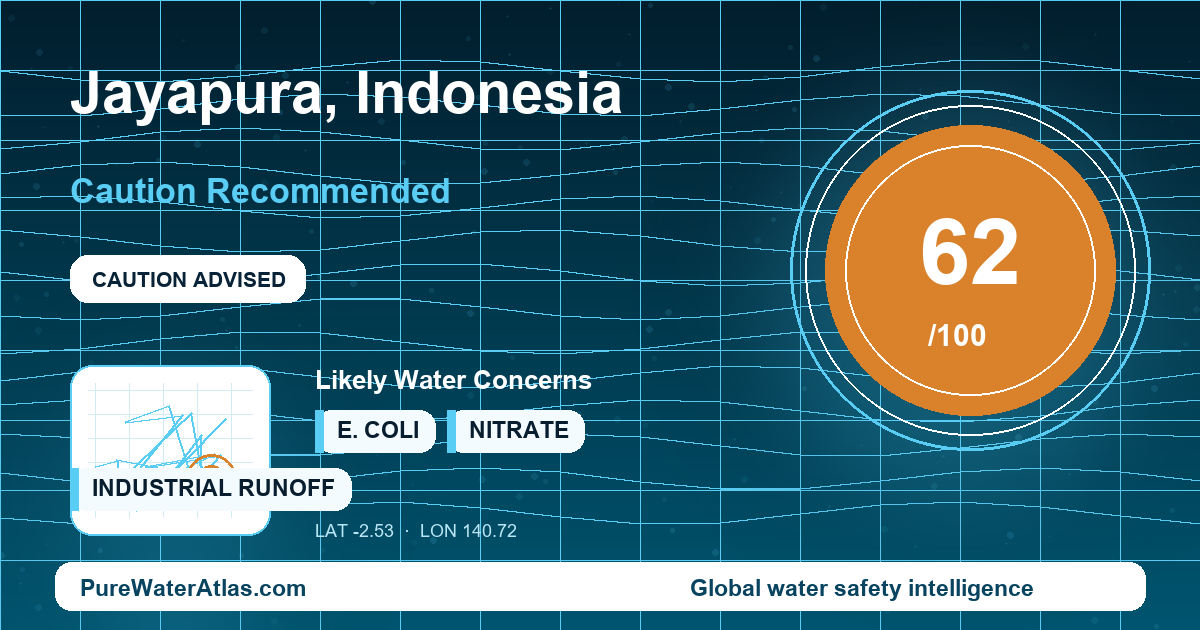
Jayapura, Indonesia: tap-water safety, local utility context, tropical catchment risks, household storage concerns, and practical guidance for visitors and residents.
Quick Answer
| Overall status | Caution recommended. PureWaterAtlas safety score: 62/100. Jayapura has an organized piped-water utility, but recent public neighborhood-level finished-water test results are limited. |
|---|---|
| Can visitors drink the tap water? | Not recommended untreated. Visitors should use sealed bottled water, properly boiled water, or reliably treated hotel water for drinking. |
| Resident guidance | Residents should treat tap water before drinking unless they have recent reliable test results from their own building or tap. |
| Main local water source context | Jayapura’s urban piped supply relies mainly on multiple nearby surface-water and spring-fed catchments around Jayapura and the Cycloop foothills, not one single uniform source for every tap. |
| Water authority | PT Air Minum Jayapura Robongholo Nanwani, commonly referred to as the Jayapura water utility or former PDAM Jayapura. |
| Filter recommendation | Use a treatment barrier for drinking water: sediment prefiltration, activated carbon where useful for taste and chlorine-related issues, and boiling, UV, ultrafiltration, or reverse osmosis depending on risk, budget, and test results. |
The short answer for Jayapura is caution, not panic. The city has identifiable water infrastructure and a local utility, but the public evidence available does not support a strong claim that tap water is consistently potable at the household tap across all districts, buildings, pressure zones, and storage conditions.
Why Jayapura Is Different
Jayapura is not a flat, single-source water system. It is a coastal city in northern Papua with steep terrain, bays, short river catchments, nearby Lake Sentani, and the Cycloop mountain watersheds. Those geographic conditions create large differences in runoff, turbidity, water pressure, and supply reliability between upland, lowland, and coastal areas.
The most Jayapura-specific everyday concern is variability. Water that looks clear during normal conditions may become cloudy, earthy, or sediment-laden after heavy rain, storm runoff, landslides, construction disturbance, or intake disruption. Short, steep tropical catchments can respond quickly to rainfall, pushing sediment and organic matter into raw-water sources. That matters because high turbidity can make treatment more difficult and can reduce the reliability of disinfection if not controlled.
Jayapura’s hilly layout also makes pressure management important. Reservoirs, pumps, break-pressure tanks, pressure zones, and household storage tanks are not minor details; they are part of the real drinking-water safety picture. If service becomes intermittent or pressure drops, contamination can enter through leaks, cross-connections, or poorly maintained plumbing. In warm tropical conditions, stagnant water in roof tanks, ground tanks, and dead-end plumbing can also become a microbial risk if tanks are not covered, cleaned, and protected.
Public information about Jayapura’s water tends to focus more on service expansion, utility operations, governance, and raw-water availability than on routine publication of finished-water laboratory results at the tap. Because current citywide tap-level results are limited, this profile does not claim that every neighborhood is unsafe or safe. It recommends practical caution until household-level or building-level evidence is available.
Where Does Jayapura’s Tap Water Come From?
Jayapura’s urban piped supply is operated by the local water company and is understood to rely mainly on nearby surface-water and spring-fed catchments in the Jayapura and Cycloop foothill area. These include small river, stream, and spring sources feeding treatment units and reservoirs. It is not appropriate to assume that all Jayapura tap water comes from one single source, and it is also not appropriate to assume that Lake Sentani supplies every tap.
The city’s water system developed around local gravity-fed springs and small surface-water intakes because Jayapura is steep, coastal, and divided by hills and bays. As the urban area expanded through Abepura, Heram, Jayapura Selatan, Jayapura Utara, and surrounding growth corridors, the system became more dependent on multiple intakes, storage reservoirs, pressure zones, transmission mains, and household storage.
Key infrastructure relevant to safety includes local surface-water and spring intakes, treatment installations, chlorination points, service reservoirs, break-pressure tanks, pumps, transmission mains, and distribution lines. Customer-side infrastructure is also important. Roof tanks, ground tanks, and refillable containers can become water-quality control points, especially when water service is intermittent or pressure is low.
Because the city depends on short tropical catchments, rainfall can change water quality quickly. Heavy rain can raise raw-water turbidity and treatment difficulty. Storms, landslides, or flooding in Jayapura and Cycloop catchments can damage intakes or increase sediment levels. Dry periods may reduce stream or spring flow, potentially worsening continuity and pressure. These conditions explain why a single general statement about Jayapura tap water can be misleading.
Who Manages Drinking Water in Jayapura?
The local piped-water provider is PT Air Minum Jayapura Robongholo Nanwani, commonly referred to as the Jayapura water utility or former PDAM Jayapura. This is the main public source for local utility identity, service information, and customer notices.
At the government level, local context is provided through the Kota Jayapura government and official statistical publications from Badan Pusat Statistik Kota Jayapura. These sources are useful for governance, population, housing, public-service context, and water-access indicators, but they do not replace current household tap testing.
Indonesia’s drinking-water quality framework is governed nationally by Ministry of Health standards, including Permenkes No. 2 Tahun 2023, which addresses environmental health quality standards and water health requirements. Water-supply infrastructure and raw-water context also involve national agencies such as the Ministry of Public Works and Housing, including the SPAM information system and the Directorate General of Water Resources at sda.pu.go.id.
The data limitation is important: there is enough evidence to identify the utility, regulatory framework, geography, and major system vulnerabilities, but not enough publicly available current distribution-zone or household-tap laboratory reporting to verify consistent potability at every tap in Jayapura.
Main Local Water Concerns
- Turbidity and sediment after rain: Jayapura’s short, steep catchments can produce cloudy water and sediment pulses after heavy rainfall, storms, landslides, or source disturbance.
- Intermittent service and low pressure: Pressure drops can increase intrusion risk in older or leaky distribution lines, especially where cross-connections or pipe defects exist.
- Household storage tanks: Roof tanks and ground tanks may accumulate sediment, biofilm, insects, mosquito access, dust, or microbial contamination if they are not covered and cleaned.
- Taste and odor variation: Chlorination, organic matter, pipe conditions, and storage can affect taste and smell. Taste alone does not prove safety.
- Private shallow wells near the coast: Some coastal lowland wells may have salinity or brackish taste where groundwater is influenced by seawater intrusion. This should not be generalized to all piped water.
- Older internal plumbing: Houses, schools, offices, clinics, or lodging with older plumbing may add metal risk even if utility water leaves treatment in acceptable condition.
- Limited public tap-level results: Recent public results for E. coli, turbidity, residual chlorine, metals, nitrate, and salinity are limited at citywide household-tap level.
For Travelers
Short-term visitors should generally avoid drinking untreated tap water in Jayapura. Use sealed bottled water, properly boiled water, or hotel-provided treated water for drinking. Tap water is usually acceptable for washing hands and showering, but use safer water for infant formula, immunocompromised travelers, pregnant travelers, young children, and anyone with a sensitive stomach.
For brushing teeth, bottled, boiled, or reliably filtered water is the safer choice for visitors. Many long-term residents may brush with tap water, but travelers are less adapted to local microbial conditions and should be more cautious.
Avoid ice from unknown sources. Ice may be lower risk in reputable hotels or restaurants that clearly use treated water, but street-vendor ice or unlabelled bulk ice should be treated as uncertain. In restaurants, choose sealed bottled drinks or hot beverages served steaming hot. Do not assume that a modern building has clean tanks or a properly maintained treatment system.
For a short stay, the simplest strategy is to buy sealed bottled water or use a portable purifier that combines filtration and disinfection. If you must use tap water in an apartment or guesthouse, let visibly turbid water settle, prefilter it, then boil it at a rolling boil before drinking. The PureWaterAtlas Boiling Water Purification: Complete Guide explains when boiling is effective and when additional filtration is needed.
For Residents
Residents connected to the piped network should use a treatment barrier for drinking water unless recent laboratory testing confirms safety at the household tap. A practical Jayapura setup is a washable sediment filter before the tank or at point-of-entry, activated carbon for taste and chlorine-related issues, and point-of-use boiling, UV, ultrafiltration, or reverse osmosis for drinking water depending on household risk and budget.
Reverse osmosis is especially relevant for private wells with salinity, nitrate, or metal concerns, but it requires maintenance and wastewater management. UV can be useful for stored water, but it should not be used as the only barrier when water is visibly cloudy; turbidity should be controlled first. See the PureWaterAtlas UV Water Purification: Complete Guide and Water Purification guide for method comparisons.
Testing is especially important for roof tanks, ground tanks, private wells, buildings with repeated stomach illness, and homes affected by outages, floods, pipe repairs, or unusual taste and odor. Test for E. coli or thermotolerant coliforms where microbial contamination is possible. Test turbidity and residual chlorine when water looks cloudy, smells unusual, or service has recently been interrupted. For private wells, include electrical conductivity or total dissolved solids to screen for salinity, especially in coastal lowlands. Near drains, septic systems, agriculture, or dense settlement, include nitrate and basic microbiology.
Older buildings deserve extra attention. Corroded galvanized pipes, soldered joints, brass fittings, or poorly maintained internal plumbing can affect water that sits overnight. For schools, clinics, offices, and older homes, consider first-draw and flushed samples for lead, copper, iron, and manganese. PureWaterAtlas provides additional guidance on lead testing and nitrate testing.
Storage tanks are a major control point in Jayapura. Keep tanks covered, screened, and physically intact. Clean accumulated sediment, disinfect after cleaning, prevent rainwater and animals from entering, and do not drink directly from a tank that has not been cleaned or tested.
Relevant Contaminants and Water-Quality Issues
The most relevant Jayapura water-quality issues are not limited to one confirmed citywide toxic contaminant. They are a practical risk cluster involving tropical surface-water conditions, intermittent pressure, and household storage.
- Turbidity and sediment are highly relevant after heavy rain, storms, intake disturbance, or pipe work.
- E. coli is a key microbial indicator where pressure is intermittent or tanks and wells are used.
- Chlorine matters because residual disinfectant helps protect distribution networks, although taste and odor complaints can occur.
- Lead is mainly a building-plumbing concern, especially in older structures, rather than a confirmed Jayapura-wide source-water issue.
- Iron and manganese may be relevant where residents see staining, metallic taste, old pipe deposits, or well-related issues.
- Nitrate is relevant for private wells near septic systems, dense settlements, agriculture, or runoff influence.
For broader context, see PureWaterAtlas guides on Drinking Water Safety and Water Microbiology.
How to Verify Your Water Quality
The most reliable answer for a Jayapura household is a recent test from the actual tap used for drinking, not a general city claim. If you use a storage tank, sample water after it has passed through the tank and household plumbing. If the building is old, compare first-draw water with flushed water to separate plumbing effects from incoming supply conditions.
Prioritize E. coli or thermotolerant coliforms, turbidity, residual chlorine, and basic physical observations when the concern is intermittent pressure, tank hygiene, or post-rain cloudiness. For private wells, add electrical conductivity or total dissolved solids for salinity screening, plus nitrate where septic or runoff influence is plausible. For older buildings, add metals such as lead, copper, iron, and manganese.
Use the PureWaterAtlas Water Testing guide to plan sampling, the Global Water Safety Checker to compare Jayapura with other destinations, and the Contaminants Search Engine to look up specific substances. Related categories include Drinking Water Safety, Water Purification, Water Testing, and Water Microbiology.
Official and Technical Sources
- PT Air Minum Jayapura Robongholo Nanwani — local piped-water operator serving Jayapura and nearby service areas.
- Kota Jayapura government — municipal public-service and local infrastructure context.
- Badan Pusat Statistik Kota Jayapura — official statistics for demographics, housing, public services, and water-access indicators.
- Permenkes No. 2 Tahun 2023 — Indonesian health-based environmental and water-quality regulatory reference.
- Ministry of Public Works and Housing SPAM information system — national water-supply infrastructure context.
- Directorate General of Water Resources — Indonesian raw-water and watershed authority context.
- BMKG Indonesia — official meteorology and climate source relevant to rainfall, flooding, and landslide-related water impacts.
- WHO Guidelines for Drinking-water Quality — international guidance on microbial safety, turbidity, disinfection, and risk-based management.
- CDC Yellow Book: Food and Water Precautions for Travelers — traveler guidance where local tap-water safety is uncertain.
Bottom Line
Jayapura tap water should be treated with caution for drinking. The city has a recognized piped-water utility and local surface-water and spring-fed systems, but public current household-tap laboratory data are limited. The main Jayapura risks are variable turbidity after heavy rain, intermittent pressure, intrusion risk in older lines, warm-weather microbial regrowth, and poorly maintained household storage tanks. Visitors should use sealed bottled, boiled, or reliably treated water. Residents should use sediment control plus a drinking-water treatment barrier and test tanks, wells, old buildings, and water affected by outages or floods. This profile does not claim a confirmed citywide toxic contaminant; it recommends practical caution because reliable tap-level verification is limited.
Read the full guide: Global Water Quality Guide
Explore more in this category: Global Water Quality Articles