
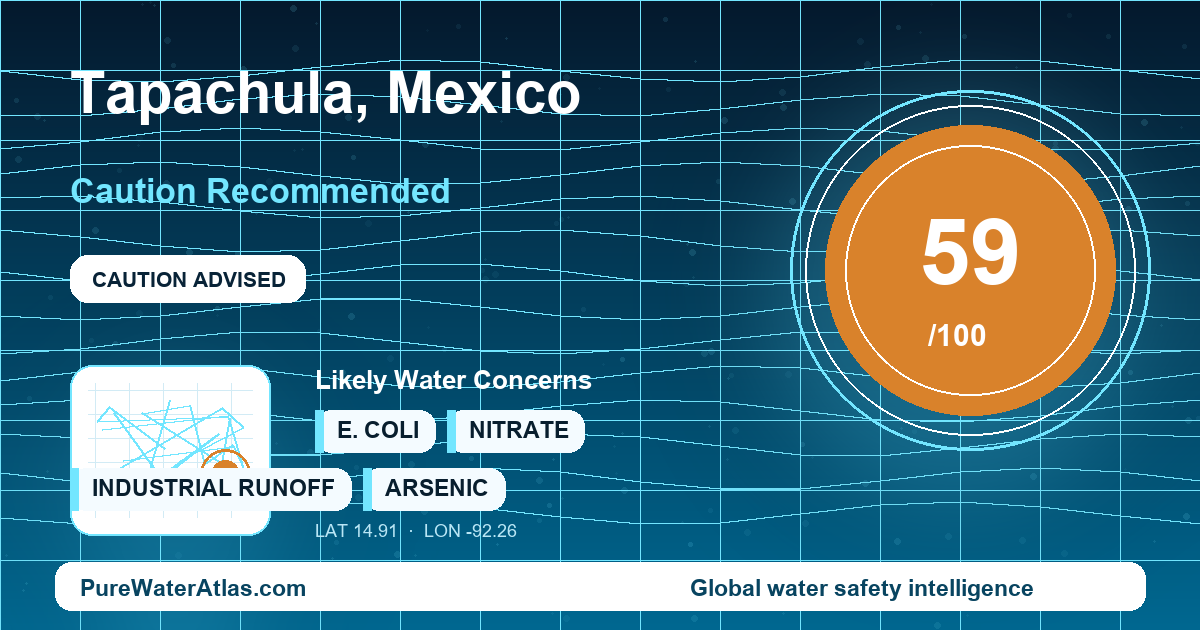
Tapachula, Chiapas has a chlorinated municipal water system, but rainy-season turbidity, intermittent service, household storage tanks, and limited public tap-level reporting mean untreated tap water should be approached with caution.
Quick Answer
| Water safety score | 59 / 100 |
|---|---|
| Risk level | Caution Recommended |
| Can visitors drink the tap water? | Not recommended untreated. Short-term visitors should use sealed bottled water, boiled water, or water treated by a reliable purification system. |
| Resident guidance | Municipal tap water can often be used for washing and general household use, but drinking and cooking water should be treated at the point of use unless recent testing confirms safety at the actual tap. |
| Main water-source context | A mixed municipal system strongly influenced by local surface-water catchments draining the Sierra Madre de Chiapas and Volcán Tacaná area toward the Soconusco coastal plain, with local references associating supply with basins such as the Coatán and Cahoacán area. |
| Local water authority | Comité de Agua Potable y Alcantarillado de Tapachula, commonly abbreviated COAPATAP. |
| Practical filter recommendation | Sediment prefiltration plus activated carbon, followed by reverse osmosis, certified ultrafiltration, or UV depending on test results, tank condition, and maintenance capacity. |
Overall verdict: caution recommended. Tapachula has a formal municipal water utility and a chlorinated public supply, but recent, neighborhood-level finished-water reporting is not consistently available to the public. In practice, the safety of the water at a bathroom or kitchen tap can depend on rainfall, pressure interruptions, repairs, building plumbing, cisterns, rooftop tinacos, and whether the household or hotel maintains its storage system.
Why Tapachula Is Different
Tapachula is not a small resort town with one simple water-quality profile. It is a regional commercial and migration hub in the Soconusco region of southern Chiapas, close to Guatemala and downstream of steep volcanic and mountain catchments. That geography matters for drinking water because rivers and streams in this setting can respond quickly to intense rain. Heavy storms can increase turbidity, debris, and microbial loading in raw surface water before it reaches treatment infrastructure.
The practical risk in Tapachula is also not limited to what happens at a treatment plant. Water quality can change inside the distribution network and inside buildings. Intermittent service, pressure drops, pipe repairs, and household storage can create opportunities for contamination after water has already been treated. Cisterns and rooftop tanks are common in Mexican cities, and in Tapachula they are especially important because hotels, homes, and businesses may depend on stored water during pressure variability or outages.
This is why the PureWaterAtlas rating for Tapachula is not a blanket statement that every tap is unsafe or that every tap is safe. The best city-specific conclusion is more careful: the municipal system exists and is disinfected, but conditions at the point of use can vary substantially. Visitors should avoid untreated tap water, while residents should manage drinking water with point-of-use treatment, storage-tank hygiene, and periodic testing.
Where Does Tapachula’s Tap Water Come From?
Tapachula is supplied by a municipal public-water system operated in the Soconusco region of Chiapas. The raw-water context is strongly influenced by rivers and streams descending from the Sierra Madre de Chiapas and the Volcán Tacaná area toward the coastal plain. Public and local references associate Tapachula’s urban supply with surface-water sources in basins such as the Coatán and Cahoacán area, together with treatment, storage, distribution infrastructure, and some use of groundwater or wells in the broader municipal system.
Because source shares can change with season, outages, and operating decisions, it is not responsible to describe Tapachula as relying on one single, fully documented source published for all consumers. The safer description is that Tapachula has a mixed municipal system dominated by local surface-water catchments. That makes rainfall and catchment conditions central to day-to-day water-quality risk.
Tapachula’s older water-system context also matters. The city developed around nearby mountain-fed rivers and later expanded across the coastal plain with more storage, pumping, and distribution works. As the city grew, pressure on water, drainage, and sanitation infrastructure increased. Even when water leaves treatment with chlorine, it can later be affected by older distribution mains, pressure changes, household cisterns, rooftop tinacos, and long internal plumbing runs.
Key infrastructure elements include COAPATAP’s municipal distribution network, surface-water capture and treatment infrastructure associated with rivers draining the Sierra Madre and Soconusco basin, storage tanks, pumping and pressure zones, and household-level cisterns and rooftop storage tanks. Drainage and wastewater infrastructure are also relevant because storm events and flooding can influence source-water and flood-related contamination risk.
Who Manages Drinking Water in Tapachula?
The local drinking-water and sewerage operator is the Comité de Agua Potable y Alcantarillado de Tapachula, commonly known as COAPATAP. The Ayuntamiento de Tapachula provides official municipal context for local public-service governance.
At the national level, drinking water in Mexico is regulated under federal health standards, including NOM-127-SSA1-2021, the Mexican standard for water for human use and consumption. Sanitary surveillance is handled through Mexican health authorities, including COFEPRIS and state health-risk agencies, while CONAGUA oversees national water resources and concessions.
These institutions are important, but their existence does not prove that every tap in Tapachula is safe at every moment. PureWaterAtlas found city-level information for the water authority, municipal geography, national regulation, and regional hydrology, but not a recent public consumer-confidence-style report with tap-by-tap results for Tapachula. That data limitation is central to the cautious verdict.
Main Local Water Concerns
- Microbial risk: The most important practical concern is contamination from distribution breaches, low pressure, damaged pipes, or unclean household storage. Testing for total coliform and E. coli is the clearest way to check this risk at a specific tap or tank.
- Rainy-season turbidity: Tapachula’s river-fed raw-water context means heavy rainfall can make water muddier before treatment. Storms, flooding, landslides, system flushing, and repairs can also lead to cloudy or sediment-containing water at taps.
- Intermittent service and first-flush water: After outages or pressure changes, water may appear cloudy, rusty, or carry sediment. This water should not be used for drinking until cleared and treated.
- Storage tanks and tinacos: Cisterns and rooftop tanks can become secondary contamination points if lids, screens, vents, or cleaning routines are neglected.
- Chlorine uncertainty: Chlorine taste or odor may indicate disinfection, but it does not guarantee that water remained sanitary in a cistern, tinaco, or long building plumbing run.
- Agricultural and private-source concerns: In homes using private wells or mixed sources, nitrate and pesticide screening is reasonable because Tapachula sits in the agriculturally influenced Soconusco region.
- Old plumbing metals: Older buildings or unknown internal plumbing may contribute metals, especially where water sits for long periods.
For Travelers
Most short-term visitors should not drink untreated tap water in Tapachula. Use sealed bottled water, properly boiled water, or water from a trusted purification system. This is especially important for travelers with sensitive stomachs, children, pregnant travelers, older adults, and immunocompromised visitors.
For brushing teeth, bottled or treated water is the safer option. Many travelers tolerate small accidental exposures, but using purified water reduces avoidable gastrointestinal risk. Carry sealed bottled water during hot weather, check that bottle caps are intact, and use purified water for medications and infant formula.
Be careful with ice. Avoid ice from informal vendors or unknown sources. In hotels, cafes, and restaurants, ask whether the ice is made from purified water. Commercially produced ice is generally safer than ice made on small premises from untreated tap water, but the safest practice is to ask for agua purificada or agua embotellada.
Higher-end hotels and established restaurants in Tapachula often use garrafón water or purification systems for drinking water, but do not assume the bathroom tap is potable. The weak point may be the building’s storage tank or plumbing rather than the municipal supply itself. Avoid swallowing water in showers or pools, especially after heavy rain events.
For Residents
For Tapachula residents, the most practical approach is to treat drinking and cooking water at the point of use unless recent testing confirms safety at the actual tap. A sensible setup begins with a washable sediment prefilter to protect downstream equipment during rainy-season turbidity or post-repair sediment events. After that, activated carbon can reduce chlorine taste and some organic compounds. For microbial risk, use reverse osmosis, certified ultrafiltration, or UV treatment depending on test results and the household’s ability to maintain the system.
Testing should be part of the routine, not only a one-time purchase of a filter. Test for total coliform and E. coli at least annually and after floods, long outages, plumbing repairs, or tank cleaning. Check free chlorine at the tap periodically, especially at the far end of the plumbing system or after water has sat in a cistern. After heavy rain or service interruptions, visually inspect water and filter sediment before using it for drinking.
Homes using private wells or mixed sources should test nitrate, electrical conductivity, hardness, iron, manganese, and basic microbiology. In older buildings or buildings with unknown plumbing materials, test first-draw and flushed samples for lead and other metals. Flush stagnant water before use if a building has been vacant, has long pipe runs, or produces metallic taste or discoloration.
Cisterns and tinacos deserve special attention in Tapachula. Keep lids sealed, screens intact, and vents protected from insects and animals. Clean and disinfect storage tanks on a regular schedule and after contamination, flooding, or animal intrusion. Clear-looking water is not proof of microbial safety.
Relevant Contaminants and Water-Quality Issues
Several PureWaterAtlas contaminant profiles are especially relevant to Tapachula’s local water context. Turbidity in drinking water is important because local surface-water catchments can become muddy after intense rain. Sediment in drinking water is useful for residents who see cloudy, sandy, rusty, or gritty water after repairs, outages, or heavy storms.
For microbial safety, E. coli in drinking water is the key indicator to understand because it can reveal fecal contamination risk in storage tanks, plumbing, or distribution breaches. Chlorine in drinking water is also relevant: chlorine residual helps protect water, but it can decline in cisterns, rooftop tanks, and long plumbing runs.
For wells and non-municipal sources, nitrate in drinking water is a reasonable screening parameter in an agricultural region. For older buildings, lead in drinking water and the PureWaterAtlas guide to lead testing and detection methods can help residents decide whether internal plumbing is contributing metals.
How to Verify Your Water Quality
The most reliable way to know whether water is safe in a specific Tapachula home, hotel, school, or business is to test the water at the point where it is actually consumed. City-level regulation and utility operation do not replace building-level verification, especially when water is stored in cisterns or tinacos.
Start with microbiology: total coliform and E. coli. Add chlorine residual checks if the home depends on stored municipal water. If water is cloudy after storms or outages, evaluate turbidity and sediment before relying on UV or other disinfection equipment. For wells or mixed sources, add nitrate and basic chemistry. For older buildings, include first-draw and flushed metal samples.
PureWaterAtlas resources that can help include the main guide to water testing, the background guide to drinking water safety, the overview of water microbiology, and the guide to water treatment systems. For treatment during short-term uncertainty, see boiling water purification and UV water purification. Travelers comparing destinations can use the Global Water Safety Checker, and residents reviewing lab reports can search the Contaminants Search Engine.
Official and Technical Sources
- COAPATAP – Comité de Agua Potable y Alcantarillado de Tapachula: local water and sewerage authority for Tapachula.
- Tapachula municipal government: official municipal context for local public-service governance.
- NOM-127-SSA1-2021, Agua para uso y consumo humano: Mexican federal drinking-water quality standard.
- Sistema Nacional de Información del Agua: CONAGUA national water-information portal.
- Servicio Meteorológico Nacional – Climatología: climate context supporting rainy-season and storm-related turbidity assessment.
- INEGI geographic information for Tapachula municipality: official municipal geography and demographic reference.
- CDC Mexico Traveler View: travel-health guidance supporting conservative water precautions when local tap-water safety is uncertain.
- WHO Guidelines for Drinking-water Quality: international reference for microbial risk, turbidity, disinfection, and household water safety principles.
Bottom Line
Tapachula’s tap water should be treated with caution. The city has a formal municipal operator, COAPATAP, and a chlorinated public supply influenced mainly by local surface-water catchments draining the Sierra Madre de Chiapas and Volcán Tacaná area. However, rainy-season turbidity, flooding, intermittent service, pressure changes, pipe repairs, household cisterns, rooftop tinacos, and limited public tap-level reporting make untreated drinking risky, especially for visitors. Travelers should use sealed bottled or purified water for drinking, brushing teeth, medications, and infant formula. Residents should treat drinking water at the point of use, keep storage tanks clean and sealed, and test for coliform, E. coli, chlorine residual, sediment-related issues, nitrate where wells are involved, and metals in older buildings.
Read the full guide: Global Water Quality Guide
Explore more in this category: Global Water Quality Articles