
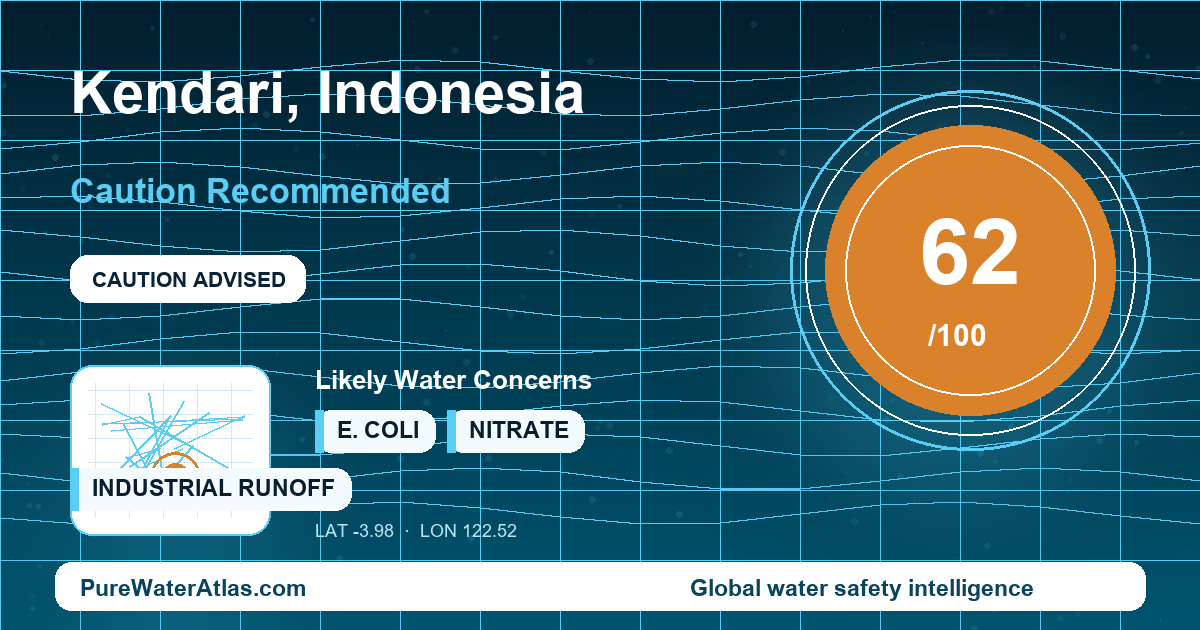
Kendari, Southeast Sulawesi: municipal piped water exists, but drinking it untreated is not recommended because household-level safety depends on treatment, distribution pressure, storage tanks, private wells, rainy-season turbidity, and dry-season salinity risks.
Quick Answer
| Water safety score | 62 / 100 |
|---|---|
| Risk level | Caution Recommended |
| Can visitors drink the tap water? | No, not as a default travel practice. Short-stay visitors should use sealed bottled water, reputable refill water, or water that has been boiled or treated with a reliable purifier. |
| Resident advice | Residents connected to Perumda Air Minum Tirta Anoa can generally use piped water for washing and many household uses, but drinking water should be boiled and, where practical, filtered. |
| Main raw-water context | Kendari’s municipal supply is closely associated with the Pohara raw-water system and SPAM Regional Pohara, drawing surface water from the Pohara River catchment outside the dense urban core. |
| Water authority | Perumda Air Minum Tirta Anoa Kota Kendari, with local government and public-health oversight under Indonesian drinking-water regulations. |
| Home treatment recommendation | Sediment prefiltration plus activated carbon for taste, followed by boiling, UV, or a maintained reverse-osmosis system for drinking water. RO is especially useful where salty or high-TDS taste recurs. |
Verdict: Caution recommended. Kendari has an organized municipal utility and treated piped-water system, but recent neighborhood-level tap-water results are not consistently available in a public format. Treat tap water before drinking unless you have current household or building-level evidence that it is safe.
Why Kendari Is Different
Kendari is not a city where drinking-water safety can be judged only by whether a building has a tap. It is a coastal city built around Kendari Bay in Southeast Sulawesi, with urban neighborhoods spread across coastal lowlands and hilly areas. That geography matters: the city’s water system must deal with heavy tropical rainfall, river-catchment runoff, variable distribution pressure, household storage, and coastal-source vulnerability.
The most important Kendari-specific issue is that a visitor or resident may encounter several different drinking-water pathways in the same day. A hotel may provide filtered dispenser water, a restaurant may serve bottled water, a household may boil PDAM water, a small guesthouse may rely on roof tanks, and some residents may use private wells, boreholes, springs, rainwater storage, or purchased refill water. Safety therefore depends strongly on the building, storage practice, and provider—not only on the citywide utility.
The city’s water-supply discussions often reference the Pohara system because it is a strategic raw-water source for urban supply. During low-flow periods, local reporting and user complaints have noted brackish or salty characteristics affecting water acceptability. That concern is consistent with coastal-source vulnerability and reduced freshwater flushing. During rainy periods, the opposite problem can occur: runoff can increase turbidity, sediment, color, and microbial loading in surface-water sources.
Where Does Kendari’s Tap Water Come From?
Kendari’s municipal piped-water supply is closely associated with the Pohara raw-water system and SPAM Regional Pohara. This system uses surface water from the Pohara River catchment outside the dense urban core and conveys treated bulk water toward Kendari and nearby Southeast Sulawesi areas. The city then depends on transmission infrastructure, local reservoirs, pumps, distribution pipes, treatment units, and service zones operated through the municipal water system.
That regional surface-water context is important because source-water conditions can change seasonally. Heavy rainfall can wash sediment and contaminants into river catchments, increasing turbidity and color. Low river discharge in the dry season can reduce available raw-water volume and may worsen salty or brackish taste where coastal influence becomes more significant. Neither issue automatically means every tap is unsafe, but both increase the importance of treatment performance, residual disinfectant, and household-level precautions.
Before larger regional bulk-water supply became central to the system, Kendari households commonly depended on smaller local intakes, shallow wells, boreholes, springs, rainwater storage, and purchased refill water. Those sources remain important in practice for some residents, especially where piped-water continuity or pressure varies. Private wells and shallow groundwater require more caution because they can be affected by sanitation separation, floodwater intrusion, drainage channels, gardens, livestock areas, and nearby septic systems.
For many homes, the last step before use is not the municipal network but a household roof tank or ground tank. These tanks help families manage intermittent supply, but they can also become contamination points if they are unsealed, dirty, exposed to insects or animals, or affected by floodwater entry. Even treated water can lose disinfectant residual during extended storage.
Who Manages Drinking Water in Kendari?
The municipal drinking-water utility serving Kendari is Perumda Air Minum Tirta Anoa Kota Kendari. It is responsible for customer operations and the city’s piped-water distribution network. Local government context is provided by the Pemerintah Kota Kendari, while demographic and geographic service-demand context can be checked through Badan Pusat Statistik Kota Kendari.
Indonesia’s drinking-water quality requirements are set nationally by the Ministry of Health, including Permenkes No. 2 Tahun 2023, which covers environmental health quality standards and water health requirements. Water-resources and infrastructure context relevant to Kendari’s raw-water system is linked to national and regional agencies such as Kementerian PUPR, Balai Wilayah Sungai Sulawesi IV Kendari and Kementerian PUPR, Direktorat Jenderal Cipta Karya.
The key limitation is public data access. Kendari has identifiable institutions, a known raw-water context, and documented local concerns, but current tap-level monitoring results are not published in a single easily accessible, recent, neighborhood-by-neighborhood dataset. This profile should not be read as proof that every Kendari tap passes or fails Indonesian standards. Building plumbing, pressure events, tanks, wells, and refill depots can change safety at the point of use.
Main Local Water Concerns
- Dry-season salinity or brackish taste: Low raw-water flow can worsen salinity risk and water acceptability, especially in connection with coastal influence on the Pohara raw-water system.
- Rainy-season turbidity: Heavy runoff, flooding, river disturbance, and catchment sediment can raise turbidity, color, and microbial loading. High turbidity can reduce disinfection effectiveness if treatment is stressed.
- Microbial contamination: Private wells, shallow groundwater, and household tanks are vulnerable where sanitation separation is poor or tanks are not hygienically maintained. E. coli is the key indicator to test for fecal contamination.
- Intermittent service and low pressure: Low-pressure events can increase intrusion risk if pipes are damaged, aging, or exposed to contaminated water around leaks.
- Sediment, iron, manganese, taste, and discoloration: Complaints can arise from raw-water changes, pipe deposits, household tanks, groundwater influence, or internal plumbing. Learn more about sediment, iron, and manganese.
- Limited neighborhood-level data: Public access to recent tap-level results for E. coli, residual chlorine, turbidity, chloride, TDS, and metals is limited.
For Travelers
Short-stay visitors should not drink Kendari tap water untreated. Use sealed bottled water, reputable refill water, or water that has been boiled or treated with a reliable purifier. Do not rely on taste, smell, or clarity alone; clear water can still contain microbial contamination, and water that tastes acceptable may still be affected by storage-tank hygiene.
For brushing teeth, bottled or boiled water is the safer default, especially in small guesthouses, older buildings, and locations where bathroom water may come from a roof tank. In higher-end hotels, ask whether bathroom tap water is filtered for drinking use or only chlorinated for general use.
Be cautious with ice. Avoid ice from informal vendors unless you can confirm it was made from treated commercial water. In established hotels and restaurants, ice is often factory-made or filtered, but sensitive travelers, children, pregnant travelers, older adults, and immunocompromised people should still ask.
In restaurants, request sealed bottled water or hot boiled water if unsure. Do not assume water served in an open jug is safe unless the establishment can explain its source. Hot drinks are safer when made with water brought to a rolling boil. For travel-treatment methods, see Boiling Water Purification: Complete Guide and the broader Water Purification guide.
For Residents
Residents connected to Perumda Air Minum Tirta Anoa can generally use piped water for washing, bathing, and many household uses, but drinking water should be boiled and, where practical, filtered. A practical Kendari home setup is sediment prefiltration for rainy-season turbidity and particles, activated carbon for taste and chlorine-related issues, and a final safety barrier such as boiling, UV, or a maintained reverse-osmosis system.
Reverse osmosis is especially useful where salty taste, brackish characteristics, high TDS, chloride, or electrical conductivity are recurring concerns. However, RO systems must be maintained and paired with hygienic storage. A poorly maintained system or dirty dispenser can reintroduce microbes after treatment.
Household testing is important for private wells, boreholes, roof tanks, ground tanks, and any non-utility source. Test for E. coli and total coliform if water is used for drinking. Measure turbidity, color, odor, pH, residual chlorine, and TDS when water changes after heavy rain, pipe repairs, outages, or unusually low pressure. During dry-season salty taste events, check chloride, conductivity, or TDS. Test iron and manganese if water stains laundry, appears reddish-brown or black, or has a metallic taste. Test nitrate if a shallow well is near septic tanks, gardens, livestock areas, or drainage channels.
Older buildings also deserve attention. Water that sits overnight in plumbing can pick up metals or sediment from internal pipes, brass fixtures, soldered joints, or unknown materials. Flush first-draw water before drinking-water collection and consider lead testing where children or pregnant residents consume the water. For methods, see Lead in Drinking Water: Testing and Detection Methods.
Storage tanks are a major Kendari control point. Keep roof tanks and ground tanks sealed, screened against insects and animals, cleaned on a schedule, and protected from floodwater entry. If tank hygiene is uncertain, boil or disinfect drinking water before use.
Relevant Contaminants and Water-Quality Issues
The most relevant Kendari water-quality issues are not one single contaminant but a combination of source-water changes, distribution conditions, storage practices, and household plumbing. Turbidity is important because heavy tropical rain and catchment runoff can increase suspended particles and make disinfection harder. E. coli is the priority microbial indicator for wells, tanks, and any water that may have been affected by sanitation or intrusion.
Chlorine residual matters because it helps protect treated water during distribution, but residual can decline in long networks, low-flow areas, and household tanks. Sediment, iron, and manganese are relevant when residents see discoloration, staining, particles, or metallic taste. Nitrate matters most for shallow wells near sanitation or runoff pathways. Lead is mainly a building-plumbing concern rather than a known citywide source-water issue, but it should be considered in older or mixed-material plumbing.
How to Verify Your Water Quality
The only reliable way to know whether a specific Kendari tap, tank, well, or refill source is safe is to verify it at the point of use. Start with the Water Testing guide for choosing parameters and interpreting results. For microbial risk, the PureWaterAtlas Water Microbiology guide explains why E. coli and total coliform testing matter in tropical urban systems.
If you are comparing Kendari with other destinations, use the Global Water Quality Checker. If a lab result mentions a parameter you do not recognize, search the Contaminants Search Engine. For general decision-making, see Drinking Water Safety. For specific private-well concerns, the Nitrate Contamination Testing guide is relevant where shallow groundwater is near septic systems or runoff pathways.
Official and Technical Sources
- Perumda Air Minum Tirta Anoa Kota Kendari — local municipal drinking-water utility responsible for Kendari piped-water service and customer operations.
- Pemerintah Kota Kendari — official city-government source for local administration, public services, and infrastructure context.
- Badan Pusat Statistik Kota Kendari — official statistics source for Kendari demographic and geographic context.
- Permenkes No. 2 Tahun 2023 — Indonesian national regulation covering environmental health quality standards and water health requirements.
- Kementerian PUPR, Balai Wilayah Sungai Sulawesi IV Kendari — regional water-resources authority relevant to Southeast Sulawesi river-basin and raw-water availability context.
- Kementerian PUPR, Direktorat Jenderal Cipta Karya — national authority for drinking-water supply system infrastructure and SPAM development.
- ANTARA News Sulawesi Tenggara — regional reporting source documenting Kendari water-supply issues such as service complaints, drought effects, and brackish or salty water concerns; useful as context, not a substitute for current laboratory testing.
- World Health Organization: Drinking-water fact sheet — global public-health context on microbial contamination and safe drinking water.
Bottom Line
Kendari has a functioning municipal water utility and a treated piped-water system associated with the Pohara raw-water supply, but tap water should not be treated as automatically drinkable at the household level. Coastal geography, dry-season salinity risk, rainy-season turbidity, intermittent pressure, old or damaged pipes, roof tanks, private wells, and limited public tap-level data all justify caution. Visitors should use sealed bottled water, reputable refill water, or boiled/treated water for drinking and brushing teeth. Residents should boil drinking water, maintain tanks, use appropriate filtration, and test wells or stored water for E. coli, turbidity, TDS, salinity indicators, nitrate, iron, manganese, and plumbing-related metals where relevant.
Read the full guide: Global Water Quality Guide
Explore more in this category: Global Water Quality Articles