
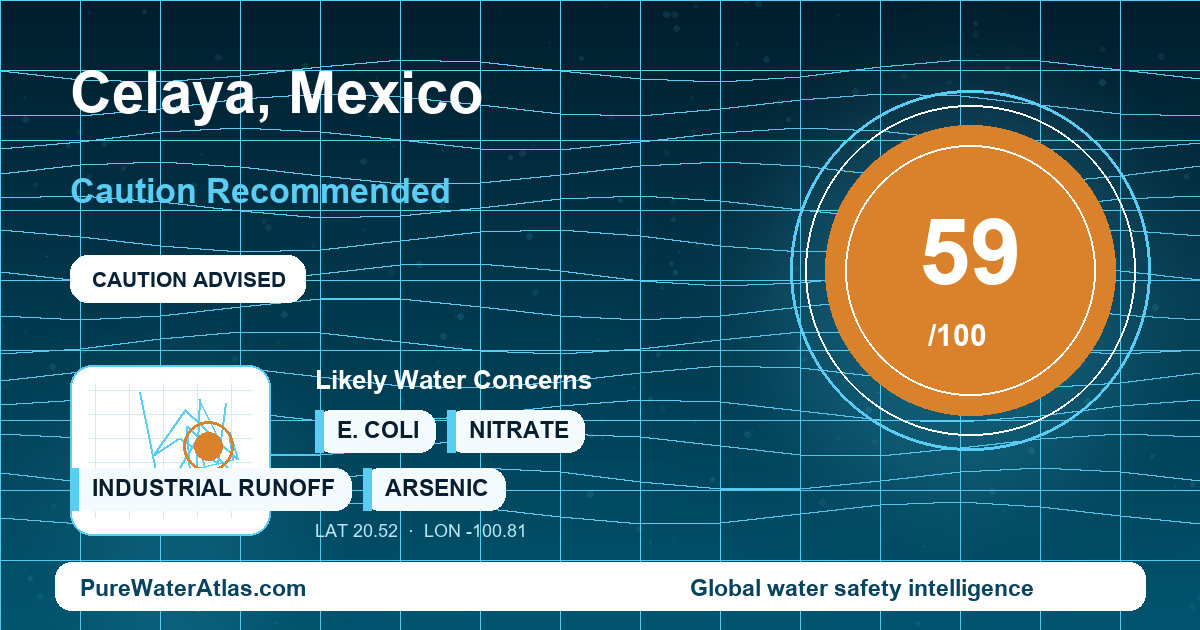
Celaya, Guanajuato has a municipal groundwater-based supply managed by JUMAPA, but direct tap drinking is best approached with caution because current neighborhood-level public water-quality results are limited and household storage can change water quality before it reaches the faucet.
Quick Answer
| Overall safety status | Caution recommended. Celaya is not an untreated rural supply, but a blanket “safe at every tap” claim is not supported by publicly accessible, current, neighborhood-level evidence. |
|---|---|
| Water safety score | 59 / 100 |
| Traveler advice | Most short-term visitors should use sealed bottled water or verified purified water for drinking. Tap water is generally acceptable for showering and handwashing. |
| Resident advice | Use household risk controls: maintain cisterns and tinacos, check water after outages or pressure loss, and test if using tap water as the primary drinking source. |
| Main water source | Predominantly municipal groundwater wells in the Valle de Celaya aquifer area, within Guanajuato’s Lerma-Chapala hydrologic region. |
| Local authority | JUMAPA Celaya, the Junta Municipal de Agua Potable y Alcantarillado de Celaya. |
| Filter recommendation | A filter may be advisable, but the correct type depends on testing. Carbon can improve taste and chlorine issues; reverse osmosis is more relevant for many dissolved contaminants such as arsenic, fluoride, nitrate, salts, or high dissolved solids. |
Why Celaya Is Different
Celaya’s drinking-water question is mainly a groundwater question. The city sits in the Bajío region of Guanajuato, in the Laja River basin area and the broader Lerma-Chapala water region. This location matters because Celaya is in an intensively farmed and urban-industrial corridor where groundwater quantity and quality management are central to long-term water security.
The practical verdict is caution recommended. Celaya’s municipal system is operated as an urban public water supply, not as an informal untreated source. However, the publicly available evidence does not allow PureWaterAtlas to verify every current drinking-water parameter at the neighborhood, building, or household-tap level. For residents and visitors, that distinction matters: water can look clear and still need testing for dissolved minerals, nitrate, arsenic, fluoride, or microbiological contamination after storage.
Another Celaya-specific issue is the role of household infrastructure. As in many Mexican cities, water may leave the municipal network and then pass through a cistern, pump, and rooftop tinaco before it reaches the kitchen tap. A municipal supply that is disinfected at the system level can become less safe if the building’s storage tanks are cracked, uncovered, dirty, or affected by intermittent pressure.
Where Does Celaya’s Tap Water Come From?
Celaya’s public drinking-water supply is understood to be predominantly groundwater pumped from municipal wells in the Valle de Celaya aquifer area. That means the local risk profile is different from a city that depends mainly on a large surface reservoir. In Celaya, the concerns are more about aquifer stress, well depth, dissolved minerals, geogenic constituents, agricultural influence, disinfection, and the condition of the distribution and storage system.
The Laja River is an important geographic and hydrologic feature near Celaya and is relevant to the regional basin, drainage, agriculture, and wastewater context. It should not be assumed to be Celaya’s routine drinking-water source. The current municipal water identity is centered on groundwater wells operated through the municipal system.
Key infrastructure in Celaya includes municipal groundwater production wells, chlorination or disinfection points, storage tanks, elevated tanks, cisterns, pressure-management infrastructure, distribution mains, household service lines, and the wastewater and sanitation facilities that form part of the municipal water cycle. At the household level, cisterns and rooftop tinacos can become the final quality-control point before drinking water reaches the tap.
Who Manages Drinking Water in Celaya?
Celaya’s local water and sewerage operator is JUMAPA Celaya, the Junta Municipal de Agua Potable y Alcantarillado de Celaya. At the federal level, CONAGUA’s Sistema Nacional de Información del Agua and CONAGUA groundwater programs provide the national water-information and aquifer-availability context. CONAGUA also maintains the Registro Público de Derechos de Agua, which is relevant to water-rights and extraction records.
Drinking-water quality in Mexico is governed by national health standards, including NOM-127-SSA1-2021 for water for human use and consumption. State-level planning and institutional context are also supported by the Comisión Estatal del Agua de Guanajuato. Celaya’s official geography can be checked through INEGI’s Celaya municipality profile.
The important limitation is that official authority and regulation do not prove that every household tap is safe at all times. Current public reporting is not sufficient to verify every drinking-water parameter at a sample-by-sample level across Celaya neighborhoods and buildings.
Main Local Water Concerns
- Groundwater dependence and aquifer stress: CONAGUA aquifer-availability materials document groundwater availability and pressure in Guanajuato aquifers, including the Celaya area. This supports high confidence that groundwater stress is a real regional context, though exact household effects vary.
- Mineralization, hardness, salinity, and scaling: Groundwater in the Bajío commonly contains dissolved minerals. Scale in kettles, boilers, and plumbing can occur. Mineral taste or scaling does not automatically mean microbial danger, but it can justify testing and treatment selection.
- Possible geogenic contaminants: Parts of central and northern Mexico, including areas of Guanajuato, have documented groundwater concerns involving naturally occurring inorganic contaminants such as arsenic or fluoride. Exact Celaya household risk requires local testing from the specific well or tap. Boiling does not remove these contaminants.
- Nitrate and agricultural influence: Celaya is surrounded by intensive agriculture and urban growth. This can affect shallow groundwater and private wells. Municipal wells may be deeper and managed differently, so nitrate should be tested rather than assumed.
- Microbial risk from tanks and pressure interruptions: Cisterns and tinacos can introduce microbiological risk if they are not covered, cleaned, or disinfected. Intermittent pressure, flooding, pipe breaks, or dirty-water episodes increase the need for caution.
- Lead and premise plumbing: Lead risk is usually driven by older building plumbing, fixtures, solder, or service materials rather than the aquifer itself. There is no verified citywide Celaya lead exceedance claim here, but older buildings deserve testing if children, pregnancy, or medically vulnerable people are involved.
Season also matters. During the rainy season, typically May to October in central Mexico, runoff, repairs, flooding, or cistern contamination can increase microbial uncertainty. During the dry season, higher demand and water-level pressure can make storage and low-pressure conditions more important. Warm rooftop tanks may also lose disinfectant residual faster if they are dirty or uncovered.
For Travelers
Most short-term visitors should not drink Celaya tap water directly from the faucet. Use sealed bottled water, water from a verified purification system, or water that has been boiled when the concern is microbial contamination. Boiling can help with bacteria, viruses, and protozoa, but it does not remove arsenic, fluoride, nitrate, salts, metals, or high dissolved solids. For details on when boiling helps, see the PureWaterAtlas Boiling Water Purification guide.
For brushing teeth, bottled or filtered water is the lowest-risk option, especially for cautious travelers, people with sensitive stomachs, and short stays. Some visitors brush with tap water in well-maintained hotels, but this depends on the building’s tank hygiene and any filtration system in use.
Use ice only from reputable hotels, restaurants, or packaged commercial sources. Avoid ice from informal vendors or places that cannot explain whether the ice was made from purified water. In higher-end hotels and established restaurants, drinking water and ice may come from bottled water, garrafones, or in-house filtration, but it is still reasonable to ask directly for purified water.
Carry bottled water in hot weather, avoid refilling from restroom taps, and use bottled water for infant formula. Switch to sealed bottled water after any outage, flood, pipe repair, unusual color, sewage odor, or cluster of stomach illness.
For Residents
For many Celaya residents, a home treatment system is advisable, but it should be chosen based on test results rather than marketing claims. For general taste, chlorine, sediment, and some organic compounds, a certified activated-carbon filter may help. For arsenic, fluoride, nitrate, high dissolved solids, and many salts, reverse osmosis or another certified treatment is usually more appropriate. UV can disinfect clear water, but it does not remove dissolved chemicals; see the PureWaterAtlas UV Water Purification guide for the limits of that method.
Residents who drink municipal tap water should consider a baseline laboratory panel that includes total coliforms, E. coli, residual chlorine, turbidity, pH, conductivity or total dissolved solids, hardness, nitrate, arsenic, fluoride, iron, manganese, and lead where building plumbing is older. Testing should be done at the tap after the cistern or tinaco, not only at the street connection, because household storage can change water quality.
Private wells and semi-rural properties around Celaya require extra caution. Test at least annually for microbiology and nitrate, and periodically for arsenic, fluoride, salinity, and other groundwater-relevant inorganic parameters. After flooding, plumbing repairs, long outages, or visible dirty water, use bottled or boiled water for microbial risk until the system is flushed and results are acceptable.
Cisterns and tinacos should be covered, screened, cleaned, and disinfected on a routine schedule. Look for cracked lids, animal or insect access, sediment, biofilm, and cross-connections. Older homes, schools, clinics, and rentals should also consider first-draw and flushed lead testing if babies, children, pregnant people, or medically vulnerable residents will drink the water.
Relevant Contaminants and Water-Quality Issues
Celaya’s most relevant water-quality topics are tied to groundwater chemistry, disinfection, storage, and building plumbing. Chlorine matters because residual disinfectant is central to keeping a municipal groundwater supply microbiologically safer through the network and storage. Turbidity and sediment matter after pipe repairs, tank disturbance, rainy-season events, or visible particles at the tap.
E. coli is the key warning organism for fecal contamination and is especially relevant after flooding, pressure loss, or poor cistern and tinaco hygiene. Arsenic and nitrate are important test parameters for groundwater and private wells; boiling is not a solution for either. Lead is mainly a premise-plumbing concern in older buildings rather than a known aquifer-wide finding for Celaya.
For deeper background, see PureWaterAtlas guides on arsenic testing, nitrate testing, and lead testing.
How to Verify Your Water Quality
The most reliable way to answer “is my Celaya tap water safe?” is to test the actual tap you drink from. Citywide averages or general utility information cannot account for cisterns, rooftop tanks, old plumbing, private wells, pressure events, or stagnant water inside a building.
Start with PureWaterAtlas resources on how to test drinking water, drinking water safety, water purification methods, and water microbiology. If you have a lab report, use the Contaminants Search Engine to look up specific parameters. Travelers comparing Celaya with other destinations can use the Global Water Quality Checker.
Official and Technical Sources
- JUMAPA Celaya — local municipal water and sewerage operator.
- CONAGUA Sistema Nacional de Información del Agua — federal hydrologic and groundwater information.
- CONAGUA disponibilidad por acuíferos — aquifer availability and groundwater-stress context.
- CONAGUA Registro Público de Derechos de Agua — water-rights registry and extraction context.
- NOM-127-SSA1-2021 — Mexican drinking-water quality standard.
- Comisión Estatal del Agua de Guanajuato — state water planning and institutional context.
- INEGI Celaya municipality geography — official location context.
- World Health Organization drinking-water fact sheet — general public-health guidance on safe drinking water.
Bottom Line
Celaya’s tap water should be treated with caution, not panic. The municipal supply is primarily groundwater from the Valle de Celaya aquifer area and is managed by JUMAPA under Mexico’s drinking-water regulatory framework. However, current public data are not detailed enough to confirm safety at every neighborhood tap, and household cisterns, rooftop tinacos, pressure interruptions, old plumbing, and private wells can change water quality after it leaves the system. Travelers should use sealed bottled or verified purified water for drinking. Residents should maintain storage tanks, test the actual drinking tap, and choose treatment based on results, especially for microbiology, nitrate, arsenic, fluoride, hardness, dissolved solids, and lead in older buildings.
Read the full guide: Global Water Quality Guide
Explore more in this category: Global Water Quality Articles