
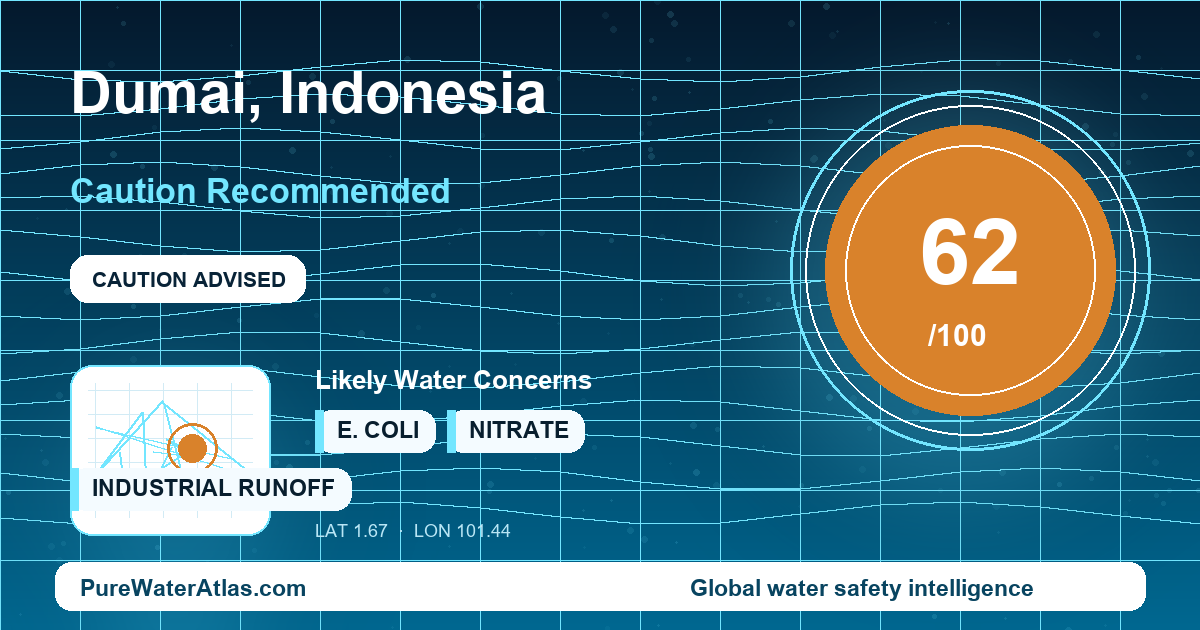
Dumai, Riau: coastal Sumatra tap water profile for travelers and residents, with a PureWaterAtlas safety score of 62/100 and a caution-recommended verdict.
Quick Answer
| Overall status | Caution Recommended. Tap water in Dumai should be treated as conditionally usable but not reliably safe to drink untreated. |
|---|---|
| Water safety score | 62/100 based on local source-water context, infrastructure risk, and limited public tap-level water-quality transparency. |
| Traveler advice | Do not drink untreated tap water. Use sealed bottled water, reputable refill-water depots, hotel-provided filtered water, or boiled water. |
| Resident advice | Use point-of-use treatment for drinking water, especially where water is stored in tanks or comes from private wells. |
| Main water context | Municipal supply is associated with Perumdam Tirta Dumai Bersemai and regional SPAM development, including SPAM Regional Durolis linked to the Rokan River system. |
| Water authority | Perumdam Tirta Dumai Bersemai under Dumai city government, with national SPAM and health-standard oversight through Indonesian public-works and health institutions. |
| Filter recommendation | Sediment prefiltration plus activated carbon is practical for many homes; add boiling, UV, ultrafiltration, or reverse osmosis depending on source and test results. |
Short answer: visitors should not drink Dumai tap water straight from the tap. Residents connected to the municipal or SPAM-supported system should still treat drinking water at the point of use. Private wells in coastal or low-lying areas should be tested before being used for drinking.
Why Dumai Is Different
Dumai is not an inland city with a large upland reservoir immediately behind it. It is a coastal city in Riau Province on the east coast of Sumatra, facing the Strait of Malacca. Its low-lying coastal and peatland setting makes reliable freshwater management more difficult than in cities with abundant inland freshwater sources. That geography is central to the water-safety question in Dumai.
The city’s water picture is shaped by constrained local freshwater, surface-water dependence, household storage, private wells, rainwater use, bottled water, and refill-water depots. Historically, many households have used a mix of available options rather than relying on one consistently high-confidence tap-water supply. In coastal and low-lying areas, shallow groundwater may be brackish, iron-rich, colored, acidic, poor-tasting, or vulnerable to microbial contamination from local drainage conditions.
Dumai’s port, petroleum, palm-oil, and logistics economy also makes source-water protection and monitoring important. However, PureWaterAtlas does not claim a verified citywide industrial-chemical exceedance in Dumai tap water because the available public dataset does not support that. The more defensible conclusion is practical: Dumai tap water can be usable after suitable treatment, but it should not be assumed reliably safe for drinking untreated.
Where Does Dumai’s Tap Water Come From?
Dumai’s piped-water system is associated with Perumdam Tirta Dumai Bersemai and regional SPAM development. The key strategic raw-water improvement for the wider Dumai area is SPAM Regional Durolis, a regional drinking-water supply project designed to serve Dumai, Rokan Hilir, and Bengkalis. This regional system draws on the Rokan River system and is intended to improve treated water availability for Dumai and neighboring areas.
That regional supply context matters because Dumai has required investment beyond small local sources. Local Dumai supply has also relied on smaller surface-water sources, reservoirs, treatment plants, distribution pipes, and local systems discussed in public infrastructure reporting around the Bukit Timah and Sungai Mesjid area. In practice, the water reaching a household may pass through municipal treatment, bulk-water infrastructure, distribution pipes, and then building-level tanks or containers before it is consumed.
For some residents, private wells, rainwater collection, trucked water, bottled water, and refill-water depots remain important alternatives. Each option has a different risk profile. Piped water may depend on treatment performance, pressure stability, pipe integrity, and tank hygiene. Shallow wells may be affected by salinity, iron, manganese, acidity, color, drainage, flooding, or microbial contamination. Refill water depends on the treatment and handling standards of the depot.
Who Manages Drinking Water in Dumai?
The local municipal drinking-water utility is Perumdam Tirta Dumai Bersemai, operating under Dumai city government. The Pemerintah Kota Dumai provides the municipal governance context for the city. Regional bulk-water infrastructure, including SPAM Regional Durolis, involves Indonesian public-works institutions and provincial or regional coordination, with national public-works information available through Kementerian PUPR Republik Indonesia.
Water-resources management for the broader Riau surface-water context is also connected to basin-level institutions such as Balai Wilayah Sungai Sumatera III. Official demographic and household-services context for Dumai can be checked through Badan Pusat Statistik Kota Dumai.
Indonesia’s drinking-water quality framework is governed nationally through Ministry of Health environmental health standards, including Permenkes No. 2 Tahun 2023. Drinking-water supply infrastructure is regulated through Indonesia’s SPAM framework and public-works institutions. Local health offices generally have a surveillance role. The important limitation for consumers is transparency: a recent, public, consumer-facing report with routine Dumai tap, neighborhood, storage-tank, and private-well sampling results was not found in open sources. For that reason, this profile emphasizes known infrastructure context, source-water risks, and household verification rather than claiming confirmed citywide compliance or non-compliance.
Main Local Water Concerns
The main Dumai-specific drinking-water concerns are linked to geography, raw-water quality, distribution conditions, storage practices, and limited public tap-level data.
- Coastal groundwater salinity: Dumai’s coastal and low-lying setting creates risk that shallow groundwater may be brackish or otherwise unsuitable for drinking without treatment.
- Peat-influenced water quality: Surface water and local freshwater sources may show high color, organic matter, acidity, and taste concerns, especially where peatland influence is present.
- Rain-related turbidity: Heavy rain can increase suspended sediment, turbidity, and microbial loading in surface-water sources. High turbidity can make disinfection less reliable.
- Microbial risk after treatment: Water can become unsafe after leaving the treatment plant if pressure is intermittent, pipes are compromised, or residual disinfectant is lost in household tanks.
- Iron and manganese: Some groundwater or pipe-affected supplies may have reddish-brown staining, black staining, metallic taste, or deposits associated with iron and manganese.
- Household storage: Roof tanks, ground tanks, buckets, and refill containers are practical risk points in Dumai because stored water can lose disinfectant protection and pick up contamination.
- Limited public results: The lack of easy public access to recent point-of-use laboratory data means households should not rely on appearance or taste alone.
Season also matters. Heavy rain can disturb raw-water quality and contaminate shallow wells. Dry periods can reduce freshwater availability and may increase salinity pressure in coastal or estuarine-influenced sources. Flooding or poor drainage can contaminate shallow wells and household storage systems. Haze-season or drought conditions can increase reliance on stored water or alternative vendors, making container hygiene more important.
For Travelers
Do not drink untreated tap water in Dumai. Travelers should use sealed bottled water, reputable refill-water depots, hotel-provided filtered water, or boiled water. Check bottle seals before drinking. Avoid refilling bottles from bathroom taps, even in hotels, unless the accommodation specifically confirms that the water is filtered or treated for drinking.
For brushing teeth, bottled or boiled water is the safer option, especially for children, pregnant travelers, immunocompromised travelers, people with sensitive stomachs, or anyone staying in accommodation where water is visibly discolored or the storage tank is uncertain. Some experienced travelers may brush with hotel tap water, but that is a risk decision rather than a confirmed safety guarantee.
For ice, avoid ice from street vendors unless you can confirm it was made from treated commercial water. In established hotels and restaurants, ice is lower risk, but it still depends on the water source and handling. Ask whether drinking water is filtered, boiled, or commercially supplied; do not assume the bathroom tap is drinking-water grade.
Boiled water is a practical fallback for tea, coffee, instant noodles, and toothbrushing. For details on boiling as a disinfection method, see Boiling Water Purification: Complete Guide.
For Residents
Dumai residents should treat drinking water with a household barrier matched to the actual source. For municipal or SPAM-supported supply, a practical baseline is sediment prefiltration for turbidity and particles, activated carbon for taste and odor, and a validated microbial barrier such as boiling, UV, ultrafiltration, or a properly maintained reverse-osmosis system. The right choice depends on whether the household receives piped water, stores water in tanks, uses a private well, buys refill water, or switches between sources.
Private well users should test before choosing equipment. Salinity, iron, manganese, nitrate, and microbial contamination require different solutions. Reverse osmosis may help with dissolved salts, but it is not the same decision as treating iron staining or disinfecting bacteria. UV can be useful for microbial control only when turbidity is already controlled. Learn more in UV Water Purification: Complete Guide and Water Treatment Systems.
Recommended tests for private wells and stored household water include E. coli or thermotolerant coliforms, turbidity, pH, electrical conductivity or TDS, chloride or salinity indicators, nitrate, iron, and manganese. If the home is near port, industrial, fuel-storage, workshop, landfill, or heavily drained areas, consider broader laboratory screening rather than relying on taste and odor. Retest after flooding, pipe repairs, long service interruptions, major changes in taste or color, or a switch between piped water, well water, and vendor-supplied water.
Older premises may have corroded internal plumbing, galvanized iron pipe, old solder, fittings, stagnant dead-end lines, pumps, or storage hardware that can affect metals. Indonesia does not have the same legacy lead-service-line profile as some older Western systems, but lead and other metals can still come from premise plumbing. Flush stagnant water and test if the building is old or used by children; see Lead in Drinking Water: Testing and Detection Methods.
Storage tanks are one of the most important practical risk points in Dumai. Tanks should be covered, screened, cleaned, disinfected periodically, protected from roof runoff and animals, and checked after floods or long interruptions. Even a treated utility supply can become unsafe if disinfectant residual is lost in a dirty roof tank or ground tank.
Relevant Contaminants and Water-Quality Issues
Several PureWaterAtlas contaminant profiles are especially relevant to Dumai’s coastal, surface-water, and storage-tank context. Turbidity is important because heavy rain and surface-water disturbance can increase suspended particles and reduce disinfection reliability. Sediment is useful for homes seeing visible particles, tank deposits, or pipe disturbance.
E. coli is the key microbial indicator for shallow wells, flood-affected water, stored water, and untreated tap water. Chlorine matters because disinfectant residual helps protect water in tropical distribution networks, but that protection can decline in storage tanks or long pipe runs.
Iron and manganese are relevant for groundwater taste, staining, deposits, and complaints about reddish-brown or black particles. For households with infants or private wells, nitrate should also be considered; see Nitrate Contamination in Drinking Water: Testing and Detection Methods.
How to Verify Your Water Quality
Because recent public tap-level laboratory results for Dumai are limited, verification should happen at the household point of use. Test the water you actually drink, not only the incoming pipe. If water passes through a roof tank, ground tank, depot container, filter, or dispenser, sample after that point as well.
Use the PureWaterAtlas Water Testing guide to plan a basic panel for microbial indicators, turbidity, pH, salinity indicators, nitrate, iron, and manganese. For broader safety concepts, see Drinking Water Safety, Water Microbiology, and Global Water Quality.
You can also explore issue-specific profiles through the Contaminants Search Engine and compare broader location guidance using the Global Water Quality Checker. For topic archives, see Drinking Water Safety, Global Water Quality, Water Testing, and Water Purification.
Official and Technical Sources
- Perumdam Tirta Dumai Bersemai — local municipal drinking-water utility for Dumai.
- Pemerintah Kota Dumai — official municipal government context.
- Kementerian PUPR Republik Indonesia — national public-works authority for SPAM infrastructure context, including regional water-supply development.
- Balai Wilayah Sungai Sumatera III — river basin and water-resources authority relevant to Riau surface-water management.
- Badan Pusat Statistik Kota Dumai — official statistics for Dumai geography, population, and household-services context.
- Permenkes No. 2 Tahun 2023 — Indonesian national environmental health regulation relevant to drinking-water quality standards.
- WHO Indonesia: Water, Sanitation and Hygiene — public-health context for WASH risks in Indonesia.
- WHO/UNICEF Joint Monitoring Programme: Indonesia Household Drinking Water Data — country-level drinking-water service context where local Dumai tap-level data is limited.
Bottom Line
Dumai tap water should be approached with caution. The city’s coastal lowland setting, constrained freshwater sources, regional SPAM dependence, possible brackish groundwater, peat-influenced water quality, household storage, and limited public tap-level testing data all argue against drinking untreated tap water. Travelers should use sealed bottled water, reputable refill water, hotel-filtered water, or boiled water, and should be careful with ice and bathroom taps. Residents should treat drinking water at the point of use, clean storage tanks, and test private wells for microbes, turbidity, salinity indicators, nitrate, iron, and manganese. Dumai’s supply may be usable with proper treatment, but it is not a city where untreated tap water can be assumed reliably safe.
Read the full guide: Global Water Quality Guide
Explore more in this category: Global Water Quality Articles