
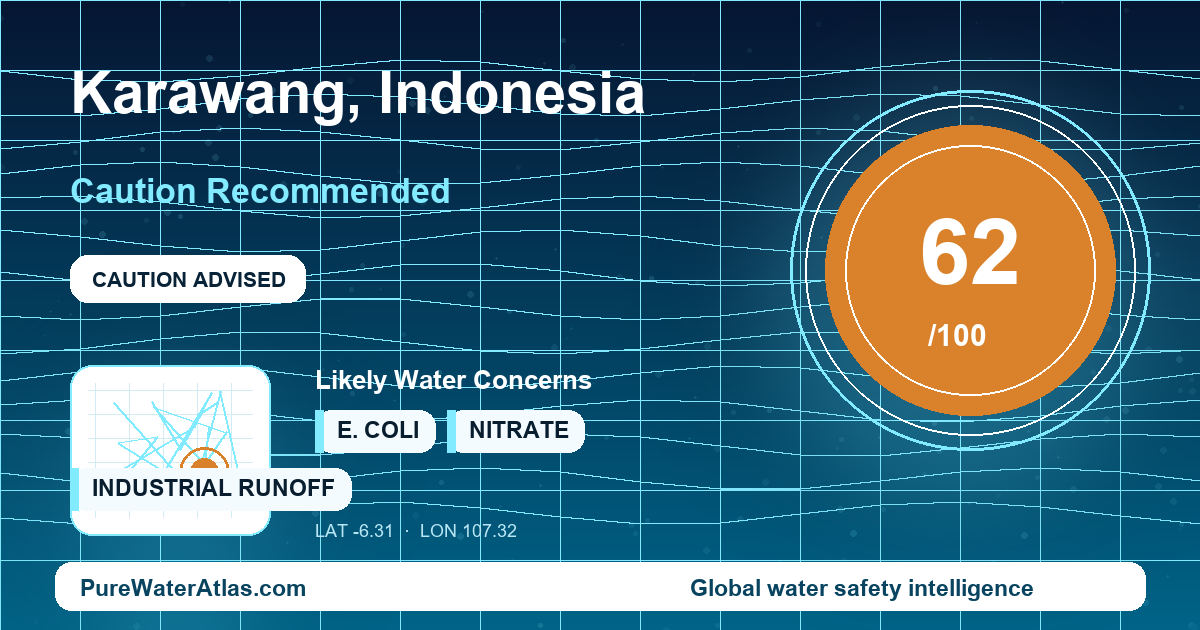
Karawang, West Java: Caution recommended for untreated tap water due to Citarum-basin source-water pressure, monsoon turbidity, household storage, private-well uncertainty, and limited public neighborhood-level test data.
Quick Answer
| Water safety score | 62 / 100 |
|---|---|
| Risk level | Caution Recommended |
| Can tourists drink the tap water? | Not recommended untreated. Use sealed bottled water, reputable refill water, boiled water, or water treated with a reliable purifier. |
| Resident guidance | Managed Perumdam/PDAM water is treated, but point-of-use treatment is prudent for drinking, especially where water is stored in roof tanks, pressure is intermittent, pipes are old, or water becomes cloudy after rain. |
| Main raw-water context | Karawang’s formal piped supply is tied to the Citarum River basin, Jatiluhur Reservoir, and Tarum raw-water and irrigation canal system. |
| Local water authority | Perumdam Tirta Tarum Kabupaten Karawang, commonly referred to as Perumdam Tirta Tarum or PDAM Tirta Tarum. |
| Filter recommendation | For drinking: sediment prefilter plus activated carbon, followed by boiling or UV disinfection. Consider reverse osmosis for private wells with salinity, high TDS, nitrate, or site-specific industrial concerns, based on test results. |
Verdict: Caution recommended. Karawang has a formal municipal water utility and treated piped water, but recent public tap-level water-quality data by neighborhood is limited. The safest approach is to treat tap water before drinking and to test private wells rather than assuming they are safe.
Why Karawang Is Different
Karawang is not simply a typical tropical travel-water destination. Its drinking-water risk profile is shaped by its position on the northern coastal plain of West Java, east of Bekasi, within the Citarum watershed. The regency combines dense urban growth, major industrial estates, irrigated rice fields, river and canal systems, and low-lying coastal districts toward the Java Sea. That mix creates a water environment where treated municipal supply, household wells, refill depots, bottled water, and stored water may all be used within the same broader urban area.
The name Tirta Tarum reflects the central role of the Tarum and Citarum water system in Karawang’s water identity. The Citarum River, Jatiluhur Reservoir, and Tarum canal network have long supported irrigation, raw water, hydropower, flood control, industrial supply, and wider regional bulk-water needs. Karawang’s water security is therefore connected not only to local utility operations but also to the condition of a heavily used basin that serves agriculture, industry, and communities across part of West Java.
For public-health decision-making, the key limitation is transparency at the point of use. Karawang has identifiable water institutions and infrastructure, but recent public, neighborhood-specific tap-water compliance results are not readily available. Water leaving a treatment plant may not represent water consumed from a kitchen tap after it has passed through distribution pipes, pressure changes, roof tanks, ground tanks, pumps, old fixtures, or private building plumbing.
Where Does Karawang’s Tap Water Come From?
Karawang’s formal piped-water system is tied to the Citarum River basin and the Jatiluhur-Tarum raw-water and irrigation canal system. Treated distribution is handled locally by Perumdam Tirta Tarum Kabupaten Karawang. The wider water landscape includes the Citarum River basin, Jatiluhur Reservoir, Tarum canal and irrigation network, regional SPAM and bulk-water projects linked to the Jatiluhur system, and local treatment and distribution assets operated for Karawang customers.
This source-water setting matters because the Citarum basin carries known pressure from domestic wastewater, industrial activity, agriculture, and solid-waste pollution. The presence of a treatment system is important, but raw-water quality can increase the burden on treatment, especially during heavy rain when river and canal turbidity rises. Learn more about why cloudy water matters in the PureWaterAtlas guide to turbidity and the related profile on sediment.
Outside fully served piped areas, households may rely on shallow wells, bore wells, refill-water depots, bottled water, or mixed sources. In Karawang’s northern coastal and estuarine areas, groundwater can be affected by brackish or saline conditions, particularly where households depend on shallow wells rather than treated piped water. In agricultural and mixed sanitation settings, private wells also need attention for microbial contamination and nitrate risk.
Who Manages Drinking Water in Karawang?
The local public water utility is Perumdam Tirta Tarum Kabupaten Karawang, commonly referred to as Perumdam Tirta Tarum or PDAM Tirta Tarum. It is the municipal entity associated with treated piped-water service in Karawang. Water resources in the larger Citarum-Jatiluhur system are also managed by national and basin institutions, including the Ministry of Public Works and Housing, BBWS Citarum, and Perum Jasa Tirta II.
Drinking-water quality in Indonesia is governed nationally by Ministry of Health sanitation and drinking-water quality requirements, including Permenkes No. 2 Tahun 2023. Local drinking-water surveillance is normally handled through local health authorities and local government, while SPAM infrastructure policy sits within the Ministry of Public Works and Housing and local utility systems.
For city-level context, Badan Pusat Statistik Kabupaten Karawang is a high-authority source for local statistics, population, infrastructure, and water-company indicators. However, such publications do not generally provide tap-by-tap or neighborhood laboratory datasets in the same manner as detailed public utility compliance reports. This is why PureWaterAtlas rates confidence for Karawang as medium rather than high.
Main Local Water Concerns
- Citarum-basin source-water pressure: Domestic wastewater, industry, agriculture, and solid-waste pollution increase the need for robust treatment and monitoring before raw water becomes drinking water.
- Rainy-season turbidity: Heavy rain, runoff, and flooding can raise sediment loads in rivers and canals. This can increase treatment burden and contribute to cloudy water complaints if distribution or household storage is not well maintained.
- Intermittent supply and pressure loss: After service interruptions, loss of pressure can allow intrusion in older or leaky distribution lines. Flushing and point-of-use disinfection become more important after disruptions.
- Private-well vulnerability: Shallow wells are more vulnerable than treated piped water to microbial contamination from sanitation, flooding, surface runoff, and poorly sealed well construction.
- Coastal groundwater salinity: Northern coastal and estuarine districts can face brackish or saline groundwater issues, especially where shallow wells are used.
- Industrial land use: Industrial areas increase the importance of site-specific testing for private wells. Taste, odor, and clarity are not reliable screening tools for all chemical risks.
- Refill-water depot variability: Refill water can be practical, but safety depends on treatment maintenance, container hygiene, and local inspection.
- Household storage tanks: Roof tanks and ground tanks can recontaminate treated water if uncovered, dirty, exposed to insects or rodents, or affected by floodwater.
For Travelers
Travelers should not rely on untreated tap water for drinking in Karawang. This is a precaution based on local infrastructure, storage practices, source-water pressure, and limited public tap-water transparency. It is not a claim that every tap in every hotel or building is unsafe. The lower-risk choice is sealed bottled water, reputable refill water, boiled water, or water treated by a reliable purifier.
For brushing teeth, bottled or treated water is recommended if you have a sensitive stomach, are traveling with children, are pregnant, are immunocompromised, or are staying in a budget property that may use tank storage. In larger or better-managed hotels, many guests may use tap water for brushing, but bottled water remains the lower-risk choice.
Use ice only in reputable hotels, restaurants, and cafes that are likely to use treated water or commercial ice. Avoid informal ice if the water source is unclear. In restaurants, ask for sealed bottled water or hot drinks made with boiled water. Carry drinking water during day trips, avoid drinking from bathroom taps, and check bottle seals before opening.
If the tap water appears cloudy, brown, salty, or has an unusual odor, do not drink it. Simple carbon filtration alone is not enough when microbial safety is uncertain; disinfection through boiling, UV, or another reliable method is needed. For practical steps, see Boiling Water Purification: Complete Guide.
For Residents
Residents connected to Perumdam or PDAM Tirta Tarum receive managed treated water, but point-of-use treatment is still prudent for drinking and cooking in many homes. A practical Karawang setup is a sediment prefilter followed by activated carbon, then boiling or UV purification for microbiological safety, especially if the water is stored in a roof tank or ground tank.
Reverse osmosis may be appropriate for private wells with high salinity, high TDS, nitrate, industrial-chemical concerns, or other dissolved contaminants, but it should be selected based on actual test results. For wells in agricultural or sanitation-impacted areas, nitrate should not be ignored; see the PureWaterAtlas guide to nitrate testing and detection.
For PDAM tap water, consider testing at the kitchen tap for total coliform or E. coli, turbidity, residual chlorine, pH, and basic taste-odor indicators if water quality changes. For homes with storage tanks, test after the tank, not only at the incoming line, because tanks can recontaminate treated water.
For private wells, test E. coli or total coliform, nitrate, conductivity or TDS, chloride or salinity, iron, manganese, pH, and turbidity. If the well is near factories, workshops, fuel storage, waste channels, or industrial estates, add site-specific chemical parameters through a qualified lab.
Karawang does not have publicly available evidence showing a citywide lead-service-line problem. Still, older buildings can have metal leaching from brass fixtures, solder, galvanized pipes, pumps, or fittings. If the building is old, water sits overnight, or infants and children drink the water, consider first-draw and flushed sampling. See Lead in Drinking Water: Testing and Detection Methods.
Storage tanks are a major practical risk point. Keep tanks covered, screened from insects and rodents, cleaned on a schedule, protected from floodwater entry, and disinfected after contamination events. After floods, private wells, ground tanks, and low-level plumbing should be considered potentially contaminated until cleaned, disinfected, and tested.
Relevant Contaminants and Water-Quality Issues
The most relevant Karawang issues are not limited to one contaminant. Monsoon runoff and canal sediment make turbidity and sediment important indicators. Turbid water can interfere with disinfection and may signal treatment stress, pipe disturbance, or tank contamination.
Microbial safety is central for private wells, flood-affected sources, and stored water. E. coli is a key indicator because it points to fecal contamination risk. For treated piped water, residual chlorine helps show whether disinfectant protection remains in the distribution system, though chlorine presence alone does not prove every household tank is clean.
For groundwater, especially in agricultural or mixed sanitation areas, nitrate deserves attention. For wells or older plumbing with discoloration or deposits, iron and manganese are useful parameters. In Karawang’s agricultural setting, the PureWaterAtlas FAQ on agricultural runoff in drinking water is also relevant.
How to Verify Your Water Quality
Because recent public neighborhood-level water-quality data for Karawang is limited, the most reliable answer for a specific home, boarding house, restaurant, factory dormitory, school, or hotel is testing at the actual point of use. Start with the PureWaterAtlas guide to Water Testing and the broader pillar on Drinking Water Safety.
If you receive a lab report, use the Contaminants Search Engine to look up individual substances and health significance. For treatment selection, see Water Treatment Systems. For microbial risk, the PureWaterAtlas guide to Water Microbiology explains why clear water is not always safe water.
Travelers comparing Karawang with other destinations can use the Global Water Quality Checker and the Global Water Quality hub. Related category pages include Drinking Water Safety, Global Water Quality, Water Testing, and Water Purification.
Official and Technical Sources
- Perumdam Tirta Tarum Kabupaten Karawang official website — identifies the local public water utility responsible for Karawang piped-water service.
- Badan Pusat Statistik Kabupaten Karawang — local statistics source for population, infrastructure, water-company indicators, and household conditions.
- BBWS Citarum, Ministry of Public Works and Housing — official basin source for Citarum watershed management context.
- Perum Jasa Tirta II — state-owned water resources operator associated with Jatiluhur Reservoir and the Citarum-Tarum infrastructure system.
- Citarum Harum program — official program documenting long-term pollution and restoration concerns in the Citarum watershed.
- Permenkes No. 2 Tahun 2023 — Indonesian Ministry of Health regulation covering environmental health standards, including drinking-water quality requirements.
- World Health Organization drinking-water fact sheet — public-health reference for safe drinking-water principles and microbial risks.
- WHO Guidelines for Drinking-water Quality — international reference for drinking-water risk assessment, treatment, and monitoring.
Bottom Line
Karawang has a formal municipal water utility and treated piped water, but untreated tap water should be approached with caution. The local system is connected to the Citarum-Jatiluhur-Tarum water network, a basin affected by domestic, industrial, agricultural, and monsoon-related pressures. For travelers, sealed bottled water, reputable refill water, boiled water, or reliable purification is the safer drinking choice. For residents, point-of-use treatment and targeted testing are sensible, especially where water is stored in tanks, supply is intermittent, pipes are old, or private wells are used. Karawang’s main uncertainty is not whether treatment infrastructure exists; it does. The issue is limited public tap-level data and the large variation created by buildings, wells, depots, storage tanks, and seasonal conditions.
Read the full guide: Global Water Quality Guide
Explore more in this category: Global Water Quality Articles