
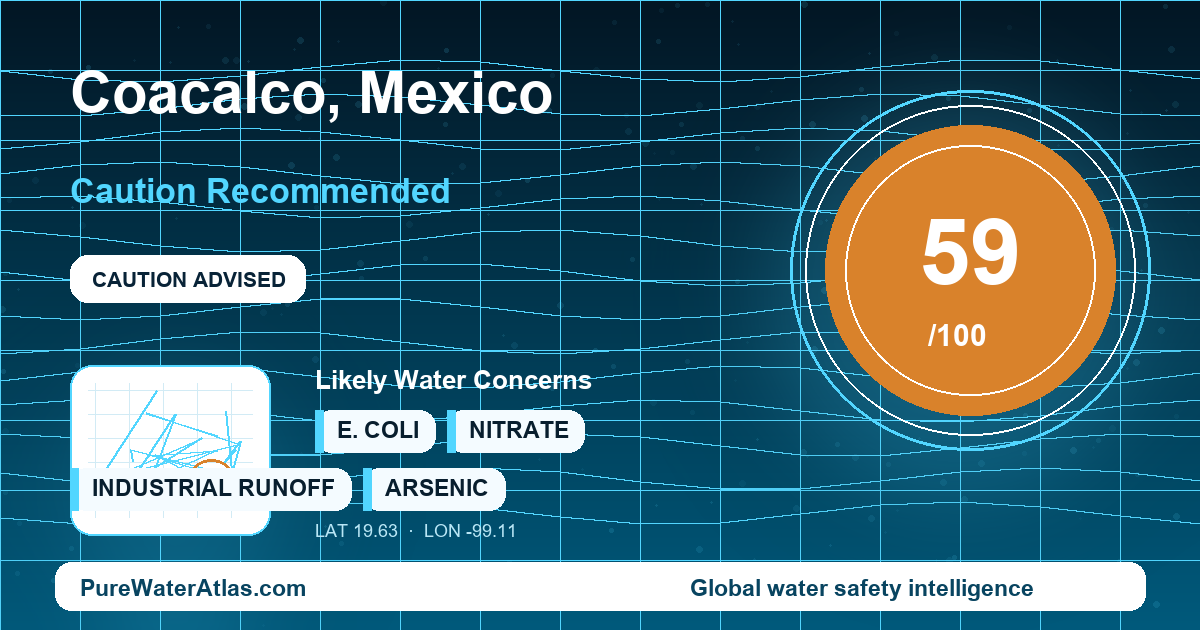
Coacalco tap water requires caution: the municipality is connected to the metropolitan Valley of Mexico water system, but intermittent service, groundwater stress, aging distribution, and household cisterns or rooftop tinacos can affect what reaches the kitchen tap.
Quick Answer
| Water safety score | 59 / 100 |
|---|---|
| Risk level | Caution Recommended |
| Can visitors drink the tap water? | Not recommended as a routine drinking source. Visitors should use sealed bottled water, reputable purified garrafon water, or properly filtered and disinfected water. |
| Resident guidance | Municipal tap water can be used for general household purposes, but drinking water should ideally be verified by testing and treated through a maintained point-of-use system or supplied by a reputable purified-water provider. |
| Main water source context | Mixed metropolitan supply: local and regional groundwater from the Cuautitlan-Pachuca aquifer system plus treated imported surface water through State of Mexico infrastructure, including Cutzamala-related bulk supply where available. |
| Local water authority | SAPASAC, the Sistema de Agua Potable, Alcantarillado y Saneamiento de Coacalco. State-level infrastructure is associated with CAEM; federal water-resource oversight is under CONAGUA. |
| Filter recommendation | A practical household setup is sediment prefiltration plus activated carbon and UV or certified microbiological treatment when water is stored in a cistern or tinaco. Reverse osmosis should be considered only when testing shows dissolved-contaminant concerns. |
Editorial verdict: Caution recommended. Coacalco is not an untreated rural supply, but recent tap-specific public data by neighborhood are limited. The main risk is not only source water; it is the full chain from aquifer or imported supply to pipes, pressure changes, cisterns, rooftop tanks, and the final kitchen tap.
Why Coacalco Is Different
Coacalco de Berriozabal is a dense urban municipality in the State of Mexico on the northern side of the Mexico City metropolitan area, near the Sierra de Guadalupe and within the broader Valley of Mexico water-stress region. Its drinking-water situation is therefore not comparable to a small isolated community with a single source, nor to a city with highly transparent neighborhood-level tap reports available to every consumer.
The city’s practical water-safety profile is shaped by metropolitan infrastructure and household storage. Coacalco depends on pumped water, municipal distribution lines, state bulk-water connections, local storage and pressure management, and common building-level cisterns and rooftop tinacos. That means water quality can change after treatment. A home with a dirty, uncovered, or rarely cleaned cistern can have worse drinking-water quality than the water entering the property from the municipal network.
This is why the answer for Coacalco is cautious rather than absolute. The municipality has identifiable water authorities and is subject to Mexican drinking-water regulation, but residents and visitors should not assume that every tap in every building is safe for routine drinking without current verification.
Where Does Coacalco’s Tap Water Come From?
Coacalco relies on a mixed metropolitan supply. The dataset identifies local and regional groundwater from the Cuautitlan-Pachuca aquifer system and treated surface water imported through State of Mexico infrastructure, including Cutzamala-related bulk supply where available. The exact proportion can vary by zone, season, operational conditions, and scheduled reductions.
Historically, municipalities on the northern side of the Valley of Mexico depended heavily on groundwater wells. Rapid urbanization across the metropolitan area increased demand and created more reliance on combinations of municipal wells, state-operated bulk water, pumping, storage tanks, and rotating service during shortages. For Coacalco, this mixed-source identity matters because groundwater-dependent sectors may experience mineral, hardness, salinity, or taste issues, while surface-water supply can be affected by turbidity and system operations.
Important infrastructure includes the municipal distribution network operated locally by SAPASAC, groundwater wells and pumping infrastructure serving municipal sectors, and state-level bulk-water and interconnection infrastructure coordinated by CAEM. The metropolitan links include supply infrastructure associated with the Cutzamala system and Macrocircuito distribution. Neighborhood storage, repair points, pressure management, and tank refilling can also affect turbidity and continuity of service.
The most important final link is often inside the property: cisterns and rooftop tinacos. These are common in the Valley of Mexico and can become a major water-quality control point after water leaves the utility network. If lids, vents, floats, piping, or cleaning schedules are poor, chlorine residual can decline and microbial regrowth can occur.
Who Manages Drinking Water in Coacalco?
The local water operator is SAPASAC, Sistema de Agua Potable, Alcantarillado y Saneamiento de Coacalco. SAPASAC is the municipal authority associated with water service, local operations, billing, repairs, and sanitation functions in Coacalco.
State-level water infrastructure and bulk supply are associated with the Comision del Agua del Estado de Mexico, commonly referred to as CAEM. Federal water-resource oversight, aquifer availability, concessions, and national water policy are under CONAGUA. CONAGUA also publishes official information on the Sistema Cutzamala, a major imported surface-water system affecting parts of the Mexico City metropolitan region, including connected State of Mexico municipalities during shortages and maintenance periods.
Drinking water quality in Mexico is regulated under NOM-127-SSA1-2021, which establishes sanitary requirements and permissible limits for water for human use and consumption. However, Coacalco does not have the same kind of standardized, public, neighborhood-level consumer confidence reporting that residents might expect in some other countries. That data limitation is important: official system context does not prove the quality of water at a specific apartment, cistern, rooftop tank, or kitchen tap.
Main Local Water Concerns
The main concerns for Coacalco are practical distribution and storage risks rather than a single confirmed citywide contaminant exceedance. Intermittent or reduced-pressure service can occur during metropolitan shortages, Cutzamala-related reductions, scheduled maintenance, or emergency repairs. When pressure drops or service is restored, sediment, turbidity, rust color, or discoloration may appear at the tap.
Household storage is a central issue. Cisterns and rooftop tinacos can support microbial regrowth or contamination if they are not sealed, cleaned, and disinfected. Heat and long storage time in rooftop tanks can accelerate chlorine loss. This matters because chlorine residual is one of the basic barriers against microbial growth after water has entered the distribution system.
Groundwater-dependent parts of the Valley of Mexico can have higher mineral content, hardness, salinity, or taste issues. The regional Cuautitlan-Pachuca aquifer area has been documented by CONAGUA as a heavily used groundwater system in the northern Valley of Mexico. Regional overextraction raises long-term concerns about supply reliability, pumping depth, water age, mineralization, and infrastructure stress. These regional facts do not prove a contaminant exceedance at any specific Coacalco tap, but they do justify testing when water tastes salty, bitter, or causes severe scaling.
Lead and copper concerns are more likely to come from older internal plumbing, fixtures, valves, or solder than from the source water itself. Building age matters. Private wells, informal water sources, or tanker water should be treated as separate risk categories and tested more comprehensively.
For Travelers
Visitors should not drink Coacalco tap water as their default. The conservative choice is sealed bottled water, commercially purified garrafon water, or water that has been properly filtered and disinfected. This advice is consistent with cautious traveler health practice for Mexico, including guidance from the U.S. Centers for Disease Control and Prevention Mexico Traveler View.
For brushing teeth, most healthy adults are unlikely to receive a large exposure from brief brushing, but cautious travelers should use bottled or purified water. This is especially sensible for children, pregnant travelers, people with sensitive stomachs, and anyone visiting for a short stay who does not know the building’s storage-tank history.
Use ice only if it is made from purified water. In hotels, restaurants, and cafes, ask whether the ice is from agua purificada. Many establishments in the Mexico City metropolitan area use purified water or garrafon water for drinking and food service, but visitors should confirm rather than assume. Avoid uncertain street-vendor ice.
Practical travel habits in Coacalco are simple: carry bottled or purified water, use bottled water for medications, choose sealed beverages, and do not assume bathroom tap water is drinking water. If staying in an apartment, ask whether the kitchen has a maintained filter and when the cistern and rooftop tinaco were last cleaned.
For Residents
Residents can generally use municipal tap water for bathing, cleaning, handwashing, and other household purposes. For routine drinking, however, a home barrier is advisable unless recent tap-specific testing shows the water is suitable. A practical Coacalco setup is a sediment prefilter followed by activated carbon and either UV disinfection or another certified microbiological treatment where water is stored in a cistern or tinaco. See the PureWaterAtlas guides to UV water purification and broader water purification methods for treatment selection.
Reverse osmosis can be useful when testing confirms high dissolved solids, sodium, arsenic, nitrate, or other dissolved contaminants. It should not be purchased blindly, because RO systems require maintenance, waste some water, and are not the best first answer for every Coacalco home. If the main problem is sediment after outages, a sediment prefilter may be more immediately relevant. If the main concern is microbial regrowth in stored water, UV or certified disinfection may be more important.
Residents should test kitchen tap water for total coliform and E. coli if the building uses a cistern or tinaco, after flooding, after plumbing work, or after a long outage. After service interruptions, also check free chlorine residual, turbidity, color, odor, and pH. If taste is salty or bitter, or scaling is severe, measure TDS, hardness, chloride, sulfate, and sodium.
Older buildings need extra attention. Lead, copper, rust, biofilm, and sediment can be released from old pipes, valves, fixtures, or rooftop-tank plumbing. Flush stagnant water before drinking and test first-draw and flushed samples if lead is a concern. Cisterns and rooftop tinacos should be tightly covered, protected from insects and dust, and cleaned and disinfected on a regular schedule, commonly every 6 to 12 months or sooner after contamination, construction, or flooding.
Relevant Contaminants and Water-Quality Issues
For Coacalco, the most relevant issues are those connected to intermittent service, storage, and building plumbing. Chlorine matters because residual disinfectant can decline in cisterns and rooftop tanks, especially with heat and long storage time. Turbidity and sediment are relevant when water appears cloudy, rusty, gritty, or discolored after repairs, pressure changes, tank refilling, or service restoration.
Microbial indicators are critical when stored water is involved. E. coli should not be present in drinking water and is a key warning sign of fecal contamination or intrusion. For homes using private wells, tanker water, or unverified sources, testing should be broader and include microbial indicators plus nitrate, arsenic, fluoride, iron, manganese, and other parameters as appropriate.
Lead is relevant mainly for older internal plumbing and fixtures. It should not be assumed absent simply because municipal source water is treated. Arsenic and nitrate are included as screening priorities for private wells, unverified sources, infant-safety decisions, pregnancy, or high-TDS groundwater situations; they are not presented here as confirmed citywide Coacalco exceedances.
How to Verify Your Water Quality
The most reliable answer for a Coacalco household is current testing at the point of use. Start with the kitchen tap actually used for drinking. If the home has a cistern or tinaco, test after normal storage, not only at the street connection. Use a certified laboratory for health decisions; home strips can be useful for screening but should not be the final basis for infant, pregnancy, or chronic-health risk decisions.
PureWaterAtlas resources that can help include the complete guide to water testing, the general drinking water safety framework, and the water microbiology guide for understanding bacteria, viruses, and storage-related risk.
If a lab report shows an unfamiliar contaminant, use the PureWaterAtlas Contaminants Search Engine to interpret metals, microbes, minerals, and disinfection byproducts. To compare Coacalco with other cities, use the Global Water Quality Checker. For specific testing methods, see the PureWaterAtlas guides on lead testing, arsenic testing, and nitrate testing. During suspected microbial contamination, the boiling water purification guide explains emergency use and limitations.
Official and Technical Sources
- SAPASAC, Sistema de Agua Potable, Alcantarillado y Saneamiento de Coacalco — local municipal water and sanitation authority.
- Comision del Agua del Estado de Mexico — State of Mexico authority involved in bulk water supply, infrastructure, and municipal coordination.
- CONAGUA: Sistema Cutzamala — official information on the major imported surface-water system serving parts of the metropolitan region.
- CONAGUA: Disponibilidad media anual de agua subterranea, Acuifero 1508 Cuautitlan-Pachuca — regional groundwater-availability document relevant to Coacalco’s source-water context.
- NOM-127-SSA1-2021 — Mexican national drinking-water quality standard.
- INEGI: Areas geograficas, Coacalco de Berriozabal — official geographic and municipal reference.
- Monitor de Sequia en Mexico — drought monitoring from Servicio Meteorologico Nacional and CONAGUA.
- CDC Mexico Traveler View — traveler health guidance supporting conservative drinking-water practices.
Bottom Line
Coacalco’s tap water deserves caution, not panic. The municipality is part of the metropolitan Valley of Mexico water system and is served by SAPASAC with state and federal oversight, but the final water quality at a home depends on mixed sources, pumping, pressure changes, distribution conditions, and especially cisterns and rooftop tinacos. Visitors should use bottled or purified water for drinking and should confirm ice and food-service water are purified. Residents should maintain storage tanks, watch for sediment or discoloration after outages, and test kitchen tap water when using stored water or older plumbing. Without recent tap-specific testing, Coacalco tap water should not be assumed safe for routine drinking.
Read the full guide: Global Water Quality Guide
Explore more in this category: Global Water Quality Articles