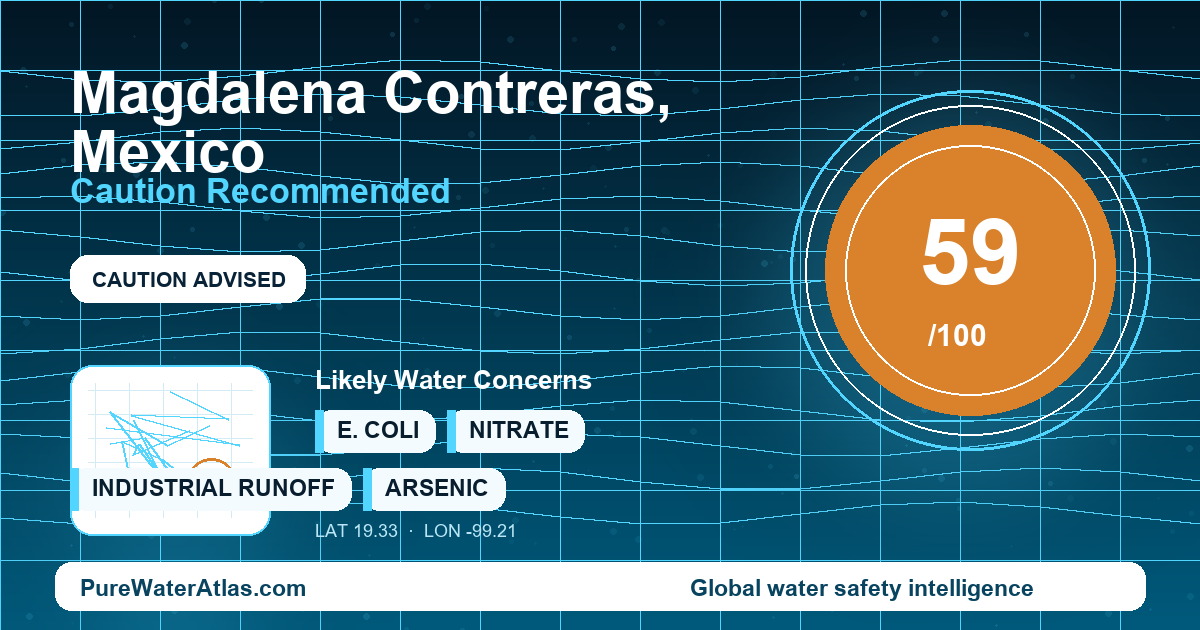
Magdalena Contreras, Mexico City: treated public water, hilly distribution zones, and household cistern or tinaco conditions make point-of-use safety the key question.
Quick Answer
| Overall safety status | Caution recommended. PureWaterAtlas assigns Magdalena Contreras a water safety score of 59/100. The main issue is not the absence of treated public water; it is the risk introduced by pressure changes, old plumbing, household cisterns and rooftop tinacos before water reaches the glass. |
|---|---|
| Can tourists drink the tap water? | Most short-term visitors should use sealed bottled water, boiled water, or reliably filtered water for drinking. Tap water may be chlorinated at the network level, but a visitor usually cannot verify hotel plumbing, storage tanks or recent low-pressure events. |
| Resident guidance | Residents should treat tap water as conditionally usable, not automatically drinkable. A maintained point-of-use filter, clean cistern or tinaco, and periodic testing are sensible, especially in older buildings or homes with infants, pregnant people, older adults or immunocompromised residents. |
| Main water source | Magdalena Contreras is supplied as part of Mexico City’s SACMEX public network, with a variable mix that can include Valley of Mexico groundwater, imported Cutzamala System water, imported Lerma System water, and local spring or surface-water contributions in some western and southern zones. |
| Water authority | Sistema de Aguas de la Ciudad de México, known as SACMEX, operates Mexico City’s water system. National water resources are overseen by CONAGUA. |
| Filter recommendation | A home filter is advisable for routine drinking water. In many homes, a practical setup is sediment prefiltration plus activated carbon; reverse osmosis may be considered when broader reduction of dissolved metals, salts or nitrate is desired, provided the system is maintained. |
Why Magdalena Contreras Is Different
Magdalena Contreras is not a flat, centrally located Mexico City neighborhood with a simple distribution profile. It is a mountainous alcaldía in southwest Mexico City, located on the slopes of the Sierra de las Cruces and the Ajusco-Chichinautzin region. That topography matters for drinking water because steep terrain requires pressure management, pumping, storage and neighborhood-level distribution adjustments. In practical terms, two homes in the same alcaldía may experience different pressure conditions, different service interruptions and different reliance on private storage.
The alcaldía also has a distinctive hydrologic identity. The Río Magdalena basin is one of the last perennial river systems within Mexico City, and the area contains important conservation land. Historically, springs and mountain runoff supported local communities, mills, settlements and irrigation. That history sometimes leads people to assume that household taps receive direct mountain spring water. For drinking-water safety, that is not the right assumption. Modern household supply in Magdalena Contreras generally comes through the broader Mexico City public network operated by SACMEX, not from direct use of the Río Magdalena.
This is why the safety question in Magdalena Contreras is highly local. System water may be treated and chlorinated, but the building-level pathway can change the result. A clean, sealed and recently maintained cistern or tinaco can reduce risk; a poorly sealed storage tank with sediment buildup can increase it. This is especially relevant in hillside and forest-adjacent areas such as San Nicolás Totolapan, San Bernabé Ocotepec, La Carbonera and routes toward Los Dinamos, where reliability may depend heavily on the individual property’s storage setup.
Where Does Magdalena Contreras’s Tap Water Come From?
Magdalena Contreras does not have a standalone municipal drinking-water utility separate from Mexico City. It is supplied as part of the metropolitan Mexico City water network. The exact blend for a specific address can vary by pressure zone, season, maintenance work and operating decisions. The broader Mexico City mix includes local groundwater wells in the Valley of Mexico aquifer system, imported surface water from the Cutzamala System, imported water from the Lerma System, and local spring or surface-water contributions in some western and southern zones.
Key infrastructure relevant to Magdalena Contreras includes the SACMEX distribution network, the Cutzamala System, the Lerma System, Valley of Mexico groundwater wells, pumping stations, pressure zones, neighborhood distribution pipes and household storage systems. Because the alcaldía is hilly, pressure management is not a minor detail. Low-pressure episodes and intermittent service can affect water quality because they may mobilize sediment, reduce disinfectant residual or create opportunities for intrusion where pipes or plumbing are compromised.
Household and building-level storage is especially important. Cisterns and rooftop tinacos are common in Mexico City, and in Magdalena Contreras they can strongly affect the quality of water that finally reaches a kitchen tap. Treated network water can deteriorate if it sits in a dirty, cracked, uncovered or rarely disinfected tank. For that reason, water quality at the tap may be more dependent on private infrastructure than many residents expect.
Who Manages Drinking Water in Magdalena Contreras?
Drinking water service in Magdalena Contreras is managed through the Mexico City system operated by Sistema de Aguas de la Ciudad de México, commonly known as SACMEX. National water resources and major supply systems are overseen by CONAGUA. Drinking-water health requirements in Mexico are set through federal sanitary standards, including NOM-127-SSA1 for water for human use and consumption. The official text is published through the Diario Oficial de la Federación.
Mexico City also has local public-health surveillance institutions, including the Agencia de Protección Sanitaria del Gobierno de la Ciudad de México. These authorities are relevant because drinking-water safety is both a utility issue and a public-health issue. However, regulatory compliance at the treatment plant or network level does not prove that every tap in Magdalena Contreras is safe at every moment. Water can pass through old service lines, building plumbing, private cisterns and rooftop tanks before it is consumed.
PureWaterAtlas rates confidence for Magdalena Contreras as medium. Public system-level information is available from official agencies, but recent, transparent, alcaldía-specific tap-level analytical results for Magdalena Contreras are limited. Conditions can vary by colonia, elevation, pressure zone, building plumbing, cistern condition and recent service interruptions. This profile should not be read as proof that every tap is safe or unsafe.
Main Local Water Concerns
The most important concerns in Magdalena Contreras are distribution and point-of-use risks. Intermittent or low-pressure supply in some areas can increase the chance of intrusion during pipe leaks, repairs or pressure recovery. After hydraulic changes, repairs or heavy rain, residents may notice sediment, discoloration or turbidity. Cloudy or yellow-brown water should not be used for drinking without treatment.
Private cisterns and rooftop tinacos are another major concern. If tanks are not sealed, screened, cleaned and disinfected regularly, they can accumulate sediment, lose chlorine residual, allow mosquito entry or become exposed to animal access. Warm weather can accelerate microbial growth in poorly maintained storage. A building may receive treated water, but if that water is held in poor storage conditions, the tap result can be unsafe.
Older buildings can also introduce risks that are not visible in citywide water reports. Lead is not usually a problem from modern large mains alone, but old plumbing materials, brass fixtures, soldered joints, galvanized pipe corrosion and stagnant water can elevate metals at the tap. Taste and odor from chlorine are also common in disinfected public supplies. Chlorine odor does not automatically mean the water is unsafe, but it often leads residents to distrust tap water and switch to garrafón water or filters.
Seasonal factors matter. Dry-season water stress can affect imported surface-water availability and contribute to operating changes, pressure reductions or scheduled adjustments in Mexico City. Rainy-season runoff can increase turbidity in surface-water sources and disturb sediments in distribution systems after hydraulic changes. Local earthworks, pipe repairs and neighborhood maintenance can temporarily produce cloudy or discolored water even when the broader supply remains treated.
For Travelers
Visitors to Magdalena Contreras should use bottled, boiled or reliably filtered water for drinking unless a hotel or host can confirm that water is treated at the point of use and that storage tanks are maintained. This conservative advice is especially important for first-time visitors to Mexico City and anyone with a sensitive stomach. The CDC Travelers’ Health guidance for Mexico supports careful food and water precautions for travelers.
For brushing teeth, most travelers can reduce risk by using bottled or filtered water. If using tap water, avoid swallowing it and confirm that the building has maintained storage tanks. For ice, use ice only in established restaurants, hotels or cafes that state they use purified water. Avoid ice from informal sources if you cannot verify the water source.
Hotels, restaurants and cafes in Mexico City commonly use garrafón bottled water or in-house purification for drinking water and ice. Ask for agua purificada if unsure. Do not assume that bathroom tap water is the same as water served at the table. If staying in hillside or forested parts of Magdalena Contreras, pay extra attention to the building’s storage system. If water service has just returned after an outage, or if water is cloudy, yellow-brown or has visible particles, do not drink it without treatment.
For Residents
Residents should manage tap water in Magdalena Contreras as a household water-safety system, not just a utility connection. A home filter is advisable for routine drinking water, especially where buildings use cisterns or rooftop tinacos. Sediment prefiltration can help protect downstream filters and reduce visible particles. Activated carbon can improve chlorine taste and odor and reduce some organic compounds. Reverse osmosis may be appropriate for residents who want broader reduction of dissolved metals, salts or nitrate, but it requires regular maintenance and produces wastewater.
Testing is important when conditions change. Test for total coliform and E. coli if the home uses a cistern, tinaco or private storage tank, or after flooding, plumbing work or loss of pressure. Check turbidity, free chlorine residual, pH and conductivity when water appearance, odor or taste changes. Test for lead if the building is old, has unknown internal plumbing, brass fixtures, soldered joints or if children or pregnant people live in the home.
Consider a broader laboratory panel including arsenic, nitrate, iron, manganese and total dissolved solids if the home uses alternative local supply, tanker water, private wells, or if water has persistent staining, metallic taste or high mineral taste. Retest after replacing filters, cleaning cisterns or changing plumbing because household infrastructure can be the dominant exposure point.
Cisterns and rooftop tinacos should be sealed, screened, cleaned and disinfected on a regular schedule. Watch for cracked lids, sediment buildup, dead storage zones, animal access and loss of chlorine residual. Flush stagnant water before drinking or cooking, especially in older buildings or after periods away from home.
Relevant Contaminants and Water-Quality Issues
The water-quality issues most relevant to Magdalena Contreras are tied to distribution, storage and building plumbing. Chlorine is relevant because Mexico City drinking water is disinfected and residents often notice chlorine taste or odor. Turbidity is important when water turns cloudy after pressure changes, pipe repairs, storms or sediment disturbance. Sediment can accumulate in tinacos, cisterns and older pipes.
For older properties, lead should be treated as a building-plumbing concern, especially where fixtures or pipe materials are unknown. For homes with storage tanks or intermittent supply, E. coli testing is one of the clearest ways to check whether fecal contamination has entered the household water system. For more background, see PureWaterAtlas guides on lead testing and detection, boiling water purification, UV water purification, and lead filters and treatment solutions.
How to Verify Your Water Quality
The only reliable way to know the safety of a specific tap in Magdalena Contreras is to verify that address, building and storage system. Start by checking whether water is coming directly from the network or through a cistern and tinaco. Inspect whether tanks are sealed, clean and recently disinfected. Note recent outages, pressure drops, construction or pipe work. If water is discolored, cloudy or contains particles, avoid drinking it until it has been treated and the cause has been investigated.
For a structured approach, use the PureWaterAtlas Water Testing guide and the broader Drinking Water Safety resource. Residents comparing treatment options can review Water Treatment Systems, while microbial concerns are covered in Water Microbiology.
You can also use the Global Water Quality Checker for a broader risk overview and the Contaminants Search Engine to understand specific test results. Related PureWaterAtlas categories include Drinking Water Safety, Global Water Quality, Water Testing and Water Purification.
Official and Technical Sources
- Sistema de Aguas de la Ciudad de México — official water authority for Mexico City, including Magdalena Contreras.
- CONAGUA — national water authority and source for Cutzamala System information and storage updates.
- Diario Oficial de la Federación — official publication source for NOM-127-SSA1-2021, Mexico’s drinking-water standard for water for human use and consumption.
- Agencia de Protección Sanitaria del Gobierno de la Ciudad de México — local public-health authority involved in sanitary surveillance.
- CDC Travelers’ Health: Mexico — traveler health guidance supporting conservative water and food precautions.
- SEDEMA — environmental context for Mexico City’s conservation land and hydrologic areas, including the Río Magdalena context.
- Alcaldía La Magdalena Contreras — local government source for borough context, public works notices and community updates.
- World Health Organization Guidelines for Drinking-water Quality — international reference for health-based drinking-water risk assessment and household water safety principles.
Bottom Line
Tap water in Magdalena Contreras should be approached with caution. The alcaldía is part of Mexico City’s treated public water network, but its mountainous terrain, pressure zones, intermittent service risks and widespread use of cisterns and rooftop tinacos make point-of-use quality highly building-specific. Tourists should generally drink sealed bottled, boiled or reliably filtered water and use purified water for brushing teeth when possible. Residents should maintain storage tanks, use appropriate filtration and test when water changes appearance, pressure is lost, plumbing is old or vulnerable people live in the home. Because recent, public, tap-level data specific to Magdalena Contreras is limited, local verification matters more than broad assumptions about the Mexico City system.
Read the full guide: Global Water Quality Guide
Explore more in this category: Global Water Quality Articles