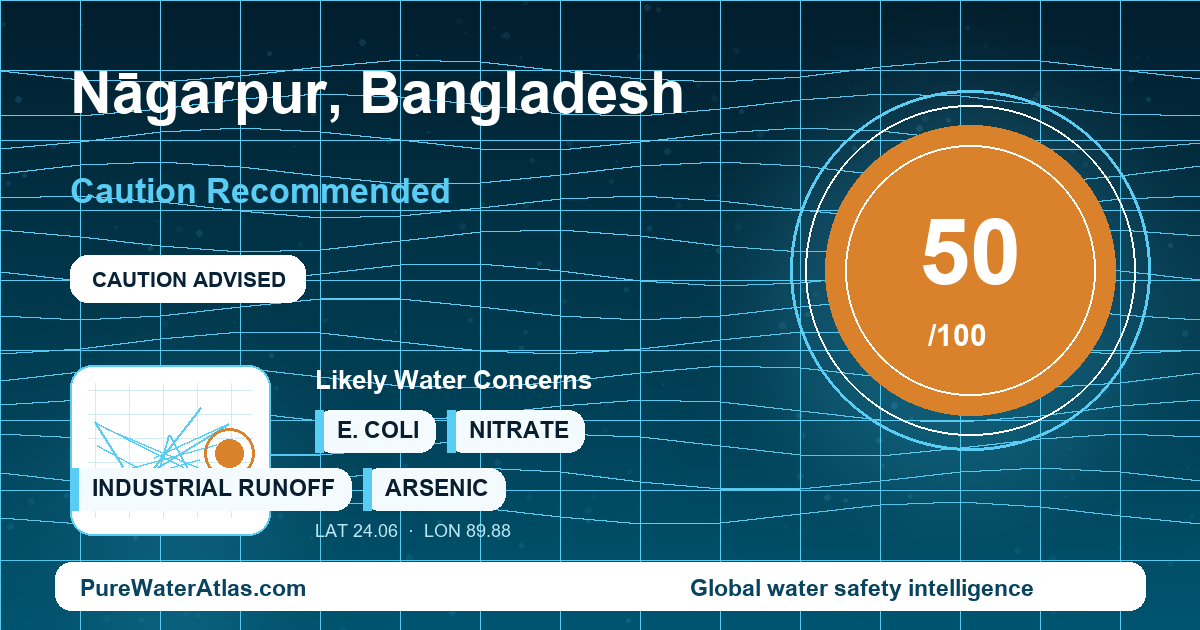
Nāgarpur, Tangail District, Bangladesh: groundwater-based drinking water with caution recommended because city-level monitoring data are limited and household safety depends on the specific tubewell, piped point, storage system, and treatment method.
Quick Answer
| Overall status | Caution recommended. PureWaterAtlas assigns Nāgarpur a water safety score of 50/100 because there is no clear public city-level compliance dashboard or recent consumer-style report for routine tap-water results. |
|---|---|
| Can visitors drink it? | No, not as a default. Visitors should not drink untreated tap, tubewell, or hotel bathroom water unless a trusted host can verify treatment, safe storage, and recent testing. |
| Resident guidance | Residents should test the actual household source, especially for arsenic and microbial indicators such as E. coli. Appearance and taste are not enough. |
| Main water source | Predominantly groundwater from shallow tubewells, deep tubewells, hand pumps, private wells, and small local groundwater-fed piped schemes where available. |
| Relevant authority | The Department of Public Health Engineering under the Local Government Division, local Upazila and Union Parishad authorities, and any local municipal or community operator where a piped scheme exists. |
| Filter recommendation | Choose treatment based on testing. Boiling helps with microbes, but it does not remove arsenic, nitrate, iron, manganese, or salinity. Arsenic requires a verified arsenic-removal solution or a tested safe alternative source. |
Why Nāgarpur Is Different
Nāgarpur is not best understood as a city served by one large, continuously monitored metropolitan surface-water utility. The available evidence points to a more decentralized drinking-water pattern typical of many rural and small-town settings in Bangladesh: household and community tubewells, deep tubewells where installed, private wells, hand pumps, and localized piped schemes that are usually groundwater-fed. That makes water safety highly local. One household may use a deep tubewell, another may use a shallow private source, and another may depend on stored water after collection.
The local setting matters. Banglapedia identifies Nagarpur Upazila in Tangail District and notes the Dhaleshwari River as a main river associated with the area. This places Nāgarpur in a riverine floodplain environment rather than a coastal salinity zone. For drinking-water safety, that means flood exposure, shallow well protection, household storage, and post-collection contamination are central concerns. Rivers, canals, ponds, and floodwater should be treated as unsafe for drinking unless professionally treated and disinfected.
PureWaterAtlas did not identify a current public Nāgarpur-specific water-quality report showing routine sampling results, treatment performance, residual chlorine, neighborhood arsenic maps, or E. coli compliance at taps. This limitation is important: the safest conclusion is not that all local water is unsafe, but that residents and visitors should not assume safety without source-specific testing and safe handling.
Where Does Nāgarpur’s Tap Water Come From?
Drinking water in Nāgarpur is expected to come mainly from groundwater. The key local infrastructure includes household and community hand tubewells drawing shallow groundwater, deep tubewells installed where safer aquifer access is needed, small local piped-water or point-source schemes where available, and private wells. In homes, the water may then pass through pitchers, buckets, rooftop tanks, ground storage tanks, hoses, local distribution lines, or household filters before it is consumed.
This source-to-cup chain is essential in Nāgarpur. A tubewell that produces clear-looking water may still need arsenic testing. A deep tubewell that tests acceptable at the source can still become unsafe if water is carried in unclean containers or stored in uncovered vessels. A piped point may depend on the condition of local lines, the treatment arrangement, and the cleanliness of building storage. During the monsoon, submerged or poorly sealed wellheads and contaminated storage containers can become important pathways for microbial contamination.
Historically, before tubewells became widespread in Bangladesh, rural households commonly used ponds, rivers, canals, and rainwater for domestic purposes. Tubewells reduced many surface-water microbial risks, but the shift to groundwater created a different safety question: groundwater chemistry must be verified. In Bangladesh, the best-known example is arsenic in susceptible alluvial aquifers, which cannot be detected reliably by taste, smell, or appearance.
Who Manages Drinking Water in Nāgarpur?
For Nāgarpur, the relevant public-sector water institutions are the Department of Public Health Engineering, the Local Government Division, local Upazila and Union Parishad authorities, and any local municipal or community operator where a piped scheme exists. DPHE is the principal Bangladesh government agency for rural and small-town water supply outside the major WASA service areas.
Bangladesh’s drinking-water governance is led through national standards, WASH planning, and local-government implementation frameworks. However, the practical reality for Nāgarpur households is that the controlling “system” may be a single tubewell, a deep community well, a small piped arrangement, or a household storage setup. This differs from a large urban utility model where one treatment plant and distribution network may publish regular compliance results. In Nāgarpur, safety often has to be confirmed at the point of use.
Because city-level public compliance data are limited, PureWaterAtlas rates confidence as medium-low for exact Nāgarpur compliance status and medium for identifying the likely water-supply pattern and Bangladesh-relevant risks. Residents should therefore treat official infrastructure improvements and household testing as complementary, not interchangeable.
Main Local Water Concerns
Arsenic: Arsenic is a Bangladesh-wide groundwater issue in parts of the alluvial aquifer system. Tangail is not described here as a coastal salinity hotspot, but arsenic risk is spatially variable enough that every drinking-water tubewell in Nāgarpur should have its own recent arsenic test. A neighbor’s result does not prove another well is safe, particularly if wells differ in depth or aquifer.
Microbial contamination: E. coli and other microbial indicators are plausible concerns where tubewells are poorly sealed, located near latrines, affected by flooding, or where clean source water is recontaminated during transport and storage. Flood events are especially important in a riverine floodplain setting. After flooding, affected wells should be disinfected or tested, and households should use boiled or otherwise treated water until safety is confirmed.
Iron, manganese, sediment, and turbidity: Many Bangladesh groundwater supplies can have iron and manganese concerns that cause staining, taste, black or reddish deposits, and sediment. These may be aesthetic or operational problems, but they can also interfere with household treatment. Turbidity can reduce UV effectiveness, so cloudy water should be settled or filtered before UV disinfection.
Nitrate and local sanitation influence: Shallow wells near latrines, livestock, fertilizer use, or intensive agriculture should be checked for nitrate, particularly where infants or pregnant people may consume the water. Boiling does not remove nitrate.
Premise plumbing and storage: Lead is not identified as the signature regional contaminant for Nāgarpur, but old plumbing, brass fittings, solder, pump parts, and storage hardware can contribute metals in individual buildings. Household and rooftop tanks can also turn acceptable source water unsafe if they are uncovered, cracked, rarely cleaned, or contaminated by insects, animals, hoses, or floodwater.
For Travelers
Short-term visitors should take a conservative approach in Nāgarpur. Do not drink untreated tap, tubewell, or bathroom water unless a reliable host can explain the treatment system, confirm safe storage, and provide recent testing. The safer default is sealed bottled water, properly boiled water, or water treated by a maintained purifier.
Use bottled, boiled, or filtered water for brushing teeth if you are a short-term visitor, immunocompromised, pregnant, traveling with young children, or prone to stomach illness. Avoid ice from street stalls and small venues unless the venue can confirm that it was made from treated water. Freezing does not reliably make contaminated water safe.
In hotels and restaurants, ask whether drinking water and ice come from sealed bottled water, a maintained RO or UV system, or boiled water. Do not assume bathroom tap water is potable. Hot tea or coffee is generally safer only when the water has reached a proper boil. Carry sealed water during travel, check bottle seals, and remember that hand hygiene and food handling can be as important as the original water source.
For Residents
Residents should make decisions from test results, not from taste or clarity. At minimum, every household drinking-water source should be tested for arsenic. Microbial testing is especially important after floods, pump repairs, changes in water appearance, or recurring household gastrointestinal illness. If water has metallic taste, reddish staining, black deposits, or visible sediment, test for iron, manganese, turbidity, pH, and total dissolved solids.
A filter may be needed, but the correct system depends on the contaminant. For microbial risk, boiling, chlorination, UV after prefiltration, or a maintained purifier can help. For arsenic, use a tested arsenic-removal unit, a verified safe deep tubewell, or reverse osmosis where practical. Ordinary carbon filters, boiling, and taste-based judgment should not be relied on for arsenic or nitrate removal.
Older buildings and locally modified plumbing can add risk even when the source tubewell is acceptable. Flush stagnant water before drinking, avoid using hot tap water for cooking, and consider first-draw and flushed samples for lead and other metals where old metal pipes, brass fixtures, pump parts, storage tanks, or unexplained metallic taste are present.
Storage tanks and household containers deserve the same attention as wells. Tanks should be covered, cleaned on a routine schedule, protected from insects and animals, and disinfected after flooding or repairs. Stored water should be handled with clean utensils and kept away from floodwater, latrine drainage, animals, and unclean hoses.
Relevant Contaminants and Water-Quality Issues
The most important Nāgarpur-specific issue to verify is arsenic in drinking water, because Bangladesh groundwater risk is spatially variable and cannot be judged by appearance. For testing options, see Arsenic in Drinking Water: Testing and Detection Methods. For treatment options, see Arsenic in Drinking Water: Best Filters, Systems and Solutions.
Microbial risk should be evaluated through indicators such as E. coli, particularly after monsoon flooding, pump repairs, or storage contamination. For broader context, see Water Microbiology. Where water is cloudy or disturbed, review turbidity and sediment, because particles can reduce the reliability of UV treatment.
Other relevant groundwater and household issues include iron, manganese, and nitrate. If an older building has metal plumbing or long stagnation times, residents may also use Lead in Drinking Water: Testing and Detection Methods as a practical reference, even though lead is not the defining regional contaminant for Nāgarpur.
How to Verify Your Water Quality
For Nāgarpur, verification should start with the exact water you drink: the household tubewell, deep tubewell, piped tap, storage tank outlet, or drinking-water container. Test every drinking-water tubewell for arsenic through DPHE, a recognized laboratory, an NGO program, or a reliable field-testing program. Repeat testing after a new well is installed or when the source depth changes.
Test for E. coli or thermotolerant coliforms after floods, pump repairs, or recurring illness. If the water has staining, sediment, metallic taste, or cloudiness, add iron, manganese, turbidity, pH, and total dissolved solids. If a shallow private source is near latrines, livestock, fertilizer use, or agricultural inputs, include nitrate testing.
PureWaterAtlas resources that can help include the complete guide to water testing, the Global Water Quality Checker, and the Contaminants Search Engine. For treatment selection after results are known, see Water Purification, UV Water Purification, and Boiling Water Purification. For a broader safety framework, see Drinking Water Safety and Water Contamination.
Official and Technical Sources
- Banglapedia: Nagarpur Upazila — local geographic context for Nagarpur Upazila in Tangail District, including the riverine setting.
- Department of Public Health Engineering, Bangladesh — national agency for rural and small-town water supply and WASH infrastructure outside major WASA systems.
- Local Government Division, Government of Bangladesh — government division responsible for local government institutions and the national water supply and sanitation sector framework.
- WHO Bangladesh: Water, sanitation and hygiene — public-health context for WASH risks in Bangladesh.
- UNICEF Bangladesh: Arsenic — overview of arsenic as a Bangladesh drinking-water issue and the need for safe alternative sources and testing.
- British Geological Survey and DPHE: Arsenic contamination of groundwater in Bangladesh — technical background on arsenic distribution and hydrogeology.
- UNICEF Bangladesh: Progotir Pathey, Bangladesh Multiple Indicator Cluster Survey 2019 — national WASH and household service context.
- WHO/UNICEF Joint Monitoring Programme: Bangladesh household WASH data — international monitoring source for Bangladesh drinking-water, sanitation, and hygiene indicators.
Bottom Line
Nāgarpur’s drinking-water safety should be treated as source-specific rather than guaranteed by a single citywide utility report. The area is expected to rely mainly on groundwater from tubewells, deep tubewells, private wells, hand pumps, and small local piped schemes. The main practical concerns are arsenic in susceptible groundwater, microbial contamination after floods or poor storage, and iron, manganese, sediment, turbidity, nitrate, or plumbing-related metals in individual homes. Visitors should use sealed bottled, boiled, or reliably purified water and avoid uncertain ice. Residents should test their own drinking source, protect wells and storage tanks, and select treatment based on results. Boiling is useful for microbes but does not remove arsenic or nitrate.
Read the full guide: Global Water Quality Guide
Explore more in this category: Global Water Quality Articles